twi-ny recommended events

OPEN PRACTICE

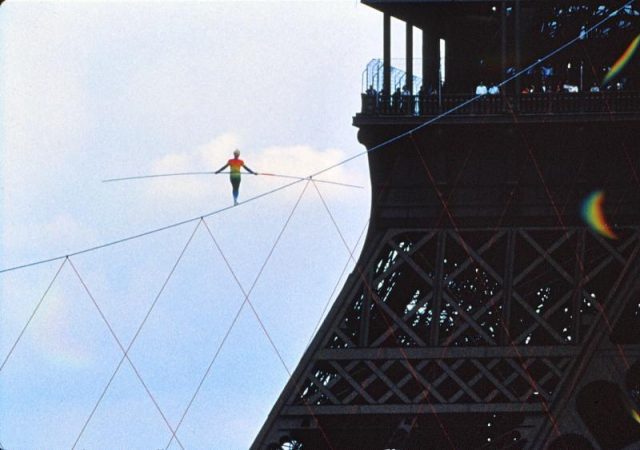
Photo: Michael Kerstgens/Collection Philippe Petit

Philippe Petit will share many of his tightrope secrets at STREB on February 8 (photo by Michael Kerstgens/Collection Philippe Petit)

SLAM (STREB Lab for Action Mechanics)
51 North 1st Street
Thursday, February 8, $40-$45, 7:00
streb.org/masterclass

Tightrope master Philippe Petit has walked between the two towers of the World Trade Center and across the Niagara River, the Sydney Harbor Bridge, the Eiffel Tower, Grand Central Terminal, and other locations around the world. On February 8, the sixty-nine-year-old French-born, New York City-based magician, juggler, fencer, bullfighter, and circus performer will be at SLAM in Brooklyn, the STREB Lab for Action Mechanics, holding an open practice. The public is invited into one of his “secret” sessions at 7:00, consisting of an introduction, warm-up exercises, and walking on a twenty-five-foot-long, seven-foot-high tightrope, where the audience can get up close and watch his every movement and facial gesture. The walks will be accompanied by stories of the choreographic elements, followed by a Q&A. Tickets are $40 in advance and $45 at the door for this rare opportunity to go behind the scenes with one of the greatest high-wire artists of all time.

VERKLÄRTE NACHT: ANNE TERESA DE KEERSMAEKER / ROSAS

(photo by Maria Baranova)

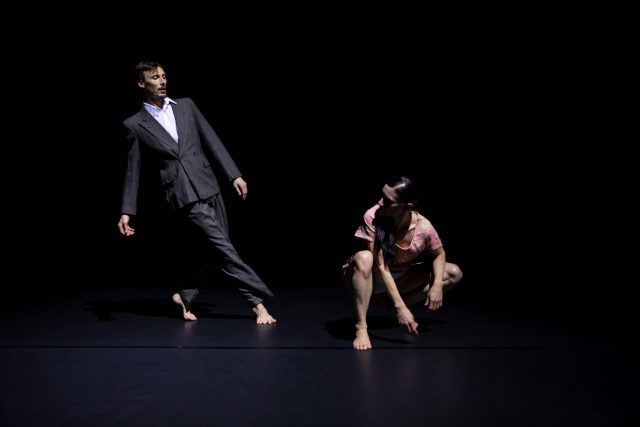
Cynthia Loemij and Igor Shyshko have a brief encounter in Anne Teresa De Keersmaeker’s Verklärte Nacht (photo by Maria Baranova)

Baryshnikov Arts Center, Jerome Robbins Theater
450 West 37th St. between Ninth & Tenth Aves.
January 30 – February 3, $20-$25
866-811-4111
bacnyc.org
www.rosas.be/en

Anne Teresa De Keersmaeker’s 2014 streamlined version of Verklärte Nacht (“Transfigured Night”), originally an ensemble piece from 1995, is making its New York debut this week, continuing at the Baryshnikov Arts Center’s Jerome Robbins Theater through February 3. The short but powerful forty-minute work from the Belgian choreographer’s Rosas company is inspired by German Symbolist Richard Dehmel’s 1896 poem, which itself inspired Austrian American composer Arnold Schönberg’s romantic 1899 program music (op. 4) for string sextet. Dehmel’s short poem is about a woman who decides to become a single mother, having sex with a stranger. However, after she is pregnant, she unexpectedly falls in love with another man but has to tell him that she is carrying someone else’s child. In the poem, the specific text of which is not in the show, she opines, “I am carrying a child, and not yours; / I walk in sin beside you. / I have deeply sinned against myself. / I no longer believed in happiness / And yet was full of longing / For a life with meaning, for the joy / And duty of maternity; so I dared / And, quaking, let my sex / Be taken by a stranger, / And was blessed by it. / Now life has taken its revenge, / For now I have met you, yes you.” In a piece that was initially rejected by program committees and the public, Schönberg brings to life the emotions ripping through the woman’s soul as well as the man’s. (De Keersmaeker uses a lovely recording by Pierre Boulez and the New York Philharmonic.)

(photo by Maria Baranova)

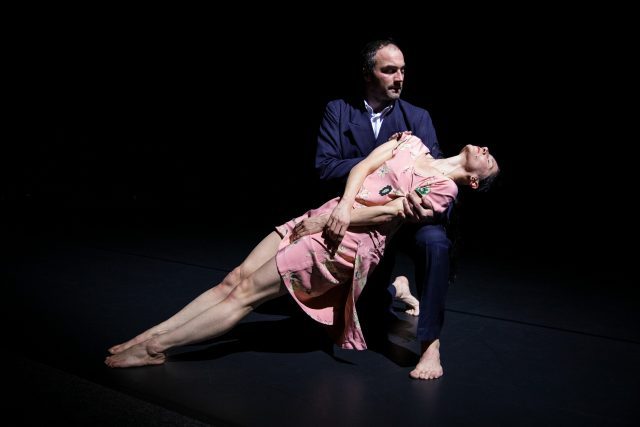
Boštjan Antončič holds up Cynthia Loemij in emotional work at Baryshnikov Arts Center (photo by Maria Baranova)

The dance takes place in a stark black box theater with no accoutrements whatsoever. (The spare lighting is by De Keersmaeker and Luc Schaltin.) The opening is rendered in silence, as Cynthia Loemij (the woman) engages with Igor Shyshko (the stranger). Once the music starts, Verklärte Nacht transforms into an epic expressionistic silent film as Loemij and Boštjan Antončič as her true love repeatedly come together and separate. She falls to the floor again and again, jumps on him with her knees on his shoulder, brings his head to her belly. He stands in the corner, looking away, then runs around the space, lifting and twirling her. On the ground, she motions as if giving birth, exhibiting the pain and loneliness she expects to experience once he ultimately rejects her. She’s in a loose-fitting flower-print dress, a sign of spring and rebirth though muted, while he is in a dark suit and white shirt; both are barefoot. (The costumes are by Rosas and Rudy Sabounghi.) In some ways it is a feminist reinterpretation of thebiblical story of the Garden of Eden; the woman took a bite of a stranger’s fruit and now must face the consequences after being cast out of paradise, but Dehmel, Schönberg, and De Keersmaeker (A Love Supreme, Six Brandenburg Concertos) offer a touching finale. Although its operatic scope may feel a bit dated, the performers’ total mastery of the material and Loemij’s brilliant dancing continue to make the piece involving and compelling.

FIRST SATURDAYS: SOUL OF A NATION

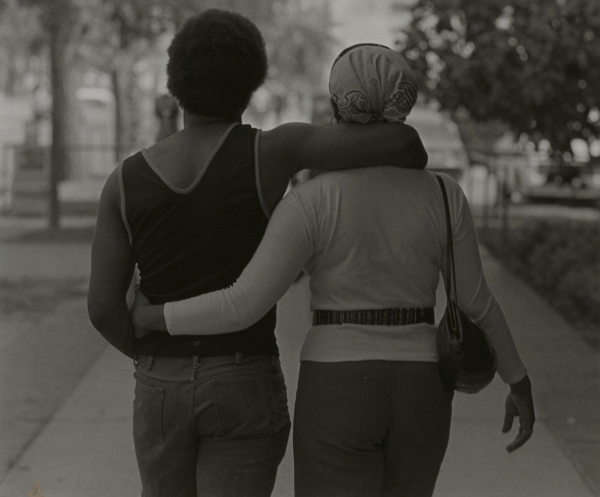
Roy DeCarava, Couple Walking, gelatin silver print on paper, 1979 (© 2017 estate of Roy DeCarava)

Roy DeCarava, “Couple Walking,” gelatin silver print on paper, 1979 (© 2017 estate of Roy DeCarava)

FIRST SATURDAYS
Brooklyn Museum
200 Eastern Parkway at Washington St.
Saturday, February 2, free (some events require advance tickets), 5:00 – 11:00
212-864-5400
www.brooklynmuseum.org

The Brooklyn Museum honors Black History Month in the February edition of its free First Saturday program. There will be live performances by Winard Harper, YahZarah (“I’m Taking You Back”), and Toshi Reagon with violinist Juliette Jones and bassist, guitarist, and vocalist Ganessa James; curator tours of “Soul of a Nation: Art in the Age of Black Power” and “Eric N. Mack: Lemme walk across the room” with Ashley James; a Learning Lesson discussion with artist Kameelah Janan Rasheed inspired by Octavia Butler’s idea of “primitive hypertext”; pop-up gallery talks of “Soul of a Nation” with teen apprentices; a screening of Mr. Soul (Melissa Haizlip & Samuel D. Pollard, 2018), introduced by the directors; a hands-on workshop in which participants can create wearable activist patches inspired by the messages of the Guerrilla Girls and AfriCOBRA; an artist talk featuring Shani Jamila’s new podcast, Lineage, with photographers Ming Smith and Russell Fredrick of the Kamoinge collective; “Soul of a Nation”–inspired poetry with Karisma Price, Naomi Extra, and Stephanie Jean of Cave Canem; an “Archives as Raw History” tour with archivist Molly Seegers; and Black Gotham Experience’s immersive Magnetic Resonance, consisting of a photo studio by Kamau Ware with styling by Charles Johnson, video collage by Kearaha Bryant, and music by GoodWill, P.U.D.G.E., and Rimarkable. In addition, the galleries will be open late so you can check out “Soul of a Nation: Art in the Age of Black Power,” “Eric N. Mack: Lemme walk across the room,” “One: Do Ho Suh,” “Half the Picture: A Feminist Look at the Collection,” “Something to Say: Brooklyn Hi-Art! Machine, Deborah Kass, Kameelah Janan Rasheed, and Hank Willis Thomas,” “Rob Wynne: FLOAT,” “Infinite Blue,” “A Woman’s Afterlife: Gender Transformation in Ancient Egypt,” “Kwang Young Chun: Aggregations,” and more.

GOODBYE FIRST LOVE

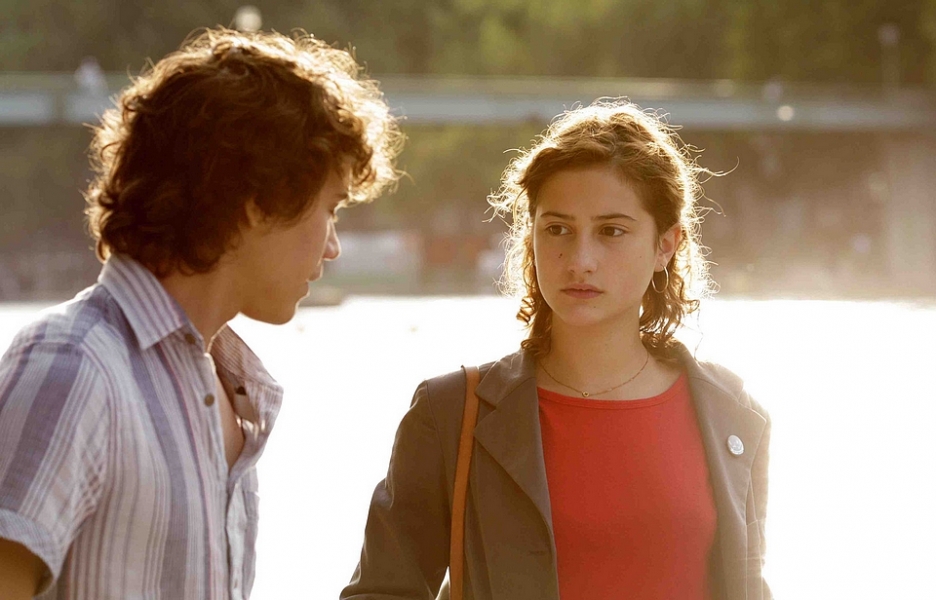
Sullivan (Sebastian Urzendowsky) and Camille (Lola Créton) experience the pleasure and pain of young romance in Goodbye First Love

GOODBYE FIRST LOVE (UN AMOUR DE JEUNESSE) (Mia Hansen-Løve, 2011)
Metrograph
7 Ludlow St. between Canal & Hester Sts.
Monday, February 4, 9:30
212-660-0312
www.ifcfilms.com
metrograph.com

French filmmaker Mia Hansen-Løve will be at Metrograph on February 4 to introduce a special screening of her third film, an infuriating yet captivating tale that runs hot and cold. Goodbye First Love begins in Paris in 1999, as fifteen-year-old Camille (Lola Créton) frolics naked with Sullivan (Sebastian Urzendowsky), her slightly older boyfriend. While she professes her deep, undying love for him, he refuses to declare his total dedication to her, instead preparing to leave her and France for a long sojourn through South America. When Camille goes home and starts sobbing, her mother (Valérie Bonneton), who is not a big fan of Sullivan’s, asks why. “I cry because I’m melancholic,” Camille answers, as only a fifteen-year-old character in a French film would. As the years pass, Camille grows into a fine young woman, studying architecture and dating a much older man (Magne-Håvard Brekke), but she can’t forget Sullivan, and when he eventually reenters her life, she has some hard choices to make. Créton (Bluebeard) evokes a young Isabelle Huppert as Camille, while Urzendowsky (The Way Back) is somewhat distant as the distant Sullivan. There is never any real passion between them; Hansen-Løve (All Is Forgiven, The Father of My Children) often skips over the more emotional, pivotal moments, instead concentrating on the after-effects and discussions. While that works at times, at others it feels as if something crucial was left out, and not necessarily with good reason. Still, Créton carries the film with her puppy-dog eyes, lithe body, and a graceful demeanor that will make you forgive her character’s increasingly frustrating decisions.

EDDIE AND DAVE

(photo by Ahron R. Foster)

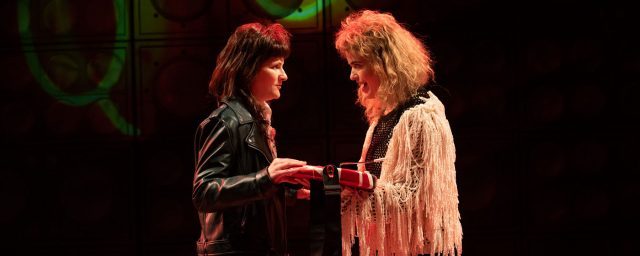
Playwright Amy Staats is Eddie Van Halen and Megan Hill is David Lee Roth in new play about 1970s hard rockers (photo by Ahron R. Foster)

Atlantic Stage 2
330 West 16th St. between Eighth & Ninth Aves.
Tuesday – Sunday through February 17, $56.50
atlantictheater.org

I have a difficult confession to make: I have never been a fan of Van Halen, the 1970s/’80s hard rockers with such hits as “Jump,” “Jaimie’s Cryin’,” “Hot for Teacher,” and “Runnin’ with the Devil.” But I am a big fan of Eddie and Dave, first-time playwright Amy Staats’s very funny show about the on-again, off-again relationship between the band’s songwriters, guitarist and composer Eddie Van Halen and lyricist and lead singer David Lee Roth — which has been extended at Atlantic’s Stage 2 through February 17. The story is told in flashback by a former MTV VJ based somewhat on Kurt Loder (“This is my memory play,” she says), centering on the group’s very brief reunion at the 1996 MTV Video Music Awards, when Eddie; his brother, drummer Alex Van Halen; bassist Michael Anthony; and Roth got together for the first time in more than a decade to present a prize. At the podium, Alex leans over and whispers something to Dave; what was said is the mystery behind the play and a solid-enough excuse to dig into the band’s strange and bizarre history. But Staats pulls an outrageous gender switch in her casting: She plays Eddie, Megan Hill is Dave, Adina Verson is Alex, Omer Abbas Salem is Valerie Bertinelli (Eddie’s eventual wife), and Vanessa Aspillaga is the VJ, a roadie, the Van Halens’ father, Quincy Jones, and other minor male characters. Anthony is portrayed by a framed photograph.

(photo by Ahron R. Foster)

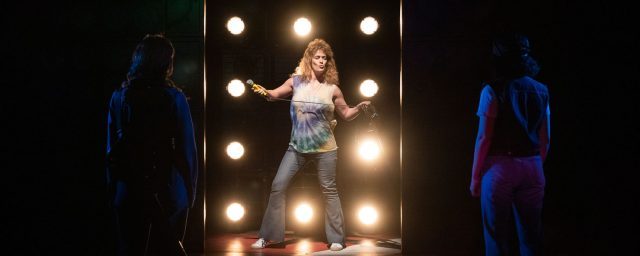
Van Halen brothers Eddie (Amy Staats) and Alex (Adina Verson) look on as David Lee Roth (Megan Hill) struts his stuff at Atlantic Stage 2 (photo by Ahron R. Foster)

Scenic designer Reid Thompson has filled the theater with posters and flyers advertising such other 1970s/’80s groups as Pantera, Misfits, Iron Maiden, Dead Kennedys, Bruce Springsteen and the E Street Band, and the Ramones; as the audience enters the space, music by Journey, AC/DC, Black Sabbath, and Aerosmith is likely to have attendees of a certain age singing along and playing air guitar. Montana Levi Blanco’s costumes are send-ups of what the band really wore, including Eddie’s overalls and flannel shirt and Diamond Dave’s flashy over-the-top style. Cookie Jordan is responsible for the fab hair and wigs, featuring some damn fine mullets. Whether because of rights issues or as an artistic (financial?) choice, there is no actual Van Halen music in the show, only instrumental snippets (by Michael Thurber) heard here and there or seen in Shawn Boyle’s projections; in fact, no original Van Halen songs or albums are even mentioned by name except for their 2012 comeback record, A Different Kind of Truth.

(photo by Ahron R. Foster)

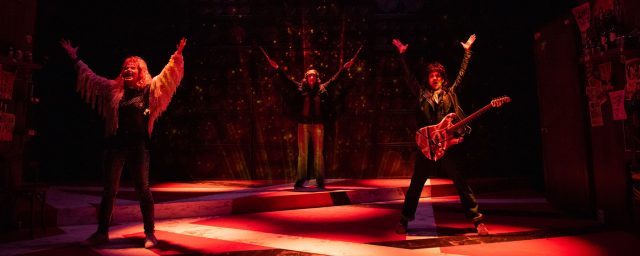
Van Halen rocks out — and fights — all over again in new play Eddie and Dave (photo by Ahron R. Foster)

None of the actors attempts to impersonate the famous people they portray, instead turning them into eccentric characters who say and do a lot of dumb but endearing stuff, the key word being “dumb.” Thus, Anthony comes off as the most intelligent member of the group, since he never speaks. (“We can’t talk about him; there’s not enough time,” the VJ explains.) Gleefully directed by Margot Bordelon, Eddie and Dave is a highly original mini-soap-rock opera that would delight Wayne and Garth (“Wayne’s World! Excellent!”), a fun and snarky account of a group of grown-up men, and one woman, who are not the brightest bulbs in the chandelier but managed to carve out some pretty successful careers. I’m still not a Van Halen fan, but I definitely have a newfound admiration for their wild and wacky tale.

FAR-OUT IN THE 70s — A NEW WAVE OF COMEDY, 1969–1979: LITTLE MURDERS

LITTLE MURDERS

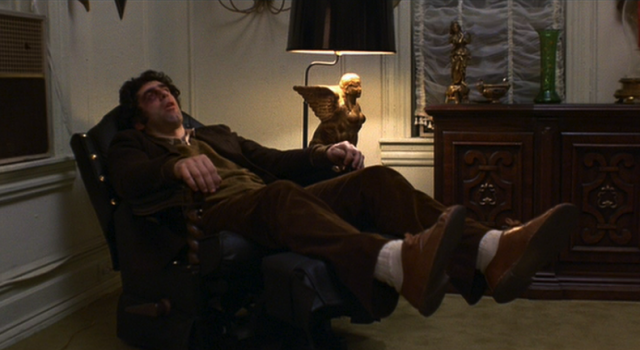
Alfred Chamberlain (Elliott Gould) takes a break in Alan Arkin’s Little Murders

LITTLE MURDERS (Alan Arkin, 1971)
Film Forum
209 West Houston St.
Thursday, January 31, 4:20
Friday, February 1 2:40, 7:00
Series runs through February 14
212-727-8110
filmforum.org

Alan Arkin’s directorial debut is a hysterically absurdist foray into the urban paranoia that haunted a lawless New York City in the late 1960s and 1970s. Based on Jules Feiffer’s first play, which was a Broadway flop in 1969 but became a hit in London and off Broadway, Little Murders centers on the offbeat relationship between the determined and domineering Patsy Newquist (Marcia Rodd) and the calm, easygoing Alfred Chamberlain (Elliott Gould). They first meet when Patsy tries to save him from getting beaten up yet again by a group of thugs, but he doesn’t want any help; he never fights back, instead letting them tire themselves out. A former successful commercial photographer, Alfred now spends his time taking artistic pictures of feces he finds on the filthy streets. He and Patsy sort of start dating, but Alfred, who regularly says, “I don’t know what love is,” is too passive for Patsy, who makes it her project to mold him into a stronger man, as if he were one of her interior design projects. The black comedy reaches new heights when Alfred meets Patsy’s rather eccentric family, played by the three actors who originated the roles on the stage. Vincent Gardenia is her high-strung father who laments what has become of the city, Elizabeth Wilson is her prim and proper mother who only sees what she wants to see, and Jon Korkes is deliciously funny as her crazy brother, who finds humor in just about everything. Meanwhile, wherever Patsy goes, a heavy-breathing phone caller follows.

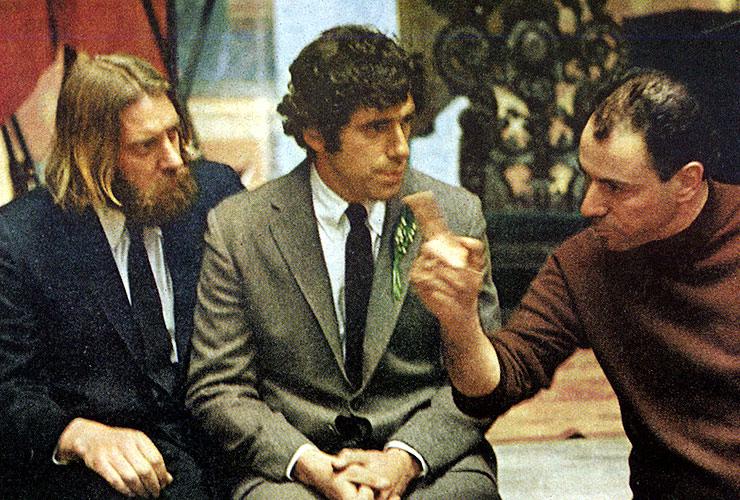
Donald Sutherland, Elliott Gould, and Alan Arkin discuss the wacky wedding scene in LITTLE MURDERS

Donald Sutherland, Elliott Gould, and Alan Arkin discuss the wacky wedding scene in Little Murders

Little Murders is one of the great unsung films of the 1970s, a wickedly funny, at times manic examination of love, fear, family, faith, and violence. The story is highlighted by several riotous monologues about the state of the world, including an epic rant delivered by Lou Jacobi as an angry judge and an oddball hippie speech by Donald Sutherland (Gould’s M*A*S*H costar) as an alternative minister. Arkin also appears as Lt. Practice, a cop stuttering about how many unsolved murders there have been in the past six months. The film is shot in a beautifully subdued, lurid palette by Gordon Willis, who photographed such other seminal New York–set ’70s pics as The Landlord, Klute, The Godfather I and II, Annie Hall, and Manhattan. A genuine underground cult classic, Little Murders is screening January 31 and February 1 in the Film Forum series “Far-Out in the 70s: A New Wave of Comedy, 1969–1979,” which continues through February 14 with such other period comedies as Hal Ashby’s Being There, Milos Forman’s Taking Off, a double feature of Art Carney in The Late Show and Harry and Tonto, and Brian De Palma’s Hi, Mom! in addition to The Landlord and a double feature of Annie Hall and Manhattan.

CINEMA OF TRAUMA: THE FILMS OF LEE CHANG-DONG

Burning

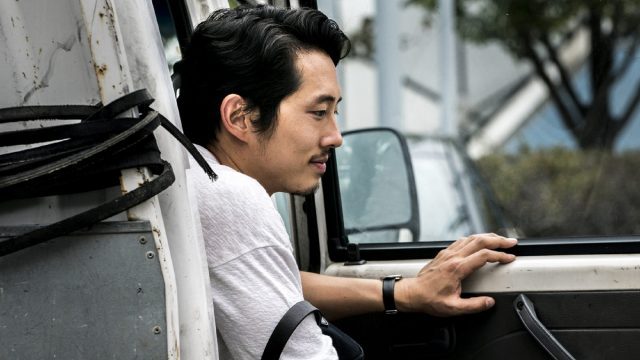
Lee Chang-dong’s Burning is first South Korean movie to make Oscar shortlist for Best Foreign Language Film

MoMA Film, Museum of Modern Art
11 West 53rd St. between Fifth & Sixth Aves.
February 1–9
212-708-9400
www.moma.org

Since his debut as a writer and director with 1997’s Green Fish, South Korean auteur has Lee Chang-dong has made only six feature films, which might actually add to his growing international reputation, especially with the success of his first film since 2010, Burning. MoMA will be screening all six works in the series “Cinema of Trauma: The Films of Lee Chang-dong,” running February 1-9, with Lee on hand for two postscreening discussions and one introduction. Based on the short story “Barn Burning” by Japanese author Haruki Murakami, Burning — the first South Korean film to be shortlisted for a Best Foreign Language Oscar — is a long psychological thriller, cowritten by Oh Jung-mi, about a wannabe young writer and slacker, Lee Jong-su (Yoo Ah-in), who bumps into an old classmate, Shin Hae-mi (Jeon Jong-seo), and starts up a new friendship with her, including taking care of her cat when she’s away. Lee is none too happy when she later shows up with Ben (Steven Yeun), who Jong-su thinks is wrong for her. Ben shares with Jong-su his penchant for burning down greenhouses, which only furthers Jong-su’s distrust of Ben, which does not please Hae-mi. At two and a half hours, Burning is long and slow moving, but it is also lushly photographed by Hong Kyung-pyo and deeply meditative, with a powerful ending that is worth waiting around for. Burning is showing February 1 at 6:30, followed by a Q&A with the sixty-four-year-old director, a former Minister of Culture and Tourism in South Korea, and again on February 9 at 7:00.

Secret Sunshine

Lee Shin-ae (Jeon Do-yeon) reexamines her life in Secret Sunshine

SECRET SUNSHINE (MILYANG) (Lee Chang-dong, 2007)
Saturday, February 2, 3:30, followed by a discussion with the filmmaker
Monday, February 4, 6:30
www.moma.org

Lee Chang-dong’s fourth film — and his first since 2002’s Oh Ah Shisoo (Oasis) — is a harrowing examination of immeasurable grief. After losing her husband, Lee Shin-ae (Jeon Do-yeon) decides to move with her young son, Jun (Seon Jeong-yeob), to Milyang, her late husband’s hometown. Milyang, which means “secret sunshine,” is a typical South Korean small town, where everyone knows everybody. Restarting her life, Shin-ae gets help from Kim Jong-chan (Song Kang-ho), a local mechanic who takes an immediate liking to her. But Shin-ae is more concerned with settling down with her son and giving piano lessons. But when a horrific tragedy strikes, she begins to unravel, refusing help from anyone until she turns to religion, but even that does not save her from her ever-darkening sadness. Cannes Best Actress winner Jeon gives a remarkable, devastating performance, holding nothing back as she fights for her sanity. Song, best known for his starring role in THE HOST, is charming as Jong-chan, a friendly man who is a little too simple to understand the depth of what is happening to Shin-ae. Don’t let the nearly two-and-a-half-hour running time scare you away; Secret Sunshine is an extraordinary film that does not feel nearly that long. Secret Sunshine will be showing at 3:30 on February 2, with Lee present for a postscreening discussion, and 6:30 on February 4 in MoMA’s “Cinema of Trauma: The Films of Lee Chang-Dong” series.
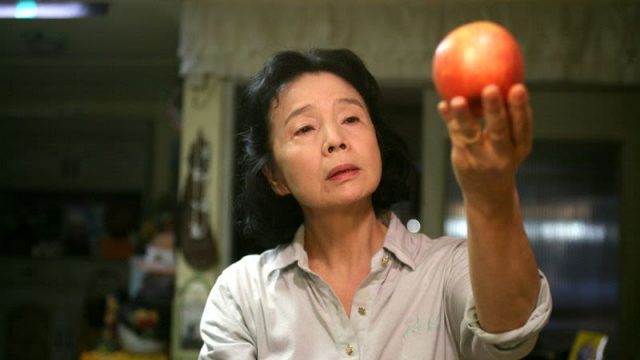
Yun Jung-hee returns to the screen for the first time in sixteen years in moving Poetry

Yun Jung-hee returns to the screen for the first time in sixteen years in moving Poetry

POETRY (SHI) (Lee Chang-dong, 2010)
Sunday, February 3, 4:30
Wednesday, February 6, 7:00
www.kino.com/poetry
www.moma.org

Returning to the screen for the first time in sixteen years, legendary Korean actress Yun Jung-hee is mesmerizing in Lee Chang-dong’s beautiful, bittersweet, and poetic Poetry. Yun stars as Mija, a lovely but simple woman raising her teenage grandson, Wook (Lee David), and working as a maid for Mr. Kang (Kim Hi-ra), a Viagra-taking old man debilitated from a stroke. When she is told that Wook is involved in the tragic suicide of a classmate (Han Su-young), Mija essentially goes about her business as usual, not outwardly reacting while clearly deeply troubled inside. As the complications in her life grow, she turns to a community poetry class for solace, determined to finish a poem before the memory loss that is causing her to forget certain basic words overwhelms her. Winner of the Best Screenplay award at the 2010 Cannes Film Festival, Poetry is a gorgeously understated work, a visual, emotional poem that never drifts from its slow, steady pace. Writer-director Lee (Peppermint Candy, Secret Sunshine) occasionally treads a little too close to clichéd melodrama, but he always gets back on track, sharing the moving story of an unforgettable character. Throughout the film he offers no easy answers, leaving lots of room for interpretation, like poems themselves. Poetry will be showing at 4:30 on February 3 and 7:00 on February 6 in MoMA’s “Cinema of Trauma: The Films of Lee Chang-Dong” series.