twi-ny recommended events

NORDIC UTOPIA: BLACK ARTISTS FINDING FREEDOM IN SCANDINAVIA

William Henry Johnson paintings are a highlight of “Nordic Utopia?” show at Scandinavia House (photo by twi-ny/mdr)

NORDIC UTOPIA? AFRICAN AMERICANS IN THE 20th CENTURY
Scandinavia House
58 Park Ave. at 38th St.
Tuesday – Saturday through March 8, free
212-847-9740
www.scandinaviahouse.org

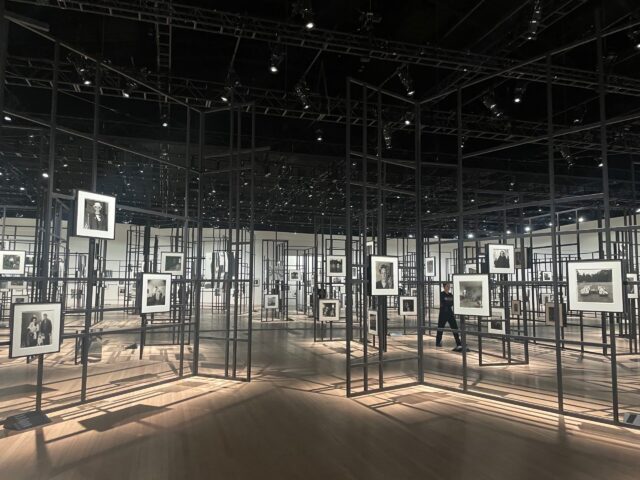
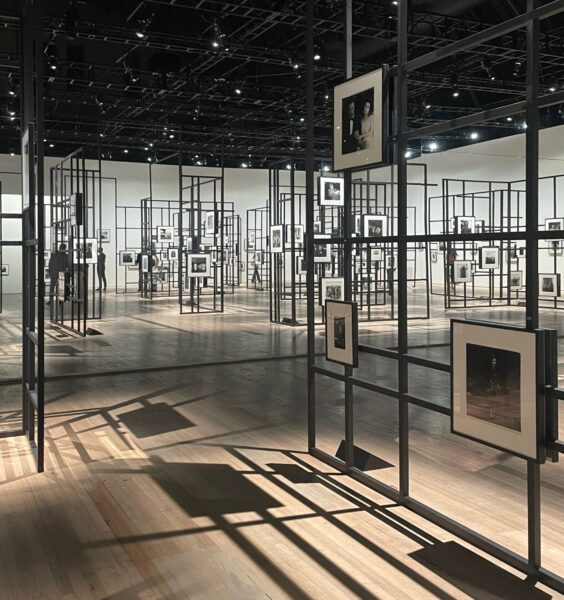
One of the best gallery shows right now in New York City is the small but revelatory “Nordic Utopia? African Americans in the 20th Century” at Scandinavia House, which explores the surprising connection between African American jazz musicians and Denmark, Finland, Norway, and Sweden. Continuing through March 8, “Nordic Utopia?” comprises painting, drawing, photography, ceramics, sculpture, music, and video by and about Black artists who left the United States for calmer pastures in Scandinavia.

“It was the first time in my life that I felt a real, free man,” visual artist and collector Howard Smith said in a 1976 interview about moving to Finland in 1984 after teaching at Scripps College in California. “So much so that one day I was walking down the street, I panicked because I suddenly realized that I had no further need for armor. I felt absolutely naked. In the United States you could not possibly walk down the street feeling free, spiritually unclothed, because you always felt that you are subject to attack. Well, here I am walking and I suddenly realize I have no armor whatsoever. I felt light as a feather — and it was frightening.” Smith, who died in 2021, has ten works on view, including several depictions of flowers, the small stoneware sculpture Female, the white porcelain Frida, and the 1986 Calligraphy Plate.

Sweet jazz floats in the air as visitors make their way through the three sections: “Creative Exploration & Cross Pollination,” “Lifelong Residency & Lasting Careers,” and “Travels & Sojourns,” encountering photos of Josephine Baker (including one by Helmer Lund-Hansen of the Black Venus in a white fur, cradling black and white baby dolls), Babs Gonzales, Fats Waller, Coleman Hawkins, and Dexter Gordon, who settled in Scandinavia from 1962 to 1976; “Since I’ve been over here, I felt that I could breathe, you know, and just be more or less a human being, without being white or black, green or yellow,” the LA-born saxophonist told DownBeat magazine.

Dexter Gordon at Jazzhus Montmarte, silver gelatin print, 1964 (photo by / courtesy of Kirsten Malone)

In Hans Engberg’s 1970 two-part documentary Anden mands land, an ex-pat writer explains, “I’m in a new man’s land. Here, I’ve found friends, buddies, and allies.” Eight surrealist paintings by New York City native Ronald Burns take viewers on a fantastical journey involving floating women, complex grids, a carousel, “Mental Costumes,” and a pair of dizzying renderings of “The Triumph of Nature.” The highlight of the show are six oil paintings by William Henry Johnson, three portraits, two gorgeous landscapes (Sunset, Denmark and A View Down Akersgate, Oslo), and the captivating Boats in the Harbor, Kerte-minde.

As the exhibition approaches its final weeks, there are a handful of special programs happening. On February 22 at 3:00, cocurators Ethelene Whitmire and Leslie Anne Anderson and scholars Denise Murrell and Tamara J. Walker will gather for a free two-hour symposium. On February 25 at 2:00 ($5), Sámi author and journalist Elin Anna Labba will discuss her book The Rocks Will Echo Our Sorrow!, about the expulsion of the Sámi from northern Norway and Sweden, in a virtual talk with moderator Mathilde Magga. On February 26 at 6:30 ($13), Scandinavia House will screen Bertrand Tavernier’s 1986 film about Dexter Gordon, ’Round Midnight, followed by a conversation with New Yorker film critic Richard Brody and Gordon’s widow, Maxine, author of Sophisticated Giant: The Life and Legacy of Dexter Gordon. And on March 5 at 5:30, ASF’s Emily Stoddart will lead a free guided tour of the show.

[Mark Rifkin is a Brooklyn-born, Manhattan-based writer and editor; you can follow him on Substack here.]

A BITCHIN’ MUSICAL JOURNEY AT THE WILD PROJECT

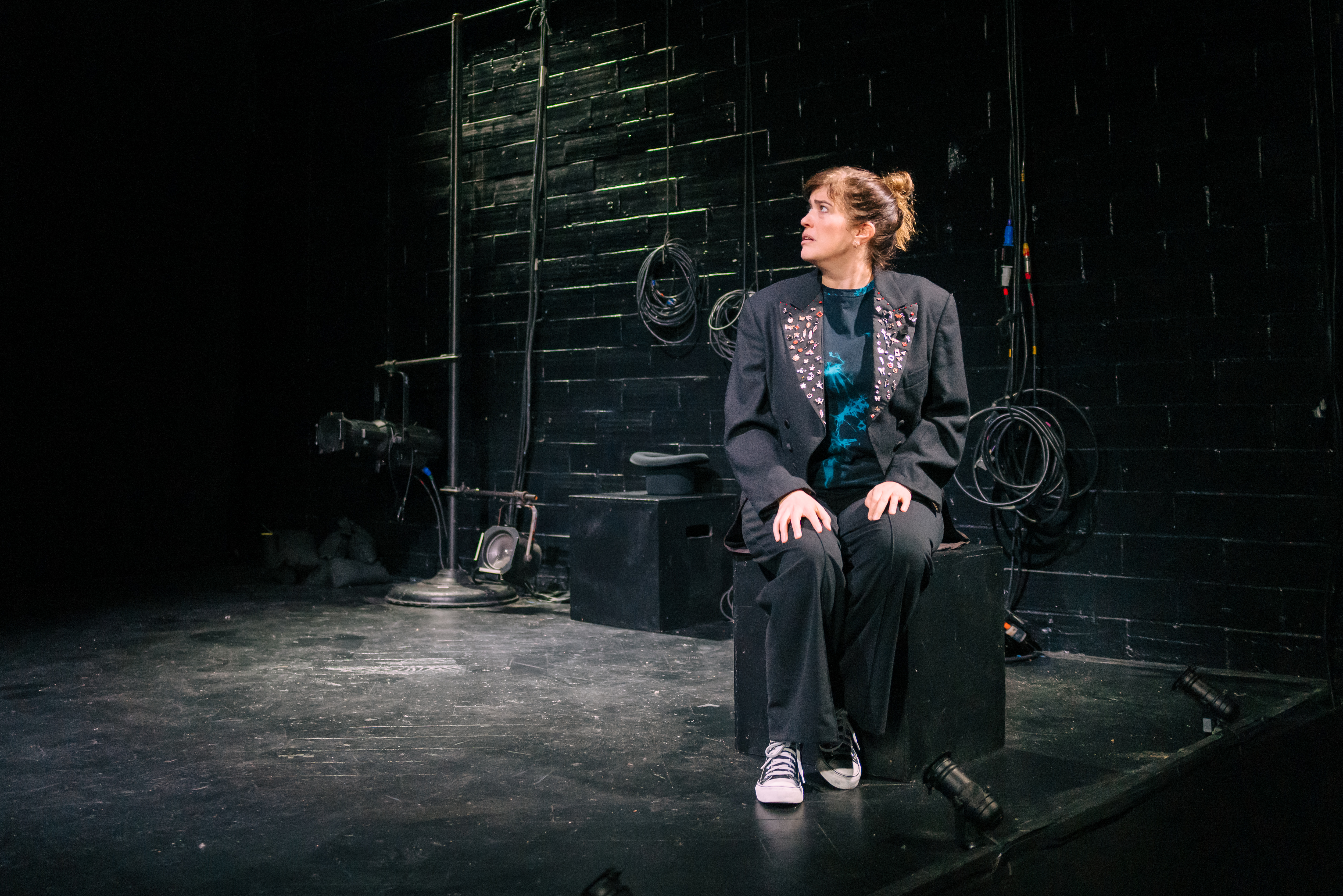
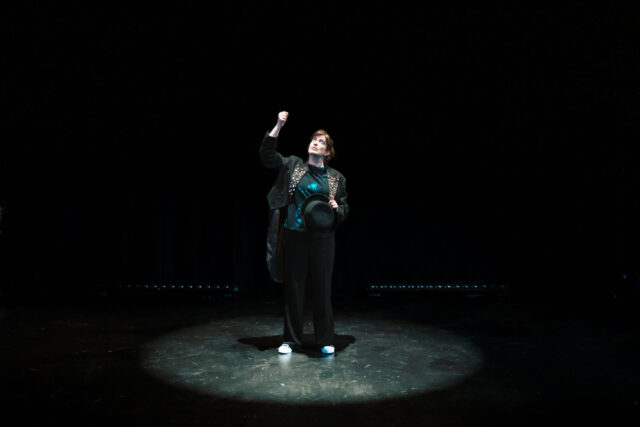
Karen Mould, aka Bitch, shares her intimate story in dazzling multimedia show (photo by Eric McNatt)

B*TCHCRAFT
the wild project
195 East Third St. between Aves. A & B
Through March 1, $36
thewildproject.com
bitchmusic.com

“I was a quiet child,” Karen Mould, aka Bitch, says numerous times in her not-quite-solo show, the scorching and endearing B*tchcraft: A Musical Play, continuing at the wild project through March 1. She whispers the phrase, sings it, and screams it, echoing her transition from a young girl resented by her parents to a fierce performer not afraid to stand up for what she believes in.

Born in 1973, Bitch was raised in suburban Michigan by an English father and mother who let her know that she kept them from living out their dreams. “My dad wanted to be a painter / But as an only child / Destined to take care of his parents / And then three daughters / He had to get a real job / So my job is to pour him the perfect beer,” she sings in the opening number. “My mom didn’t want to be a mom / She wanted to be a musical theater legend / But Michigan was as far off Broadway as you could get / Plus she had three girls to raise / And we all know whose job that is.”

“You’re bloody useless,” the voice of her father screams out.

“You’re a bull in a china shop,” the voice of her mother complains, referring to her daughter’s size and clumsiness.

“Up in my bedroom, I was NOT a quiet child,” Bitch tells the audience.

She imagines that the broom she uses to sweep the house can help her fly away. She writes heart-rending stories in her notebook that she reads to her bestie, a stuffed beaver named Beavy (Francesca) that comes to life. She falls in love with the violin. When she has her first period, dozens of tampons fall from the sky. She goes to college, takes theater and feminist courses, and meets Danny, with whom she forms a band, Bitch and Animal (Francesca). They build a following, but an incident at the Michigan Womyn’s Music Festival involving transphobia and TERFs alters her future dramatically.

B*tchcraft: A Musical Play continues at the wild project through March 1 (photo by Eric McNatt)

B*tchcraft was conceived by Bitch and director Margie Zohn, who wrote the impressive book together; the music and lyrics are by Bitch, with contributions from Faith Soloway, Melissa York, Jon Hyman, and Greg Prestopino. The intimate ninety-minute tale is accompanied by Bitch’s drawings, first black-and-white, then color, projected on the back and side walls (with framed works on paper in the lobby). The images change from her father’s angry eyes, swirling stairs, and a magical hillside to a tsunami of blood and such terms as “Male Gaze,” “Patriarchy,” “Misogyny,” and “Camp Twat: ‘Tenacious Women and Transfolk.’” The fun projection design is by Brian Pacelli, with lighting by Amina Alexander.

The immersive audio, by sound designer Sean Hagerty and engineer Gregory Kostroff, is virtually a character unto itself, from soft and tender to loud and aggressive, including a crackling fire, tinkling chimes, violin and guitar, a shower, a highway, crickets, and disembodied voices (by Seth Bodie, Ian Brownell, Amy Goldfarb, Ron Goldman, Jenna S. Hill, Mal Malme, Soloway, and Zohn). Samantha Tutasi’s set and props, which are brought on- and offstage and moved around by two crones (Cary Curran and Donovan Fowler), feature a wooden pentagonal covered box that morphs from a cauldron and bed to a sandbox and truck. Andrea Lauer’s costumes both contain and free Bitch as she goes from a little girl to a grown woman.

The musical numbers feature such powerful and engaging songs as “Pussy Manifesto,” “Hateful Thoughts,” and “Fallen Witch,” guiding us from her childhood to road trips to facing cancellation, with playful tap choreography by Michelle Dorrance. Through it all, Bitch stands tall; in “Be Bitch,” she declares, “I could be bitch / It rhymes with witch / I’ll wear the badass drag of it / Reclaim that word it sounds absurd / I’m gonna be bitch I’m gonna let it rip / You can call me bitch / This whole world can suck my tit.”

Bitch has released such solo albums as Make This Break This, In Us We Trust, and Blasted! and, with Animal, What’s That Smell and Eternally Hard, establishing herself as a queer music icon, including opening for Indigo Girls and Ani Difranco. In B*tchcraft, she stirs it all together in an exciting multimedia cauldron that should lift her career to a new level — although the specter of the Trump administration’s attack on the arts hovers over the production.

“At some point I had actually believed that coming out, we would be embraced into this big happy gay world utopia. But patriarchy was alive and well in most gay spaces because they were mostly run by men. If I had a nickel for every drag show we sat through at prides that ripped on women, or said hateful things about lesbians or our genitalia, I’d be richer than Oprah right now!” she says in the show, holding nothing back.

But more than anything else, B*tchcraft is a clarion call for everyone to keep writing, to keep singing, to keep sharing, and, hopefully, to keep making shows like this.

[Mark Rifkin is a Brooklyn-born, Manhattan-based writer and editor; you can follow him on Substack here.]

ROMEO + JULIET ON BROADWAY CONQUERS KING LEAR AT THE SHED

Sam Gold’s Romeo + Juliet is made for Gen Z but can be enjoyed by all (photo by Matthew Murphy and Evan Zimmerman)

ROMEO + JULIET
Circle in the Square Theatre
1633 Broadway at 50th St.
Tuesday – Sunday through February 16, $159-$1002
romeoandjulietnyc.com

Last fall, when I saw Sam Gold’s Romeo + Juliet at Circle in the Square and Kenneth Branagh’s King Lear at the Shed, I was not anticipating being charmed by the former and disappointed in the latter.

Tony and Obie winner Gold has had decidedly mixed results with controversial and often confusing star-driven adaptations of such Shakespeare plays as Macbeth and King Lear on Broadway, Othello at New York Theatre Workshop, and Hamlet at the Public.

Meanwhile, Branagh is widely considered the finest interpreter of the Bard since Laurence Olivier, both onstage, such as his immersive version of Macbeth at Park Ave. Armory and his 1987 and 2016 takes on Romeo and Juliet, and his well-received cinematic adaptations of Henry V and Much Ado About Nothing.

Lear is a personal favorite of mine; Branagh’s is the eighth major production I’ve seen in the last twenty years. I have not had as much luck with R&J, from David Leveaux’s flat 2013 Broadway revival to Hansol Jung’s profoundly perplexing 2023 effort at the Lynn Angelson, although I adored Michael Mayer’s & Juliet, a musical imagining of what might have happened if Juliet had survived.

Closing February 16, Gold’s Romeo + Juliet is a plush and lively, radical AMSR presentation tailored for Gen Z, complete with an Insta-friendly plethora of stuffed teddy bears onstage and in the lobby. When the audience enters the theater in the round, the actors are already hanging out, talking, dancing, and dissing with each other, pushing around a shopping cart of stuffed animals, skateboarding, and lounging on plastic furniture. They wear sneakers, hoodies, and a Hello Kitty backpack. On one side, a giant pink teddy bear watches in silence while across the space a DJ spins Jack Antonoff’s thumping music.

The youthful cast features the hot Rachel Zegler as Juliet and the even hotter Kit Connor as Romeo, with Tony nominee Gabby Beans as Mercutio and the friar, Sola Fadiran as both Capulet and Lady Capulet, Taheen Modak as Benvolio, Tommy Dorfman as the nurse and Tybalt, and Gían Pérez as Samson, Paris, and Peter. The doubling and tripling often makes it hard to know who is who, and some actors do better with the tweaked dialogue than others. Two songs are completely unnecessary, and the use of a handheld microphone is baffling, as is the handling of a poison jug.

But much of the staging is dazzling, from Juliet’s bed, which drops slowly from the rafters, to a colorful expanse of flowers that emerges from the floor. Yes, the F-bomb appears twice, but surprises await those who fully invest themselves in this contemporary tale made for this moment in time.

Kenneth Branagh’s ritualistic King Lear goes astray early (photo by Marc J. Franklin / courtesy the Shed)

Unfortunately, Branagh, codirecting with Rob Ashford and Lucy Skilbeck, struggles with his streamlined adaptation, which, at a rushed two hours without intermission, has cut several key scenes and famous lines, and without the proper character development it’s often hard to differentiate among the minor characters, who are played by recent graduates of the Royal Academy of Dramatic Arts and look like survivors from Game of Thrones. Branagh, who is sixty-four, does not portray Lear as an aged, failing man but as a younger warrior, which alters the plot’s narrative center.

Like Gold’s R+J, Branagh’s staging involves a large sphere, in this case an imposing UFO-like disc that hovers over the action, occasionally moving and tilting, onto which ominous weather patterns are projected. (The script identifies the setting as “outer space.”) It also leaves in one of the songs, which feels extraneous given the show’s shortened length.

Thus, my initial thoughts that Gold would pale in comparison to Branagh were misbegotten.

“O teach me how I should forget to think!” Romeo tells Benvolio.

Who woulda thunk it?

[Mark Rifkin is a Brooklyn-born, Manhattan-based writer and editor; you can follow him on Substack here.]

A WILD[E] SALOME FROM HEARTBEAT OPERA

Heartbeat Opera’s English-language Salome continues at the Space at Irondale through February 16 (photo by Russ Rowland)

SALOME
The Space at Irondale
85 South Oxford St., Brooklyn
February 4-16, $21.79-$114.25
www.heartbeatopera.org/salome

“When it premiered, it was extremely shocking to its audiences because it was dangerous and there were so many taboos that get broken in it,” co-adaptor and director Elizabeth Dinkova says about Richard Strauss’s Salome, which Heartbeat Opera is presenting this month in a rare English-language version at the Space at Irondale. In the promotional video, she continues, “There are a few core mysteries at the center of this piece around what it means to be in love, and the great terror and violence that erupts when you’re not.”

Oscar Wilde’s 1891 play about the first-century Jewish princess who was the daughter of Herodias and stepdaughter of Herod II was translated into German by Hedwig Lachmann and became the libretto for Strauss’s opera, which debuted in Dresden in 1905. Tom Hammond translated the work into English in the late 1980s for the English National Opera, and now Dinkova and co-adaptor, music director, and conductor Jacob Ashworth have collaborated on a new version for seven singers, eight clarinetists, and two percussionists. The cast features Summer Hassan as Salome, Patrick Cook as Herod, Nathaniel Sullivan as Jokanaan (John the Baptist), Manna K Jones as Herodias, David Morgans as Narraboth, Jaharis as Page Melina, and Jeremy Harr as a soldier; Francesca Federico will perform the title role on February 9.

Heartbeat has previously staged unique versions of such classics as Eugene Onegin, Tosca, and Fidelio as well as the original The Extinctionist. Up next is a one-hundred-minute retelling of Charles Gounod’s Faust at Baruch Performing Arts Center in May.

In the video, music arranger Dan Schlosberg explains, “This was a scandal, this piece; [Strauss] wrote it, and he knew that people were going to be scandalized.”

Heartbeat Opera attempts to bring back that sense of shock and scandal in its take on Salome, which promises, among other things, a “Dance of the Seven Veils” like you’ve never seen before.

[Mark Rifkin is a Brooklyn-born, Manhattan-based writer and editor; you can follow him on Substack here.]
WALLA WALLA BANG BANG: JOY BEHAR TAKES ON LOVE AND MARRIAGE

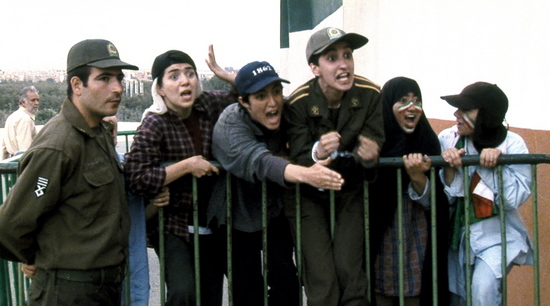
Joy Behar, Adrienne C. Moore, Tovah Feldshuh, and Susie Essman star in My First Ex-Husband (photo by Joan Marcus)

MY FIRST EX-HUSBAND
MMAC Theater
248 West Sixtieth St. between Tenth & Eleventh Aves.
Wednesday – Sunday through May 18, $69-$186
www.myfirstexhusband.com

Joy Behar looks at the lighter side of marital strife in the funny and affecting My First Ex-Husband, which opened last night at MMAC Theater. Based on interviews Behar conducted with numerous women, the eighty-five-minute play consists of eight poignant monologues delivered by four actors, taking turns at the front podium, where the script is there for them to refer to.

Behar, the longtime host of The View who has appeared in such shows as The Food Chain and The Vagina Monologues and written Crisis in Queens, Bonkers in the Boroughs, and Me, My Mouth and I, introduces the play by pointing out that nearly half of US marriages end in divorce. She asks the audience how many of them are divorced, then follows that up by saying, “How many of you wish you were?”

Through February 23, the the initial cast features the Brooklyn-born Behar, who is on her second marriage; two-time Emmy nominee and four-time Tony nominee Tovah Feldshuh (Funny Girl, Golda’s Balcony), a Manhattan native who has been married to the same man sine 1977; NAACP Image Award winner Adrienne C. Moore (The Taming of the Shrew, For Colored Girls . . . ,), who hails from Nashville; and Behar’s bestie of more than forty years, the Bronx-born Susie Essman (Curb Your Enthusiasm, Broad City), who has been married since 2008.

In the first monologue, “Clothes Make the Man?,” Serena (Essman) talks about dealing with her ex-husband’s fetish of wearing women’s clothes. In “The Widow,” June (Feldshuh) shares her abandonment issues and her ex’s obsession with her weight. In “Where Are You At,” Laila (Moore) is a successful actress on the brink of stardom whose husband is cheating on her. And in “The Touch,” Monica (Behar) discovers a new side of herself when her bookie husband is sent to the hoosegow.

Adrienne C. Moore nearly steals the show at MMAC Theater (photo by Joan Marcus)

Behar has a penchant for strong first lines, as demonstrated by the below examples.

“The Widow”: “Okay, my husband’s dead.”
“Walla Walla Bang Bang”: “My shrink says that it’s important to have some things in common with your spouse.”
“The Drummer’s Wife”: “I was on my way to the honeymoon, and I was thinking, ‘How am I gonna get out of this.’”
“Get Off of Me”: “I really don’t belong here tonight because I’m not divorced yet. But I’m on the cusp.”

It’s no surprise that the topic that comes up the most is not money or age or children but sex. “He was respectful and didn’t pressure me to have sex,” Serena says. Laila remembers when her husband asked her, “Can I please have sex on the side? I’ll be discreet.” In “Walla Walla Bang Bang,” Jessica (Essman) explains about her ex, “He also was a product of his strict Catholic upbringing, and he didn’t function very well sexually. In my opinion, religion can fuck up your libido.” In “Wigged Out,” an arranged Orthodox marriage between Rebecca (Feldshuh) and a teenage boy is complicated by her vaginismus. And in “Get Off of Me,” Gloria (Moore) thinks her husband might be a sex addict.

Under the unobtrusive direction of Randal Myler (Hank Williams: Lost Highway, Love, Janis), the ensemble, all dressed in black, is excellent, but Feldshuh and Moore deserve extra accolades for their performances, Feldshuh for injecting a sly sense of humor and Moore for bringing down the house several times with her energetic movement and overall enthusiasm, even when she’s sitting in the back watching the others, waiting for her turn.

From February 26 to March 23, Judy Gold, Susan Lucci, Cathy Moriarty, and Tonya Pinkins take over, followed March 26 to April 20 by Veanne Cox, Gina Gershon (April 2–20), Jackie Hoffman, and Andrea Navedo, and then Marilu Henner, Marsha Mason, Benja K Thomas, and Julia Sweeney from April 23 to May 18.

You should go no matter what state your own relationship is in, but don’t get any ideas.

[Mark Rifkin is a Brooklyn-born, Manhattan-based writer and editor; you can follow him on Substack here.]
THE ROAD TO FREEDOM: FAITH RINGGOLD’S FOR THE WOMEN’S HOUSE

Formerly incarcerated women Enid “Fay” Owens, Nancy Sicardo, and Mary Baxter check out Faith Ringgold’s For the Women’s House in Paint Me a Road Out of Here

PAINT ME A ROAD OUT OF HERE (Catherine Gund, 2024)
Film Forum
209 West Houston St.
Opens Friday, February 7
212-727-8110
www.filmforum.org

“No one and nothing is safe at a prison, including the guards, the inmates, the walls, the furniture, and especially that painting,” author and activist Michele Wallace says in Catherine Gund’s moving and passionate documentary Paint Me a Road Out of Here, opening February 7 at Film Forum.

Author of such books as Black Macho and the Myth of the Superwoman and Dark Designs and Visual Culture, Wallace is the daughter of children’s book writer, painter, sculptor, and performance artist Faith Ringgold. The work she is referring to is her mother’s 1972 For the Women’s House, an eight-foot-by-eight-foot mural that was commissioned for the New York City Correctional Institution for Women on Rikers Island.

Before starting the mural, Ringgold visited the institution and met with some of the women. “I knew that each one wanted to be inspired, to renew their life,” she says in the film. “They wanted to be out of there, of course. And it was obvious to me that the reason why many of them were there was because they had a lack of freedom. I asked the women, ‘What would you like to see in this painting that I’m going to do to inspire you?’ And one girl said, ‘I want to see a road leading out of here.’”

The large canvas is divided into eight triangular sections depicting women in nontraditional roles, including as professional basketball players, a bus driver, a police officer, a priest, a lawyer, a construction worker, and US president, accompanied by quotes from Rosa Parks and Coretta Scott King.

“Almost every single profession in that painting was not open to women in 1971,” curator Rujeko Hockley points out. She also equates prisons with museums, noting, “Black people were held captive in one institution and excluded from the other.”

Gund traces the history of For the Women’s House, delving into its conception, detailing how it was painted over in white by prison employees in 1988, and examining its restoration and the very strange journey it took as the Brooklyn Museum attempted to acquire it in order to save it from potential oblivion. She also places it in context within Ringgold’s career, looking at her seminal 1967 breakthrough gallery show, featuring such powerful and important works as Die, The Flag Is Bleeding, and The American People Series #19: US Postage Commemorating the Advent of Black Power. She meets with Ringgold in her studio, on her porch, and at the New Museum, which eventually hosted her revelatory career retrospective, “American People,” in 2022.

The director balances that narrative with the inspirational tale of Mary Enoch Elizabeth Baxter, who gave birth while incarcerated and fought to right her life through art and activism after serving time. Baxter returns to the Riverside Correctional Facility in Philadelphia in 2022 and installs a mural comprising multiple affirmations, providing hope for the women there through art. She also developed a friendship with Ringgold.

Gund (Born to Fly: Elizabeth Streb vs. Gravity, Chavela), who participated in freeing the painting after first encountering it in late 2021, speaks with Michael Jacobson, who was the commissioner of the Dept. of Corrections in the mid-1990s when the painting virtually disappeared; artist and author Michelle Daniel Jones, who teamed up with Baxter to put on an exhibition; curators Hockley and Catherine Morris, who staged “We Wanted a Revolution: Black Radical Women, 1965–85” at the Brooklyn Museum in 2017; Rikers corrections officer Barbara Drummond, who led the fight to preserve For the Women’s House; and ACA gallerist Dorian Bergen, who explains about Ringgold’s early work, “These are among the most important paintings of the twentieth century. History had to catch up with Faith.”

The artworks shown in the film will be eye-opening to viewers who are not familiar with Ringgold’s oeuvre, from the aforementioned pieces to Childhood, The Fall of America, Sojourner Truth Tanka: Ain’t I a Woman, Uptight Negro, and Flag Is Bleeding. “I became an artist so that I could tell my story,” Ringgold, who dressed in splashy outfits with sparkling accoutrements, says, and what a story it is.

A New York City native, Ringgold passed away in New Jersey in 2004 at the age of ninety-three. Her remarkable legacy will live on in the hearts and minds of her many fans, fellow artists, and incarcerated and formerly incarcerated women who find freedom in what she stood for.

As curator and author Nicole R. Fleetwood declares, “I think art is disruptive, and I think art disrupts lazy thinking.”

There is no lazy thinking when it comes to Faith Ringgold.

[There will be a series of postscreening discussions at Film Forum, presented by the New Museum and the Women’s Community Justice Association on February 7 at 7:00, the Center for Art & Advocacy on February 8 at 7:00, the Vera Institute of Justice and Silver Art Projects on February 13 at 7:00, the New York Women’s Foundation and the Center for the Study of Women and Society at the Graduate Center on February 18 at 6:30, and the Guggenheim on February 20 at 6:30.]

[Mark Rifkin is a Brooklyn-born, Manhattan-based writer and editor; you can follow him on Substack here.]
GONE FISHING: ROB TREGENZA BRINGS UNIQUE WWII DRAMA TO MoMA

Anna Kristiansen (Ellen Dorrit Petersen) and Adam Honderich (Andreas Lust) are caught up in WWII intrigue in Rob Tregenza’s The Fishing Place (courtesy Cinema Parallel)

THE FISHING PLACE (Rob Tregenza, 2024)
MoMA, the Museum of Modern Art
The Debra and Leon Black Family Film Center
11 West Fifty-Third St. between Fifth & Sixth Aves.
February 6-12
www.moma.org

Rob Tregenza’s The Fishing Place is a tour de force of filmmaking, and the writer-director isn’t shy about making sure the audience knows it. The movie, divided into three sections that Tregenza refers to as “flows,” opens with a shot of a boat out at sea, shown in the negative, a ghostly white in a gray, gloomy seascape that slowly reverses into color over Earecka Tregenza and Jason Moody’s melancholic score. We are then introduced to the three protagonists via superimpositions and fades that point toward memory, as well as through mysterious, virtually impossible camera movements forward.

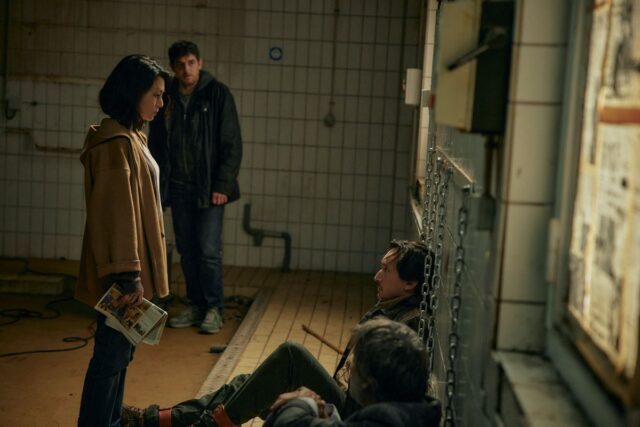
It’s 1945 in a small Norwegian town, and Anna Kristiansen (Ellen Dorrit Petersen) is a Nazi prisoner working as a housekeeper for Klaus (Eindride Eidsvold), a wealthy collaborator. Adam Honderich (Andreas Lust) is a newly arrived German Lutheran priest. Nazi officer Aksel Hansen (Frode Winther) orders Anna to work for Honderich for three days and spy on him, as it’s suspected that the priest is part of the resistance.

Anna becomes the focus in a stunning six-and-a-half-minute scene at a small party being thrown by Klaus for Aksel; Anna works with the cook (Lena Barth-Aarstad) and a maid (Ingvild Holthe Bygdnes), serving Klaus and Aksel in addition to Willie (Peder Herlofsen), a young man who would rather be reading his book; a man (Jonas Strand Gravli) trying to convince Klaus to invest in his electronic gadgets; the elegant, wheelchair-bound Margit (Gjertrud L. Jynge) and her doctor (Ola Otnes); among others. It’s intense and almost interminably slow-paced; every sound — a footstep, a glass being put on a tray, background music — feels as if we’re on a precipice, every element desperate to break free. The stunning sound design, also highlighted by boots in the snow, a crackling fire, and gunshots, is by Øyvind Rydland.

Soon after the party, Anna finds a frightened child named Ada (Ella Maren Alfsvåg Jørgensen) hiding out in a shack on Honderich’s property. Later, a local man visits Honderich, bringing him a fish that seems to be more of a threat than a gift, and comments on his priestly dress. Honderich says, “Unfortunately, I didn’t have much choice.” The man responds in an ominous tone, “We all have a choice, don’t we?”

Margit makes a surprising confession to the priest. The doctor takes Anna for a ride in his automobile and shares his suspicions of who she is and what she is doing there. In his church, which bursts with colors that stand out in the otherwise bleak but beautiful snowy winter landscape, Honderich suddenly is filled with fire and brimstone. As the camera circles an old fishing boat where Honderich and Aksel have cast out their lines, the colors morph into a hellish red. “Are you happy with yourself?” the priest asks. The Nazi officer replies, “No. And you know it.”

In another dazzling sequence, the camera goes down a horizontal row of characters who one at a time share brief thoughts and then appear again at the other end, with no cuts. “Don’t look back,” the priest prophetically warns us.

Later, after a fadeout, we can hear talking behind-the-scenes as a scene is readied; a man claps the slate and we see the cast and crew in action in a virtuosic twenty-minute crane shot that starts with indoor close-ups before heading outside and almost flying away. Tregenza is the cinematographer, but camera operators Pål Bugge Haagenrud and Art Eng deserve huge kudos, as does editor Elise Olavsen.

Kansas native Tregenza (Talking to Strangers, Gavagai) mixes in a little Ingmar Bergman and Jean-Luc Godard in The Fishing Place, which was partly inspired by the work of philosophers Henri Bergson and Gilles Deleuze. “The self is only a threshold, a door, a becoming between two multiplicities,” the latter wrote in A Thousand Plateaus: Capitalism and Schizophrenia, as well as “Bring something incomprehensible into the world!”

The Fishing Place is making its North American theatrical premiere February 6–12 at MoMA; Tregenza will be at the museum for a Q&A following the 6:30 show on opening night.

[Mark Rifkin is a Brooklyn-born, Manhattan-based writer and editor; you can follow him on Substack here.]