twi-ny recommended events

AN EVENING WITH RALPH LEMON AND POPE.L

Bruce Nauman’s “Wall/Floor Positions” is centerpiece of Modern Mondays presentation at MoMA January 28

Bruce Nauman’s “Wall/Floor Positions” is centerpiece of Modern Mondays presentation at MoMA January 28

Who: Ralph Lemon, Pope.L, Adrienne Edwards
What: Dance, response, and discussion
Where: The Museum of Modern Art, Theater 2, 11 West 53rd St. between Fifth & Sixth Aves., 212-708-9400
When: Monday, January 28, 7:00
Why: In conjunction with the exhibition “Bruce Nauman: Disappearing Acts” at MoMA and MoMA PS1, the museum’s Modern Mondays program on January 28 will begin with Minnesota-raised dancer, choreographer, and writer Ralph Lemon offering a meditation on the multidisciplinary artist’s “Wall/Floor Positions,” which is performed daily at MoMA by various dancers. Newark-born visual artist and 2017 Bucksbaum Award winner William Pope.L, who is creating an installation for the Whitney for the fall, will then offer his response to the piece, followed by a discussion with Lemon and Pope.L, moderated by Whitney curator Adrienne Edwards. The wide-ranging Nauman exhibition continues at MoMA through February 25.

BLUE RIDGE

(photo by Ahron R. Foster)

Marin Ireland is riveting as a woman with anger issues in Abby Rosebrock’s Blue Ridge (photo by Ahron R. Foster)

Atlantic Theater Company
Linda Gross Theater
336 West 20th St. between Eighth & Ninth Aves.
Through January 27, $86.50
866-811-4111
atlantictheater.org

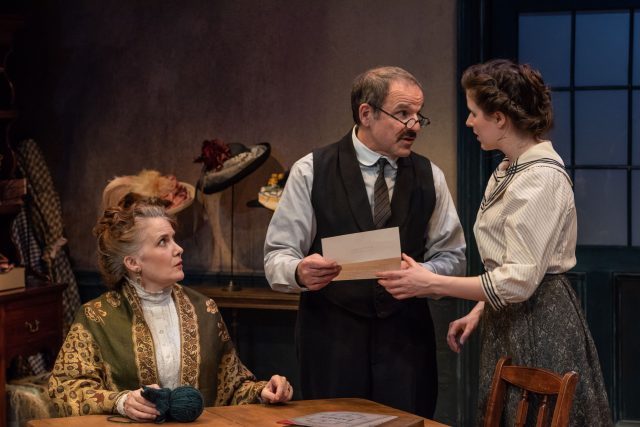
Marin Ireland sizzles as a high school English teacher with anger management issues in Abby Rosebrock’s Blue Ridge, which continues through January 27 at the Atlantic’s Linda Gross Theater. Ireland is Alison, a single woman who has been sentenced to six months at St. John’s Service House, a faith-based halfway home in western North Carolina, for having taken an ax to her principal’s car. The facility is run by Pastor Hern (Chris Stack) and his assistant, Grace (Nicole Lewis), who hold daily sessions in which either they or the residents read a Bible passage of their own choosing and then relate it to their life and addiction. Also living at the house is Cherie (Kristolyn Lloyd), another teacher; Wade (Kyle Beltran), a wannabe guitarist and songwriter; and the newly arrived Cole (Peter Mark Kendall), a young man who appears to be a bit addled. Alison has lost her license and been told she will never teach again, but she is determined to get a second chance and has opted for St. John’s because “the Yelp review said, ‘Best in Appalachia.’” Each of the characters has their own problems to solve, and Alison can’t help but get in the middle of most of them, unable to control her passion for what she considers the right thing to do, turning everything upside down as her inner rage threatens to bust out again.

(photo by Ahron R. Foster)

Blue Ridge is set in a halfway house for recovering addicts (photo by Ahron R. Foster)

Blue Ridge takes place in a quaint living room with a back window looking out at the woods behind the house, where freedom awaits. (The set design is by Adam Rigg.) Rosebrock (Dido of Idaho, Different Animals) creates well-drawn characters, each with their own touch of mystery, and she avoids being condescending to them, although it occasionally comes close. Cole’s game of “Tree or Stalin,” in which people have to guess an object in a twist on “Twenty Questions” (“Is it bigger than a breadbox?”), is odd and confusing, and one of the main conflicts seems forced, but Obie-winning director Taibi Magar (Is God Is, The Great Leap) wisely keeps the focus on Ireland. You can’t take your eyes off her; she’s constantly making small gestures and scrunching up her malleable face in extraordinary ways, each movement adding insight to her character, and you won’t want to miss a second of it. Ireland, who has won an Obie (Cyclone) and been nominated for a Tony (reasons to be pretty), two Drama Desk Awards (On the Exhale, Ironbound), and an Independent Spirit Award (Glass Chin), is one of New York’s finest actors; she makes anything she’s in worth seeing, and makes it better merely by her glowing presence.

BETWEEN THE THREADS / THE CONVENT

(photo by Ahron R. Foster)

A group of women seek answers about their unhappy lives in The Convent (photo by Ahron R. Foster)

THE CONVENT
Mezzanine Theatre at A.R.T./New York Theatres
502 West 53rd St. between Tenth & Eleventh Aves.
Tuesday – Sunday through February 17, $45
weathervanetheater.org
www.rattlestick.org

In the world premiere of Jessica Dickey’s The Convent, which opened last night at A.R.T./New York Theatres, six nondenominational spiritual seekers, all women, go on a weeklong retreat to find out who they are and what they want in life. In the world premiere of Coral Cohen’s Between the Threads, which opened tonight at HERE, five Jewish women talk about the limitations of growing up female in a religious tradition that limits their freedom to determine their own identity. There are numerous intriguing similarities between the two superb plays, from the very outset. In Between the Threads, the women are informally chatting with one another as the audience enters the space, the stage dotted with knitted dreamcatcher-like objects referencing weaving, which is traditionally considered women’s work, while in The Convent, one of the women is sweeping up leaves as the audience comes in; she then sits down and starts to sew. Both works also examine matriarchal lineages and the relationship among daughters, mothers, and grandmothers.

(photo by Ahron R. Foster)

Patti (Samantha Soule) watches Jill (Margaret Odette) express herself in new Jessica Dickey play (photo by Ahron R. Foster)

“I remember when I first climbed those stairs. I was penniless, lost, exhausted, but more than that — I was spiritually bankrupt,” Mother Abbess (Wendy vanden Heuvel) says after a new group of women enter the courtyard of the Convent. “No matter what has brought you, what you sacrificed to get here — no matter your past, your beliefs, if you’re rich or broke, thanks to the support of a generous few — you are welcome here.” Jill (Margaret Odette), Wilma (Lisa Ramirez), Tina (Brittany Anikka Liu), and Patti (Samantha Soule) have joined Dimlin (Annabel Capper) and Bertie (Amy Berryman) in the south of France, seeking insight into their lives. They all don similar long blue robes and share intimate details about themselves, filtering them through the nomen card they each select from a deck of female saints. (Nomen is Latin for “name,” but it also can be read as “no men.”) For example, Jill picks Teresa of Avila, Patti chooses Mechthild of Magdeburg, and Dimlin gets Catherine of Siena.

Each day is filled with chores and rituals, prayers and discussion sessions. While some of the characters are free and open, others are more tightly wound and self-protective; there is also a fierce tension between Patti and Mother Abbess. “You’re trespassing, you are not welcome at this retreat,” Mother Abbess tells the snarky Patti, who responds, “Now where’s the fun in that?” Mother Abbess strongly retorts, “I will do it. They’ll drag you cuffed and screaming. Don’t you dare fuck this up for this group of women.” They might be in a convent praying regularly to God, but this is no typical house of worship. In fact, Mother Abbess surprisingly declares, “I never liked church. I hated being told what to say, I hated being talked to through the words ‘he’ and ‘mankind.’ I felt like spirituality was this little peephole I was allowed to look through, into this room that other people got to be in. But spirituality is exactly what I was seeking. Sovereignty. True sovereignty.” Of course, not everyone gets what they were seeking.

(photo by Ahron R. Foster)

Mother Abbess (Wendy vanden Heuvel) faces her own demons in The Convent (photo by Ahron R. Foster)

Evoking Small Mouth Sounds, in which a diverse group of people join a silent retreat, The Convent takes place in the middle of the theater, the audience sitting on either side of Raul Abrego’s long, narrow, horizontal stage, which features medieval-style architecture and several plantings. The cast, wearing Tristan Raines’s costumes, often carries chairs on and off the concrete patio during prayers and discussions; Katherine Freer’s projections depict flowers blowing in the wind outside as well as Middle Ages paintings. Soule has the meatiest part, and she tackles it with relish as her character chortles, rolls her eyes, flirts with others, and often stands alone. Odette is excellent as Jill, a married woman with deep wounds, and vanden Heuvel (the artistic director of Weathervane Theater, which is presenting the play with Rattlestick) nails Mother Abbess, who harbors some dark secrets of her own. Dickey’s dialogue crackles with truth while Daniel Talbott’s direction is both warm and energetic.

(photo by Emily Hewitt)

Cousins gather for a bat mitzvah in Coral Cohen’s Between the Threads (photo by Emily Hewitt)

BETWEEN THE THREADS (JEWISH WOMEN PROJECT)
HERE Arts Center
145 Sixth Ave. at Dominick St.
Wednesday – Sunday through February 10, $25
212-647-0202
www.here.org
www.facebook.com

Truth is also central to Between the Threads (Jewish Women Project), in which co-creators Hannah Goldman, Lea Kalisch, Luisa Muhr, Daniella Seidl, and Laura Lassy Townsend essentially play themselves, telling their personal stories about the impact the Jewish religion has had on who they are and who they want to be. Hailing from the Ashkenazi, Sephardic, and Mizrahi traditions, they are joined by klezmer musician Zoë Aqua, who sits in a far corner playing the violin. “It’s not fair that people grow up. It’s not fair that you suddenly have to have your bat mitzvah and suddenly become a woman now and suddenly you can’t play with us,” Daniella says to Laura, adding, “Eventually, we will join your side for a lifetime of suffering. We too will become women.” The five women wear similar types of white or off-white clothing, either a skirt, a dress, or pants, and all are barefoot. (The costumes are by Johanna Pan, with set design by Lauren Barber.) The women prance about the stage fancifully, move about chairs to sit or stand on, and occasionally sing and dance as they relate the feminine aspects of their heritage, even including snippets of their mothers and grandparents talking.

(photo by Emily Hewitt)

Laura Lassy Townsend reads as Zoë Aqua plays the violin and the other women come together in world premiere at HERE (photo by Emily Hewitt)

The young women discuss immigration, rituals, weddings, funerals, the Torah, Christmas, and the mechitza, the partition that separates the men from the women in Orthodox synagogues. “I dream of a world without barriers. Where everyone has space. Where everyone has freedom,” Hannah says, while Lea explains, “I love the mechitza — it makes me feel more woman.” Lea, who previously described herself as a rebel, also says, “I am a twenty-first-century woman / I am in charge. . . . I’m yearning to be where the men are / as a man / Yearning for a dream / Is that what it means to be a Jewish woman? / I want to be where the men are / Want to feel like they feel,” getting right to the heart of the conflict within each of them. Throughout the seventy-five-minute show, the women make direct eye contact with the audience, reaching out for catharsis, and it’s easy to respond to them as they lay their feelings bare with humor and intelligence. In some ways they recall Tevye’s daughters from Fiddler on the Roof, trying to find their place in Judaism and the world outside. It’s no simple task; it might be a matrilineal religion, but it’s still the men who call the shots in the more fundamentalist branches.

(photo by

Lea Kalisch is one of five women who share intimate details of their lives from the Jewish Women Project (photo by Emily Hewitt)

The Convent and Between the Threads are both in harmony and counterpoints to each other. (They are also both general admission seating and performed without an intermission.) Each focuses on women’s identity in contemporary society and how faith and family impact that. Each show includes singing — in The Convent it’s a Madonna song, of course — as well as same-sex relationships. They also look at the concept of God and the power of motherhood; specific men are rarely mentioned. In Between the Threads, Luisa says, “My religion is culture, is art. I found Judaism through music. My mother found Judaism through music. You can’t silence music and you can’t silence the voices that sing it. We break down the bars. We break down the walls. And yes, we break the male gaze.” In The Convent, Mother Abbess explains, “Women cannot follow men. They can learn from them, they can partner with them, but they cannot follow them. . . . A woman can only follow herself. Which means a woman must lead herself. Which means a woman must always strive to be both — the one who is following, and the one who is leading.” The primary difference between the two shows is that in The Convent, the characters are hurt and angry, severely disappointed with their lives, but in Between the Threads the women are joyous and happy even as they grapple with disturbing aspects of their religion. The women in Between the Threads are not in need of a spiritual retreat, nor would the women in The Convent likely find the answers they are seeking in Judaism.

KEVIN BEASLEY: A VIEW OF A LANDSCAPE

(photo by twi-ny/mdr)

Cotton gin motor is centerpiece of Kevin Beasley exhibition at the Whitney (photo by twi-ny/mdr)

Whitney Museum of American Art
99 Gansevoort St.
Through March 10, $18-$25
Performances January 26, February 16, and March 2, free with museum admission
212-570-3600
whitney.org

In 2011, artist and automotive enthusiast Kevin Beasley went to his family’s Virginia farm and was surprised to see that it was planted with cotton for the first time. The Yale MFA candidate picked some of the cotton and brought it home with him, wanting to incorporate the material into his work. Searching on eBay, Beasley found a 2200-pound cotton gin motor for sale in Maplesville, Alabama, where it had been in use from 1940 to 1973, overlapping with the heart of the civil rights movement; Selma, where the march to Montgomery began in 1965, is only thirty miles away from Maplesville. Beasley, now based in Brooklyn with a studio in Astoria, then combined the personal with the political and the historical to create the powerful exhibition “View of a Landscape,” continuing at the Whitney through March 10. The centerpiece of the show is the cotton gin motor, which Beasley transported from Alabama following the route of the Great Migration. At the Whitney, the motor is encased in a soundproof glass and steel vitrine in a room by itself, as if not only on display but on trial. Beasley has attached multiple audio wires to the motor, turning it into a musical instrument; the wires connect to modular synthesizers and processors in the next room, emitting electronic sounds throughout the day, evoking Robert Morris’s 1961 “Box with the Sound of Its Own Making.”

(photo by twi-ny/mdr)

“Campus” and “The Acquisition” are two of three freestanding walls that are part of Kevin Beasley’s “View of a Landscape” (photo by twi-ny/mdr)

The installation is supplemented with a trio of slab sculptures, eight-hundred-pound eight-by-ten-feet freestanding walls made of articles related to Beasley, his family, and slavery, focusing on race, labor, and ancestry. Titled “The Reunion,” “Campus,” and “The Acquisition,” they are like excavations dug out of the soil, composed of polyurethane resin, raw cotton, garbage bags, clothing, du-rags, music equipment, and elements from Beasley’s time at Yale, from his cap and gown to harlequin masks. Eli Whitney, who invented the cotton gin in 1793, was also a Yale grad; the Eli Whitney Students Program currently helps those who have taken five or more years off from school. In addition, Yale itself was named after slave trader Elihu Yale, and Eli Whitney is related to Harry Payne Whitney, who married Gertrude Vanderbilt, the founder of the Whitney Museum of American Art in 1931. The installation is a deep dig, no stone left unturned as Beasley puts it all together into a cohesive unit
.

(photo by twi-ny/mdr)

Kevin Beasley kicked off the first of several related concerts on January 12 at the Whitney (photo by twi-ny/mdr)

On January 12, Beasley, who was an artist-in-residence at the Studio Museum in Harlem in 2013-14, played the first of four concerts using the cotton gin motor, manipulating the many wires hooked up to several synthesizers in the listening room. He was joined by multi-instrumentalist, songwriter, and vocalist Taja Cheek for two hours of compelling noise. Wearing a Frederick Douglass sweatshirt and a serious mien, Beasley alternated sounds, from the industrial roar of the motor to space-age riffs, not smiling until the show was over. I sat on the large woofer near the center, which made it feel like I was experiencing it in Sensurround, the bass reverberating through my body. If it’s not completely packed, you should walk around, as different sounds are emitted from the various speakers. Recognizable words occasionally came through as well, including “Freedom” and “I’m here.” There will also be concerts (free with museum admission) on January 26 at 6:00, 7:00, and 8:00 with Eli Keszler, February 16 at 6:00 with Beasley, and March 2 at 6:00, 7:00, and 8:00 with Jlin. The line started about an hour before showtime, so get ready. And Beasley will be in conversation with Daphne Brooks and Jace Clayton on February 1 at 6:30 ($10).

KARYN KUSAMA: AEON FLUX

Charlize Theron

Charlize Theron stars as live-action version of animated superhero in Aeon Flux

AEON FLUX (Karyn Kusama, 2005)
Nitehawk Cinema
136 Metropolitan Ave. between Berry St. & Wythe Ave.
Sunday, January 27, 10:45 am
Series runs January 24-27
718-384-3980
www.aeonflux.com
nitehawkcinema.com

We were big fans of Peter Chung’s animated Aeon Flux shorts, which aired on MTV’s Liquid Television, and Karyn Kusama didn’t let us down with this live-action version — pay no attention to the mostly terrible reviews it garnered. A black-haired Charlize Theron stars as the title character, a Monican secret agent who is assigned by the otherworldly Handler (an oddly cast Frances McDormand) to assassinate Trevor Goodchild (Martin Csokas, who looks more and more like Kevin Spacey as the film goes on), the leader of the walled city of Bregna, the last civilization on earth in the year 2411. But Aeon is not able to pull the trigger, as some faraway, faded memory keeps her from killing him, even following the government’s murder of her sister (Amelia Warner) — and she soon finds herself being hunted by her former partner, Sithandra (Sophie Okonedo), who has hands for feet, while Trevor’s brother (Jonny Lee Miller) has plans of his own. Aeon Flux is simply good sci-fi fun; there are no outrageous special effects, the plot is riddled with holes, and we’re still trying to figure out what it all means, but heck, we never understood what was going on in the cool animated series either. The film is screening January 27 at 10:45 am in the Nitehawk Cinema tribute to Kusama being held January 24-27 in conjunction with the release of her latest, Destroyer. The four-day retrospective also includes Jennifer’s Body, The Invitation, Destroyer, Girlfight, and XX, with Kusama in person at several shows.

LATE NITES AT METROGRAPH: NEWS FROM HOME

NEWS FROM HOME

Chantal Akerman combines footage of 1970s New York with letters from her mother in News from Home

NEWS FROM HOME (Chantal Akerman, 1977)
Metrograph
30 Lafayette Ave. between Ashland Pl. & St. Felix St.
January 24-26, 11:00; January 29, 7:00 & 9:00
Series runs through March 2
718-636-4100
metrograph.com

In 1971, twenty-year-old Chantal Akerman moved to New York City from her native Belgium, determined to become a filmmaker. Teaming up with cinematographer Babette Mangolte, she made several experimental films, including Hotel Monterey and La Chambre, before moving back to Belgium in 1973. But in 1976 she returned to New York City to make News from Home, a mesmerizing work about family and dislocation, themes that would be prevalent throughout her career. The film consists of long, mostly static shots, using natural sound and light, depicting a gray, dismal New York City as cars move slowly down narrow, seemingly abandoned streets, people ride the graffiti-laden subway, workers and tourists pack Fifth Ave., and the Staten Island Ferry leaves Lower Manhattan. The only spoken words occur when Akerman, in voice-over, reads letters from her mother, Natalia (Nelly) Akerman, sent during Chantal’s previous time in New York, concerned about her daughter’s welfare and safety. “I’m glad you don’t have that job anymore and that you’re liking New York,” Akerman reads in one letter. “People here are surprised. They say New York is terrible, inhuman. Perhaps they don’t really know it and are too quick to judge.” Her mother’s missives often chastise her for not writing back more often while also filling her in on the details of her family’s life, including her mother, father, and sister, Sylviane, as well as local gossip.

Although it was not meant to be a straightforward documentary, News from Home now stands as a mesmerizing time capsule of downtrodden 1970s New York, sometimes nearly unrecognizable when compared to the city of today. The film also casts another light on the relationship between mother and daughter, which was highlighted in Akerman’s final film, No Home Movie, in which Chantal attempts to get her mother, a Holocaust survivor, to open up about her experiences in Auschwitz. Nelly died shortly after filming, and Akerman committed suicide the following year, only a few months after No Home Movie played at several film festivals (and was booed at Locarno). News from Home takes on new meaning in light of Akerman’s end, a unique love letter to city and family and to how we maintained connections in a pre-internet world. News from Home is screening January 24-29 as part of the “Late Nites at Metrograph” series, which continues through March 2 with such other films as Diao Yi’nan’s Black Coal Thin Ice, Claire Denis’s Trouble Every Day, and Mamoru Oshii’s Ghost in the Shell.

J. P. MORGAN TOURNAMENT OF CHAMPIONS: SQUASH 2019

Top-ranked Raneem El Welily is in the semifinals of annual tournament in Grand Central Terminal

Top-ranked Raneem El Welily is in the semifinals of annual tournament in Grand Central Terminal

Grand Central Terminal, Vanderbilt Hall
42nd St. at Vanderbilt Ave.
January 23-24, women’s semis $45-$200, men’s semis $115-$450
718-569-0594
www.tocsquash.com
www.grandcentralterminal.com

Billed as the “World’s Largest Squash Spectator Event,” the Tournament of Champions is back at Grand Central Terminal’s Vanderbilt Hall for the twenty-second year, consisting of squash matches and other related special events held in a specially installed ten-ton, four-walled glass court where you can either buy tickets for one of the coveted five hundred seats or just watch in a standing-room area for free. The women’s semifinals take place today at 5:00, with 2016 GCT champ Raneem El Welily from Egypt playing fourth-ranked New Zealander Joelle King, followed by two more Egyptians, reigning champ #2 Nour El Sherbini (who also won in 2016) battling it out with #3 Nour El Tayeb. The all-Egypt men’s semis begin at 8:00 with top-seeded 2015-16 champ Mohamed ElShorbagy taking on 2017 winner Karim Abdel Gawadat and #2 Ali Farag slugging it out with #4 Tarek Momen. The finals for both are set for Thursday night at 6:30. You need to get there very early if you want to watch without tickets.