twi-ny recommended events

LIFE SUCKS.

(photo by Russ Rowland)

Seven characters examine love and loss in Life Sucks. at the Wild Project (photo by Russ Rowland)

The Wild Project
195 East Third St. between Aves. A & B
Through April 20, $20-$79
thewildproject.com
www.wheelhousetheater.org

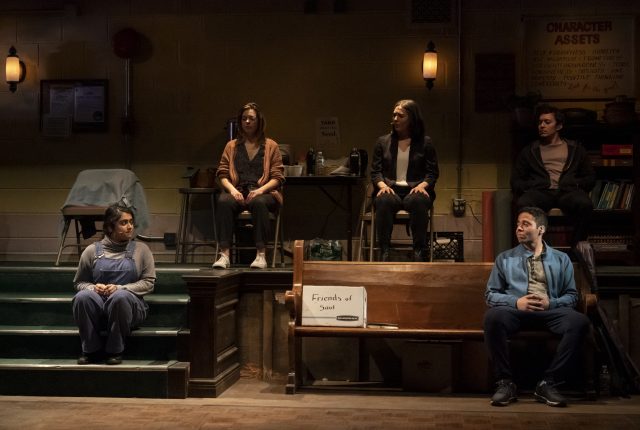
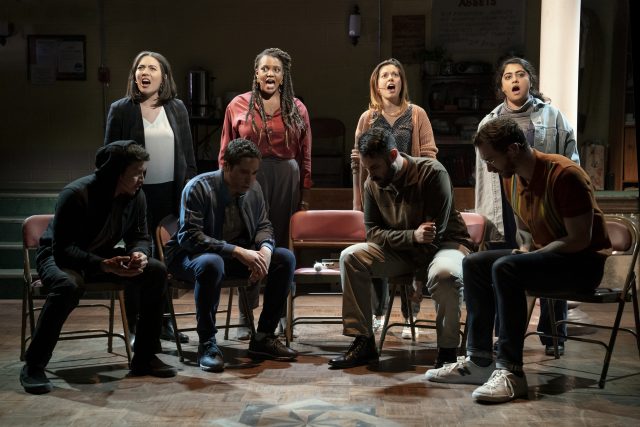
In 2018, Wheelhouse Theater Company staged one of the best plays of the year, a no-holds-barred version of Kurt Vonnegut’s Happy Birthday, Wanda June. The New York City troupe has now delivered one of the best plays of 2019, Aaron Posner’s outrageously funny, irreverent reimagining of Anton Chekhov’s Uncle Vanya titled Life Sucks., which opened last week at the Wild Project, where it continues through April 20. A follow-up to Stupid Fucking Bird, Posner’s “sort of” adaptation of Chekhov’s The Seagull (next Posner will take on Three Sisters, to be called No Sisters), Life Sucks. — the period in the title is intentional, making it a simple and direct statement of fact — is set in the present, with seven characters gathered at a country estate run by the bitter, sardonic, tightly wound Vanya (Jeff Biehl) and his niece, Sonia (Kimberly Chatterjee), a wholly competent and caring young woman with severe self-esteem issues. The pedantic and egotistical elderly Professor (Austin Pendleton) and his much younger wife, the beautiful Ella (Nadia Bowers), have arrived unannounced to relax and share some important news. Also on hand are Babs (Barbara Kingsley), a nonjudgmental, smart, and funny artist; Dr. Aster (Michael Schantz), a tall, sexy, but odd workaholic whom women are drawn to; and the honest-to-a-fault Pickles (Stacey Linnartz), an average Jane and loyal lesbian who takes things rather literally.

(photo by Russ Rowland)

The ubiquitous Austin Pendleton plays the Professor in Aaron Posner’s reimagining of Uncle Vanya (photo by Russ Rowland)

As in Stupid Fucking Bird, the characters interact with the audience throughout. The play opens with the seven men and women lined up at the front of the stage, making announcements about cell phones, exits, and photography and pointing out, “We’re the actors. And you, of course, are the audience.” “Our play transpires in four succinct acts . . . just like Chekhov’s original, superior play,” the Professor explains. “Most of it is going to be about love and longing. Yep. That’s right, campers. LOVE. And LONGING,” Vanya promises. “It’s also about the audacious, ludicrous, and protean nature of the obstreperous and ever-feckless human heart,” the Professor adds. And Dr. Aster expounds, “It’s also about how disastrously, irretrievably fucked up the world is, and the insanity of the choices we humans have made for the last four hundred years.” In addition, the genius work deals with the very nature of theater itself.

(photo by Russ Rowland)

Pickles (Stacey Linnartz) bares her soul in Aaron Posner’s brilliant Life Sucks. (photo by Russ Rowland)

Over the course of two hours and fifteen minutes, various characters admit their unrequited love for others — most crucially, Vanya desperately desires Ella, which increases his hatred of the Professor — and they all share their likes and dislikes and pour out personal monologues that reveal their deepest inner thoughts directly to the audience, sometimes even requesting a response. “How many of you would like to sleep with me if you could?” Ella asks, then waits for an answer. When Vanya wants to speak with the audience, he says to Babs and Sonia, “Can I have the room?” Director and Wheelhouse founder Jeff Wise (DANNYKRISDONNAVERONICA, Happy Birthday, Wanda June) controls the glorious chaos as the barriers between what is real and what isn’t break down in hysterical ways, but it’s key to understand that the characters are always the characters, never the actors portraying them. Brittany Vasta’s set is a cozy living room with a piano, a trio of wall hangings, and a back wall constructed partially from wooden crates that carry theater supplies, with such words as “Uncle Vanya” stenciled on them. The cast is splendid, but it’s Biehl who rules the day, filling the Wild Project with riotous doom and gloom as Vanya, his disappointment with life hovering over the space like a dark cloud.

Chekhov’s play, itself a revised version of his earlier The Wood Demon, lends itself to reinterpretation, from Louis Malle’s film Vanya on 42nd Street and Markus Wessendorf’s Uncle Vanya and Zombies to Sally Burgess’s opera Sonya’s Story, Richard Nelson’s Apple Family–like version for the Hunter Theater Project, and New Saloon’s experimental Minor Character: Six Translations of Uncle Vanya at the Same Time. With Life Sucks., Posner, a longtime director who has also written reverent adaptations of Chaim Potok’s The Chosen and My Name Is Asher Lev, has created a Vanya for the twenty-first century, a brilliant skewering of contemporary values and, in the end, a triumphant celebration of that little thing called life.

BATSHEVA DANCE COMPANY: VENEZUELA

(photo by Stephanie Berger)

Batsheva’s Venezuela offers chills and thrills at BAM (photo by Stephanie Berger)

BAM Howard Gilman Opera House
Peter Jay Sharp Building
230 Lafayette Ave.
March 27-30, 7:30
718-636-4100
www.bam.org
batsheva.co.il/en

Batsheva’s Venezuela is yet another exhilarating must-see work from one of the world’s most adventurous and exciting companies. Running March 27–30 at the Howard Gilman Opera House, the evening-length piece, which doesn’t overtly reference the titular, troubled South American nation in its narrative, consists of two forty-minute sections. In the first part, the Israeli troupe moves as a group, breaks into energetic solos and daring duets, skips around with delight, and lines up at the front of the stage, each dancer stepping forward one at a time as two men rap Biggie’s NSFW “Dead Wrong” (“The weak or the strong / who got it goin’ on / You’re dead wrong”). The women ride the men like donkeys. In a blur, the cast, all dressed in black (the costumes are by dancer Eri Nakamura), briskly skip from one side to the other, some moving forward, some backward, chaos threatening but soon replaced by a childlike wonder. The music primarily consists of Gregorian chants until a growing drone overtakes everything and the lights go out.

(photo by Stephanie Berger)

Batsheva dancers repeat themselves in dazzling ways in Ohad Naharin’s Venezuela at BAM (photo by Stephanie Berger)

The lights come back on and there are different dancers now onstage, and for the next forty minutes they perform the exact same choreography, only to a different soundtrack (including songs by Rage Against the Machine, Olafur Arnalds, and Vox; the lush soundtrack design and edit is by Maxim Waratt) and with different lighting by Avi Yona Bueno (Bambi), offering an enchanting perspective on what choreographer Ohad Naharin showed us in the first half, his Gaga movement language telling a new story. Even the blank cloths that were dropped in the first section now become colorful symbols. The first Batsheva work to come to New York since former company dancer Gili Navot took over as artistic director from Naharin, who is now house choreographer, Venezuela is another triumph from a scintillating company that has been enriching dance and dazzling audiences for decades.

THE BRINK

The Brink

Alison Klayman seeks to reveal the method behind the madness of Stephen Bannon in The Brink

THE BRINK (Alison Klayman, 2019)
IFC Center
323 Sixth Ave. at West Third St.
Opens Friday, March 29
212-924-7771
www.magpicturesinternational.com
www.ifccenter.com

Near the end of Alison Klayman’s illuminating documentary, The Brink, after a lively debate between Steve Bannon and conservative commentator David Frum, former Goldman Sachs president John Thornton tells Bannon backstage, “To people who don’t know you, you’re totally disarming because you’re sort of charming and kind of, you pick up irony and you’re, they’re kind of shocked that you’re such a quote unquote nice guy.” But what about the people who do know him? In the film, which opens today at IFC, Klayman doesn’t humanize the man considered an evil genius as much as demystify the onetime Trump campaign head and Breitbart News founding member, following him from the fall of 2017, as he is ousted from the White House shortly after the Charlottesville incident, through the midterm elections of the following year. She is embedded as part of his otherwise all-male entourage as he travels around the country and the world, building support for his far-right beliefs, pushing his agenda of “economic nationalism” and raising money for his 501 (c) 4, Citizens of the American Republic.

Klayman (Ai Weiwei: Never Sorry, Take Your Pills) is given nearly full access; Bannon only occasionally asks her to leave the room as he meets with such far-right populists as French National Rally Party leaders Jérôme Rivière and Louis Aliot, Belgian People’s Party politician Mischaël Modrikamen and Vlaams Belang Party leader Filip Dewinter, Sweden Democrats member Kent Ekeroth, former UK Independence Party leader Nigel Farage, Italian Minister of Interior Matteo Salvini, Brothers of Italy leader Giorgia Meloni, and other anti-refugee extremists. He sits down with Blackwater founder Erik Prince, visits with Chinese billionaire Miles Kwok, and plans courses of action with Republican strategists, pollsters, and congressional candidates. He particularly enjoys engaging with members of the media who might not necessarily agree with him; he speaks with Devil’s Bargain author and Bloomberg journalist Joshua Green, Fire and Fury writer Michael Wolff, MSNBC’s Ari Melber, and reporters from Politico, the Washington Post, the New York Times, and Der Spiegel.

The Brink

Stephen K. Bannon goes on the road to push his far-right ideology in The Brink

One of the best moments of the film occurs when Guardian journalist Paul Lewis challenges Bannon on issues of globalism and anti-Semitism. Bannon refuses to back down without evincing upset or anger; he relishes controversy, defending himself with a sly smile. He travels to small-town America, showing his documentary Trump @ War at local gatherings, speaking directly to the “deplorables,” exhibiting care and understanding, precisely the kind of thing that Hillary Clinton didn’t do, contributing to her loss of the presidency. The question of Bannon’s sincerity and true purpose hovers in every interaction. Bannon describes his Trump film to Klayman as propaganda, but Klayman then shows us a woman who’s just seen the film praising it because it’s not propaganda. Klayman also captures Bannon raving about the German efficiency that went into building concentration camps, comparing himself to Leni Riefenstahl, supporting Roy Moore’s Senate candidacy, and continually posing for pictures with couples, putting the woman in the center and saying, “a rose between two thorns.”

The Brink was made because producer Marie Therese Guirgis (On Her Shoulders, The Loneliest Planet), the younger sister of writer-director Stephen Adly Guirgis, used to work with Bannon at an independent film distribution company, and she became disturbed by his far-right activity. As he gained power, the left-wing Guirgis would email him, calling him out accusingly, but he would always reply in a civil tone. On her fourth request to make a film about him, he finally relented, agreeing to give Guirgis and Klayman complete control over the project. The two progressive women are not shy about where they stand on the issues and about Bannon’s beliefs; Klayman, who did not have a crew for the shoot — she did the cinematography and the sound and served as coeditor and producer — includes news footage that is not particularly favorable to Bannon, and she does not attempt to humanize him so much as depict him as a driven, determined man who is a master manipulator. The title of the film also reveals their thoughts about Bannon, coming from an Abraham Lincoln quote about being “on the brink of destruction.” When Bannon, who prefers wearing at least two shirts all the time, lets his guard down, as he does on several occasions, he turns into a nasty, self-obsessed figure who makes rash, mean-spirited decisions and is not as pleasant as he likes himself to appear. Of course, it’s impossible to know when Bannon is playing Klayman, using the documentary to further his own ideology. But in taming the beast, Klayman also reveals Bannon’s fascinating methods, something that liberals around the world should study and learn from. Klayman will be at IFC for Q&As with investigative journalist Azmat Khan on March 29 at 7:15 and March 30 at 2:45, with Alissa Wilkinson of VOX on March 30 at 5:00, and on April 1 at 7:15.

TICKET GIVEAWAY: MIRACLE IN RWANDA

miracle in rwanda

MIRACLE IN RWANDA
The Lion Theatre, Theatre Row
410 West 42nd St. between Ninth & Tenth Aves.
April 4 – May 11, $39-$90
212-560-2183
miracleinrwanda.nyc
bfany.org

“This is my story, told as I remember it . . . and I remember it as though it happened yesterday,” Immaculée Ilibagiza writes in Left to Tell: Discovering God Amidst the Rwandan Holocaust, about her experience trying to stay alive during the 1994 Rwandan genocide of the Tutsi people by the Hutu government. Leslie Lewis and Edward Vilga have adapted her harrowing tale into a one-woman show, Miracle in Rwanda, which begins previews April 4 at the Lion Theatre at Theatre Row. Rwandan actress, poet, and activist Malaika Uwamahoro (Measure Back, Our Lady of Kibeho), a Fordham grad, portrays Ilibagiza and two dozen other characters in the play, including a pastor, a machete-wielding murderer, refugees, friends, family members, soldiers, and more. The role was originally played by cocreator Lewis on its world tour.

TICKET GIVEAWAY: Directed by George Drance, Miracle in Rwanda runs April 4 through May 11 (with an April 9 opening) at the Lion Theatre at Theatre Row, and twi-ny has three pairs of tickets to give away for free. Just send your name, phone number, and favorite one-woman show to contest@twi-ny.com by Wednesday, April 3, at 5:00 pm to be eligible. All entrants must be twenty-one years of age or older; three winners will be selected at random.

WORKING WOMAN

Working Woman

Liron Ben Shlush is powerful as a married mother of three reentering the job market and facing sexual harassment in Working Woman

WORKING WOMAN (ISHA OVEDET) (אשה עובדת) (Michal Aviad, 2018)
IFC Center
323 Sixth Ave. at West Third St.
Opens Wednesday, March 27
212-924-7771
zeitgeistfilms.com
www.ifccenter.com

Liron Ben Shlush gives a heart-wrenching performance as a mother reentering the work force in Israeli feminist director Michal Aviad’s second fiction film, Working Woman. Ben Shlush is Orna, who has three young children and gets a job to help support the family while her husband, Ofer (Oshri Cohen), gets his struggling new restaurant off the ground. She takes a position with her former army commander, Benny (Menashe Noy), a high-powered real estate developer. Despite her lack of experience, Orna is an instant success as a savvy salesperson, pushing exclusive new beachfront luxury property. Orna is dismayed when Benny unexpectedly kisses her against her wishes, but when he continues his advances even as she shoves him away, she finds herself in an old, all-too-common situation, forced to decide whether she controls her body or her boss does; since her body is basically a commodity in this society, her decision is financial as well, as it will affect both her career and her family.

Working Woman

Orna (Liron Ben Shlush) has to keep looking over her shoulder, watching out for her predatory boss, Benny (Menashe Noy), in Michal Aviad’s second fiction film

Written before the #MeToo movement began by longtime documentarian Aviad (Jenny & Jenny, Invisible) with Sharon Azulay Eyal and Michal Vinik, Working Woman tells a familiar story but provides unique perspective. Although Orna does nothing to encourage Benny, she begins questioning whether his creepy attraction to her is her fault regardless, that she is not doing enough to keep him away from her. She is surrounded by wealth — Benny is a rich man, living in a large, fancy home with his wife, Sari (Dorit Lev-Ari), and Orna spends her days trying to sell luxury apartments to the one percent, including the Benayouns (Gilles Ben-David and Corinne Hayat), a French couple who might bring a small community with them — but she and Ofer, a proud man who wants no help, were having financial difficulties prior to her job. If she were to quit, her family would suffer, something she will not allow to happen even as she considers the cost. Aviad handles the conflict with a profound sensitivity and deep understanding, providing no easy answers when it comes to sexual harassment. Cinematographer Daniel Miller composes long shots that follow Ben Shlush’s (Next to Her, Road 40 South) yearning, expressive eyes as she searches for a way out, a place where she can be a wife and a mother with a good full-time job. Key scenes feature subtleties that emphasize the power a male boss can hold over a female employee in so many ways that go beyond forcible contact. Working Woman opens at IFC on March 27; Aviad will be at the Greenwich Village theater for Q&As at the 7:45 screenings on March 27 and 30.

VENEZUELA

(photo by Asca)

Batsheva’s Venezuela dances into BAM this week (photo by Asca)

BAM Howard Gilman Opera House
Peter Jay Sharp Building
230 Lafayette Ave.
March 27-30, 7:30
718-636-4100
www.bam.org
batsheva.co.il/en

Superstar Israeli troupe Batsheva Dance Company is back at BAM this week with Ohad Naharin’s Venezuela, running March 27-30 at the Howard Gilman Opera House. The evening-length work consists of two forty-minute sections that mirror each other movement-wise but change the score, which ranges from Gregorian chants to songs by Rage Against the Machine, Olafur Arnalds, the Notorious B.I.G., and Vox. Under Naharin’s leadership, Batsheva has been presenting dance at BAM for many years, including The Last Work, Hora, and Sadeh21; this will be the main troupe’s first visit since former company dancer Gili Navot took over as artistic director, with Naharin remaining as house choreographer to develop new pieces and continue his research into his unique Gaga language. Venezuela, which addresses freedom of choice and has been percolating in Naharin for decades, is performed by Etay Axelroad, Billy Barry, Yael Ben Ezer, Matan Cohen, Ben Green, Chiaki Horita, Chunwoong Kim, Rani Lebzelter, Hugo Marmelada, Eri Nakamura, Nitzan Ressler, Kyle Scheurich, Maayan Sheinfeld, Yoni (Yonatan) Simon, Hani Sirkis, Amalia Smith, Imre van Opstal, and Erez Zohar, with lighting by Avi Yona Bueno (Bambi), soundtrack design and edit by Maxim Waratt, and costumes by Nakamura. On March 29 at 10:30 am at the Mark Morris Dance Center, a Batsheva company member will lead a Gaga and Repertory master class for professionals ($25).

KISS ME, KATE

(photo by Joan Marcus 2019)

Kelli O’Hara and Will Chase star as a divorced couple making a musical version of The Taming of the Shrew in Kiss Me, Kate (photo by Joan Marcus 2019)

Studio 54
254 West 54th St.
Through June 30, $59-$352
212-719-1300
www.roundabouttheatre.org

The #MeToo makeover of golden age Broadway musicals continues with Roundabout’s Kiss Me, Kate, which opened March 14 at Studio 54. In the last year, major or minor changes have been made to My Fair Lady, Carousel, and Oklahoma! in order to deal with their troublesome presentations of sexism, misogyny, domestic violence, and gender inequality. Tony nominee Amanda Green (Hands on a Hardbody, Bring It On), who tweaked Roundabout’s 2015 revival of On the 20th Century, now does the same with Kiss Me, Kate, implementing small fixes that most audience members won’t notice in director Scott Ellis’s exuberant adaptation of one of Cole Porter’s most beloved shows, which in 1949 won the first-ever Tony for Best Musical and in 2000 won for Best Revival of a Musical. The book by Sam and Bella Spewack (Boy Meets Girl, My Favorite Wife), inspired by the real-life relationship of legendary actors Alfred Lunt and Lynn Fontanne during their 1935 revival of William Shakespeare’s The Taming of the Shrew at the Guild Theatre (now known as the August Wilson), also won a 1949 Tony.

The tale is set in the summer of 1948, as a company prepares for opening night of a musical version of Shrew at Baltimore’s Ford Theatre, hoping for an eventual Broadway run. The show is produced and directed by Fred Graham (Will Chase), who also plays Petruchio, opposite his ex-wife, movie star Lilli Vanessi (Kelli O’Hara), who is returning to the stage as Katharine (Kate), the character who supposedly needs taming. The backstage shenanigans mimic Shakespeare’s plot with an extra dollop of Hollywood screwball comedy as Petruchio woos Kate for her father’s (Mel Johnson Jr., who also plays stage manager Harry Trevor) money despite her resistance, for she wants no part of any man, while Fred and Lilli become enmeshed in a battle of the sexes over fame, fortune, and love. Fred is fooling around with the sweet but not-so-innocent ingénue Lois Lane (Stephanie Styles), who is dating Bill Calhoun (Corbin Bleu), a cad with a $10,000 gambling debt he has surreptitiously signed over to Fred. In the musical within the musical, Lois is Bianca, Kate’s younger sister, who has a trio of suitors, Gremio (Will Burton), Hortensio (Rick Faugno), and Lucentio, the last played by Bill. Lilli has just gotten engaged to General Harrison Howell (Terence Archie), a rigid military man who is not as devoted to his fiancée as he is to his country or other women. Meanwhile, Fred is being closely watched by two gangsters (John Pankow and Lance Coadie Williams) who are sticking around to collect their boss’s ten grand and who even take roles in the show to make sure Fred doesn’t go anywhere.

(photo by Joan Marcus 2019)

“Too Darn Hot” is a highlight of Roundabout revival of Kiss Me, Kate (photo by Joan Marcus 2019)

Ellis’s revival takes a while to get going, building too slowly. It isn’t until the second act opener, the sizzling “Too Darn Hot,” led by James T. Lane as Paul, Fred’s assistant, that the show starts hitting its mark. The chemistry between Tony nominee Chase (The Mystery of Edwin Drood, Nashville) and Tony winner O’Hara (The King and I, South Pacific) is just not there at the beginning; Fred is too unsympathetic, and Lilli is not shrewish enough, especially as compared to Petruchio and Kate. You just don’t want them to fall back in love. In her Broadway debut, Styles (Kingdom Come, Roman Holiday) is a delight as Lois/Bianca, and Pankow (Twelve Angry Men, The Iceman Cometh) and Williams (Sweat, Bootycandy) have fun as the gangsters, although “Brush Up Your Shakespeare” goes on too long. Paul Gemignani’s orchestrations of such Porter tunes as “Another Op’nin’, Another Show,” “Wunderbar,” “Why Can’t You Behave,” and “Where Is the Life That Late I Led?,” performed by a band positioned in the audience boxes on either side of the stage, go from syrupy to extravagant, with O’Hara cutting it loose with her operatic voice and making Lilli’s point exceedingly clear in “I Hate Men” (“I hate men. / Though roosters they, I will not play the hen. / If you espouse an older man through girlish optimism, / He’ll always stay at home at night and make no criticism, / Though you may call it love the doctors called it / Rheumatism. / Oh, I hate men.”).

The choreography by Tony winner Warren Carlyle (After Midnight; Hello, Dolly!) is highlighted by “Too Darn Hot,” which includes tap and lots of heat, and “Tom, Dick or Harry,” as Gremio, Hortensio, and Lucentio make their case to Bianca through dazzling moves. David Rockwell’s sets change to a choreography all their own. But even as Lilli strikes back at Fred, literally and figuratively, her ultimate choice does not feel as liberating as one might wish. “Come, come you wasp; i’ faith, you are too angry,” Petruchio tells Kate, who replies, “If I be waspish, best beware my sting.” Eight-time Tony nominee Ellis’s (Curtains, 1776) Shrew lacks the necessary sting, but it does have bite.