Mary Elizabeth Winstead and Colin Woodell star in two-actor, three-character play at Second Stage (photo by Joan Marcus)
2econd Stage Theater
Tony Kiser Theater
305 West 43rd St. between Eighth & Ninth Aves.
Through June 30, $30-$125
2st.com/shows
With President Trump threatening to attack Iran and Congress fighting over whether to fully fund ailing 9/11 first responders, Christopher Shinn’s 2007 Pulitzer Prize finalist, Dying City, takes on added relevance in its intense Second Stage revival at the Tony Kiser Theater, where it runs through June 30. The two-actor, three-character play shuttles between July 2005 and January 2004 as Gold Star wife Kelly (Mary Elizabeth Winstead) examines her relationship with her husband, Craig (Colin Woodell), upon the sudden arrival of Craig’s twin brother, Peter (Woodell), late one night at her Manhattan apartment. It’s been nearly a year since Craig was killed in the Iraq war, and Peter, an actor on the rise, needs to connect with Craig’s widow, Kelly, a therapist who has not been returning his calls or emails.

Mary Elizabeth Winstead makes a strong theater debut as a Gold Wife widow in Christopher Shinn’s Dying City (photo by Joan Marcus)
“It’s — yeah, it’s. — I’ve been meaning to call you and — it’s — I just haven’t. I’ve been so busy,” Kelly stumbles, offering excuses. “I wanted to make sure I had the, that I had enough — energy, mental space, before I called.” Kelly seems to want to put everything behind her and get on with her life, but Peter, who is starring in a New York City production of Eugene O’Neill’s Long Day’s Journey into Night — a prime example of family dysfunction — insists on dredging up the past, insinuating that something may be wrong with the story of Craig’s death. Peter is also facing problems with his boyfriend, Tim.
Meanwhile, in 2004, it’s Craig’s last night at home before heading to Fort Benning in the morning, and Kelly is not having the touching goodbye she expected as he criticizes Peter’s choice of movies and lovers and how she is handling one of her patients, a man who claims to be a fierce animal in bed. “You’re so passive,” Craig tells Kelly. “This always happens when we talk seriously about my work,” she responds. “We don’t talk seriously about your work,” he replies. “Exactly,” she shoots back. As that final night gets rehashed, Kelly, Peter, and Craig enter some harsh territory.
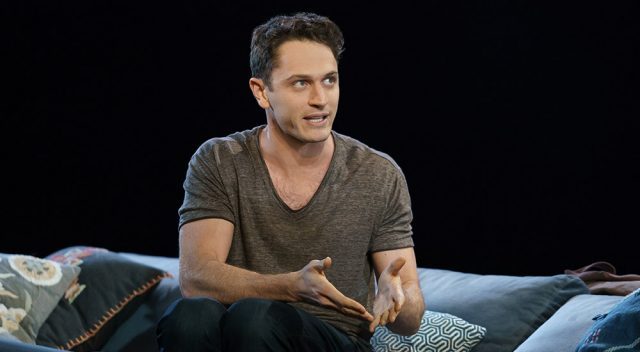
Colin Woodell plays very different identical twin brothers in Dying City revival (photo by Joan Marcus)
Obie winner Shinn (Where Do We Live, Now or Later), who also directed this version, has said that he structured Dying City like a trauma; in many ways, it feels like Kelly and Peter are suffering through their own forms of PTSD over what happened to Craig and how that has impacted their lives. Dane Lafrey’s comfortable, uncluttered apartment-house set — a sharp contrast to the characters’ inner turmoil — consists of an L-shaped couch at the center, with an unseen kitchen off stage left, a hallway in the back that leads to the bedroom, and a television in the front corner, often tuned to The Daily Show with Jon Stewart. The barefoot Winstead wears the same clothing throughout the ninety-minute play, while Woodell makes slight changes as he morphs from Craig to Peter and back again, usually walking out of view as one character and then returning as another, darkness and a flash of light accompanying the shifting scenes. (The costumes are by Kaye Voyce, with lighting by Tyler Micoleau.)
Winstead (Fargo, All About Nina) is terrific in her stage debut, embodying Kelly’s extreme unease at having to speak with Peter and look at the past, while Woodell (Unsane, Masters of Sex), who did in fact recently appear in a revival of Long Day’s Journey into Night (in LA), excels at keeping his portrayals of the twin brothers separate, the needy Peter insecure and sensitive, the brash Craig more concerned with his manhood. Dying City is a breadcrumb play; the plot and its many intricacies — among the topics that get covered are sexual assault, the military, political leanings, guns, homosexuality, the theater, lies, violence, love, and war — unfold slowly in bits of dialogue that require close concentration. However, following the crumbs does not lead to a fairy-tale ending but to a devastating finale.

 In conjunction with the fiftieth anniversary of the Stonewall riot, the Museum of the Moving Image is presenting “Grit and Glitter: Before and After Stonewall,” a thirteen-film series guest curated by Donal Mosher and Michael Palmieri (October Country, Peace in the Valley) consisting of queer-cinema works that have inspired them. The seventeen-day festival began with such films as Jack Smith’s Flaming Creatures, Tony Richardson’s A Taste of Honey, and Pier Paolo Pasolini’s Teorema and continues June 28 with one of John Waters’s craziest early works, when the King of Bad Taste, serving as writer, director, producer, cinematographer, and editor, was only twenty-three. The extremely low budget romp Multiple Maniacs begins with barker Mr. David (David Lochary) inviting people into Lady Divine’s Cavalcade of Perversions, proclaiming, “This is the show you want. . . . the sleaziest show on earth. Not actors, not paid imposters, but real, actual filth who have been carefully screened in order to present to you the most flagrant violation of natural law known to man.” Of course, that is an ideal introduction to the cinematic world of Waters, one dominated by the celebration of sexual proclivities, fetish, salaciousness, indecency, violence, and marginalized weirdos living on the fringes of society. Lady Divine, played by Divine, turns out to be a cheat, the freak show just a set-up for a robbery. Soon Divine is jealous of David’s relationship with Bonnie (Mary Vivian Pearce), hanging out with her topless daughter, Cookie (Cookie Mueller), and being led into a church by the Infant of Prague (Michael Renner Jr.), where she’s brought to sexual ecstasy by Mink (Mink Stole). There’s also rape, murder, Jesus (George Figgs), the Virgin Mary (Edith Massey), and the famed Lobstura. Shot in lurid black-and-white, Multiple Maniacs is a divine freak show all its own, an underground classic that redefined just what a movie could be, a crude, disturbing tale that you can’t turn away from.
 “Grit and Glitter: Before and After Stonewall” takes quite a turn from Multiple Maniacs with Thai director Apichatpong Weerasethakul’s Tropical Malady, a beautiful, mystical work that won the Jury Prize at Cannes and will thoroughly engage you — if you allow it to. Part tender love story between a country boy (Banlop Lomnoi) and a soldier (Dakda Kaewbuadee), part folktale set in the deep forests of Thailand, Tropical Malady is like a visual poem in which details are not as important as the overall effect, which is intoxicating. The unorthodox film features ghosts, a shape-shifter, unusual characters, and a playful sense of humor that come together to form a subtle meditation on life and love. Weerasethakul once again displays the gentle, captivating narrative technique that lies at the heart of his oeuvre, which also includes such works as Blissfully Yours, Syndromes and a Century, and 2010 Palme d’Or winner