Harlem Week kicks off July 28 with the annual celebration “A Great Day in Harlem”
U.S. Grant National Memorial Park
Wes 122nd St. & Riverside Dr.
Sunday, July 28, free, 12 noon – 8:30 pm
Festival runs July 28 – August 31 harlemweek.com
Tens of thousands of people are expected to converge in U.S. Grant National Memorial Park on July 28 for the beloved Great Day in Harlem festival, part of the forty-fifth annual summer Harlem Week celebration. This year’s theme is “Our Local History Creates a Global Impact,” focusing on Harlem’s cultural influence around the world, while the music theme is Bill Withers’s classic “Lovely Day.” A Great Day in Harlem will feature an International Vendors Village from 12 noon to 8:00, the Artz, Rootz, and Rhythm International Cultural Showcase at 1:00, the Regional Gospel Caravan at 3:00 with Bishop Hezekiah Walker, the McDonald’s Gospel Super Choir, Kirk Franklin, and a tribute to Dr. Bobby Jones, a Fashion Fusion Showcase at 4:30 honoring the Black Fashion Museum, and “A Concert under the Stars” at 6:00 with Nicole Bus, Harlem Week music director Ray Chew, and more paying tribute to Spike Lee and the thirtieth anniversary of Do the Right Thing and Robert “Kool” Bell of Kool & the Gang in honor of the group’s fiftieth anniversary. Harlem Week continues through August 31 with such other events as the Youth S.T.E.A.M. Hackathon on August 1, New York City Economic Development Day on August 8, Summer in the City on August 17, Harlem Day on August 18, and Harlem Restaurant Week beginning August 19.
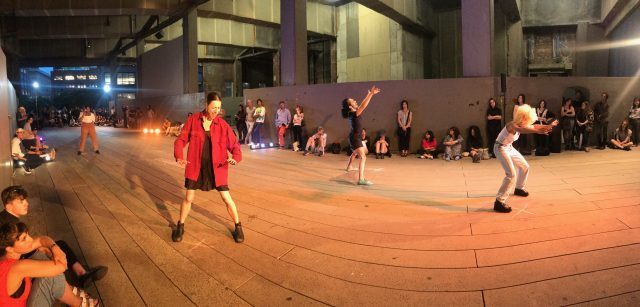
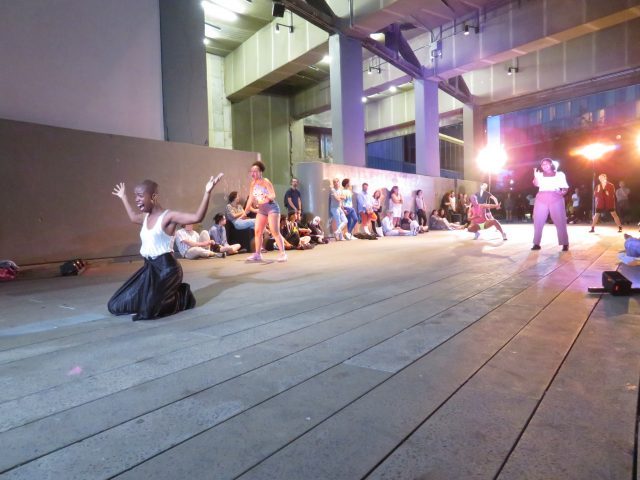
Dancer and choreographer Ligia Lewis takes her Sensation series outside with the captivating Sensation 1 / This Interior, continuing in the High Line’s Fourteenth Street Passage through July 25. The free show is set in one half of the divided passageway under a building, protecting it from potential rain, and the audience gathers at either of the two ends or lines up against the long, horizontal walls. Over the course of sixty minutes, Trinity Bobo, Emma Cohen, Rebecca Gual, Miguel Ángel Guzmán, Stephanie Peña, and Jumatatu M. Poe slowly walk into the space one at a time, moving extremely slowly as they head to spots marked on the ground by a pink “X.” When they reach their destination, they stay there for an extended period of time, their feet firmly planted on the ground as their bodies convulse, their hands reach out, and their faces contort into silent screams, set to an electronic score by Twin Shadow (aka George Lewis Jr., Lygia’s brother) that begins as noise, then incorporates words and phrases before transforming into a song.
Dancers reach out in Sensation 1 / This Interior in the High Line’s Fourteenth Street Passage (photo by twi-ny/mdr)
To best experience the powerful performance — admission is free with advance RSVP — attendees are strongly encouraged to walk throughout the area, weaving around the dancers and making direct eye contact; it is like a sculpture garden where the statues have come to life, moving in agonizing, yearning ways. (Of course, the High Line is itself a sculpture garden, its 1.4-mile length filled with changing site-specific artworks.) Very few audience members, however, took advantage of that opportunity on opening night; after the show, I spoke with several of the dancers, who said they want the people to walk around them in the shared space, to become part of what is happening together. The Dominican-born, Berlin-based Lewis, who has recently completed a trilogy consisting of Sorrow Swag (2014), minor matter (2016), and Water Will (in Melody) (2018), rightfully calls this outdoor piece Interior, as it delves deep into what’s inside all of us, and needs to get out.
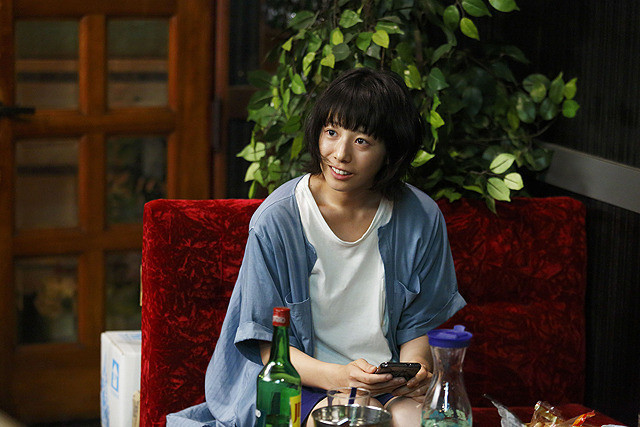
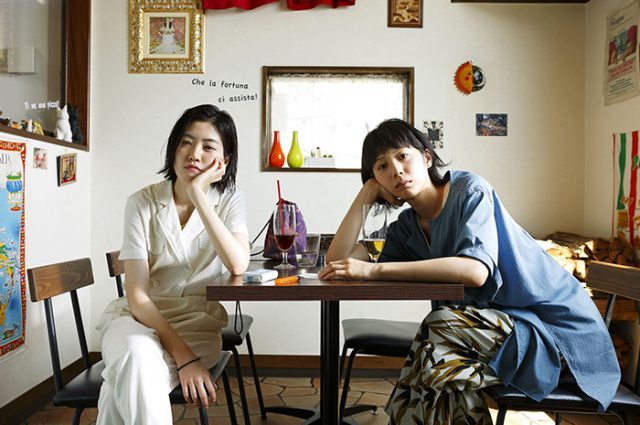
Kiyoura (Shim Eun-Kyung) and Sunada (Kaho) wonder what’s next in Yuko Hakota’s Blue Hour
FESTIVAL OF NEW JAPANESE FILM: BLUE HOUR (BURU AWA NI BUTTOBASU) (ブルーアワーにぶっ飛ばす) (Yuko Hakota, 2019)
Japan Society
333 East 47th St. at First Ave.
Sunday, July 28, 8:00
Festival runs July 19-28
212-715-1258 www.japansociety.org
The Japan Cuts festival at Japan Society concludes July 28 with the North American premiere of Yuko Hakota’s beautiful, wistful Blue Hour. The movie is named after one of the two magic times of day, particularly for filmmakers: The golden hour occurs right after sunrise and before sunset, when the sky turns a warm, golden color, while the blue hour takes place right before sunrise and after sunset, when a colder, deep blue permeates. In the film, Kaho stars as Sunada, a television commercial director with a habit of making poor decisions in her life and career. She’s just turned thirty and wants to do more than produce ads but does not appear to be driven enough. She is married to a kindhearted man-child (Daichi Watanabe) but is having an affair with the married Togashi (Yusuke Santamaria). At a party, she drinks to excess, embarrassing herself in front of her crew. And she hasn’t been home to visit her family in several years. She seemingly could have it all, but she lacks ambition and often seems chilly and aloof to others. “I don’t like people who like me,” she says at one point. Later, she admits, “I don’t know what it’s like to be close.”
Sunada (Kaho) has trouble finding happiness in Blue Hour
When Sunada mentions to one of her only friends, the impulsive, unemployed, and very charming Kiyoura (Shim Eun-Kyung), that she is getting ready to go home to see her grandmother, Kiyo proclaims that she will drive them there right away, so they get into her car and away they go. We learn a lot about the two women on the road trip — although this is no Thelma and Louise — but even more when they arrive at Sunada’s family’s small farm in the boondocks, where her oddball brother, Sumio (Daisuke Kuroda), lives with their sweet mother (Kaho Minami) and eclectic father (Denden). Sunada looks like she would rather be anywhere else. As Sunada refuses to relate to her significantly un-Ozu-like clan, Kiyo fits right in, always seeking fun in whatever she does, the polar opposite of her friend.
Lovingly photographed in soft hues by Ryuto Kondo, Hakota’s debut is a moving and poignant tale of a woman who has, sadly, apparently given up too soon; she’s an unusual protagonist in that just as she says that she doesn’t like people who like her, she herself is difficult to like. It’s hard not to see her as emblematic of Japan’s current troubled younger generation, one noted for its failure to socialize, date, marry, get a job, or even leave the house. Former teen model Kaho (A Gentle Breeze in the Village,Our Little Sister) wonderfully captures the character’s ennui, while award-winning South Korean actress and former child star Shim (Happy Killers, Miss Granny) is radiant as the ever-positive Kiyo, who is in love with life no matter where it takes her. Blue Hour is a small gem, quirky and insightful, delicate and alluring. The screening will be followed by a Q&A with Hakota, Kaho, and Shim. Among the other films playing at Japan Cuts are Mitsuaki Iwago’s The Island of Cats, Hiroshi Okuyama’s Jesus, and Makoto Sasaki’s Night Cruising in addition to the free panel discussion “The Current State of Film Restoration in Japan” on July 26 at 4:30, which will examine the industry itself and the restoration of Kenji Mizoguchi’s masterpiece Ugetsu.
With MoMA’s main digs in Midtown under renovation, the second summer PopRally is going across the river to Staten Island on July 27. Partnering with Rooftop Films, MoMA is holding the festivities at one of the city’s genuine treasures, Snug Harbor Cultural Center & Botanical Garden, for food, drink, music, film, and more. The main event is a 9:00 screening of Ron Howard’s classic 1984 comedy, Splash, starring Tom Hanks as Allen Bauer, a single guy who falls in love with a mermaid (Daryl Hannah) who is being tracked by a scientist (Eugene Levy); John Candy is Hanks’s crazy brother. The evening will also include giveaways, trivia contests, music from DJ Tom of Maker Park Radio and the Gotham Easy Brass Band, beverages from Five Boroughs Brewing Co., and food from Staten Island vendors Ho’ Brah Tacos and Egger’s Ice Cream Parlor. Free shuttle bus service will be provided between Snug Harbor and the Staten Island Ferry terminal before and after the screening. Attendees are encouraged but not required to show up in aquatic costumes; you can bring a blanket (limited chairs will be available) that you can spread out on the South Meadow. Go early and check out the lovely Snug Harbor itself; admission is only five dollars and it’s open till five. PopRally will be traveling to the Bronx next.
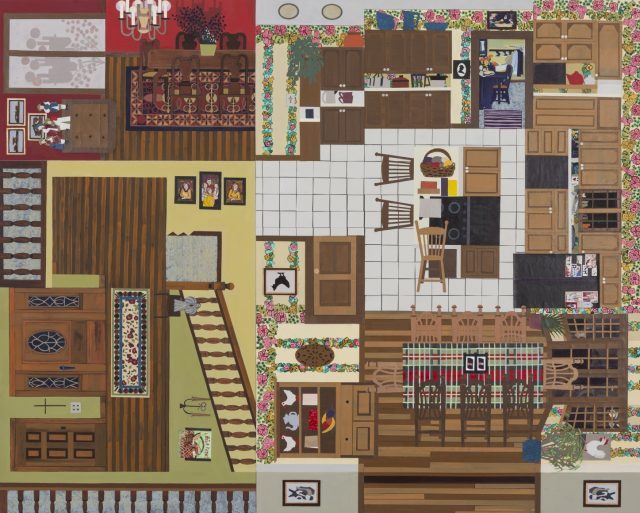
Ann Toebbe, Friend: Jana, gouache, paper collage and pencil on panel, 2018
Tibor de Nagy
11 Rivington St.
Tuesday – Saturday through July 27, 10:00 am – 6:00 pm
212-262-5050 www.tibordenagy.com
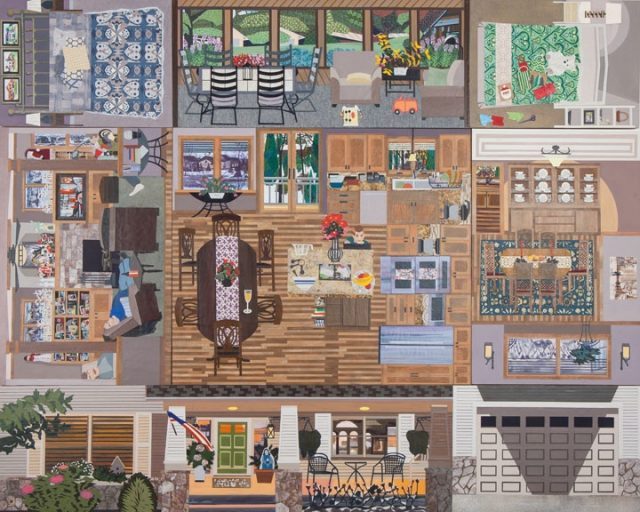
At first glance, you might think that Ann Toebbe’s “Friends and Rentals” exhibit at Tibor de Nagy on the Lower East Side consists of flat architectural renderings of real home layouts. But up close you’ll see they’re delightfully detailed three-dimensional collages of the interiors of houses, it turns out, owned by Toebbe’s friends and members of her extended family in Ohio and Kentucky. The Cincinnati-born, Chicago-based artist creates the works based on social media postings and actual visits to these houses, but she uses only her memory, not photographs or on-site sketches. Toebbe incorporates flocking, cut paper, yarn, glitter, pencil, gouache, and other materials on panels in constructing these birds’-eye views that serve as unique biographical portraits even though most of them contain no people in them. The rooms are divided to resemble how a brain is compartmentalized into different thought processes and, in these crazy days, how so many of us must multitask, but the works have a calming effect, not a frantic pace. Friend: Jana features a muted brown palette, while Friends: Lisa and Tim is much more colorful, and the only one seen from a horizontal perspective of the standing house. Not surprisingly, LA Air BnB is more standard and folksy than Friend: Becky, which includes children’s toys and a flatscreen TV showing a football game.
Ann Toebbe, Friend: Susan, gouache, paper collage, flocking and pencil on panel, 2019
You’ll find family photos, religious icons, the American flag, carpets, knickknacks, backyards, Christmas decorations, pets, plants, clocks, birthday presents, and a few lurking human figures, all helping describe people that we are likely never to meet but now somehow know. In the catalog essay “Ann Toebbe Wants to Organize Your Life,” Ryan Steadman writes that Toebbe “empathically [relates] to her subjects’ desire to reinvent themselves in their living spaces by making paintings that are themselves appealing coping strategies. . . . with a fortitude that usually belongs to a librarian or a paleontologist.” Each work is not to scale and is not architecturally sound, as Toebbe, who counts Venezuelan artist Arturo Herrera as her mentor, puts a little fantasy into each life. As you walk around the gallery, you’ll wonder what your home might look like if Toebbe re-created it on panel, but you’ll only be able to imagine it, or perhaps go home and reorganize your own clutter.
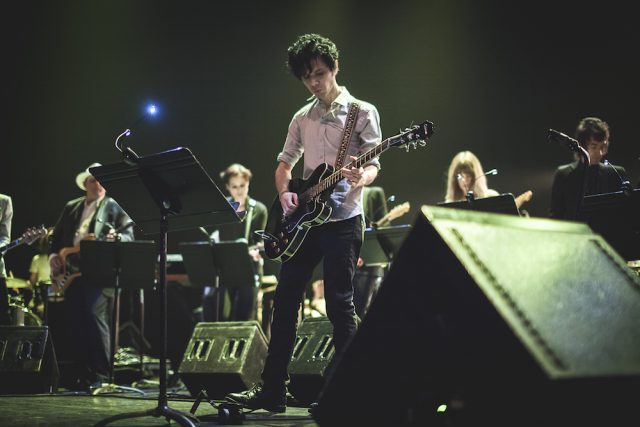
Nick Zinner will lead a large, handpicked ensemble to perform “41 Strings” at Rockefeller Center on July 27 (photo by Jason Williamson)
Who:Nick Zinner and an all-star group of musicians What:“41 Strings” Where:Rockefeller Center plaza, between 49th & 50th Sts. and Fifth & Sixth Aves. When: Saturday, July 27, free, 6:00 Why: On July 27, Yeah Yeah Yeahs guitarist Nick Zinner will perform his symphonic composition “41 Strings” in Rockefeller Plaza. A celebration of the four seasons, the four-part, twenty-eight-minute work, cowritten with creative producer Berrin Noorata, debuted in 2011 for the forty-first anniversary of Earth Day. At Rockefeller Center, Zinner, an adventurous musician and photographer who has collaborated on several artistic projects, will be joined by guitarists Paul Banks of Interpol, Lenny Kaye of the Patti Smith Band, Sarah Lipstate of Noveller, Aku Orraca-Tetteh of Florence and the Machine, Ava Mendoza of Unnatural Ways, Angel Deradoorian, and Andrew Wyatt, in addition to synth players Nancy Whang of LCD Soundsystem and Ben Vida of Soft Circle, drummers Brian Chase of Yeah Yeah Yeahs, Ryan Sawyer of Gang Gang Dance, and Hisham Bharoocha of Soft Circle and Black Dice, bassists Jaleel Bunton of TV on the Radio and Andy Macleod, and a thirty-five piece string ensemble with arrangements by Gillian Rivers. The free concert will begin at 6:00 with “IIII” by Bharoocha, Chase, Sawyer, Vida, and student drummers. You can get a taste of what’s to come in this Creators Project video from 2011.
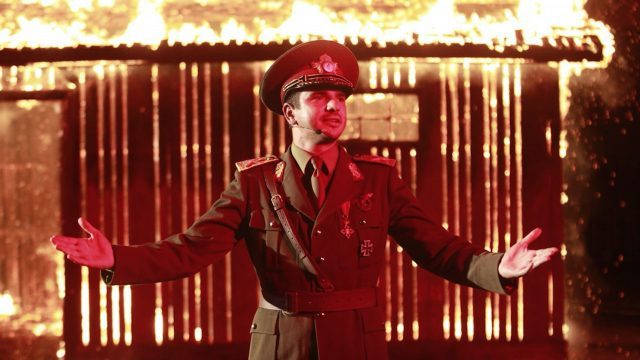
How the 1941 Odessa massacre has been remembered is the central focus of Radu Jude’s “I Do Not Care If We Go Down in History as Barbarians”
“I DO NOT CARE IF WE GO DOWN IN HISTORY AS BARBARIANS” (ÎMI ESTE INDIFERENT DACĂ ÎN ISTORIE VOM INTRA CA BARBARI) (Radu Jude, 2018)
IFC Center
323 Sixth Ave. at West Third St.
Opens Friday, July 19
212-924-7771 www.ifccenter.com bigworldpictures.org
Romanian writer-director Radu Jude follows up his 2017 documentary, The Dead Nation, with “I Do Not Care If We Go Down in History as Barbarians,” a bold, provocative fiction film with nonfiction elements that explores continuing anti-Semitism and bigotry in Romania, Eastern Europe, and the world. The title is taken from a statement made by Romanian military dictator Marshal Ion Antonescu to the Council of Ministers in the summer of 1941, just a few months before the Odessa massacre in which tens of thousands of Jews were killed by Romanian troops. The film is set in contemporary times, as theater director Mariana Marin (Ioana Iacob) is preparing for a live, one-time-only massacre reenactment in the town square. Marin is determined to show what really happened during those days, complete with brutal murders and hangings, but Constantin Movilă (theater director Alexandru Dabija), her connection with the local government, insists that she leave out the gruesome parts, that the show should be a celebration of Romanian heroes. She argues that it would not be fair to the nearly four hundred thousand Jews that were ethnically cleansed by the Romanian military, but he quibbles over what’s true and what the community wants to see. As the show approaches, Movilă threatens to cancel it while numerous actors complain about the negative aspects being depicted, displaying affection for “Uncle Hitler” and a lack of empathy for the exterminated Jews.
“I Do Not Care If We Go Down in History as Barbarians” is like a post-Nouvelle Vague film, echoing elements of French cinema from Jean-Luc Godard and Jacques Rivette to Olivier Assayas and Arnaud Desplechin, with debates of texts by Isaac Babel, Ludwig Wittgenstein, Joseph Goebbels, Nicolae Steinhardt, and others. But instead of becoming pedantic, the discussions serve to enlighten the arguments and define such characters as Movilă and, in particular, Marin, who not accidentally shares the same name with a Romanian poet who wrote, “Serene and bitter, I hurry across my native land / As if tomorrow had already been.” The entire film is seen from Marin’s determined point of view, whether she’s reading in bed with her lover, Ștefan (Șerban Pavlu), getting support from her lead actor, Traian (Alex Bogdan), and right-hand assistant, Oltea (Ilinca Manolache), or smoking and drinking in a bubbles-free bath. She’s mad at the state of the world and disgusted that people don’t want to know the truth of their history; she’s like the tank she insists she must have for the production — and like the tank, which has to stand still, Marin refuses to budge, understanding the difference between compromise and censorship.
In her first leading role, Iacob is mesmerizing throughout the film’s 140 minutes, giving a tour-de-force performance that lays it all out there as she portrays a bold and brash woman who won’t back down from her personal and professional desires; she’s so immersed in the part that at times you’ll think you’re watching a documentary, enhanced by cinematographer Marius Panduru’s wandering, unpredictable camera. Jude (Scarred Hearts,Aferim!) tackles such critical issues as governmental whitewashing of history, the public’s selective memory, and the definition of patriotism itself, a debate raging across America under the current administration as well as in other nations. Whether Marin gets to stage the show or not ends up being besides the point as the people around her reveal their biases and hatreds, something a play is not about to change. “I Do Not Care If We Go Down in History as Barbarians” is a necessary film, but it’s also a frightening one.

 The Japan Cuts festival at Japan Society concludes July 28 with the North American premiere of Yuko Hakota’s beautiful, wistful Blue Hour. The movie is named after one of the two magic times of day, particularly for filmmakers: The golden hour occurs right after sunrise and before sunset, when the sky turns a warm, golden color, while the blue hour takes place right before sunrise and after sunset, when a colder, deep blue permeates. In the film, Kaho stars as Sunada, a television commercial director with a habit of making poor decisions in her life and career. She’s just turned thirty and wants to do more than produce ads but does not appear to be driven enough. She is married to a kindhearted man-child (Daichi Watanabe) but is having an affair with the married Togashi (Yusuke Santamaria). At a party, she drinks to excess, embarrassing herself in front of her crew. And she hasn’t been home to visit her family in several years. She seemingly could have it all, but she lacks ambition and often seems chilly and aloof to others. “I don’t like people who like me,” she says at one point. Later, she admits, “I don’t know what it’s like to be close.”