twi-ny recommended events

KNOWLEDGE OF WOUNDS

(photo by S.J Norman, Cicatrix I, 2019)

S.J Norman’s Cicatrix I is the symbol for “Knowledge of Wounds” weekend festival

Performance Space New York
150 First Ave. at Ninth St.
January 11-12, day pass $35, weekend pass $55
performancespacenewyork.org

The second annual “Knowledge of Wounds,” celebrating indigenous cultures through readings, discussions, performances, and ritual gatherings, takes place January 11-12 at Performance Space New York in the East Village. Organized by S. J Norman (Koori, Wiradjuri descent) and Joseph M. Pierce (Cherokee Nation), the event explores ideas of threshold spaces, displacement, settler colonialism, borders, and community. Below is the full schedule; tickets are $35 for one day and $55 for both days.

Saturday, January 11
Morning physical session with devynn emory and Joshua.P, noon

Opening Blessing & Group Prayers with the Fire, 1:00

Kinstillatory Action, with Emily Johnson, 2:30

Bodies in Resistance, 4:00

Active rest with devynn emory and Joshua.P, 5:30

Story time with Joe Cross and Donna Couteau, 6:00

Shadow Songs and Root Mirrors, with Laura Ortman, Demian DinéYazhi’ and Kevin Holden, and Elisa Harkins, 8:30

Ixkin: Kaxb’ichil, Xamal, Ootzaqib’al / ThreeStones: Wound, Fire, Knowledge — Tohil Fidel Brito, in collaboration with María Regina Firmino-Castillo and with the participation of Amaru Márquez Ambía, 10:30

Sunday, January 12
Morning physical session with devynn emory and Joshua.P, noon

Opening blessing and fire ritual blessing with Javier Stell-Frésquez, 1:00

Making Love to the Land, 2:30

La utopía de la mariposa, María Regina Firmino-Castillo, 4:30

Ancestral Skin, with Holly Mitiquq Nordlum, 6:00

Sustenance with Chef Quentin Glabus of I-Collective, 8:00

Night offering and fire ritual with devynn emory and Joshua.P, 9:30

THE WOMAN WHO LOVES GIRAFFES

Giraffes

Anne Innis Dagg returns to where it all started in The Woman Who Loves Giraffes

THE WOMAN WHO LOVES GIRAFFES (Alison Reid, 2019)
Quad Cinema
34 West 13th St. between Fifth & Sixth Aves.
Opens Friday, January 10
212-255-2243
quadcinema.com

Before Jane Goodall went to Tanzania to study chimpanzees and Dian Fossey headed to Rwanda to study mountain gorillas, Canadian biologist Anne Innis Dagg was in South Africa, studying giraffes. Her delightful yet infuriating story is told in Alison Reid’s The Woman Who Loves Giraffes, which opens January 10 at the Quad, where the eighty-six-year-old Dagg will participate in Q&As with Reid at six screenings on Friday and Saturday. Dagg fell in love with giraffes when she was three and first saw them at the Brookfield Zoo in Chicago. In 1956, when she was twenty-three, she set off for the Fleur de Lys ranch near Kruger National Park. That trip was quite a victory, based on a bit of subterfuge; in her application to manager Alexander Matthew, she didn’t identify herself as female because she had been previously rejected by many other locations that claimed that “Africa is no place for a young woman.”

She spent a year taking meticulous notes on the social and sexual behavior of giraffes, essentially making up her methods as she went. “No one had ever really studied an African animal in the wild, or pretty well any animal in the wild,” she says in the film. “So I was sort of breaking ground without realizing it.” But when she returned to Toronto, Dagg, the daughter of a university professor father and an economic historian mother, both of whom were widely published writers, was met with a frightening amount of misogyny in the scientific and education communities; she failed to get tenure or other prominent teaching positions, which led her to become a feminist activist in the 1970s. “She ran into the old boys’ network and I think it destroyed her career,” says former University of Guelph professor Sandy Middleton, the only member of the tenure committee that supported Dagg. All these years later, the head of the committee, former dean Keith Ronald, still adamantly defends his decision against Dagg.

It wasn’t until 2010 that Dagg, who uses “giraffe” as both a singular and a plural, reentered the giraffe fold, mainly because of women such as San Francisco Zoo curator Amy Phelps, who says, “I was the little girl that that woman was a hero for, and so it was really important to me that we be able to find her. . . . We were searching for Anne because we really didn’t know if she was alive.” Reid follows Dagg as she is celebrated at the Giraffe Care Conference in Arizona, then goes back to Africa for the first time since the mid-1950s to attend a Giraffe Indaba near Fleur de Lys, bringing her daughter, Mary, with her. Reid and editors Mike Munn and Caroline Christie heartwarmingly intercut footage Dagg took in 1956, photographs and 16mm film, with new scenes of her in the same exact places. Reid also includes narration of Dagg’s extensive letters and writings — she’s written more than twenty books, most importantly The Giraffe: Its Biology, Behavior, and Ecology, considered the bible on the subject — with the voices of Tatiana Maslany as Dagg, Victor Garber as Matthew, David Chinchilla as Anne’s husband, Ian, and Lindsay Leese as Dagg’s mother, Mary Quayle Innis.

The previously little-known Dagg — who in 1965 stumped the To Tell the Truth panel, a clip of which begins the documentary — revels in her newfound semicelebrity and has delved right back into her research. “I always wanted to be a scientist,” she says. The documentary has an inconsistent pace and treacly music, but it’s a thrill watching Dagg look back at her past as she heads into the future; it’s also hard not to think about what could have been had she not been thwarted time and time again because of her gender.

UNDER THE RADAR: THE UNKNOWN DANCER IN THE NEIGHBORHOOD

(photo by Ryuichiro Suzuki)

Dancer-choreographer Wataru Kitao stars in one-man multimedia show at Japan Society (photo by Ryuichiro Suzuki)

Japan Society
333 East 47th St. at First Ave.
January 10-14, $35
212-715-1258
Festival continues through January 19
www.japansociety.org
www.hanchuyuei2017.com

Writer-director Suguru Yamamoto returns to Japan Society after the success of his Hanchu-Yuei collective’s 2017 production of Girl X with The Unknown Dancer in the Neighborhood, a one-man dance-theater piece featuring dancer-choreographer Wataru Kitao. In the ninety-minute show, which is running January 10-14 as part of the Public Theater’s Under the Radar Festival, the Tokyo-based Yamamoto explores ideas of anonymity, empathy, and death in an abstract urban environment where young people rely on texting to make connections. Kitao, founder of the dance ensemble Baobab, portrays multiple characters of different ages and genders as he moves across a stage with various props, police caution tape, and a back wall onto which text (in Japanese and English), video, and photographs are projected; meanwhile, the lighting shifts from reds, blues, and greens to grays and blacks.

“This is a dance performance and also a play,” the thirty-two-year-old Yamamoto (I Can’t Die without Being Born, Enjoyable Time) says in an Under the Radar promotional video. “The theme is the indifference of people living in a metropolis.” It might have been written about Yamamoto’s experiences in Tokyo, but it should feel right at home here in Gotham, although Yamamoto, who founded Hanchu-Yuei in 2007 and has cited such influences as Charlie Chaplin, Buster Keaton, and Woody Allen, is a bit worried. “I don’t know how such a performance is going to be received by a New York audience, but I hope it will catalyze something interesting.” The January 10 show will be followed by a meet-the-artists reception, while the January 11 show will be followed by an artist Q&A.

FREE: MEET AT THE SHED

the shed

The Shed, the Bloomberg Building
545 West 30th St. at Eleventh Ave.
Saturday, January 11, free with RSVP, 11:00 am – 8:00 pm
646-455-3494
theshed.org

If you haven’t been to the Shed yet, the entertainment hub at Hudson Yards, this Saturday offers you a pretty good reason to finally head over. From 11:00 am to 8:00 pm, admission to the two current art exhibits, “Agnes Denes: Absolutes and Intermediates” and “Manual Override,” which usually require $10 tickets each, is free. There will also be several special programs as well as food trucks in the McCourt, a photo booth on level six, and music and dance. There will be tours of the wide-ranging Agnes Denes retrospective, which consists of more than 150 works from throughout the career of the eighty-eight-year-old Budapest-born American artist (including newly commissioned pieces), at 2:30 with artists Bahar Behbahani, Tattfoo Tan, Avram Finkelstein, Moko Fukuyama, and Janani Balasubramanian and astrophysicist Dr. Natalie Gosnell, at 3:15 with curatorial assistant Adeze Wilford, at 3:45 with senior curator Emma Enderby, and at 5:00 with John Hatfield and artist Torkwase Dyson. “Manual Override” brings together the work of Morehshin Allahyari, Simon Fujiwara, Lynn Hershman Leeson, Sondra Perry, and Martine Syms, which combines social and ethical issues with cutting-edge technology. In addition, DJ Synchro will be spinning in the lobby from 2:00 to 4:00, DJ April Hunt from 4:00 to 6:00, and DJ Bembona from 6:00 to 8:00; Dance Battle: It’s Showtime NYC! vs. the D.R.E.A.M. Ring will get under way in the lobby at 2:15 and 4:30; the two dance teams will be hosting workshops around the building at 3:00 and in the Tisch Skylights at 5:00 and 5:15; and Brooklyn-based singer-songwriter J Hoard will perform in the Tisch Skylights at 5:30.

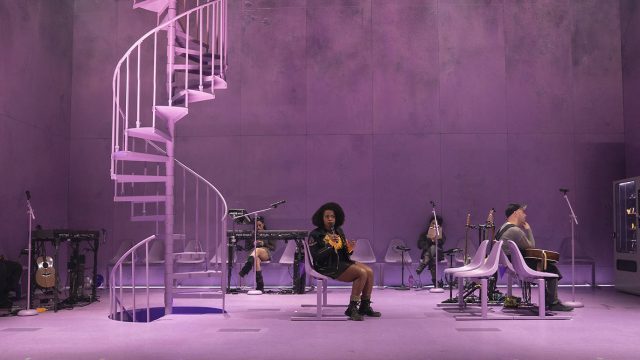
UNDER THE RADAR: NICK PAYNE’S CONSTELLATIONS

(photos by Yang Yang)

Wang Xiaohuan and Li Jialong star in Nick Payne’s Constellations at Under the Radar Festival (photo by Yang Yang)

Ellen Stewart Theatre, La MaMa Experimental Theatre Club
66 East Fourth St.
January 9-12, $30
Festival continues through January 19
212-475-7710
lamama.org/constellations
publictheater.org

Five years ago, Jake Gyllenhaal and Ruth Wilson starred in Nick Payne’s Constellations on Broadway, a time-bending play set in the quantum multiverse, taking place in the past, present, and future as a beekeeper and a cosmologist repeat scenes over and over again to reveal the intricacies of a relationship. Now artistic director Wang Chong and his Théâtre du Rêve Expérimental are bringing a Chinese twist to the work, which is running January 9-12 at La MaMa as part of the Public Theater’s Under the Radar Festival. The ninety-minute multimedia piece, which features live streaming video and a hamster, stars Wang Xiaohuan and Li Jialong, with music by Li Yangfan, set design by Ji Linlin and Di Tianyi, and lighting by Meng Lingyang. The play takes place on a circular white stage on the floor, surrounded by video cameras. At the center of the floor is a hamster on a wheel in a see-through Lucite case. Wang and Ji enact each scene in front of a different camera — multiple versions of how they met, their first night together, fidelity issues, etc. — resulting in distinct visual perspectives and emotions that are watched on a large screen suspended behind them. In between scenes, director Wang cuts to video of the hamster, who is often running on the wheel in either direction, as if he is making the time go backward or forward by his motion, which is accompanied by celestial projections on the floor.

In writing Constellations, Payne — who previously tackled climate change in If There Is I Haven’t Found It Yet, in which Gyllenhaal made his New York theater debut — was inspired by the work of Columbia physics and mathematics professor Brian Greene, the superstring theorist and author of the highly influential book The Elegant Universe, lending a well-researched scientific edge to the play. Founded in 2008, Théâtre du Rêve Expérimental’s previous productions include Henrik Ibsen’s Ghosts 2.0, Mike Daisey’s The Agony and the Ecstasy of Steve Jobs, Woody Allen’s Central Park West, and such Wang originals as Thunderstorm 2.0 and The Warfare of Landmine 2.0.

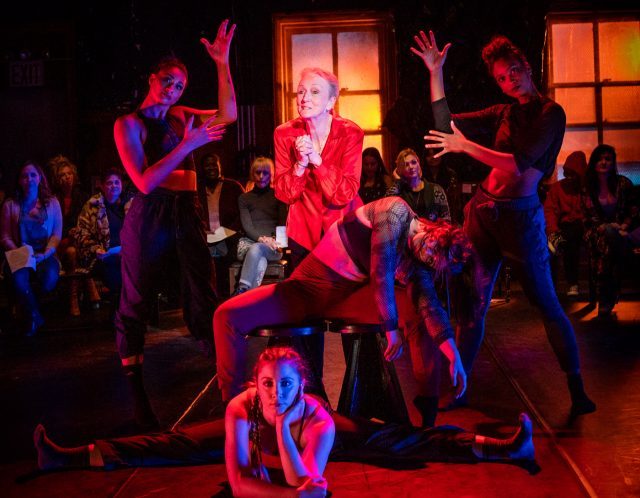
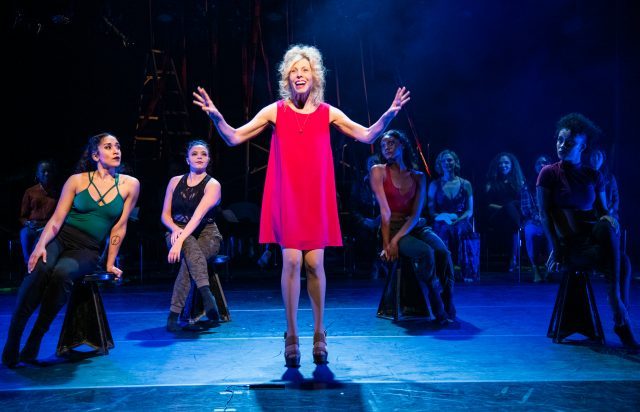
FAYE DRISCOLL — THANK YOU FOR COMING: SPACE

(photo by Maria Baranova)

Faye Driscoll’s Thank You for Coming: Space concludes five-plus-year trilogy (photo by Maria Baranova)

LIVE ARTERY
New York Live Arts
219 West 19th St.
January 8-11, $15-$30
Festival continues through January 15
newyorklivearts.org
fayedriscoll.com

“I think I have always been interested in performance as a ritual of expression, protest, transformation, and basically one gigantic act of mirroring with the performers and audience,” Guggenheim Fellow and Bessie Award-winning choreographer Faye Driscoll explained in a March 2014 twi-ny talk. “I don’t buy this idea that in order to be socially engaged you have to adapt to a certain way of being; I think we are all socially engaged whether we like it or not — or maybe whether we choose to deal with it or not. . . . I am trying through my own formal and aesthetic experiments to expand my perception of this interconnection, and maybe others will feel that or maybe they won’t.” Others have felt that interconnection through her trilogy that began with Thank You for Coming: Attendance in March 2014 at Danspace and was followed by Thank You for Coming: Play in November 2016 at the BAM Fisher.

Driscoll concluded the three-part piece in April 2019 at Montclair State University’s Peak Performances with Thank You for Coming: Space. If you didn’t make it to Jersey, you can catch the work January 8-11 as part of New York Live Arts’ annual Live Artery series, held in conjunction with the APAP conference. Thank You for Coming: Space explores presence and absence, death and grief, taking place in an intimate kinetic installation where it’s just Driscoll and the audience. You do not need to have seen the earlier works in order to join the potent and poignant community that Driscoll creates onstage. Live Artery continues through January 15 with such other shows as Kimberly Bartosik/Daela’s through the mirror of their eyes, Molly Lieber and Eleanor Smith’s Body Comes Apart, and Liana Conyers’s #ImFxckingFunny.

THE INHERITANCE

(photo by Matthew Murphy for MurphyMade, 2019)

Matthew Lopez’s The Inheritance tackles issues of gay eroticism, literature, and legacy over six and a half hours (photo by Matthew Murphy for MurphyMade, 2019)

Ethel Barrymore Theatre
243 West 47th St. between Broadway & Eighth Ave.
Wednesday – Sunday through June 7, $39 – $199
theinheritanceplay.com

Matthew Lopez’s The Inheritance is a terrific two-and-a-half-hour play — however, it runs six and a half hours in two lengthy installments at the Ethel Barrymore Theatre, each of which requires separate admission. Angels in America meets The Boys in the Band by way of E. M. Forster’s Howards End in the epic drama, which broke the record for winning the most Best Play awards in the West End, including four Oliviers (Best Play, Best Actor for Kyle Soller, Best Director for Stephen Daldry, and Best Lighting Design by Jon Clark). The play is set in contemporary New York City, where Eric Glass (Soller) and Toby Darling (Andrew Burnap) are in love and are considering marriage after seven years together. Toby is a beautiful, magnetic, hard-partying writer who is turning his coming-of-age novel, Loved Boy, into a play; the more grounded Eric works for Jasper (Kyle Harris), a social justice entrepreneur. Eric and Toby are friends with an urbane, wealthy older couple, Walter Poole (Paul Hilton) and Henry Wilcox (John Benjamin Hickey), who host fabulous gatherings at their summer place in the Hamptons. Fate brings actor Adam McDowell (Samuel H. Levine) into Toby’s life; Toby quickly thinks Adam should star in his play. But when Toby meets bedraggled street prostitute Leo (Levine), a double for Adam, various relationships start swirling out of control.

(photo by Matthew Murphy for MurphyMade, 2019)

Eric Glass (Kyle Soller) and Henry Wilcox (John Benjamin Hickey) talk about life and love as E. M. Forster (Paul Hilton) looks on in Olivier Award winner (photo by Matthew Murphy for MurphyMade, 2019)

Throughout the play, Forster (Hilton) comments on the plot and interacts with some of the characters, as if he’s the omniscient narrator of a novel. Early on, a Greek chorus of young men speak with Forster about Howards End. “It’s a great book, don’t get me wrong. And the movie’s good. But, I mean, the world is so different now. I can’t identify with it at all,” one man says. “It’s been a hundred years,” adds another. “The world has changed so much,” a third points out. “Our lives are nothing like the people in your book,” a fourth chimes in. Forster asks, “How can that be true? Hearts still love, don’t they? And break. Hope, fear, jealousy, desire. Your lives may be different. But surely the feelings are the same. The difference is merely setting, context, costumes. But those are just details.” Lopez is referring to his play itself, a modern-day reimagining of Howards End that has been transformed into a gay fantasia. The difference in context matters very much, however, and is brought into sharp focus by the presence of Forster, a closeted homosexual who did not have sex until he was thirty-eight and died in 1970 at the age of ninety-one. He would not allow his own gay fantasia, the queer novel Maurice, written in 1912, to be published until after his death, a fact that is discussed in the play, which also deals directly with the AIDS crisis of the 1980s and 1990s.

Hilton (Peter Pan, Anatomy of a Suicide) is sensational as both Forster and Walter; when he reappears onstage after a lengthy absence, the audience erupts into applause, and with good reason: He is essential to the narrative, which too often drifts into melodrama that would even make Douglas Sirk cringe. Levine (Kill Floor) makes a poignant Broadway debut as Adam and Leo, switching between two characters that are polar opposites of each other. Soller is superb as the thoughtful and caring Eric, displaying a tender chemistry with Tony winner Hickey (The Normal Heart, Love! Valour! Compassion!), whose Henry is the seasoned sage of the group and whose painful memories of those lost to AIDS leads to one of the play’s most searing moments. (Hickey will be on hiatus through April 22 to make his directing debut with Plaza Suite and will be replaced by Tony Goldwyn.) Daldry (Billy Elliot, Skylight) tries to keep things moving on Bob Crowley’s minimal set, a large platform around which Eric and Toby’s friends and wannabe writers (including Jonathan Burke, Carson McCalley, Jordan Barbour, Darryl Gene Daughtry Jr., Dylan Frederick, and Arturo Luís Soria) hang out, watch the action, and interject, getting more in the way than adding worthwhile dialogue.

(photo by Matthew Murphy for MurphyMade, 2019)

Henry Wilcox (John Benjamin Hickey) has some sharp things to say to the younger generation in Matthew Lopez’s The Inheritance (photo by Matthew Murphy for MurphyMade, 2019)

“With personal relationships. Here is something comparatively solid in a world full of violence and cruelty,” Forster wrote in his seminal 1938 essay “What I Believe,” continuing, “Not absolutely solid, for Psychology has split and shattered the idea of a ‘Person,’ and has shown that there is something incalculable in each of us, which may at any moment rise to the surface and destroy our normal balance. We don’t know what we are like. We can’t know what other people are like. How, then, can we put any trust in personal relationships, or cling to them in the gathering political storm? In theory we cannot. But in practice we can and do.” Lopez (The Whipping Man, The Legend of Georgia McBride) captures that part of Forster’s ethos but also strays from it too often.

There is also a very noticeable lack of women in the story, and only one onstage, the key figure of Margaret, played by the impeccable Lois Smith (The Trip to Bountiful, Marjorie Prime), who sums it all up at the end, but by that time Lopez has long bit off more than he can chew, taking on too much and losing focus of the main plot in favor of emotionally manipulative scenes that lack the necessary subtlety even as he tackles such intense subjects as gay eroticism, class, sex, AIDS, and, most critically, legacy. The Inheritance is filled with delicate, beautiful scenes that will move you deeply, unforgettable moments that exemplify what makes live theater so potent. But it just can’t sustain itself for six and a half hours.