twi-ny recommended events

ONCE WERE BROTHERS: ROBBIE ROBERTSON & THE BAND

Documentary explores the history and legacy of the Band from a singular point of view

Documentary explores the history and legacy of the Band from a singular point of view

ONCE WERE BROTHERS: ROBBIE ROBERTSON & THE BAND (Daniel Roher, 2019)
IFC Center
323 Sixth Ave. at West Third St.
Opens Friday, February 21
212-924-7771
www.ifccenter.com

The opening night selection of the tenth annual DOC NYC festival, Daniel Roher’s Once Were Brothers: Robbie Robertson & the Band is an intimate, if completely one-sided, look inside one of the greatest, most influential music groups in North American history. The film was inspired by Band cofounder Robbie Robertson’s 2016 memoir, Testimony, offering his take on the Band’s ups and downs, famous battles, and ultimate breakup. “I don’t know of any other group of musicians with a story equivalent to the story of the Band, and it was a beautiful thing. It was so beautiful it went up in flames,” Robertson, sitting in a chair in a vast, empty room, guitars hanging on the wall far behind him, says. The setup puts the focus on Robertson’s individuality, his alone-ness, in what others trumpet as a collection of extraordinary musicians. “There is no band that emphasizes coming together and becoming greater than the sum of their parts, than the Band. Simply their name: The Band. That was it,” fan Bruce Springsteen says. “I was in great awe of their brotherhood. It was the soul of the Band,” notes Eric Clapton, who says he wanted to join the group made up of singer-songwriter and guitarist Robertson, singer and bassist Rick Danko, singer and keyboardist Richard Manuel, singer and drummer Levon Helm, and keyboardist and accordionist Garth Hudson.

When Robertson, who was born in Toronto in 1943, talks about his childhood — his mother was born on the Six Nations of the Grand River Indian reserve, which had a profound effect on him musically, and his biological father was a Jewish gangster, although he was raised by an abusive stepfather — the film is revelatory, with archival photographs and live footage of Robertson’s early bands and his time with Ronnie Hawkins and the Hawks. Robertson shares mesmerizing anecdotes about going electric with Bob Dylan, recording the Basement Tapes in a house called Big Pink, and discussing his craft. “I don’t have much of a process of like I’m thinking about this, and now I’m going to write a song and it’s gonna be about that,” he explains. “A lot of times, the creative process is trying to catch yourself off guard. And you sit down and you’ve got a blank canvas and you don’t know what you’re gonna do and you just see what happens.”

Hawkins speaks glowingly of his protégé Robertson, who wrote his first songs for Hawkins when he was only fifteen. Roher also talks to executive producer Martin Scorsese, Rolling Stone founder Jann Wenner, record producer John Simon, road manager Jonathan Taplin, equipment manager Bill Scheele, photographer John Scheele, Asylum Records creator David Geffen, and musicians Dylan, Taj Mahal, Peter Gabriel, Van Morrison, and Jimmy Vivino, who all rave about Robertson and the Band. “They were totally in love with their music, and they were in love with each other,” photographer Elliott Landy says. “I never saw any jealousy, I never saw any arguments, I never saw them disagree. They were always supporting each other. They were five brothers, very clearly five brothers who loved each other, and I never saw anything but that.”

Of course, Roher cannot talk to Manuel, Danko, and Helm, who are all dead, and Hudson did not participate in the documentary. Robertson and his wife, Dominique, paint a harrowing picture of the Band’s severe strife as drugs and alcohol tear them apart. There’s really no one, aside from a brief point made by guitarist Larry Campbell, to offer an opposing view to Robertson’s tale, which puts him on a golden throne despite some very public disagreements, particularly with Helm over songwriting credit and royalties. Robertson speaks enthusiastically and intelligently throughout the film, but it’s clear from the get-go that these are his carefully constructed, perhaps selective memories about what happened. But Roher doesn’t disguise that conceit; the film is named after one of Robertson’s solo songs, and the second half of the title is, after all, Robbie Robertson & the Band, as if Robertson is separate from the rest.

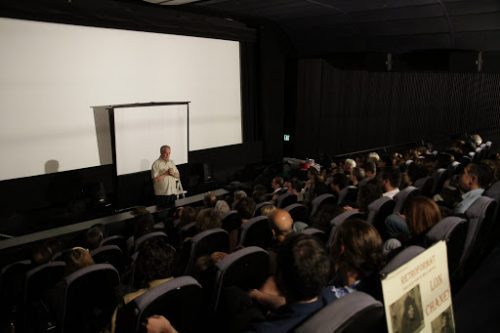
One of the main surprises is Robertson’s claim that the Last Waltz concert at Winterland in 1976 was not meant as a farewell but just a pause; Roher and Robertson fail to point out that the group continued to tour and record without Robertson. On his sixth solo album, Sinematic, which was released last September, Robertson has a song about the Band, the aforementioned “Once Were Brothers,” that can be heard at the start of the film. “Oh, once were brothers / Brothers no more / We lost a connection / After the war / There’ll be no revival / There’ll be no one cold / Once were brothers / Brothers no more,” Robertson sings. “When that curtain comes down / We’ll let go of the past / Tomorrow’s another day / Some things weren’t meant to last.” It’s a sad testament to a storied legacy, packed with amazing photos and live clips that make it a must-see for fans of the group. Once Were Brothers opens at IFC on February 21, with music photographer Elliott Landy, who appears in the film, participating in a Q&A at the 7:45 show Friday night.

BURNT-OUT WIFE

(photo by Nick Pierce)

Sara Juli explores marriage in personal, funny ways in latest one-woman show (photo by Nick Pierce)

Dixon Place
161A Chrystie St. between Rivington and Delancey Sts.
February 21-22, 27-28, $19-$23, 7:00
dixonplace.org
www.sarajuli.com

“The funny thing about marriage over time is I was very focused on locking it in, and now I just feel locked in,” Sara Juli says in her one-woman show Burnt-Out Wife, which makes its New York premiere February 21-22 and 27-28 at Dixon Place in conjunction with the American Dance Festival. The comedic dance-theater work takes place in a peppy pink bathroom designed by Pamela Moulton, with Juli wearing a range of household costumes (or not much of anything) created by Carol Farrell as she sings, dances, and riffs on relationships while sharing intimate moments and eliciting audience participation. Juli, a Skidmore graduate with degrees in dance and anthropology whose previous shows include The Money Conversation and Tense Vagina: an actual diagnosis, lived in New York for fifteen years before moving in 2014 with her husband and two children to Maine, where she produces the contemporary dance series Maine Moves and runs the fundraising consulting practice Surala Consulting, among other artistic ventures. In preparing for Burnt-Out Wife, Juli and her husband went to marriage counseling, covering as many bases as possible as she explores commitment in deeply personal yet funny ways from a distinctly feminist perspective. The seventy-minute presentation, which involves cake, an original song, and plungers, features dramaturgy by Michelle Mola, sound by Ryan MacDonald, and lighting by David Ferri; tickets are $19 in advance and $23 at the door.

A SOLDIER’S PLAY

(photo by Joan Marcus)

Capt. Richard Davenport (Blair Underwood) and Pvt. James Wilkie (Billy Eugene Jones) watch Sgt. Vernon C. Waters (David Alan Grier) in flashback in A Soldier’s Play (photo by Joan Marcus)

American Airlines Theatre
227 West 42nd St. between Broadway & Eighth Ave.
Tuesday – Sunday through March 15, $59-$299
212-719-1300
www.roundabouttheatre.org

Perhaps no one knows Charles Fuller’s A Soldier’s Play better than David Alan Grier, even more so than Fuller himself. In the show’s original 1981-83 Negro Ensemble run, which earned Fuller the Pulitzer Prize and featured Adolph Caesar, Denzel Washington, and Samuel L. Jackson, Grier replaced Larry Riley as Pvt. C. J. Memphis. In Norman Jewison’s 1984 film, starring Caesar, Washington, Riley, Howard E. Rollins Jr., Wings Hauser, Robert Townsend, and Patti LaBelle, Grier played Cpl. Bernard Cobb. And now Grier is taking on the role of controversial sergeant Vernon C. Waters in the show’s Broadway debut, a Roundabout production that moves with expert military precision at the American Airlines Theatre.

It’s 1944, and Waters is in charge of an all-black unit of the 221st Chemical Smoke Generating Company at Fort Neal, Louisiana, under the command of Capt. Charles Taylor (Jerry O’Connell). In the opening moment, a drunk Waters is on his knees on a platform, calling out, “They’ll still hate you!” A shot rings out, and Waters falls dead, murdered in cold blood by an unseen perpetrator. Capt. Richard Davenport (Blair Underwood), a black lawyer attached to the 343rd Military Police Corps Unit, arrives to solve the crime, but the white Taylor has a problem with that.

“I didn’t know that Major Hines was assigning a Negro, Davenport,” Taylor says. “My preparations were made in the belief that you’d be a white man. I think it only fair to tell you that had I known what Hines intended I would have requested the immediate suspension of the investigation. . . . I don’t want to offend you, but I just cannot get used to it — the bars, the uniform — being in charge just doesn’t look right on Negroes!” Taylor attempts to talk Davenport out of accepting the case, in part because of the danger he thinks he will face from the local KKK, but Davenport is not about to be scared into leaving. “I got it. And I am in charge! All your orders instruct you to do is cooperate!” he firmly declares.

(photo by Joan Marcus)

Capt. Charles Taylor (Jerry O’Connell) is not thrilled that Capt. Richard Davenport (Blair Underwood) has come to investigate a murder in Roundabout Broadway production (photo by Joan Marcus)

Assisted by Taylor’s right-hand man, Cpl. Ellis (Warner Miller), Davenport begins interrogating the members of the unit, which includes Pfc Melvin Peterson (Nnamdi Asomugha), Pvt. Louis Henson (McKinley Belcher III), Cpl. Cobb (Rob Demery), Pvt. Tony Smalls (Jared Grimes), Pvt. James Wilkie (Billy Eugene Jones), and Pvt. Memphis (J. Alphonse Nicholson), each of whom had a unique relationship with Waters, via their responsibilities to the army as well as through their place on the company’s extremely successful baseball team, as most of them played in the Negro League. Their stories unfold in flashback as Davenport and the witness sit stage right as the captain watches the action take place in the center and at left. Derek McLane’s two-level wooden set switches from the men’s barracks to Davenport’s and Taylor’s offices as chairs and desks are brought on and offstage and beds are pushed from the back to the front, accompanied by sharp lighting by Allen Lee Hughes.

Davenport also speaks with key white suspects Lt. Byrd (Nate Mann) and Capt. Wilcox (Lee Aaron Rosen); the former in particular is an avowed racist with no respect for Davenport. “Where I come from, colored don’t talk the way he spoke to us — not to white people they don’t!” Byrd says about Waters, talking about the night of the killing. Davenport discovers that Waters apparently had many more enemies than friends, resulting in plenty of suspects.

(photo by Joan Marcus)

Broadway debut of Charles Fuller’s A Soldier’s Play is set in an all-black army barracks during WWII (photo by Joan Marcus)

Directed with adroit sureness by Tony winner Kenny Leon (A Raisin in the Sun, American Son) and loosely inspired by Herman Melville’s 1924 novella Billy Budd, A Soldier’s Play is a scorching look at racism, in the military in 1944 as well as today. Waters strongly believes that black men need to rethink their place in society and how they will succeed. “The First War, it didn’t change much for us, boy — but this one — it’s gonna change a lot of things,” he tells Memphis. “The black race can’t afford you no more. There use ta be a time when we’d see somebody like you, singin’, clownin’ — yas-sah-bossin’ — and we wouldn’t do anything. . . . Not no more. The day of the geechy is gone, boy — the only thing that can move the race is power. It’s all the white respects — and people like you just make us seem like fools.” It’s not a position that everyone agrees with, but Grier (Porgy and Bess, In Living Color) handles the role with a grace and intelligence that makes Waters neither hero nor villain, instead a strong-willed individual with a different experience than his fellow soldiers, and a different way of approaching the future.

Underwood (A Streetcar Named Desire, The Trip to Bountiful), whose father is a retired army colonel, is bold and steadfast as Davenport, a fearless man who is going to stand by his convictions and fight for what he’s earned. O’Connell (Stand by Me, Seminar) is resolute as Taylor, who is somewhat caught in the middle, a stand-in for much of America of the 1940s (and today), wrestling with the racism he grew up with while seemingly trying to accept that things are changing. Leon and Fuller (Zooman and the Sign, A Gathering of Old Men) do an excellent job developing the characters, each actor — there are no women in this testosterone-filled tale — getting the chance to speak his mind, wearing Dede Ayite’s effective costumes and eliciting some whoops when taking them off. Now almost forty years old, A Soldier’s Play doesn’t feel dated in the least. In fact, it feels all too of-the-moment, and all too necessary.

NOAH DAVIS

Noah Davis,  1975 (8), oil on canvas in artist's frame, 2013 (courtesy David Zwirner)

Noah Davis, 1975 (8), oil on canvas in artist’s frame, 2013 (courtesy David Zwirner)

David Zwirner
525 and 533 West 20th St. between Tenth & Eleventh Aves.
Through February 22, free, 10:00 am – 6:00 pm
www.davidzwirner.com

Doug Wheeler’s immersive light installation 49 Nord 6 Est 68 Ven 12 FL at David Zwirner is supposed to make you feel dizzy, but it’s the Noah Davis painting retrospective that will make you go weak in the knees. The Washington-born artist, who died of a rare form of cancer in 2015 at the age of thirty-two, left behind a dazzling legacy, both in his exquisitely beautiful and affecting canvases as well as his cofounding of the Underground Museum in LA with his wife, sculptor Karon Davis, and his brother, filmmaker Kahlil Joseph. “He made some four hundred paintings, collages, and sculptures, although I think it’s fair to say the deep DNA truth of Noah was that he was first and foremost a painter. His paintings are both figurative and abstract, realistic and dreamlike; they are about blackness and the history of Western painting, drawn from photographs and from life; they are exuberant and doleful in their palette,” museum board member and exhibition curator Helen Molesworth said in a statement.

Noah Davis, Untitled, oil on canvas, 2015 (courtesy David Zwirner)

Noah Davis, Untitled, oil on canvas, 2015 (courtesy David Zwirner)

The works at David Zwirner are simply staggering, breathtaking depictions of primarily black men, women, and children that often include a touch of magical realism. In an untitled painting from 2015, two girls sleep back-to-back on a couch, a partly covered figure at the left, an open door to the right, allowing us to peek into this intimate scene. In Prey, a Modigliani-esque, Giacometti-like faceless woman balances on a mountain, a deer peering off in the distance in front of her. Pueblo del Rio: Stain Glass Pants bursts to life with colorful geometric shapes and patterns that extend to every corner. The pool scene 1975 (8) offers a unique counterpart to David Hockney. Hung side by side, it appears that the pianist in Pueblo del Rio: Concerto is playing for the six dancers in Pueblo del Rio: Arabesque. Mark Rothko is specifically referenced in The “Fitz,” two very different depictions of a house. And in the surreal Imaginary Enemy, a man on fire is walking toward a second man wearing a strange item on his head and stepping on a giant golden bracelet that is taller than him.

Noah Davis, Imaginary Enemy, oil on wood panel, 2009 (courtesy David Zwirner)

Noah Davis, Imaginary Enemy, oil on wood panel, 2009 (courtesy David Zwirner)

The hand of the artist is vividly present in works that are superbly composed with a spectacular use of color, giving the paintings a visceral quality that gets down into your soul. As I walked around the gallery spaces, I saw other viewers who seemed to be experiencing the same power, immersed in Davis’s palpable world view. In the back room, Zwirner has re-created part of the Underground Museum, with two models of shows he was curating, family photographs, a bookshelf, a sculpture of a child by Karon Davis, Shelby George furniture designed by Davis’s mother, Faith Childs-Davis, and a video loop playing Joseph’s BLKNWS, a two-channel alternative news station that will come to BAM next month. The overall museum-quality exhibition is dizzying, in only the best way, a fitting tribute to a supremely talented artist who left us too soon.

ANATOMY OF A SUICIDE

(photo by Ahron R. Foster)

Alice Birch’s Anatomy of a Suicide takes place in three concurrent time periods (photo by Ahron R. Foster)

Atlantic Theater Company
Linda Gross Theater
336 West 20th St. between Eighth & Ninth Aves.
Tuesday – Sunday through March 15, $51-$91.50
866-811-4111
atlantictheater.org

The beginning of the Atlantic’s US premiere of Alice Birch’s Anatomy of a Suicide is a chaotic cacophony of words and images, barreling at the audience in three parts at the same time. You’ll find yourself shifting your eyes and ears constantly, struggling to understand what exactly is happening. But stick with it; in the hands of director Lileana Blain-Cruz, the play slowly takes shape and you’ll fall into the unique and compelling rhythm of its multiple, interconnected narratives.

Mariana Sanchez’s open set is divided into three sections by invisible barriers, signaled by several doors at the back and Jiyoun Chang’s poignant lighting. There is a cast-iron tub in the middle and two more doors at the sides, through which chairs, tables, and other props are brought. Hannah Wasileski’s projections subtly change the texture of the walls in soft shades of blue, referencing changes in time. Stage right, Carol (Carla Gugino) has just attempted to kill herself, much to the dismay of her caring husband, John (Richard Topol). “It was just an accident,” she coldly claims. “You slit your fucking wrists,” he responds. In the center, a drugged-out Anna (Celeste Arias) is debating semantics with an upset doctor (Vince Nappo). “I sound like I’m trying — is the point though isn’t it cos the veracity of the whole thing lies in how likely it is I’d say what you’re claiming I said,” she argues. “Veracity — you can’t stand up straight but you can say veracity,” he says. And at stage left, another doctor, the very serious Bonnie (Gabby Beans), is being hit on by a bleeding patient, Jo (Jo Mei). “Do you want to grab a drink,” Jo asks as Bonnie tends to her wounded hand, not answering. “That is an incredibly long pause to follow that question,” Jo says, to which Bonnie replies, “You’ve had a lot of painkillers. You shouldn’t drink anything for a while.” Those three interactions establish the main characters in what becomes a gripping drama about the psychological legacies parents leave their children and the biology that determines depression.

(photo by Ahron R. Foster)

Carla Gugino stars as a wife and mother battling depression in US premiere at the Atlantic (photo by Ahron R. Foster)

You’ll probably guess the relationship between Carol, John, and Anna fairly quickly, but the connection between Anna, Bonnie, and Jamie (Julian Elijah Martinez) will take a little longer, offering a clever surprise. Most of the excellent cast portray multiple characters, with Jason Babinsky, Miriam Silverman, Nappo, and Mei playing various friends, relatives, and coworkers and Ava Briglia taking on all the child roles. It can get confusing at times, but Birch (Lady Macbeth, Revolt. She Said. Revolt.), who won the prestigious Susan Smith Blackburn Prize for Anatomy, and Obie winner Blain-Cruz, who has guided such complex, experimental works as Fefu and Her Friends, Marys Seacole, and The Death of the Last Black Man in the Whole Entire World AKA the Negro Book of the Dead, eventually circle back with telling reveals and small shocks, making sure we feel the power of the story even if we can’t grasp hold of every word. Gugino (A Kid Like Jake, The Road to Mecca), Arias (Uncle Vanya), and Topol (Indecent, The Dance of Death) lead an exemplary ensemble (Gugino and Arias look particularly resplendent in Kaye Voyce’s lovely costumes), the actors hitting their marks like clockwork amid the overlapping turmoil, characters from each time period occasionally spouting key lines of dialogue in unison.

It’s like we’re in the mind of a depressed, suicidal person, experiencing what they’re experiencing as they battle a world filled with demons, an unrelenting barrage that they may not break free of. The sparkling white tub, which is never moved, is a constant reminder of what Carol, Anna, and Bonnie are facing as those around them seek to protect and love them, which doesn’t always make a difference. Performed without an intermission, it’s a tense and gripping hundred-minute journey into the legacies of mental illness, especially in women’s experiences. It’s not an easy play to watch, but you won’t be able to turn away.

MEDEA

(photo by Richard Termine)

Real-life partners Rose Byrne and Bobby Cannavale star in Simon Stone’s sizzling Medea at BAM (photo by Richard Termine)

Brooklyn Academy of Music
BAM Harvey Theater
651 Fulton St. at Ashland Pl.
Tuesday – Sunday through March 8, $45-$195
718-636-4100
www.bam.org/medea

As you enter BAM’s elegantly shabby chic Harvey Theater to see Simon Stone’s Medea, there are two young boys already onstage, one stretched out on the floor, on his laptop, the other leaning against a wall, on his smartphone. Bob Cousins’s dramatic cyclorama set is blindingly white, evoking a heavenly way station, making it look as if the unconcerned brothers are floating in a mysterious void. In this riveting adaptation, inspired by Euripides’s 431 BC original and the true story of Dr. Debora Green, who committed horrific crimes against her family in Kansas in 1995, Stone instantly puts us in the kids’ shoes. It’s a thrillingly uncomfortable moment since, of course, this is Medea, and we know it will not end well for the siblings. And getting there is indeed heart-wrenching.

Contemporary stand-ins for Jason and Medea, Lucas (Bobby Cannavale) and Anna (Rose Byrne) are married pharmaceutical scientists facing a crisis. Anna has just been released from a psychiatric facility after having done something bad to Lucas, who is in a relationship with a woman half his age, Clara (Madeline Weinstein), the daughter of their boss, Christopher (Dylan Baker). Anna plans to simply walk back into their old life with their two sons, Edgar (Gabriel Amoroso or Jolly Swag) and (Gus Emeka or Orson Hong Guindo), but Lucas has other ideas. “I know your trust will be hard to regain. What I did to you,” Anna says. “We don’t need to talk about it now,” Lucas replies. Anna: “No, I want to. It was a breach of trust. Most importantly it was trust that we lost.” Lucas: “I’m not —” Anna: “In all those messy months we lost sight of everything we’d promised to be to each other and both of us did that but I overstepped the line —” Lucas: “We should never have stayed together this long.” A determined Anna later adds, “I’m going to win you back.” That does not go so well either.

(photo by Richard Termine)

Social worker Elsbeth (Jordan Boatman) does not have the easiest of jobs monitoring Anna (Rose Byrne) and her two young sons (photo by Richard Termine)

Medea is ripe for reinterpretation, particularly in a world rife with misogyny and violence. In the past ten years I have seen Aaron Mark’s Another Medea, Limb Hyoung-taek’s Medea and Its Double, and Luis Alfaro’s Mojada, all of which took the central story and reimagined it in unique and compelling ways. Born in Basel and raised in England and Australia, Stone, who moves all around the globe, rarely settling down for an extended period of time, has previously adapted such classics as The Wild Duck, Miss Julie, John Gabriel Borkman, Peer Gynt, Three Sisters, and Hamlet and dazzled New York audiences with his sizzling Yerma at Park Avenue Armory in 2018, infusing his work with personal experience, as he does again with Medea.

The set features one large rectangular white wall that occasionally rises to serve as a projection screen, showing either extreme close-ups of the action, primarily a spellbinding Byrne, her evocative eyes searching for meaning, or live-stream shots by Edgar, who is making an autobiographical film for school. (The video design is by Julia Frey, with bright lighting by Sarah Johnston.) The play was originally performed at live-streaming master and BAM fixture Ivo van Hove’s Internationaal Theater Amsterdam (formerly Toneelgroep Amsterdam); the video footage can get to be a bit too much, so it’s a relief when the device goes away in the latter parts of the eighty-minute production, when things really heat up.

The cast is all new for this US premiere, with solid support led by Tony and Emmy nominee Baker (La Bête, Happiness, The Americans) and Weinstein (The Real Thing, Mary Page Marlowe) in addition to Victor Almanzar as bookstore owner Herbert, who offers Anna a job, and Jordan Boatman as Elsbeth, the social worker in charge of her case, keeping a close watch on her treatment of Gus and Edgar. At one point Stone makes a tongue-in-cheek reference to the finale of The Sopranos that is a wry riff on what ultimately happens in his take on Medea, as two famous families meet their fate.

(photo by Richard Termine)

Anna (Rose Byrne) is none too happy that her husband, Lucas (Bobby Cannavale), is now with Clara (Madeline Weinstein) in contemporary update of Medea (photo by Richard Termine)

Byrne (Bridesmaids, You Can’t Take It with You) plays Anna with a strong-willed vulnerability; she is no mere woman scorned, seeking revenge, but an intelligent wife, mother, and scientist who had the deck stacked against her and refuses to sit back and let everyone walk over her. She has a fiery, passionate chemistry with Cannavale (The Hairy Ape, The Lifespan of a Fact), who also displays a strong-willed vulnerability, allowing the cracks in Lucas’s armor to show through. “She created this instability,” Clara argues to Lucas. “I did too,” he readily admits. This is a Medea that could only be created in today’s #MeToo sociopolitical climate.

The Australian Byrne and New Jersey native Cannavale are real-life partners with two young boys of their own; after going through hell onstage, they head back to their nearby Gowanus apartment to be with their kids. Byrne and Cannavale work together often on television and in film, but this is the first time they are acting opposite each other onstage; later this year they will portray another married couple in Arthur Miller’s A View from the Bridge for the Sydney Theatre Company. At the start of Medea, Anna shows Lucas a painting she made while at the asylum, depicting Noah’s ship in a storm, in which all the animals are drowning. “They thought they were safe and then another storm whipped up and capsized the ark,” Anna tells a confused Lucas. She continues, “You see the dead dove floating on the swell over there? With the olive branch still in its mouth?” It’s a metaphor for Anna’s state of mind, but one can also think of it as a kind of peace offering between Byrne and Cannavale as they return to a normal life following the searing heartbreak their characters experience night after night.

TONI MORRISON’S THE SOURCE OF SELF-REGARD

92Y

André Holland and Phylicia Rashad will honor the legacy of Toni Morrison at the 92nd St. Y on February 18

Who: André Holland, Phylicia Rashad
What: Dramatic readings from The Source of Self-Regard: Selected Essays, Speeches, and Meditations
Where: 92Y, Kaufmann Concert Hall, 1395 Lexington Ave. between 91st & 92nd St.
When: Tuesday, February 18, $15-$46, 8:00
Why: In honor of what would have been Nobel Prize-winning writer Toni Morrison’s eighty-ninth birthday — the Ohio-born author of such novels as Sula, Song of Solomon, and Beloved passed away in New York City last August — Morrison scholar and Columbia professor Farah Jasmine Griffin has curated an evening of dramatic readings from Morrison’s final book, The Source of Self-Regard: Selected Essays, Speeches, and Meditations, to be performed by actor André Holland (Selma, Moonlight, Jitney) and Emmy- and Tony-winning actress and director Phylicia Rashad (The Cosby Show, A Raisin in the Sun, Creed). It is a reprise of an earlier event, held in May 2019, celebrating the release of the book; it now takes on a different meaning with Morrison’s death. The Source of Self-Regard is divided into three sections, “The Foreigner’s Home,” “Black Matter(s),” and “God’s Language,” featuring such chapters as “Racism and Fascism,” “The Slavebody and the Blackbody,” “The Site of Memory,” and “Goodbye to All That: Race, Surrogacy, and Farewell,” with tributes to Martin Luther King Jr., Gertrude Stein, James Baldwin, Romare Bearden, William Faulkner, and others. “With The Source of Self-Regard, Toni Morrison further cements her reputation as the towering literary figure of our time,” Griffin, who moderated a conversation with Morrison at the 92nd St. Y in 2015, said in a statement. “Her intellect, like her prose, is original, incisive, and illuminating. Hers is a voice we urgently need now more than ever, and I am honored to join these great artists as we bring that voice to the stage of the 92nd St. Y.”