twi-ny recommended events

GOODBYE, DRAGON INN

Tsai Ming-liang’s Goodbye, Dragon Inn is a poignant, poetic farewell to the cinema

GOODBYE, DRAGON INN (Tsai Ming-liang, 2003)
Metrograph Digital
Opens virtually December 18
metrograph.com

Taiwanese master Tsai Ming-liang’s Goodbye, Dragon Inn is a heart-stirring elegy to going to the movies, now streaming in a gorgeous 4K restoration at Metrograph Digital. The accidentally prescient 2003 film takes place in central Taipei in and around the Fu-Ho Grand Theater, which is about to be torn down. For its finale, the Fu-Ho is screening King Hu’s 1967 wuxia classic Dragon Inn, Hu’s first work after moving from Hong Kong to Taiwan; the film is set in the Ming dynasty and involves assassins and eunuchs.

In 2020, Tsai’s film seems set in a long-ago time as well. It opens during a crowded showing of Dragon Inn in which Tsai’s longtime cinematographer, Liao Pen-jung, places the viewer in a seat in the theater, watching the film over and around two heads in front of their seat, one partially blocking the screen, which doesn’t happen when viewing a film on a smaller screen at home — especially during a pandemic, when no one is seeing any films in movie theaters. Right now, Goodbye, Dragon Inn takes on a much bigger meaning, particularly since Warner Bros. recently announced that all its 2021 movies will be streamed, although they’ll play in theaters where allowed. The lockdown has changed how we experience movies forever.

Most of the film focuses on the last screening at the Fu-Ho, with only a handful of people in the audience: a jittery Japanese tourist (Mitamura Kiyonobu), a woman eating peanuts or seeds (Yang Kuei-mei), a young man in a leather jacket (Tsai regular Chen Chao-jung), a child, and two older men, played by Jun Shih and Miao Tien, who are actually the stars of the film being shown. (They portray Xiao Shao-zi and Pi Shao-tang, respectively, in Dragon Inn.) In one of the only scenes with dialogue, Miao says, “I haven’t seen a movie in a long time,” to which Chun responds, “No one goes to the movies anymore, and no one remembers us anymore.”

The tourist, a reminder of Japan’s occupation of Taiwan from 1895 to 1945, spends much of the movie trying to find a light for his cigarette — a homoerotic gesture — as well as a better seat, as he is constantly beset by people sitting right next to him or right behind him and putting their bare feet practically in his face or noisily crunching food, even though the large theater is nearly empty. In one of the film’s most darkly comic moments, two men line up on either side of him at a row of urinals, and then a third man comes in to reach over and grab the cigarettes he left on the shelf above where the tourist is urinating. Nobody says a word as Tsai lingers on the scene, the camera not moving. In fact, there is very little camera movement throughout the film; instead, long scenes play out in real time as in an Ozu film, in stark contrast to the action happening onscreen.

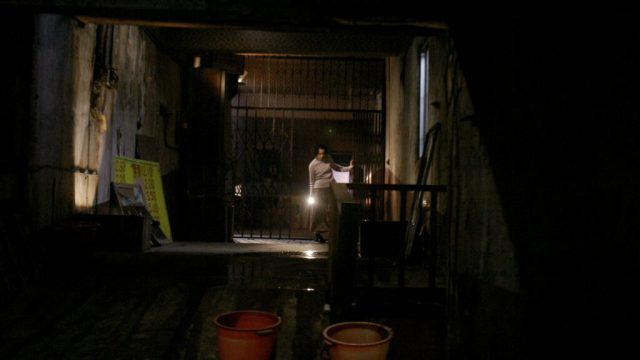
Meanwhile, the ticket woman (Chen Shiang-chyi), who has a disabled foot and a severe limp, cleans the bathroom, slowly steams and eats part of a bun, walks down a long hallway, and brings food to the projectionist (Tsai mainstay Lee Kang-sheng). She is steeped in an almost unbearable loneliness; she peeks in from behind a curtain to peer at the few patrons in the theater, and at one point she emerges from a door next to the screen, looking up as if she wishes to be part of the movie instead of the laborious life she’s living.
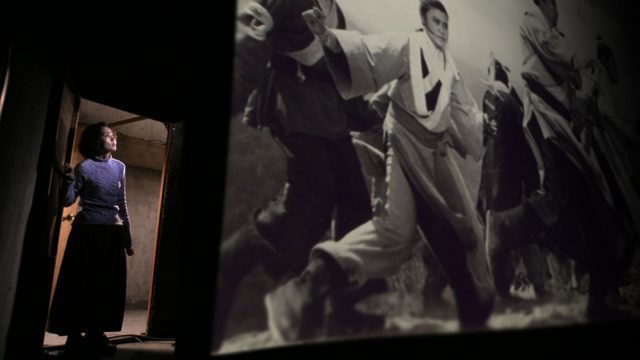
A woman (Chen Shiang-chyi) works during the final screening at the Fu-Ho Grand Theater in Goodbye, Dragon Inn

In his Metrograph Journal essay “Chasing the Film Spirit,” Tsai, whose other works include Rebels of the Neon God, The River, The Hole, and What Time Is It There? — which has a scene set in the Fu-Ho, where he also held the premiere — writes, “My grandmother and grandfather were the biggest cinephiles I knew, and we started going to movies together when I was three years old. We would go to the cinema twice a day, every day. Sometimes we would watch the same film over and over again, and sometimes we would find different cinemas to watch something new. That was a golden age for cinema, and I’m proud my childhood coincided with that time.”

He continues, “Nowadays everyone watches movies on planes. On any given flight, no matter the airline, you can choose from hundreds of films: Hollywood, Bollywood, all different types of movies. However, you can count on one thing: You’ll never find a Tsai Ming-liang picture on a plane, as I make films that have to be seen on the big screen.” Unfortunately, in 2020, we currently have no choice but to watch Goodbye, Dragon Inn on a small screen, but watch it you must; it’s a stunningly paced elegiac love letter, and even more essential during a pandemic, when we are all forced to watch films from the safety of our homes, our only seatmates those we are sheltering in place with. Already we were watching more films than ever on our private screens and monitors — as well as on airplanes — but it will be quite a while before we again participate in the communal pleasure of sitting in a dark theater with dozens or hundreds of strangers, staring up at light being projected onto a screen at twenty-four frames per second, telling us a story as only a movie can. What I wouldn’t give right now to be in that theater, a head partially blocking my view, bare feet in my face, someone crunching too loudly right behind me.
MUSEUM TOWN

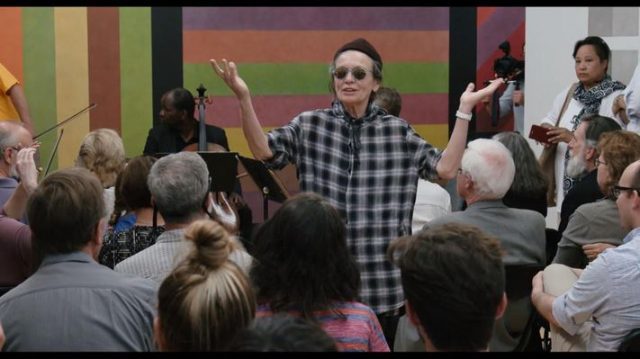
Laurie Anderson entertains art lovers at MASS MoCA in Museum Town

MUSEUM TOWN (Jennifer Trainer, 2020)
BAM Film
Opens virtually Friday, December 18, $12
www.museumtownmovie.com
www.bam.org

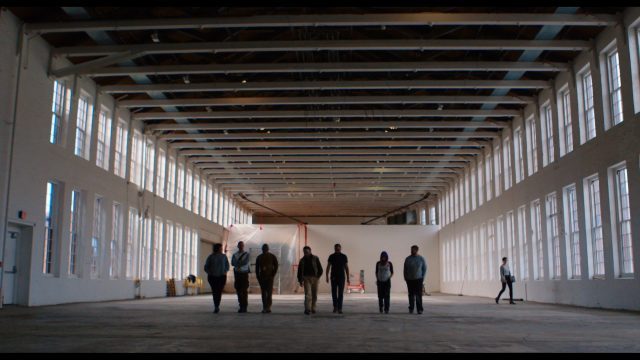
Back in August, desperate to get out of New York City and see some art amid the pandemic lockdown, my wife and I headed north to the Berkshires to MASS MoCA and the Clark Institute, two museums that had reopened with timed tickets, limited capacity, mask wearing, and social distancing. It was my second visit to MASS MoCA and my wife’s first to the extraordinary institution, whose complicated story is told in Jennifer Trainer’s debut documentary, Museum Town, which releases virtually through BAM on December 18. (You can read about our trip here.)

After watching the film, you’ll be ready to head north as well, even though New York museums are now open. As it says on one of Jenny Holzer’s marble benches at MASS MoCA, “Words tend to be inadequate.” You have to see it to believe it.

Trainer notes her unique relationship with the museum at the start: “In 1986, I moved from Manhattan to the Berkshires as a freelance journalist. I soon caught wind of a preposterous idea to turn an old factory into the world’s largest museum of contemporary art and broke the story for the New York Times. Then I signed on to help. Building MASS MoCA from the ground up consumed the next twenty-eight years of my life. . . . I’ve moved on from the museum, but I knew I had to finish writing the story I’d started nearly three decades ago. It was simply too big, too beautiful, too improbable to leave untold.”

Trainer and cowriters Noah Bashevkin and Pola Rapaport reveal it’s all those things and more, going back to the sprawling location’s beginnings as Arnold Print Works, which operated from 1860 to 1942, then as the Sprague Electric Company from 1942 to 1985, whose sudden and unexpected closure decimated the town. But then Thomas Krens, the former director of the Williams College Museum of Art, had the idea of turning the industrial complex into a contemporary art museum, and Williams graduate Joseph C. Thompson joined him in what the latter called “a radical rethinking of what a museum could be.” (Krens and Thompson became founding directors of MASS MoCA, a position Thompson held for thirty-three years.) That astonishing idea sparked ongoing economic and political battles over the value of such an institution for the town of North Adams, which was not a bastion of modern-art lovers. “It was hell on earth to get open,” Thompson remembers.

The residents of the struggling working-class town were not exactly keen on the plan. “People in North Adams are not ready for this,” recalled museum volunteer Ruth Yarter, who had been working at Sprague since 1943, while she was still in high school. Amid the location’s fascinating history, some of which is narrated by Meryl Streep, Trainer focuses in on some of the remarkable art that has been installed in large warehouse spaces, in nooks and crevices, and in gravity-defying outdoor spaces, including Primary Separation, a sculpture by Don Gummer, Streep’s husband.

“MASS MoCA isn’t so concerned about the art world and the museum world. What it really wants to do is make art happen,” curator Denise Markonish says, and much of it is art that can’t happen anywhere else; MASS MoCA thrives on allowing artists to take risks. Trainer shows temporary and long-term installations by Louise Bourgeois, Laurie Anderson, Sol LeWitt, Spencer Finch, Franz West, Joseph Beuys, Michael Oatman, and others — seeing James Turrell testing out his immersive Into the Light room is a special treat — and doesn’t shy away from the controversy surrounding Christoph Büchel’s Training Ground for Democracy, a fierce court fight about creative control over the unfinished work.

Nick Cave surveys the future home of his massive installation “Until” in Museum Town

Interspersed throughout the documentary is an irresistible behind-the-scenes look at the installation of American multidisciplinary artist Nick Cave’s 2016-17 “Until,” a vast, fantastical landscape of found objects, chandeliers, crystals, lawn jockeys, and myriad other items that address racism, gun violence, police brutality, and gender issues; the name of the exhibition comes from the phrase “innocent until proven guilty.” (You can see my photos here.)

“This is just this place of imagination and dreaming,” Cave says as he works with a large staff from the museum, including director of fabrication and art installation Richard Criddle and fabricator Megan Tamas, to make the seemingly impossible come to life, revealing that collaboration is an art form itself.

MASS MoCA also hosts live events in its unusual spaces, so Trainer has filled the documentary with an impressive soundtrack featuring songs by Bill Callahan, Wilco, Sharon Jones & the Dap-Kings, David Byrne (whose exhibition “Desire” ran at the museum in 1996), Ruthie Foster, the War on Drugs, Lucius, and others in addition to an original score by John Stirratt and Paul Pilot.

“How the hell did it happen?” architect Simeon Bruner asks at the beginning of the film. Thanks to Trainer, now we know.

THE LONG GOODBYE: ONLINE EDITION

Actor, activist, and rapper Riz Ahmed takes viewers on a personal journey of music and storytelling in one-time-only livestream of The Long Goodbye

Who: Riz Ahmed
What: One-man show with music and stories
Where: BAM, Manchester International Festival
When: Saturday, December 19, $6.75 – $27 (pay-what-you-feel), 3:00
Why: Back in March, British actor, musician, and activist Riz Ahmed was scheduled to premiere his one-man show, The Long Goodbye, at the Manchester International Festival, followed by a run at BAM this fall, but the pandemic lockdown scrapped those plans. Emmy winner Ahmed has appeared in such films as Nightcrawler, Sound of Metal, and his latest, Mogul Mowgli, such television shows as Dead Set, The Night Of and The OA, and such plays as Stephen Adly Guirgis’s Jesus Hopped the ‘A’ Train and the opera Gaddafi in addition to being a founding member, known as Riz MC, of the hip-hop band Swet Shop Boys, which has released the full-length record Cashmere and the EPs Swet Shop and Sufi La. This past March, he released the concept album The Long Goodbye, featuring such tracks as “The Breakup (Shikwa),” “Can I Live,” “Deal with It,” and “Karma,” with such special guests as Mindy Kaling, Mahershala Ali, and Hasan Minhaj. You can check out his latest video, “Once Kings,” here.

Ahmed combines all those talents in his virtually reimagined The Long Goodbye: Online Edition, streaming live one-time-only on December 19 at 3:00. Co-commissioned by MIF and BAM, the thirty-minute presentation is a companion piece to the full show, which has been postponed to 2021, once theaters are allowed to open and welcome audiences once again. Directed by Kirsty Housley with sound by Gareth Fry, the show is a personal journey with live music and storytelling that asks the question: “How did we get here?” Tickets are $6.75 to $27 based on what you can pay, but they are very limited, so act now if you want to catch what should be a unique, compelling experience.

VIRTUAL IMPOSSIBILITIES

VIRTUAL IMPOSSIBILITIES
the wild project
December 16-20, $20, 8:00 (extended Saturdays at 3:00 & 8:00, January 2 – February 27)
www.virtualimpossibilities.com

Over the summer, New York City-based mentalist and magician Eric Walton created a Zoom show for private clients and holiday parties, displaying his feats of wonder for individuals, couples, and groups. He is now taking the sixty-minute presentation, Virtual Impossibilities, public through the Lower East Side arts and culture hub the wild project. From December 16 to 20 [ed. note: extended Saturdays at 3:00 & 8:00, January 2 – February 27], Walton will be dazzling an unlimited amount of audience members with card tricks, word games, and more in this fully interactive online performance. Walton’s previous shows include Esoterica and Eric Walton: Mentalist, which incorporate philosophy and metaphysics into his many mysteries; he has also created the fun short “Welcome to the Show!” A Rube Goldberg Machine, delivered the lecture “The Psychology of Magic,” and writes and recites such poetry as “An Injunction to the Poet to Embellish, Elaborate, and Barnumize.” In addition, he is a proud vegan and activist. Tickets are $20 per household; come ready to participate and to have your mind blown.

THE LAST SERMON

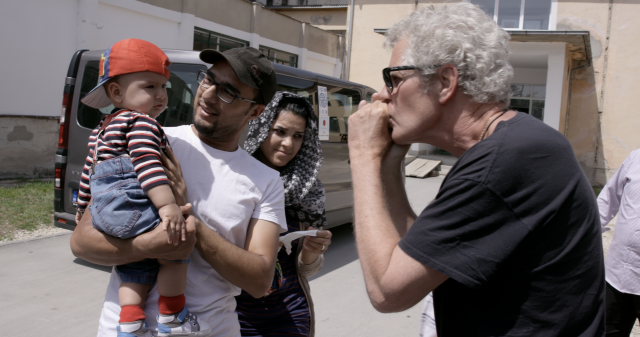
Jack Baxter plays the harmonica for a child at the Presevo Refugee Camp in Serbia in The Last Sermon

THE LAST SERMON (Jack Baxter & Joshua Faudem, 2019)
Opens in theaters, VOD, and virtually December 15
www.thelastsermonmovie.com

“There is no superiority of an Arab over a non-Arab, or of a non-Arab over an Arab, or of a white over a Black, or a Black over a white except by righteousness and piety,” Jack Baxter says from his hospital bed at the beginning of the deeply personal documentary The Last Sermon, quoting from the Prophet Muhammad’s Farewell Sermon delivered in March 632. “That’s the essence of Islam . . . Not murder.”

It was a long road to The Last Sermon for Baxter and his codirector, Joshua Faudem. In September 1993, Baxter was trying to interview Louis Farrakhan for what would become his controversial documentary Brother Minister: The Assassination of Malcolm X when he was introduced to the prophet’s Last Sermon by an Arab man. A decade later, in April 2003, Baxter went to Israel to make a documentary about accused Palestinian terrorist Marwan Barghouti, only to find out that someone else was already doing that. While taking a walk along the beach the night before he was going to go back to the States, he heard blues music coming from a bar and discovered Mike’s Place, a Tel Aviv nightclub, next to the US Embassy, where people of all races, religions, and ethnicities gathered to drink, speak in English, and listen to live blues.

Baxter teamed up with Faudem and began shooting a documentary about the club when the narrative drastically changed: On April 30, 2003, two radicalized British nationals who had entered Israel through the Gaza Strip went to Mike’s Place on a suicide bombing mission, killing Ran Baron, Dominique Caroline Hass (who they had interviewed for the film), and Yanai Weiss in the bar and seriously wounding Baxter, leaving him partially paralyzed and with “organic shrapnel” in him — tiny bits of one of the bombers. Their 2004 documentary, Blues by the Beach, ended up being very different from its original intention.

In 2015, Baxter and Faudem published the graphic novel Mike’s Place: A True Story of Love, Blues, and Terror in Tel Aviv. And then, in 2016, they set out to make a film about the refugee crisis in Europe but decided to also try to meet the families, now living in England, of the two suicide bombers. The Last Sermon follows Baxter, who grew up Irish Catholic in the Bronx and likes to play the harmonica, and Faudem, a former Israeli checkpoint guard, as they travel to Macedonia, Serbia, Berlin, Budapest, Prague, Paris, and London, visiting refugee camps, mosques, and other locations, speaking with politicians, religious leaders, journalists, musicians, scholars, fashion designers on a photo shoot, a graffiti artist, and an anti-refugee singer-songwriter, as they try to track down the suicide bombers’ families with the help of an investigator.

Baxter notes that documentarians are not supposed to be part of the story, but he explains early on that he is breaking that rule. He admits he’s not clear about what he is seeking and hasn’t planned what he will say to the families if they agree to meet with him. Cinematographer Avi Levi, who served in the Israeli army with Faudem, often focuses on Baxter deep in thought, reflecting on what he’s seeing and what he’s remembering, as his purpose grows stronger the closer he gets to his goal. Baxter, who sports impressive curly white locks, might be a peacenik — he is most often seen wearing a black T-shirt with the English word “Peace” on it, with the Hebrew above and the Arabic below — but he turns ever-more-ornery after all that he has witnessed on the way to London.

One of the most moving interactions is at the Grand Mosque of Paris with radicalization consultant Mohammed Chirani, who works with arrested terrorists. “Religion is the pretext,” he says. “There’s the ideology and there’s the religion. If ideology wants to gain power, it clothes itself with religion, with the sacred, and says, ‘Everything you’re doing, if you murder, or if you commit terrorist attacks, it’s a jihad, an honorable action. You do it in the name of G-d so you can go to paradise.’ So it’s a perversion. They need to deconstruct to separate ideology from religion and act on their spirituality.”

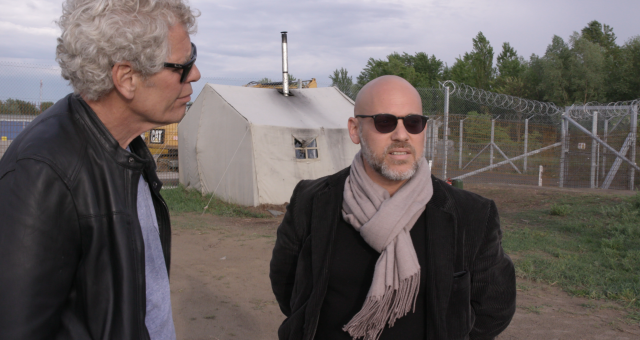
Jack Baxter and Joshua Faudem stand near the Hungary border fence in The Last Sermon

Baxter doesn’t believe that the terrorists can, or should, be saved, that they are blatant murderers who cannot be reformed. Chriani responds, “For me, radicalization is a combination of ideology, which is the manipulation of religion, due to a breach inside the individual, a failure of meaning and identity. Who am I? Where do I come from? Where am I going? . . . They have a right to redemption.” Baxter is not so sure. It’s the turning point of the documentary, as Baxter starts getting visibly angrier the rest of the way. “Who am I? Where do I come from? Where am I going? . . . They have a right to redemption” are, of course, also the questions Baxter must answer for himself.

Winner of the Best Documentary Feature and the Truth Seeker Award at the 2020 Queens World Film Festival, The Last Sermon is an intimately powerful, beautifully photographed exploration of radicalization, bigotry, hate, PTSD, and humankind’s basic desire for peace but intrinsic propensity to fight. It takes us inside one man’s very personal journey, baring his raw, exposed emotions as he tries to find resolutions that might never be able to satisfy the gaping void in his life, something we can all understand. It’s often painful to watch, but it’s also necessary, especially in these dark times. Shalom. Peace. سلام.

JASON SURAN: RECONNECTED

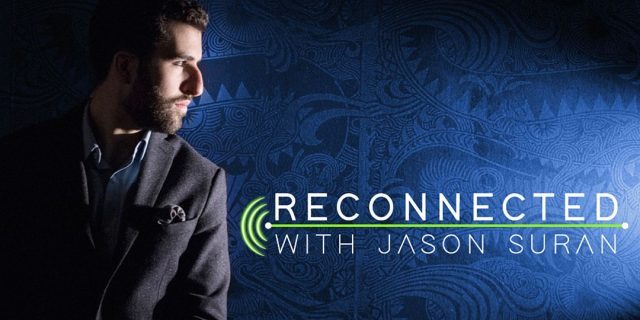
RECONNECTED: A VIRTUAL EXPERIENCE WITH MENTALIST JASON SURAN
Friday & Saturday nights through January 15 (extended through July 23), $50, 8:30
www.jasonsuran.com/reconnected

It’s one thing for mentalists to blow your mind in person. But over Zoom?

Performer and corporate consultant Jason Suran has figured out a way to do just that with his virtual show Reconnected, which takes place weekends through July 23. At each sixty-minute presentation, Suran appears before about three dozen people who have paid fifty dollars each to experience Suran’s unique abilities at what he calls “brainfuckery.” Beaming in from his home in New York City, Skokie-born Suran, whose previous works include The Other Side: A Psychological Seance and All in Your Head: An Evening of Mindreading, performs psychological illusions involving words, numbers, sharp objects, and a homemade pendulum that seem impossible but unfurl before your very eyes.

Even if you’re skeptical about mentalists and mindreading, Suran is likely to win you over with his innate charm and good humor. It also helps if you participate, either volunteering or being chosen; I have to admit to being a wee bit disappointed until Suran called on me to be part of the big finale, which was unforgettable.

When not performing feats of wonder, Suran, who conceived of the show with coproducer Adam Rei Siegel, trains corporate executives to improve observation and communication skills through his seminar “Hacking Minds,” focusing on cold reading, memory systems, and strategic questioning. Those talents are in full evidence in Reconnected; you should come prepared to use your own powers of observation and communication as well, at a moment’s notice, to enhance your experience.

“The best part of my job has always been connecting with the audience. I mean, that’s the whole point of reading minds,” Suran says in a sneak preview you can watch above. “The strange thing is, after all the shows I’ve done, all the rooms I’ve worked, all the people I’ve gotten to know, the truth is, I’ve never felt closer to the crowd than I do right now.” At a time when we are all hungering to be part of a crowd, to sit beside other people in a dark theater as we are entertained, Reconnected gives us the opportunity to connect with others, even if it’s onscreen. As the pandemic lockdown continues, there’s a lot to be said for that — and it certainly doesn’t hurt when that connection is loads of fun.

LIFT UP

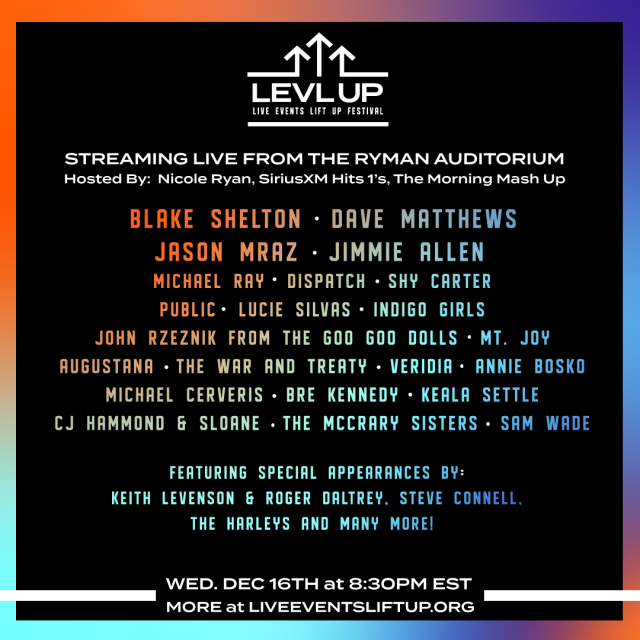
Who: Blake Shelton, Dave Matthews, Jimmie Allen, Jason Mraz, Michael Ray, Shy Carter, the War and Treaty, John Rzeznik, Dispatch, Keala Settle, Mt. Joy, Augustana, Indigo Girls, Lucie Silvas, Annie Bosko, Bre Kennedy, CJ Hammond & Sloane, Veridia, Public, Michael Cerveris, the McCrary Sisters, Sam Wade, Roger Daltrey, Steve Connell, Michael McDonald, Kenny G, Jeff Tweedy, Nick Wheeler, Greta Van Fleet, Adam Gardner, Ray Parker Jr., Jerry Dipizzo, Taye Diggs, Ben Wysoki, the Harleys, Dublin Gospel Choir, Jim Sheridan, Storme Warren, Nicole Ryan
What: “A Festival of Music & Stories of Life On & Off the Road”
Where: Ryman Auditorium
When: Wednesday, December 16, free (donations encouraged), 8:30
Why: “It is so important that music fans and governments realize the impact this virus is having on millions of self-employed people who make the music industry function to bring much needed joy to our lives,” Roger Daltrey says about the effect the pandemic lockdown is having on the people who make a living supporting the work of superstar musicians. Daltrey will be appearing along with dozen of other rock, country, pop, R&B, and gospel musicians at “Lift Up,” a festival streaming live on Twitch from the Ryman Auditorium in Nashville that benefits the entertainment and events industry. The concert will feature the brand-new song “12 Million,” written by Sam Wade and LEVL UP music supervisor Keith Levenson in tribute to the crews that make music happen from behind the scenes. “Almost my whole adult life I have been touring in one shape or form and the road crews on my team and the venue crews that welcomed us and helped us put on a great show are all part of my extended touring family,” Cisco Adler said in a statement. “They really make it possible for artists like me to do what we do, and they are truly unsung heroes. They are also the first to be hit hard by a situation like this, so part of our mission at NoCap is to get shows happening again and get these good people back to work.”