twi-ny recommended events

21st CENTURY JAPAN: FILMS FROM 2001-2020

21st CENTURY JAPAN: FILMS FROM 2001-2020
Japan Society
February 5-25, $8-$12 for three-day rental per film, $99 for all-access pass through February 4
film.japansociety.org

Japan Society and Japan’s Agency for Cultural Affairs have teamed up for “21st Century Japan: Films from 2001-2020,” an impressive collection of Japanese works from the last twenty years, streaming February 5-25. This inaugural ACA Cinema Project consists of thirty films, from recent classics to online US premieres as well as a focus on Kiyoshi Kurosawa, including a one-hour talk with the director, moderated by Abi Sakamoto. Among the primo filmmakers being represented are Sion Sono, Yukiko Mishima, Shinya Tsukamoto, Naomi Kawase, Hirokazu Kore-eda, Yoji Yamada, and Takashi Miike, many of whom are well known to regular attendees of Japan Society’s annual summer Japan Cuts festival.

“While it’s impossible to really capture the last two decades of Japanese narrative fiction filmmaking in its full breadth, we are excited to share at least the tip of the iceberg for these three weeks in February,” Japan Society deputy director of film K. F. Watanabe said in a statement. “Online or otherwise, a large majority of these titles remain unavailable to watch with English subtitles in the U.S., so I hope this series provides an opportunity to create new fans of filmmakers such as Naoko Ogigami or Shuichi Okita and expand any preconceptions of what modern Japanese cinema can offer.” Below are select reviews; keep watching this space for more recommendations.

dreams of another life in AIR DOLL

Nozomi (Bae Doona) dreams that there’s more to life in Hirokazu Kore-eda’s Air Doll

AIR DOLL (Hirokazu Kore-eda, 2009)
Over the last twenty-five years, Japanese filmmaker Hirokazu Kore-eda has compiled a remarkable resume, directing fourteen narrative features and five documentaries that investigate such themes as memory and loss. His 2009 film, Air Doll, examines loneliness through the eyes of a blow-up doll come to life. Bae Doona stars as Nozomi, a plastic sex toy owned by Hideo (Itsuji Itao), a restaurant worker who treats her like his wife, telling her about his day, sitting with her at the dinner table, and making love to her at night. But suddenly, one morning, Nozomi achieves consciousness, discovering that she has a heart, and she puts on her French maid costume and goes out into the world, learning about life by wandering through the streets and working in a video store, always returning home before Hideo and pretending to still be the doll. Adapted from a manga by Yoshiie Goda, Air Doll is another beautiful, meditative study from Kore-eda. Nozomi’s wide-eyed innocence at the joys of life comes sweet and slowly, played with a subtle wonderment by South Korean model and actress Bae (Sympathy for Mr. Vengeance, The Host). The film does, however, take one nasty turn and is a bit too long, at more than two hours. But it’s still another contemplative gem from the masterful director of Maborosi, Nobody Knows, Shoplifters, and Still Walking.

Hiroyuki Sanada gets ready to fight in Yoji Yamada’s The Twilight Samurai

THE TWILIGHT SAMURAI (Yoji Yamada, 2002)
Hiroyuki Sanada is outstanding as the title character in Yoji Yamada’s period drama, The Twilight Samurai, playing a lowly ronin who chooses to take care of his family after his wife dies, instead of wielding his sword. During the day, he works as a bean counter, then goes straight home to his aging mother and two young daughters. When he learns that a childhood friend, Tomoe (Rie Miyazawa), is divorcing her abusive husband, he ends up fighting for her honor. But instead of battling his opponent with a sharp sword, he pulls out a piece of wood. Word of his skill reaches the highest level of his clan, who wants him to kill for them, setting up an emotional and psychological inner struggle for the quiet and shy family man. The Twilight Samurai, which was nominated for a Best Foreign Language Film Oscar, is a different kind of samurai movie, focusing more on love and loss than blood and vengeance.

The great Takashi Miike adapts manga in family-friendly genre fantasy The Great Yokai War

THE GREAT YOKAI WAR (YÔKAI DAISENSÔ) (Takashi Miike, 2005)
Mixing in a liberal amount of Time Bandits with The Wizard of Oz, throwing in a little Hayao Miyazaki, and adding dashes of Raiders of the Lost Ark, The Lord of the Rings, Gremlins, Return of the Jedi, Labyrinth, and even Kill Bill, Takashi Miike has wound up with an entertaining fantasy film for both kids and adults. Known more for such ultraviolent, hard-to-watch frightfests as Audition and Ichi the Killer, Miike reveals his softer side in this genre film based on a yokai manga by Shigeru Mizuki (who also plays the Demon King). Ryunosuke Kamiki is splendid as Tadashi, a young city boy taking care of his grandfather (Hiroyuki Miyasako) in a country village, where he is chosen at a local festival as the mythical Kirin Rider, the guardian of peace and friend of justice. Soon he finds himself in a real battle between good and evil, taking him from the heights of the Great Goblin’s mountain cave to the depths of a seedy underworld run by the very white Agi (Chiaki Kuriyama) and powerful mastermind Katou Yasunori (Etsushi Toyokawa). Joined by yokai spirits Kawahime (Mai Takahashi), Kawatarou (Sadao Abe), and the oh-so-cute Sunekosuri, Tadashi fights to save the human world, wielding his special sword against a phalanx of mechanical robots and other villainous creatures. At more than two hours, The Great Yokai War is at least twenty minutes too long and would have greatly benefited by the excision of one very silly subplot. But it is still a charming tale from one of the true masters of horror.

MONTH OF REST

MONTH OF REST
February 4, 14, 17, 28, free with RSVP
playco.org

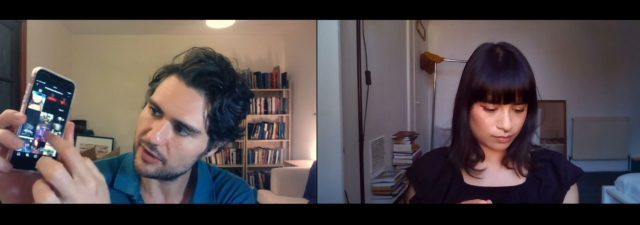
Last week, New York–based PlayCo premiered the first iteration of William Burke’s Is It Supposed to Last?, an interactive Zoom party in which attendees brought streamers, fun dress, and food and drink to a gathering that began with an ominous live piano performance of Neil Diamond’s classic “Sweet Caroline,” a favorite in bars, concert halls, sports arenas, and the internet, as evidenced by a December global singalong. But Is It Supposed to Last?, directed by Burke and Bryn Herdrich and starring Jehan O. Young and Carolina Đỗ, with music by Sugar Vendil, took a turn on the state of the world with a pair of monologues and an isolated man getting wrapped up, concluding with multiple recorded versions (Elvis!) as people decided how long they wanted to continue listening to a song that usually provides an instant connection among friends and strangers. PlayCo has vowed to do less in February, hosting four free activities before returning with the next iteration of Is It Supposed to Last? in March. It all starts February 4 at 12:30 with a gentle, guided nap led by Đỗ, addressing such questions as “Why must we, as adults, have to live with nap regrets?” and “Do you feel the siren’s call to just slip away from work into dreamland for just a lil teeny tiny nap?” On February 14 at 5:00, Justin Taylor explores self-compassion in a group meditation, advising you to love yourself even if you might be alone on Valentine’s Day. On February 17 at 11:30, Charlene Adhiambo will offer journaling tips with prompts and freewriting. And on February 28 at 8:00, you can get shaking with the virtual Social DisDance Party with Ani, Sunny, and other members of PlayCo, kicking loose as the cold, short month comes to an end.

PHASES AND THE IN-BETWEENS

Phases and the In-Betweens features animation, text, and video incorporating the phases of the moon into caregiving during the pandemic

PHASES AND THE IN-BETWEENS
The Shed
Through February 11, free
theshed.org

Phases and the In-Betweens is a collaborative intervention on the website of the Shed, the Hudson Yards performance center that opened in 2019 and hosts music, theater, dance, art, and other programs and exhibitions. The ongoing multimedia piece changes with the phases of the moons; it began with the new moon on January 13 and was updated for the first quarter January 20; next up is the last quarter on February 4, followed by the new moon on February 11, which will signal the end of the project. Phases and the In-Betweens is created by Brothers Sick, consisting of artist, educator, and curator Ezra and photographer Noah Benus; interdisciplinary media artist Yo-Yo Lin; and poet, curator, and critic DJ Queer Shoulders (danilo machado). Incorporating animation, text, and video, the work examines issues of caregiving, disability, and lockdown as they relate to the “phases of reopening” and the inevitable return to whatever “normal” might be on the other side of the Covid-19 crisis. “For this project, at its core, we really wanted to think about what care looks like in private and public and how that relationship of care is enacted during a global pandemic,” Brothers Sick said in a statement. “From there, we reference different elements of care in isolation and public, layering and blurring the intimacy of illness and public life during precious and precarious outings. We layer and blur hierarchies of material, media, and experience. For the format, we really wanted to explore these ever-present ideas of care and sickness through a broadened presentation of digital art sharing and making, across sick, disabled, Crip time, pandemic time, celestial space and time, and across ourselves in our care networks with our collaborators.”

They accomplish that with bold imagery, words that jump out at you, and detailed medical information. They narrate, “squirm fingers / nitrile disposable sanitary / a map of new york city has joined / the right side of frame / colors change from shades of green to blue / metrics and mappings / testing and cases / patches of pink and purple and orange / we move faster to the left passing more fans, / a worker and a uniformed soldier, who waves / sterling silver ringed finger / scroll touch screen questionnaire / how much pain / how severe.” Phases and the In-Betweens is part of the Shed’s “Up Close” digital series, which has previously presented House or Home: 690 Wishes with the HawtPlates and Charlotte Brathwaite, Revelation of Proverbs by Reggie ‘Regg Roc’ Gray and the D.R.E.A.M. Ring, Go Off! Joy in Defiance with DJ April Hunt, Rashaad Newsome, Legendary Monster Mon_Teese, and Precious, Solo B by Mariana Valencia, and other programs.

THE KITCHEN PLAYS

Who: Eden Theater Company
What: Short Zoom plays about isolation
Where: Eden Theater Zoom and Facebook Live
When: February 5, 11, 12, 19, 20, $5-$50, 8:00
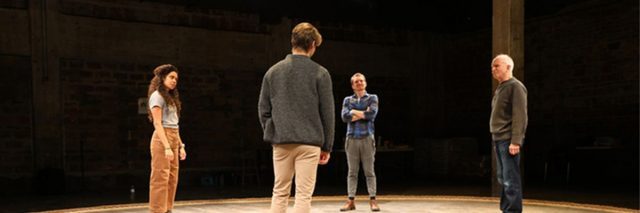
Why: New City–based Eden Theater Company continues exploring our living quarters, where we’ve been stuck since last March, with The Kitchen Plays, the follow-up to last year’s Room Plays, which took us through the bedroom, the living room, and the bathroom. The short works are like windows into the situations so many of us are experiencing as we still shelter in place, waiting for the vaccine to be administered to enough people so we can really start opening things up and return to some semblance of normalcy.

The Kitchen Plays consist of Jake Brasch’s (The Man in the Fuchsia Mask) Ginger Bug, directed by Amber Calderon and starring Brasch and Madeline Barr as a husband and wife battling it out in their weekly cookoff; Eden creative artistic director Cassandra Paras’s (Daeva) Passion Project, directed by Byron Anthony (The Man in the Fuchsia Mask) and featuring Paras (Monogamous Animals) and Larry Fleischman as a couple rehearsing an audition scene; and Madison Harrison’s For the Family, directed by Eden producing artistic director Diane Davis, with Owen Alleyne and Danielle Kogan in a story set around a Thanksgiving with estranged parents as guests. The three works will be performed live February 5, 11, 12, 19, and 20 at 8:00; tickets begin at $5 based on what you can afford.

RED FOLDER: AN ILLUSTRATED SHORT PLAY

RED FOLDER
Steppenwolf Now
January 27 – September 1, $75 for six online productions
www.steppenwolf.org

“Why aren’t you my friend?” a first grader asks his red folder in Rajiv Joseph’s devilishly clever and insightful short Red Folder, part of Steppenwolf’s online streaming portal, Steppenwolf Now. Written, directed, and illustrated by ensemble member Joseph, a Pulitzer Prize finalist and two-time Obie winner whose previous plays include Bengal Tiger at the Baghdad Zoo, Guards at the Taj, and Describe the Night, Red Folder is like an audiovisual children’s book gone mad, a deranged and demented — and repeatedly laugh-out-loud funny — story about fear of not fitting in, of loneliness and being different. “It’s something that I never would have conceived of doing outside of the restrictions that the pandemic has imposed on us,“ Joseph tells Steppenwolf artistic director Anna D. Shapiro in a video teaser.

Red Folder is a calmly told demented tale of a child’s fears in first grade

The tale takes place within a squiggly circle against a solid off-white background, with rather simplistic line-drawn characters and imagery, like a chapter of a miniature DIY graphic novel come to life. Joseph concentrates on red and black, with an occasional flash of green and yellow as anthropomorphic figures haunt the boy’s daily existence, which involves pudding, skulls, blood, a stained coffee mug, a mean teacher, and a beloved Hulk lunch box. The story is narrated in an appropriately cool, dispassionate tone by Steppenwolf’s Carrie Coon (Mary Jane, Who’s Afraid of Virginia Woolf?), accompanied by Chris P. Thompson’s original piano score, a riff on Vince Guaraldi’s music for A Charlie Brown Christmas. The eleven-minute piece was filmed and edited by Joel Moorman, with animation by Christopher Huizar; it’s essentially a memory play that will send you back to first grade and childhood’s existential dread, remembering your teacher and classmates and favorite lunch box. Hopefully what happens to the boy didn’t happen to you, although you probably experienced the same fears, the same worries, and the same overall horror that accompanies one’s first encounter with institutional authority.

Red Folder is available for streaming as part of the Steppenwolf Now package, which also features James Ijames’s two-person short Zoom play What Is Left, Burns and Isaac Gómez’s audio play Wally World; coming up next are Vivian J. O. Barnes’s Duchess! Duchess! Duchess! in March, Donnetta Lavinia Grays’s Where We Stand in April, and Sam Shepard’s Ages of the Moon in June.

100 DAYS TO LIVE

100 DAYS TO LIVE (Ravin Gandhi, 2019)
Available Tuesday, February 2
100daystolive.co

“Every ten minutes, someone in America kills themselves,” suicide prevention counselor Rebecca Church (Heidi Johanningmeier) says near the beginning of Ravin Gandhi’s cinematic debut, the insightful if methodical psychological thriller, 100 Days to Live, which releases online February 2. Gandhi is an unlikely filmmaker, a successful Illinois businessman who made his money in nonstick coatings and private equity. He felt compelled to make this film, which he wrote over several years on nights and weekends and ultimately shot in three weeks on an indie budget, much of it filmed in his house; he even cast his mother in it. But it’s not an “issue” movie: It’s a serial killer flick with a unique and powerful twist, involving suicide. “What do you see when you fantasize about death?” the killer (Gideon Emery) asks.

Suicide prevention counselor Rebecca Church (Heidi Johanningmeier) faces off against a serial killer in 100 Days to Live (photo by Nicholas Puetz)

Rebecca is putting her life back together, falling in love with Gabriel Weeks (Colin Egglesfield). But when Gabriel is kidnapped by the killer, who stalks his prey for days in an ominous white van, Rebecca works with Detective Jack Byers (Yancey Arias) to try to save him. The city of Chicago is a character unto itself as the hunt continues and characters’ secrets emerge.

Winner of the Best World Premiere and Best First Time Director awards at the 2021 San Diego International Film Festival, 100 Days to Live features several cool turns that appear just in time, whenever the narrative threatens to get bogged down in cliché or get stuck in a big plot hole. Gandhi, who serves as writer and director as well as one of the producers and executive producers, tends to forge ahead with a fairly straightforward procedural style, both visually and with the narrative, but the main twist is so good, it’s worth sticking around for and seeing through to the end.

HI, ARE YOU SINGLE?

HI, ARE YOU SINGLE?
Woolly Mammoth Theatre Company
February 1-28, $20.99 for forty-eight-hour stream (captioning and audio description available)
www.woollymammoth.net

Ryan J. Haddad wants to get laid. A lot. And also find true love and inner happiness. Is that so much to ask? He shares his bittersweet, hugely entertaining story in his one-man show Hi, Are You Single?, streaming from Woolly Mammoth Theatre Company February 1-28. Haddad delves into his deepest desires in the hourlong autobiographical play, which was filmed live on Woolly Mammoth’s DC stage, in front of a small, masked, socially distanced audience made up of members of the staff and design team.

“Have you ever felt an overwhelming sense of longing for companionship and intimacy and love?” he asks. “And how many of you just get horny sometimes, huh?” Haddad, who is gay and has cerebral palsy, requiring the use of a walker, details various encounters with men, from a high school football player to guys he meets on a gay dating site, at an East Village bar, and other pickup hotspots. He is engagingly open and honest, which can be both shocking and hysterically funny, and not just because of his disability, which he does not let stop him from fulfilling his sexual urges, like loving to be cuddled after being spanked. He also poignantly relates the issues of being both gay and disabled. After coming out to his mother, she tells him, “I’m scared, because now you’re different in two ways.”

Ryan J. Haddad gets intimate in autobiographical one-man show (photo by Lawrence E. Moten III)

Hi, Are You Single? has been touring the country since 2016; the filmed version, presented in association with LA’s IAMA Theatre Company and directed by Laura Savia and Jess McLeod, arrives at a time when theater-hungry audiences are desperate for intimate artistic connection, not unlike the companionship Haddad seeks, save, perhaps, for the erotic sexual aspect. Haddad, whose previous work includes My Straighties, Noor and Hadi Go to Hogwarts, and Falling for Make Believe at such venues as the Public Theater, Ars Nova, Joe’s Pub, Dixon Place, and La MaMa E.T.C. here in New York, also deftly handles a part of the show in which he brings someone onstage to dance with him, a startling yet affecting moment during the coronavirus crisis. In Hi, Are You Single?, Haddad takes a long look at himself, which makes us look at ourselves in solidarity, in a wholly satisfying show that will yet leave you aching for more.