Who: Claire Danes What:Shakespeare Hour Live! discussion about Romeo + Juliet Where:Facebook Live and YouTube Live When: Friday, April 23, free, 8:00 Why: Twenty-five years ago, Leonardo DiCaprio and Claire Danes starred as the title lovers in Baz Luhrmann’s Romeo + Juliet, a modern-day adaptation of Shakespeare’s tragedy, pitting two business empires against each other, the Montagues and the Capulets, while using the the Bard’s original dialogue. On the night that PBS’s Great Performances presentation of the National Theatre’s Romeo & Juliet, which was filmed following Covid-19 protocols, is making its US premiere, Danes will talk about the movies and the play in the latest Shakespeare Hour Live!, the ongoing series hosted by DC’s Shakespeare Theatre Company, whose artistic director, Simon Godwin, directed the National Theatre production. Luhrmann’s 1999 movie features Brian Dennehy and Christina Pickles as Romeo’s parents, Paul Sorvino and Diane Venora as Juliet’s folks, John Leguizamo as Tybalt, Dash Mihok as Benvolio, and Miriam Margolyes as the nurse, while Godwin’s version, which makes full use of the National Theatre space, stars Jessie Buckley as Juliet and Josh O’Connor as Romeo, with Tamsin Greig as Lady Capulet, Lloyd Hutchinson as Lord Capulet, Colin Tierney as Lord Montague, David Judge as Tybalt, Alex Mugnaioni as Paris, Shubham Saraf as Benvolio, Adrian Lester as the prince, Fisayo Akinade as Mercutio, and Deborah Findlay as the nurse.
Who:Gingold Theatrical Group What: Virtual open mic Shakespeare birthday celebration Where:Gingold Zoom and Facebook When: Friday, April 23, free with RSVP, 6:00 Why: This month marks William Shakespeare’s 457th birthday as well as the 405th anniversary of his death, and New York City’s Gingold Theatrical Group, which specializes in works by George Bernard Shaw, will be paying tribute to the Bard with a free, virtual Shakespeare Sonnet Slam open mic on April 23 at 6:00. Among those who will be reading from Shakespeare’s writings are Stephen Brown-Fried, Robert Cuccioli, Tyne Daly, George Dvorsky, Melissa Errico, Alison Fraser, Tom Hewitt, Daniel Jenkins, John-Andrew Morrison, Patrick Page, Maryann Plunkett, Tonya Pinkins, Laila Robins, Jay O. Sanders, Renee Taylor, and Jon Patrick Walker — and the general public, who is invited to offer their own favorite pieces either by or inspired by Will, kept to less than three minutes. “We’re eager to celebrate as much as we can with whatever we can these days,” GTG artistic director David Staller said in a statement. “And since nobody has contributed more to the world of the theater than William Shakespeare, we’re going to celebrate like mad. He wrote more than 150 magnificent sonnets and I doubt we’ll get through them all but we’ll give it our best shot.” In order to be part of the interactive festivities, you must register by April 22 at 4:00.
The life and art of Bill Traylor are the subject of illuminating documentary (photo courtesy Jean and George Lewis / Caroline Cargo Folk Art Collection)
“I think Traylor is probably the greatest artist you’ve never heard of, but he’s getting heard of more and more,” art critic Roberta Smith says at the beginning of Jeffrey Taylor’s Bill Traylor: Chasing Ghosts, an insightful documentary that runs April 16–22 at Film Forum — both virtually and in person at the West Houston St. theater.
I well remember the first time I truly encountered the scope of Bill Traylor’s art, at a pair of 2013 exhibits at the American Folk Art Museum. I had seen his work before, but these two shows opened my eyes to his immense self-taught skill and his poignant and personal view of the world he had experienced, becoming, in his later years, a unique chronicler of the American South, from slavery and the Civil War through the Great Migration and the Great Depression to Jim Crow and WWII. He passed away in 1949 at the age of ninety-six, leaving behind some 1,500 drawings, all made between 1939 and 1942; it would still be decades until he would be duly recognized him as one of the most important artists of the twentieth century.
Director, producer, and editor Taylor and writer-producer Fred Barron tell Traylor’s uniquely American tale through archival photos, commentary from art connoisseurs and historians, members of Traylor’s family, and, most important, images of hundreds of his works. Born into slavery in Benton, Alabama, in 1853, Traylor was a slave on a cotton plantation, a field hand, a tenant farmer, a shoe repairman, and an ill homeless man while fathering nine children with multiple women before spending three years sitting behind a small refrigerated soda case on Monroe St. in Montgomery, Alabama, drawing both from memory and observation of the bustling Black community in front of him. Using anything he could find — torn paper, stained cardboard with logos on one side — Traylor would draw flat, silhouetted objects, primarily in black but with flourishes of blue, red, and occasional yellows, imbued with a musicality that breathes life into them while also exploring race and class; today, his art evokes elements of both Jacob Lawrence and Kara Walker. Taylor often juxtaposes Traylor’s drawings with photographs of places that might have served as inspiration, which offer further understanding of the art and the man.
“There are certain elements in the work — the use of animal spirits and plant spirits, and there’s hybrid people, there’s were-people — that all of these speak to someone operating intentionally with the desire to render the fantastic. So he’s giving us a whole enchanted, magical realm,” writer, musician, and producer Greg Tate says, adding, “The mystery prevails throughout.” Artist Radcliffe Bailey notes, “When I look at Traylor’s work, I see this freedom of expressing, or seeing what’s going on around him but also being very lyrical about it.” Among the others celebrating Traylor with a deep reverence are archivist Dr. Howard O. Robinson II, professor Richard Powell, and curator Leslie Umberger. Taylor includes readings by actors Russell G. Jones and Sharon Washington, songs by Willie King, Lead Belly, Buddy Guy, and Chick Webb, and tap dances by Jason Samuels Smith, along with the words of Zora Neale Hurston and Langston Hughes as well as the white painter and teacher Charles Shannon, who championed and represented Traylor.
The film’s latter section focuses on Traylor’s descendants, including his great-grandson Frank L. Harrison, who tears up when talking about his ancestor. Some knew of Traylor, and some didn’t, which is all part of his legacy. Umberger, who curated the major 2018-19 Smithsonian retrospective “Between Worlds: The Art of Bill Traylor,” sums it up when she states, “He put down this entire oral history in the language that was available to him, which was the language of pictures.” What pictures they are, and we now know more about where they came from, thanks to Chasing Ghosts.
Who:Stefan Falke What: Illustrated discussion live on Zoom Where:Coney Island USA online When: Wednesday, April 21, $5, 7:00 Why: We have known photojournalist Stefan Falke for several decades and have enjoyed watching his career soar. The award-winning German-born, NYC-based photographer travels the world, documenting stilt walkers in the Caribbean (“Moko Jumbies: The Dancing Spirits of Trinidad”), artists on either side of the southern border (“LA FRONTERA: Artists along the US–Mexico Border”), film shoots, and, for his latest project, New Yorkers during the time of Covid in Keep Going New York!, celebrating the spirit of the city as it battles a pandemic, economic distress, and sociopolitical rage. On April 21 at 7:00, Falke, whose work is represented in “The Flag Project” at Rockefeller Center through the end of the month, will talk about his work in the popular Coney Island USA series “Ask the Experts,” which used to take place at the Coney Island Museum but is currently being held over Zoom. The series continues April 28 with lover-of-the-unusual Marc Hartzman, May 5 with visual artist and Wild Style director Charlie Ahearn, and May 12 with Sideshows by the Seashore painter Marie Roberts.
NYTF’s Yiddish Women Playwrights Festival gets under way with The Bird of the Ghetto
Who: Rachel Botchan, Rebecca Brudner, Spencer Chandler, Motl Didner, Kirk Geritano, Avi Hoffman, Maya Jacobson, Daniel Kahn, Lea Kalisch, Rebecca Keren, Avram Mlotek, Lauren Schaffel, Dylan Seders Hoffman, Tatiana Wechsler, Hy Wolfe, Mikhl Yashinsky What: Inaugural production in NYTF’s Yiddish Women Playwrights Festival Where:Folksbiene Live! When: April 18-22, free Why: At one point in The Bird of the Ghetto (Der Foygl fun Geto), a bird has fallen from a bathhouse roof. “A bird! Look, we found a bird, ” Falke exclaims. When she looks closer, she adds, “I think it’s sick.” Picking up the bird, Sholemke says, “It has broken wings. Look how it trembles. It’s frightened. Do you know how to heal sick birds, Yoyne?” Yoyne responds, “Ask Borukh, he might know.” Falke: “Do you know how to heal sick birds?” Shlemke: “Look, it can’t fly.” Yoyne: “You see, mister? A ghetto bird. You ought to pin the Star of David on it.” Borukh finally chimes in, “A real bird could fly in the ghetto too.” Sholemke: “You mean this is not a real bird? It’s alive. Look, it moves.” Borukh: “A bird should be able to fly. If it can’t fly, it’s not alive even if it lives.” Sholemke: “It’s sick.” Borukh: “So it is.” Falke: “Tell us what to do.” Borukh: “There isn’t much you can do. Be kind to itself, let it help itself.”
Written in 1958 by Holocaust survivor Chava Rosenfarb, The Bird of the Ghetto tells the true story of Jewish resistance fighter Itsik Vitenberg and the 1943 Vilna uprising. Although the play was written in Yiddish, it has never been performed in that language until now, in a virtual reading by the National Yiddish Theatre Folksbiene, directed by Suzanne Toren and translated by Goldie Morgentaler. The two-hour work is streaming for free April 18-22, in conjunction with the seventy-eighth anniversary of the Warsaw Ghetto Uprising. It features Rachel Botchan as Edzshe, Rebecca Brudner as Ester, Spencer Chandler as Vitenberg (commander of the United Partisan Organization, known as the FPO), Motl Didner as Shloyme, Kirk Geritano as Yoyne, Avi Hoffman as Judenrat head Yakov Gens, Maya Jacobson as Freydke, Lea Kalisch as Tea, Rebecca Keren as Dine, Avram Mlotek as Borukh, Lauren Schaffel as Falke, Dylan Seders Hoffman as Sholemke, Tatiana Wechsler as Sorke, Hy Wolfe as the doctor, and Mikhl Yashinsky as Yehude. Nearly all the characters wear a large yellow star on their clothing, identifying them as Jewish. The production kicks off NYTF’s Yiddish Women Playwrights Festival, which celebrates Yiddish plays by women writers. “As we commemorate the anniversary of the Warsaw Ghetto uprising, the true story behind The Bird of the Ghetto is a moving testament to the bravery and resilience of the Jewish resistance during the Holocaust,” NYTF artistic director Zalmen Mlotek said in a statement.
Park Ave. Armory, Wade Thompson Drill Hall
643 Park Ave. at 67th St.
April 9-22, $45 ($35 standby tickets available)
212-933-5812 www.armoryonpark.org
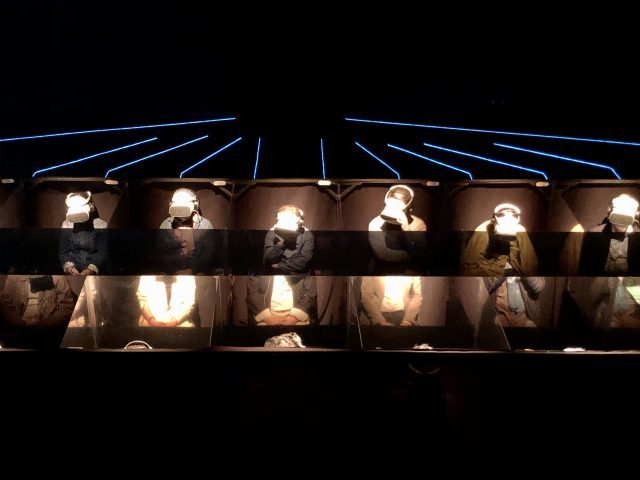
Twister is the most physical of board games. The more people come into contact with one another on the plastic mat — which contains colored circles that participants must touch with one of their hands or feet depending on what the spinner tells them to do — the more fun it is to play and to watch. The same can be said for dancing, a social activity that brings people together in numerous ways. In a 2015 study, Bronwyn Tarr, Jacques Launay, Emma Cohen, and Robin Dunbar explained, “All human cultures perform and enjoy forms of music and dance in a group setting. Dancing involves people synchronizing their movements to a predictable, rhythmic beat (usually provided by music) and to each other. In this manner, dance is fundamentally cooperative in nature, and may have served the evolutionary function of encouraging social bonds, cooperation, and prosocial behaviors between group members. To date, empirical support for this social bonding hypothesis is based mainly on a link between synchrony (i.e. performing the same movement at the same time) and bonding.” In a twist on both Twister and dancing, the Park Ave. Armory commission Social! the social distance dance club incorporates people, colorful circles on the floor, and synchronous bonding in an immensely boisterous evening of interaction that features no touching whatsoever.
The armory was supposed to kick off its Social Distance Hall series with Bill T. Jones’s Afterwardsness, but several positive Covid tests in the company led to its postponement until May, after Party in the Bardo, a collaboration between Laurie Anderson and Jason Moran running May 5-9. Conceived by choreographer Steven Hoggett (The Curious Incident of the Dog in the Night-Time,Harry Potter and the Cursed Child), Tony-winning set designer and solo show specialist Christine Jones (American Idiot,Here We Are: Theatre for One), and multidisciplinary artist David Byrne (Talking Heads, American Utopia), Social! takes place in the fifty-five-thousand-square-foot Wade Thompson Drill, where nearly one hundred ticket holders spend fifty-five minutes moving and grooving in their own private circle.
To songs by D-Train, Daft Punk, James Brown, Benny Goodman, Olivia Newton-John, Fatback, Byrne, and others, the former Talking Heads leader prompts us through various scenarios (hands waving in the air, weaving through a subway car, balancing at the edge of your circle, swaying slowly, etc., although some of it is hard to hear amid the thumping beats) before leading up to the grand finale, a unified dance that we were advised to rehearse in advance via a video in which Byrne demonstrates the moves.
The drill hall is a judgment-free space; no one is going to laugh at your dancing, and you’re not going to laugh at anyone else’s. It’s a time to kick loose and let it all go, immerse yourself in a worry-free hour of nonstop exhilaration. It’s not always easy — several people in my vicinity had to take rests, and one woman spent much of the show sitting in her circle — but the more you are able to put into it, the more you will get out of it. (Coldwell explains, “As we now know so well, it’s far easier to start dancing than it is to stop.”) And when you are taken back to your seat, a small, relevant little gift is waiting for you, one last reminder that even if we can’t be together in a physical way — Twister might not be on the menu for a bit longer — we can now gather safely and bond, as long as we’re tested, masked, socially distanced, and ready to have a blast.
Who: Penny Fuller, Bob Dishy, James Naughton, Susan Charlotte What: In-person and livestreamed play reading Where:Theatre 80 St. Marks and Zoom When: Monday, April 19, live and on Zoom, 2:00 (available on demand April 24-25, 646-366-9340 / info@foodforthoughtproductions.com) Why: Food for Thought Productions is now in its twenty-first season of presenting all-star readings of little-known and classic one-act plays by major writers. Its current series, “We Persist!,” kicked off with Christopher Durang’s For Whom the Southern Belle Tolls and Tennessee Williams’s Life Boat Drill, presented live at Theatre 80 St. Marks to a limited, masked audience. The award-winning company is now back for Arthur Miller’s I Can’t Remember Anything, directed by Antony Marsellis and starring Penny Fuller and Bob Dishy as an elderly widow and her late husband’s best friend, respectively; FFTP previously presented the play two decades ago with Elaine Stritch and Dishy, with Miller in attendance. (Miller would later go on to direct shows for the troupe.) The play will be followed by a Q&A with the cast, moderated by FFTP founder Susan Charlotte, with a special appearance by James Naughton, who directed Dishy in Miller’s The Price at the 1999 Williamstown Theatre Festival. In addition, FFTP regular Tony Roberts will read from his 2015 memoir, Do You Know Me? Free tickets to see the show in person are first come, first served, for those who agree to be part of a documentary being made about the company; the recording will be available for a small fee April 24-25. Next up for FFTP is Charlotte’s The Hairdresser on May 24.