twi-ny recommended events

KENNY SCHARF: WHEN WORLDS COLLIDE

Min Sanchez, Kenny Scharf, and Oliver Sanchez pose in front of Scharf’s artwork in Bahia, Brazil (photo by Tereza Scharf)

KENNY SCHARF: WHEN WORLDS COLLIDE (Malia Scharf & Max Basch, 2020)
Available on demand
www.kennyscharfmovie.com

“I have a balancing act between being a responsible adult and the Peter Pan syndrome because I just feel like life is so much about the moment, so I want every moment fun and beautiful,” Kenny Scharf says in the new documentary Kenny Scharf: When Worlds Collide. “It’s not reality.” Codirectors Max Basch and Malia Scharf — one of the artist’s daughters — try to make every moment of the film, now streaming on demand, fun and beautiful, often reaching that goal.

Shot over a period of eleven years, When Worlds Collide follows Scharf, who was born in 1958 in Los Angeles and moved to Manhattan to attend SVA, from his early days as a graffiti artist and muralist, when he met and became great friends with Keith Haring and Jean-Michel Basquiat and hung out with Andy Warhol at the Factory, to his vast popularity creating fantastical, colorful creatures in paintings and sculptures, from the lean years to his current obsession with recycling. “Use everything,” he says, extolling us to ”not waste precious plastic when you can turn it into bathroom sculpture” as he adds a plastic cup and straw to an ever-evolving work above his toilet.

Scharf and Basch, who also served as editor and one of the cinematographers, speak with former Ferus Gallery owner Irving Blum, art collector Peter Brant, gallerists Jeffrey Deitch and Tony Shafrazi, writer and poet Carter Ratcliff, art historian Richard Marshall, Whitney curator Jane Panetta, former Scharf assistant Min Sanchez, author and psychologist Gabor Maté, collectors Andy and Christine Hall, real estate developer Tony Goldman, and curator Dan Cameron, who all offer unique perspectives on Scharf as a person and an artist. “There’s no separation between Kenny and his art,” his friend and fellow artist Kitty Brophy says. There are also old and new interviews with such artists as Bruno Schmidt, Ed Ruscha, Samantha McEwen, Robert Williams, Marilyn Minter, KAWS, Dennis Hopper, and Yoko Ono as well as Scharf’s mother, Rose; wife, Tereza; daughters, Zena and Malia; and grandkids Jet and Lua, who share their thoughts and are seen in home movie footage.

“He just created a family where we felt we were understood and accepted for who we are,” actress and performance artist Ann Magnuson says. “The main way to communicate was to get out on the street, and the message got out there and of course the attention came, and then it started to unravel a bit when the success, the money, the fame, and the uptown world started paying attention to the downtown world. Some of that wonderful, naïve idealism was lost.”

The film doesn’t shy away from the devastation of the AIDS crisis or Scharf’s dry periods, when his style of surreal Pop art was out of favor, but he continues to create and is a fan favorite at international art fairs with his eye-catching work. He gets tearful when talking about Haring, shares his love of nature and cartoons (especially The Flintstones and The Jetsons), collects trash on the beach, remembers the influential Club 57, discusses his breakthrough painting, 1984’s When the Worlds Collide, and describes his penchant for pareidolia, seeing faces everywhere. It’s fascinating to watch him stand in front of a canvas, painting right from his imagination, without preparatory sketches. He comes off as a driven artist and dedicated family man who can be an endearing mensch. “Many people think I’m crazy, and I think that’s okay,” he says with a laugh.

GHOSTING: A PERFORMANCE ON SCREEN

Who: Anne O’Riordan
What: One-woman online play
Where: #IrishRepOnline
When: Through July 4, free with RSVP (suggested donation $25)
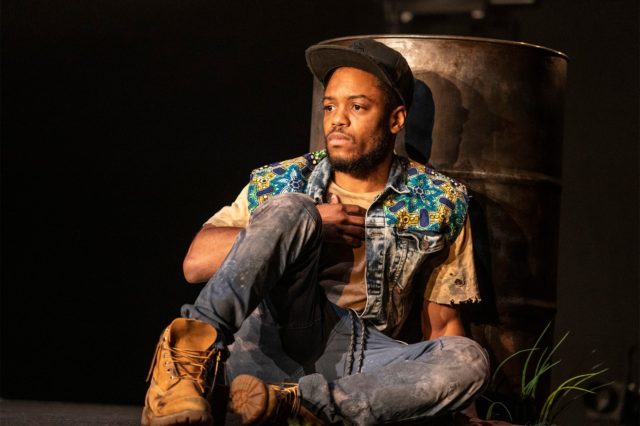
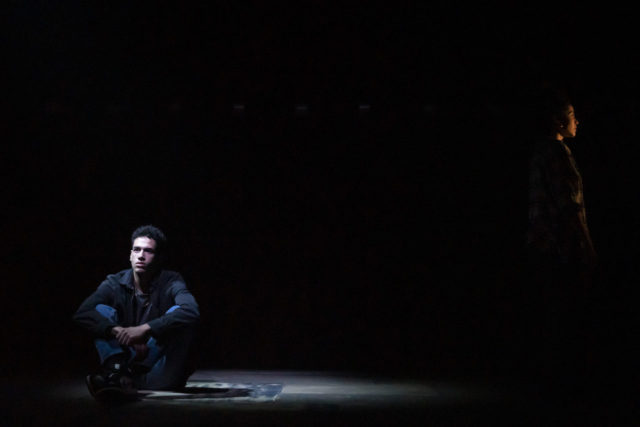
Why: The Irish Rep continues to be the most consistently innovative and creative company on the planet during the Covid-19 crisis with Anne O’Riordan and Jamie Beamish’s Ghosting, its latest “performance on screen.” The one-woman show debuted in London and made its Irish premiere at Theatre Royal in Waterford in 2019; O’Riordan returned to that stage in April 2020 for a livestreamed production that is now available on demand through July 4 via the Irish Rep, in conjunction with Throwin Shapes. O’Riordan plays Sí, a young Irish woman working in London when a strange visitor materializes in her apartment in the middle of the night. “I lie in bed and think. I know no one likes that these days but it’s ok to be on your own, with just your thoughts,” she tells us early on. “I like it. In the dark. No lights, no sound, no one to annoy me. You can lie there and hold your breath and wonder; is this it? Is this what it will be like to be dead? That’s all I was doing last night, the same thing I’ve done every night since I came to London five years ago. I was lying there awake, on my own. That’s fine sure. Who else do I want? Who else do I need? I don’t need anyone else in my life. I was thinking that exact thought last night when I realised that someone was in the bedroom with me.”

It turns out to be Mark Kelly, her onetime boyfriend who had ghosted her six years before, suddenly refusing to see her or speak with her, with no explanation. The next morning, Sí gets a text from her sister, Aisling, letting her know that Kelly died two days before. Sí says, “I feel a huge knot in my stomach. I don’t know why I’m even remotely bothered, sure he’s been dead to me for six years. He’s been blocked out of my mind for . . . well, until last night. When he . . .” At the spur of the moment, she decides to fly back home to attend the funeral, going back to her sister and father and hometown that she has been ghosting ever since she left for London. Once there, she learns more about her family and Kelly, complicating her situation and providing just as many questions as answers.

The seventy-five-minute play was written by O’Riordan and Beamish, who also serves as director, composer, and sound and projections designer, with lighting by Dermot Quinn and live video editing by Seán O’Sullivan. O’Riordan (Call the Midwife, Doctors) traverses the dark, empty set, the camera sometimes coming in for a close-up, then pulling back for a longer shot as if we’re sitting in the audience, which is empty. The projections take us from Sí’s office, the airport, and a smokey bar to a funeral home and the beach as Sí deals with a London colleague she calls Hobbit Tom; Laura, a high school acquaintance; the tall Lorcan, who works at the funeral parlor; and Mark’s mother, who has a surprising story to share. All the while, Sí considers whether she should see her father for the first time in what has been too long.

O’Riordan is mesmerizing as she examines her life not unlike how many of us have done over the last year and a half, as the coronavirus pandemic shuttered us in our homes, eliminated public gatherings, kept us far from loved ones, and was the cause of too many funerals. “We never really go away, do we?” the lonely Sí asks. “There’s always something left behind. Never mind them ghosts. I don’t believe in them anyway.” But with plays like Ghosting, we can still believe in the power of theater to help us face the world and get through the darkness.

IT’S ONLY A PLAY

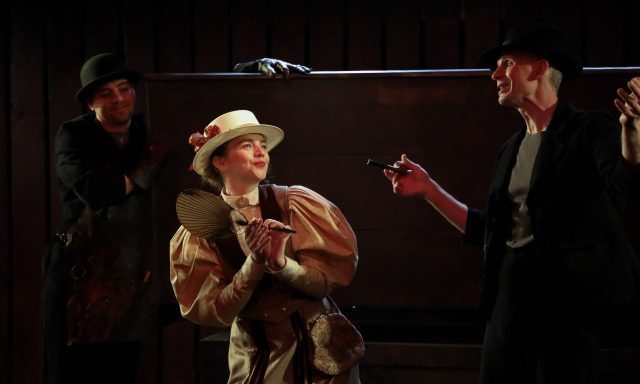
A terrific cast yucks it up onstage in George Street Playhouse’s virtual version of Terrence McNally’s It’s Only a Play (cinematography by Michael Boylan)

IT’S ONLY A PLAY
George Street Playhouse online
Through July 4, $33
georgestreetplayhouse.org

“I’m struck by how laughter connects you with people. It’s almost impossible to maintain any kind of distance or any sense of social hierarchy when you’re just howling with laughter,” Monty Python cofounder John Cleese said in the 2001 BBC series The Human Face. There is no human reaction as infectious as laughing, particularly in a theater where strangers gather to be entertained; one’s enjoyment of a comedic movie or play often relies at least in part by the sounds of glee emerging from fellow audience members. So what to do during a pandemic lockdown, when connection with others in dark spaces is impossible? The George Street Playhouse has the answer in its hysterical virtual revival of Terrence McNally’s It’s Only a Play.

The New Jersey troupe, founded in 1974, previously moved into the home of board member Sharon Karmazin for a pair of excellent one-person shows, Theresa Rebeck’s Bad Dates, starring Andréa Burns primarily in a bedroom, and Becky Mode’s Fully Committed, with Maulik Pancholy portraying forty roles in the basement. That was followed by Nia Vardalos’s Tiny Beautiful Things, which featured four actors throughout Karmazin’s lake house in the Garden State. Now the company is back onstage with seven actors for its uproarious version of McNally’s 1982 farce, which made its Broadway debut in 2014 in director Jack O’Brien’s all-star iteration at the Gerald Schoenfeld Theatre. That production featured Nathan Lane, Megan Mullally, F. Murray Abraham, Stockard Channing, Matthew Broderick, Rupert Grint, and Micah Stock, which it helps to know as references abound in this one.

Laughter might be contagious, but even sitting alone at my computer, I was exuberantly howling at the two-hour show, surprising myself at how often I let out loud snickers, snorts, and guffaws at the merriment happening onstage at the New Brunswick Performing Arts Center. It’s Only a Play takes place at an opening-night party at the ritzy home of first-time Broadway producer Julia Budder (Christine Toy Johnson) as everyone awaits the reviews, primarily Ben Brantley’s assessment in the New York Times. Julia has put her money behind playwright Peter Austin’s (Andy Grotelueschen) The Golden Egg, which could be theater gold or lay a giant egg.

They are joined by the show’s prima donna, Virginia Noyes (Julie Halston), a fading actress who can’t get a job in Hollywood anymore; actor James Wicker (Zach Shaffer), the star of a successful if empty television sitcom Out on a Limb who is best friends with Austin but nonetheless passed on appearing in the new play, which was written for him; Sir Frank Finger (Greg Cuellar), an eccentric British director who is so sick and tired of being praised for everything he does that he’s hoping to finally have a turkey on his hands; brash critic Ira Drew (Triney Sandoval), who desperately wants to be part of the in crowd; and Gus P. Head (Doug Harris), a doofy wannabe “actor-slash-singer-slash-dancer-slash-comedian-slash-performance artist-slash-mime” who has just moved to New York City and is handling the coats for the evening. Rapid-fire hilarity ensues with harsh needling, heaps of insincerity and phoniness, and plenty of ego-driven inside jokes that had me rolling with laughter.

“I don’t have to call in again for another couple of hours,” Noyes, who is wearing a house arrest ankle bracelet, tells Wicker and Head. “For a while they had me checking in every fifteen minutes. What did they think I was going to do? Kill somebody else? It was an accident. It wasn’t like they were both my parents.”

Upon entering the bedroom, Austin declares, “All my life, I dreamed that they would yell, ‘Author, author’ when I walked into my opening-night party and they did, only it was for Tom Stoppard, who was right behind me.”

George Street Playhouse returns to its home in It’s Only a Play (cinematography by Michael Boylan)

On the phone complaining to his agent, Wicker says, “Thank God for my series or I might’ve had to tell Peter the truth about his godawful play. But do you think I got even so much as a mention in the program? I only created the lead in his one and only hit, and it’s as if I never existed. The egos in this business. I know they don’t close plays after one performance, but in this case they should make an exception. What’s the word for a mercy killing? Euthanasia. They do it for people; why not plays?”

The show is directed by Kevin Cahoon with a joyful franticness, with cinematography and editing by Michael Boylan that makes it feel more like a play than a film, although occasional close-ups look awkward. David L. Arsenault’s set is glamorous, with lovely costumes by Alejo Vietti. The bright lighting is by Alan C. Edwards, with sound and music by Ryan Rumery. The cast is outstanding, reveling in the nonstop barrage of McNally’s gorgeous words; four-time Drama Desk nominee Halston gloriously chews up everything in her path, while Tony nominee Grotelueschen has a glow in his eyes as he waxes poetic about theater with a capital T. Sandoval can barely contain himself as the bitter critic hobnobbing in the inner sanctums, while Harris excels as the star-struck greenhorn who has a penchant for using terms of endearment for people he doesn’t know. Shaffer has a ball with the bulk of the most acerbic lines, Cuellar digs into Finger’s oddities with verve, and Johnson is delightful as a naive but genuine producer who regularly bungles the English language.

The stream begins with a shot of a curtain descending on an empty stage as a gentle piano version of Irving Berlin’s “There’s No Business Like Show Business” plays, but the music soon swells with a full orchestra as the title and author name in ornate lettering take over the screen and the curtain rises, revealing the fab set while paying tribute to the beloved McNally (Master Class, Love! Valour! Compassion!), who died in March 2020 of Covid-19 at the age of eighty-one. “When I saw a marquee go dark tonight,” Austin later says, “I thought, ‘It’s important that those lights keep burning. New York without the theater is Newark.’” In this case, that’s an unfair knock against Newark, which is less than thirty miles from New Brunswick, where It’s Only a Play was filmed and George Street is based, but it does serve as a delicious amuse bouche as the lights return to Broadway this fall and we’ll once again be able to laugh with one another in person.

BLINDNESS

Blindness plunges in-person audiences into literal and metaphorical darkness (photo by Helen Maybanks)

BLINDNESS
Daryl Roth Theatre
101 East Fifteenth St. at Union Square
Tuesday – Sunday through September 5, $116 per pair
www.blindnessevent.com
www.darylroththeatre.com

The first in-person, extended-run indoor theatrical presentation in New York since restrictions lifted has arrived, and it’s a doozy. British playwright Simon Stephens’s adaptation of Portuguese Nobel laureate José Saramago’s 1995 dystopian novel, Blindness, was long in the works prior to the coronavirus crisis, but its subject matter and staging are tailor-made for this precise moment in time.

The seventy-minute socially distanced sound and light installation debuted at the Donmar Warehouse last August and opened last night at the Daryl Roth Theatre in Union Square. Originally conceived as a fully staged production with a cast of a hundred by Tony winner Stephens and director Walter Meierjohann, it has been reimagined for the pandemic. A maximum of eighty-six masked people are allowed in the theater, seated in chairs in pods of two, either facing the same or opposite directions; each couple is at least six feet away from other pairs.

The set consists of dozens of horizontal and vertical fluorescent lights hanging from above, forming a kind of abstract traffic pattern, warmly changing colors from red, blue, and green to yellow and orange; as the audience enters, the sounds of cars can be heard. The otherwise empty, ominous set is by Lizzie Clachan, with lighting by Jessica Hung Han Yun. Every audience member receives a pair of headphones through which the foreboding tale unfolds. The text is performed by Olivier-winning English actress Juliet Stevenson (Truly, Madly, Deeply; Death and the Maiden), who starts out as the Storyteller before becoming the protagonist. “If you can see, look,” the Storyteller begins. “If you can look, observe.”

The dark parable immerses you in an epidemic in which a man driving down the street suddenly and inexplicably goes blind — everything turns white — and after he goes to an ophthalmologist, the doctor and several of his patients soon lose their sight as well. The contagion spreads, and only the doctor’s wife retains her vision; she takes over the narrative, which turns into an apocalyptic nightmare in which the nation’s leaders turn their back on its citizenry. “If there was a government, it was a government of the blind trying to rule the blind,” the doctor’s never-named wife says. “I didn’t know if there was going to be a future. We needed to decide how we were going to live.”

Juliet Stevenson comes face-to-face with Trevor the binaural microphone while recording Blindness (photo courtesy Donmar Warehouse)

The audio was recorded using a binaural microphone, called Trevor, that is shaped like a human head, similar to the one Simon McBurney used in his 2016 Broadway show, The Encounter. Stevenson’s physical proximity to Trevor affects how we ultimately hear her words, giving it a three-dimensional quality. At times it seems that the doctor’s wife is far away, her voice muffled in the distance, while a minute later you can practically feel her hot breath on your neck as she whispers in your ear, as if she is standing right next to you. It can be unnerving, and it’s supposed to be, melding well with the story, which grows harsher and harsher. The genius sound design is by Ben and Max Ringham, who previously used binaural recordings and silent disco headphones for Ella Hickson’s spy thriller, Anna, at the National Theatre in May 2019. You might be sitting in a space with no stage, no furniture, no props, only chairs and lights, but Stephens’s writing is so descriptive, and Stevenson’s reading so clear and poetic, that you’ll think you are in the quarantine bunker where the blind characters are struggling to survive.

Although the theater does transform into total darkness for several scenes, random flashes of white lights in the second half are distracting, with no apparent connection to the story except to perhaps evoke an instant of white blindness. Depending on where you are sitting, you might be facing another audience member, which can be unsettling; usually at the theater, the only people in front of you who you might make eye contact with are the actors onstage. That said, it’s fabulously exciting to be in a theater with other people, experiencing something together. In addition, everyone gets a flashlight to turn on in case they require technical or personal assistance, although that can be disruptive, particularly when it’s pitch black and someone suddenly flicks the light on. There is no intermission, no bathroom breaks, no gathering in the lobby to chat; if you have to leave for some reason, there is no reentry. And speaking of distractions, the night I was there, I did not see anyone on their cell phone or hear any ringers go off. Sheer bliss.

Blindness, which was adapted into a 2007 play by Godlight Theatre Company, a 2008 film by Fernando Meirelles starring Julianne Moore, Mark Ruffalo, and Danny Glover, and a 2011 opera by Anno Schreier and Kerstin Maria Pöhler — Saramago also wrote a sequel, Seeing, in 2004 — is not simply a technological marvel that explores the breakdown of society in a health crisis that is all too familiar today; it examines how we as a culture interpret how and what we see. It’s merely coincidental that we are watching a show about a pandemic, involving food insecurity, economic distress, governmental refusal to take action, and so much grief and loss, during a pandemic. Blindness delves into the interconnectedness of humanity amid greed, selfishness, and a metaphorical blindness that can lead to racism, hate, militarism, and othering. Stephens follows Saramago’s style of not using proper names for characters or locations; this could be happening to anyone, anywhere, at any time.

In writing the play, Stephens (Sea Wall, Heisenberg, The Curious Incident of the Dog in the Night-Time), who is partially sighted, consulted with Hannah Thompson, a partially sighted professor of French and Critical Disability Studies at Royal Holloway, University of London, who explained ocularcentrism to him, the belief that sight is the most privileged of the five senses and how misunderstood having less vision is. (She prefers the term “vision gain” to “vision loss.”) Early on, the Storyteller says, “Who would have believed it? Seen at a glance, the man’s eyes seemed healthy. The iris looked bright, luminous. The sclera white, as compact as porcelain. The eyes wide open, the wrinkled skin of the face, the eyebrows suddenly screwed up.” As this immersive sound and light installation reminds us, taking life, and all its wonders, for granted comes at your own risk.

THE SHED: OPEN CALL

“Open Call” features eleven immersive installations by emerging NYC-based artists (photo by twi-ny/mdr)

OPEN CALL
The Shed
545 West 30th St. at Eleventh Ave.
Thursday – Sunday through August 1, free with advance RSVP, 11:00 am – 6:00 pm
646-455-3494
theshed.org

In December 2020, I saw Aisha Amin’s Friday, a short film about a historic Brooklyn mosque, as part of the BAM virtual series “Programmers’ Notebook: New York Lives.” Its reinvention as the immersive installation The Earth Has Been Made a Place of Prayer for the fourth iteration of the Shed’s “Open Call” group show is emblematic of the current exhibition, which focuses on works by early-career New York City–based artists that explore ritual, diverse communities of color, and coming together as we emerge from the Covid-19 crisis. Amin’s film is projected on four screens hanging from the ceiling, forming a large “X,” and viewers are encouraged to watch it while sitting on one of thirty-two red and white prayer rugs that face Mecca, as if we’re all members of Masjid At-Taqwa in Bed-Stuy. “My film documents a communal prayer that happens every Friday afternoon in a confined space. It takes place in a room that is small for the amount of people who come to pray,” Amin says in a Shed interview with fellow “Open Call” artist Cindy Tran. “So, I’ve been thinking, too, about what it means to be in such close corners with people. For the audio, I had placed a recorder in the mosque to capture the two-hour prayer, and the amount of coughing and throat-clearing and sniffling and chatter I recorded. . . . Now, it would be a terrifying experience to go there if you didn’t have a mask and weren’t vaccinated, but there’s also something so nice about the closeness of the people in that space.” After I sat down, several other people joined me as we formed our own temporary community.

The exhibition features eleven installations in addition to thirteen live performances that have just concluded, chosen from approximately fifteen hundred applications, dealing with grief, loss, and mourning as well as joy, hope, and public congregation. Ayanna Dozier’s Cities of the Dead is a compelling faux documentary that details Solomon Riley’s (Ricky Goldman) dream of creating “Negro Coney Island” on Hart Island, which was scheduled to open July 4, 1924, before the city stepped in and halted the project. Hart Island was later used as a potters field for victims of AIDS and Covid-19, which disproportionately affected people of color. Kenneth Tam’s video sculpture The Crane and the Snake explores Asian American hazing and assimilation.

Aisha Amin reimagines her film Friday for Shed exhibit (photo by twi-ny/mdr)

Simon Liu invites viewers into a partially enclosed circular space to experience Devil’s Peak, a multichannel audiovisual journey into the troubled city of Hong Kong, a flurry of images with hidden bonuses just outside in one corner. Pauline Shaw’s stunning The Tomb-Sweeper’s Mosquito Bite uses MRI scans, science, memory, and the idea of diaspora in a large, hanging tapestry counterbalanced by objects encased in hand-blown glass vessels. “Autobiographical memory relies very much on the dormant network, so it’s really hard to separate what is happening in your daily life and what is happening in your memory,” she explains in a Shed talk with Liu. “Our notions of self, memory, and everyday experience are completely intertwined. Those are the intricate, scientific details of the MRI process. I’m translating the images that resulted into felt.”

Pauline Shaw explores memory and the diaspora in The Tomb-Sweeper’s Mosquito Bite (photo by twi-ny/mdr)

Emilie Gossiaux takes on anti-disability and anti-animal prejudices and celebrates her relationship with her seeing-eye dog in True Love Will Find You in the End, a pair of life-size sculptures that exhibit both human and canine characteristics shown holding hands. Stand in the middle of Tajh Rust’s Passages to read a quote from Caribbean philosopher Édouard Glissant, “I made an attempt to communicate with this absence,” stenciled repeatedly on two freestanding partially mirrored glass panels, evoking colonialism and migration. You’re encouraged to walk through Anne Wu’s A Patterned Universe, a kind of architectural playground with decorative elements representative of Flushing’s Chinese immigrant neighborhood. Esteban Jefferson pays tribute to a friend who passed away in 2019 with We Love You Devra Freelander, a pair of paintings documenting the passing of one year. Caroline Garcia mourns the loss of her mother in The Headless Headhunt, incorporating the Indigenous Filipino practice of headhunting related to grief, here enhanced with augmented reality.

And Le’Andra LeSeur’s There is no movement without rhythm, consisting of five rectangular screens arranged in a circle so people can stand in the middle, was inspired by jazz and blues and Gnawa male-dominated ceremonial traditions that LeSeur commandeers by filming herself holding objects and grasping her naked body. “I love the idea of thinking about what’s happening right now in this time and how we as artists are really processing and pushing forward with creation as a framework for healing,” LeSeur tells Open Call artist AnAkA in a conversation that gets to the heart of the exhibition as a whole. “And I’m also interested to hear you talk about this kind of collective movement. I think right now, in this time, it’s not necessarily about self, it’s about we and community, how we’re doing things not just for now but for the future. Even if we don’t have the opportunity to celebrate what we’re reclaiming, we’re creating a space for the future to have this opportunity to celebrate. And the beauty in that is really profound.”

EXPLORING SEVEN SACRED NAMES

Who: John Schaefer, Michael Harrison, W. H. S. Gebel, Ashley Bathgate, Tim Fain
What: Online album release party and discussion
Where: Arts Letters & Numbers YouTube
When: Wednesday, June 30, free with RSVP, 7:00
Why: “I wanted to show how beautiful simple harmonies can be, especially in just intonation . . . and [to create a work] that would serve as an introduction inviting listeners and musicians to start perceiving just intonation as an infinite harmonic system encompassing limitless possibilities on a spectrum between simplicity and complexity,” contemporary classical composer and pianist Michael Harrison says about his new album, Seven Sacred Names (Cantaloupe Music, June 2021). On June 30 at 7:00, Harrison, a Guggenheim Fellow, will celebrate the album’s release with an online party and discussion featuring cellist Ashley Bathgate and violinist Tim Fain, who both play on the record, and author, astrophysicist, and modern Sufi mystic W. H. S. Gebel, who wrote the liner notes and whose book Nature’s Hidden Dimension: Envisioning the Inner Life of the Universe served as inspiration to Harrison. Seven Sacred Names is a song cycle consisting of seven compositions and a reprise about “an awakening primal Self,” according to Gebel; the songs include “”Hayy: Revealing the Tones,” “Alim: Polyphonic Raga Malkauns,” “Qadr: Etude in Raga Bhimpalasi,” and “Sami: The Acoustic Constellation,” with such guests as Roomful of Teeth, Ina Filip, violist Caleb Burhans, tabla percussionist Ritvik Yaparpalvi, and composer/dhrupad/vocalist Payton MacDonald.

Harrison writes about one of the songs, “‘Al Mureed’ is the fourth of the seven names and signifies the birth of desire, the motivation needed to direct the will which awakens as a response to the dawning of relationship. The created world has become more interesting because now there is love, lover, and beloved; there is the possibility of relationship and of learning about and understanding the divine qualities as they manifest by sensing their vibration.” The event, which is presented by Arts Letters & Numbers as part of the “SunShip: The Arc That Makes the Flood Possible” exhibition for the CITYX Venice Italian Virtual Pavilion at the seventeenth Venice Architecture Biennale and is free with advance RSVP, will be hosted by John Schaefer of WNYC’s New Sounds.

ASK A CURATOR: DAVID HAMMONS AND GORDON MATTA-CLARK IN THE WHITNEY’S COLLECTION

David Hammons’s Day’s End pays homage to Gordon Matta-Clark’s 1975 deconstruction of an abandoned warehouse (photo by twi-ny/mdr)

Who: Adrienne Edwards, Elisabeth Sussman
What: Live virtual discussion about David Hammons, Gordon Matta-Clark, and Day’s End
Where: Whitney Zoom
When: Wednesday, June 30, free with RSVP, 6:30
Why: The Whitney’s “Ask a Curator” series continues June 30 with “David Hammons and Gordon Matta-Clark in the Whitney’s Collection,” a live Zoom discussion about Hammons’s recently installed permanent work, Day’s End, an homage to Matta-Clark’s 1975 similarly named intervention in an abandoned industrial building on Pier 52 at the southern edge of Gansevoort Peninsula. Whitney curators Adrienne Edwards and Elisabeth Sussman will also explore other works in the museum’s collection by the two artists, some of which were on display last fall in “Around Day’s End: Downtown New York, 1970–1986.”

The Whitney and Hudson River Park collaborated on David Hammons’s Day’s End (photo by twi-ny/mdr)

Over the course of seven years, Hammons created a 325-foot-long brushed-steel outline of the warehouse, placed in its exact same former location, a ghostly reminder of what — and who — is no longer there, a reference to the gay community that congregated in the area in the 1970s and 1980s until the AIDS crisis took so many lives. “I look at it as a statue because I’ve seen so many statues in the city and they’re all about memories,” Hammons says in a Whitney video of the dedication ceremony, which he chose not to attend. Half on land and half in the water, it’s a powerful work — officially part of Hudson River Park, not the Whitney — filled with mystery that draws the attention of passersby, many of whom may think it is the skeleton of a new building, especially since there is construction under way right next to it. Down the pier is Little Island, Barry Diller and Diane von Furstenberg’s lovely oasis, and across the street is the Whitney itself. (The Diller-von Fürstenberg Family Foundation was one of many donors who helped fund Hammons’s piece as well.) Admission is free with advance RSVP; Edwards and Sussman will be taking questions from the audience during the event.