twi-ny recommended events

FJK DANCE: RESET

Who: FJK Dance
What: Two world premieres and a repertoire work
Where: New York Live Arts, 219 West Nineteenth St. between Seventh & Eighth Aves.
When: October 7-9, $20-$45, 7:30
Why: Founded in 2014 by Fadi J. Khoury and Sevin Ceviker, FJK Dance is devoted to multicultural movement that breaks down barriers and borders. This week the New York–based company emerges from the pandemic lockdown with Reset, consisting of two world premieres and one repertory piece, running October 7-9 at New York Live Arts. The program includes Mirage, incorporating human stories from the Middle East, set to Schubert’s piano trio in E-flat, performed by Tim Ward, Sarita Apel, Estefano Gil, Khoury, and Elisa Toro Franky; Khoury’s solo Forbidden, about seeking love, with music by Abdel Wahab and Hossam Shaker; and Ravel’s Bolero, a 2019 work that investigates duality.

Bolero is one of three pieces FJK Dance will perform at New York Live Arts

The evening is dedicated to editor and FJK Dance founding board member Genevieve Young, who passed away in February 2020 at the age of eighty-nine. “In this time of reflection and finding hope, the production of this program is a dream dedicated to all the souls that we have lost during this pandemic,” the company announced in a statement. Khoury, who was born in Baghdad and raised in Iraq and Lebanon, added, “What began as a blended choreographic form has become something larger — my role is not to just create fusion choreography but to use dance as a message of peace for the world at large.”

DEEP BLUE SEA

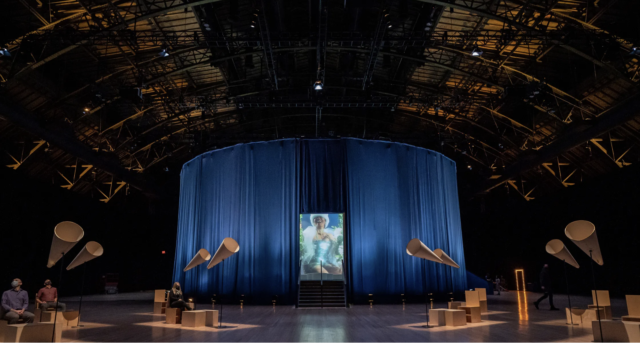
Bill T. Jones’s Deep Blue Sea is set within an illuminating, immersive environment at Park Ave. Armory (photo by Stephanie Berger)

DEEP BLUE SEA
Park Avenue Armory, Wade Thompson Drill Hall
643 Park Ave. at 67th St.
September 28 – October 9, $40
212-933-5812
www.armoryonpark.org

Bill T. Jones is in the midst of yet another well-deserved moment, culminating in the spectacular Deep Blue Sea, continuing at Park Avenue Armory through October 9. During the pandemic, the legendary dancer, choreographer, Kennedy Center honoree, and activist, along with his troupe, the Bill T. Jones/Arnie Zane Company, streamed a reimagined version of 1991’s Continuous Replay. In May, after a one-month delay because of a Covid outbreak in the company, they staged Afterwardsness at Park Ave. Armory, a socially distanced and masked production that addressed racism, police brutality, classism, and the pandemic itself. In July, the documentary Can You Bring It: Bill T. Jones and D-Man in the Waters was released, a thrilling look at Jones’s seminal 1989 piece, D-Man in the Waters, exploring intergenerational tragedy and loss while drawing comparisons between AIDS and other crises.

Delayed a year and a half due to the pandemic, Deep Blue Sea is a one-hundred-minute multimedia meditation on being Black in America. As the audience enters the Wade Thompson Drill Hall, which features a large, rectangular central space with ten rows of rafters, starting about ten feet high, on all four sides, Jones, dressed in his trademark black, is moving determinedly across the floor, almost robotically. Some people recognize him; others walk right past him to their seats, oblivious. It’s Jones’s return to performing for the first time in ten years, when he appeared (nude) in a 2011 iteration of Continuous Replay at New York Live Arts. On every seat is a long sheet of paper with writing on both sides, in Jones’s handwriting; it reads in part: “Thank you, Mr. Melville! / Thank you for the Pip / Thank you for his music / Thank you for his fragile fear / Thank you for his loneliness in the ocean . . . / Thank you for not letting him drown. / Thank you for this floor we are moving on. Thank you for the ocean just now pretending to be a stage. / Thank you, Dr. King! . . . Thank you for words that I can shred, misunderstand, mangle and still they meet the air like singing.”

Bill T. Jones stands in the middle of it all in multimedia Deep Blue Sea (photo by Stephanie Berger)

The sixty-nine-year-old Florida native soon starts a long monologue in which he explains that he was disturbed to discover that, upon revisiting Herman Melville’s Moby-Dick, he had completely forgotten about Pip, the young Black cabin boy aboard the Pequod. “Pip was invisible to me,” he recalls. Using that as a metaphor, Jones, joined by ten dancers, delves into the lack of inclusivity in the word “we” in contemporary society. He incorporates text from W. E. B. DuBois’s The Souls of Black Folk, Rev. Dr. Martin Luther King Jr.’s “I Have a Dream” speech, Kendrick Lamar’s “Never Catch Me,” and Moby-Dick, with live gospel, blues, and hip-hop performed by vocalists Philip Bullock, Shaq Hester, Prentiss Mouton, and Stacy Penson in red costumes and Jay St. Flono in more colorful African-inspired dress. (The costumes are by Liz Prince.) The dramatic score was composed by musical director Nick Hallett, accompanied by an electronic soundscape by Hprizm aka High Priest, Rena Anakwe, and Holland Andrews.

Choreographed by Jones, Janet Wong, and the company — Barrington Hinds, Dean Michael Husted, Jada Jenai, Shane Larson, s. lumbert, Danielle Marshall, Nayaa Opong, Marie Lloyd Paspe, Jacoby Pruitt, and Huiwang Zhang — Deep Blue Sea immerses the audience in a breathtaking visual environment designed by Elizabeth Diller, of Diller Scofidio + Renfro, with award-winning projection designer Peter Nigrini (Here Lies Love, Beetlejuice); the superb lighting is by Robert Wierzel. (You can watch an artist talk with Diller, Nigrini, and Hinds here.) I suggest wearing a white or light-blue mask for an added bonus when it gets dark.

The surprises are many, from a black spotlight following Jones to white spotlights on the other dancers that merge into amorphous bubbles, from mirrors that turn the space into a kind of three-dimensional infinity room to the appearance of a calming, gently rolling ocean. Snippets of text roll beneath the dancers. The face of a boy representing Pip dominates the floor, blinking up at us. Jones refers to the dancers by name several times, giving each their own identity and voice. Wearing everyday clothing, they run across the stage, form into a tight group, and line up on their backs, asserting themselves as individuals and a close-knit group. Jones expands the idea of community with an overly long though visually engaging conclusion in which ninety-nine local people share personal statements that begin, “I know . . . ,” after which the audience is encouraged to come down and mingle, becoming an ever-expanding “we.”

“[Pip] saw God’s foot upon the treadle of the loom, and spoke it; and therefore his shipmates called him mad,” Melville writes in Moby-Dick. “So man’s insanity is heaven’s sense; and wandering from all mortal reason, man comes at last to that celestial thought, which, to reason, is absurd and frantic; and weal or woe, feels then uncompromised, indifferent as his God.” At one point in Deep Blue Sea, the phrase “You can’t turn back” is projected onto the floor, Jones’s uncompromising approach to providing a way forward through indifference.

MOVEMENT WITHOUT BORDERS: A DAY OF PERFORMANCE TO CELEBRATE NEW YORK IMMIGRATION COALITION, UNLOCAL, AND GENTE UNIDA

Wladimiro Politano, The Expression of the Soul XLIX, 2010

Who: Mariana Valencia, Jimena Paz, Shamel Pitts, Francesca Harper, Francisco Cordova, Ernesto Breton/Rudy Perez, Edivaldo Ernesto, Horacio Macuacua, Emilio Rojas, Claudia Rankine, Margo Jefferson, Antonio Sánchez Band, Jonathan Mendoza, Gina Belafonte, Xaviera Simmons, Enrique Morones, Roger H. Brown, Raoul Roach, Adelita-Husni-Bey, Reverend Micah Bucey
What: Dance, poetry, music, film, and activism at historic location
Where: Judson Memorial Church, 55 Washington Square South between Thompson & Sullivan Sts.
When: Saturday, October 2, free with RSVP (suggested donation $20), 11:00 am – 6:30 pm; ninety-minute recorded version the next day at the Jersey City Theater Center
Why: An all-star lineup of artists and activists are coming together October 2 at Judson Memorial Church for “Movement without Borders: A Day of Performance to Celebrate New York Immigration Coalition, UnLocal, and Gente Unida,” honoring three organizations fighting for immigration rights. From 11:00 am to 6:30 pm, dancers and choreographers, musicians, poets, authors, visual artists, and more will honor the work being done by New York Immigration Coalition, UnLocal, and Gente Unida. Among the presenters are dancer/choreographers Mariana Valencia, Ernesto Breton/Rudy Perez, Jimena Paz, Francisco Cordova, Horacio Macuacua, Francesca Harper, Edivaldo Ernesto, and Shamel Pitts/TRIBE, multidisciplinary artist Emilio Rojas, the Antonio Sánchez Band (with Sánchez, Thana Alexa, Jordan Peters, Carmen Staaf, Noam Wiesenberg), Adelita Husni-Bey (who will screen her film Chiron), visual artist Xaviera Simmons, poets Jonathan Mendoza and Claudia Rankine, Gente Unida founder and director Enrique Morones, Sankofa executive director Gina Belafonte, music producer and activist Raoul Roach, and others. Conceived, directed, and produced by Richard Colton, “Movement without Borders” will also be available in a ninety-minute recorded version on October 3 at the Jersey City Theater Center as part of the third annual Voices International Theater Festival.

ENCORE PRESENTATION: WORLDS FAIR INN

Worlds Fair Inn explores nuclear annihilation and serial killing with a vaudeville sensibility (photo by Regina Betancourt)

ENCORE PRESENTATION: WORLDS FAIR INN
Axis Theatre
One Sheridan Sq. between West Fourth & Washington Sts.
Thursday – Saturday through October 23, $10-$30, 8:00
866-811-4111
www.axiscompany.org

On March 11, 2020, I was in Axis Theatre Company’s small, intimate downstairs space at One Sheridan Square, getting ready to watch artistic director Randy Sharp’s adaptation of Henry James’s Washington Square. Shortly before the show started, a few of us chuckled as a woman roamed the aisles, unable to choose a seat. (The venue is general admission.) When she was right behind me, I heard her mutter, “I’m not going to get sick. This virus is not going to get me.” A few of us looked at one another, thinking she had gone a bit overboard. Little did I know that Washington Square would be the last live theater with actors and an in-person audience I would experience for nearly fifteen months because of a virus that has killed more than six hundred thousand Americans and shuttered live entertainment venues around the globe.

On June 4, 2021, there I was, back at the Axis Theatre, to see my first indoor play with actors and an audience since the pandemic lockdown was lifted. It was the premiere of Sharp’s Worlds Fair Inn, performed by a cast of five to an audience of fifteen people in masks. Not only was it thrilling to be in the theater, but the hourlong work is a fab absurdist journey through madness and tragedy, a strange and enticing mix of Samuel Beckett’s Waiting for Godot, Mary Wollstonecraft Shelley’s Frankenstein, and the Three Stooges.

Axis producing director Brian Barnhart stars as Frank, a creepy character right out of a low-budget Roger Corman horror-comedy, a composite of Victor Frankenstein, the fictional mad scientist who built a creature out of dead bodies; theoretical physicist J. Robert Oppenheimer, “the father of the atomic bomb”; and H. H. Holmes, a con artist and serial killer who owned the World’s Fair Hotel, aka the Murder Castle, near the 1893 Chicago World’s Fair. Two loony bowler-hatted fellows, Eric (George Demas) and Bill (Jon McCormick), arrive at the inn, seeking shelter and company. All three men wear dark clothing and giant Frankenstein-style shoes on a set littered with dozens of bottles of whiskey, a hotel front desk that doubles as a killing casket, and a neon sign advertising the name of the place. The set is designed by Sharp, with period costumes by Karl Ruckdeschel, fun props by Lynn Mancinelli, eerie lighting by David Zeffren, and playfully sinister sound and music by former Blondie member Paul Carbonara.

“What do you think it would take to make a living man out of a bunch of cut-up dead people? I mean if you cut them up and glued them together?” Frank, who boasts that he’s a scientist, a doctor, an American, and an architect, asks.

“Why wouldn’t you use whole dead people and bring them back to life?” Eric answers, pauses, then adds, “Oh! Maybe you need separate parts so you can see how to make them work? Then stick them back?”

“Right,” Frank responds. “Or maybe I would just use the whole person. I’m an architect. It’s scientific. I just want to see what happens.”

Eric and Bill jump at the chance to help Frank in his unnatural mission, displaying no hesitancy at the prospect of killing people, chopping them up, then assembling the pieces into a new whole. “We’re builders,” Bill offers. “Not scientists. Just to be sure. We can fix things! Hard workers! . . . We’re contractors!”

Frank’s first two victims are Machine (Edgar Oliver), an erudite oddball, and Lady (Britt Genelin), a coquettish factory worker; both fall for the men’s ruse, undone by their own pride in their willingness to embrace new ways.

Lady (Britt Genelin) brings light to the dark proceedings of Worlds Fair Inn (photo by Regina Betancourt)

Worlds Fair Inn feels like a uniquely charming, deranged vaudeville act with Moe/Shemp (Frank), Larry (Bill), and Curly (Eric) filtered through Corman’s Tales of Terror. The cast is wonderfully over the top, highlighted by the risible interplay between Demas (Maverick, Last Man Club) and McCormick (Dead End, Donkey Punch). Pay particular attention to McCormick even when he’s not talking; he moves in herky-jerky fits and starts, overcome by nerves and fear, often leaving his thoughts unfinished as his eyes dart about the stage.

Barnhart (High Noon, Dead End) channels Angus Scrimm from Phantasm and John Carradine in Woody Allen’s Everything You Always Wanted to Know About Sex* (*But Were Afraid to Ask) as he delivers his lines with great bombast. It’s fab to see Oliver, a solo specialist who has presented In the Park, East 10th St.: Self Portrait with Empty House, and Attorney Street at Axis, as part of an ensemble; he and Genelin (Washington Square, High Noon) are adorable as vaudeville versions of the Creature and the Bride of Frankenstein, trapped in a skit they don’t fully comprehend.

Writer-director Sharp (Strangers in the World, Seven in One Blow) adeptly maneuvers between high and low comedy as she takes on nuclear annihilation, a different kind of rather effective serial killing — Frank, Eric, and Bill bow every time Japan is mentioned — and melds Dr. Frankenstein’s laboratory, Oppenheimer’s Los Alamos, and Holmes’s murder hotel into a supremely funny and memorable show. As we finally emerge from this dark year, we may not have much hope for the future of humanity, but Axis gives us hope for the future of theater. (And I hope the woman I foolishly chuckled at in March 2020, before Washington Square at the Axis, is alive and well and gets to catch this terrific satire, as you should too. And now you have an added opportunity, as the play is back for a well-deserved encore run September 30 through October 23.)

THE GREAT ARIA THROWDOWN #2 – LES EDITION

LUNGS HARVEST ARTS FESTIVAL
Multiple locations
Daily through October 3, free
“The Great Aria Throwdown #2 — LES Edition”
Campos Community Garden, 640-644 East Twelfth St. at Ave. C
Friday, October 1, 6:30
www.lungsnyc.org

In 2011, community gardens in Loisaida, the Lower East Side, and the East Village came together and formed LUNGS, the Loisaida United Neighborhood Gardens; its mission is “to promote, protect, and preserve gardening and greening through cooperation, coordination, and communication.” The group is now hosting its tenth annual LUNGS Harvest Arts Festival, which runs through October 3 with free music and dance, knitting, activism, art exhibits, yoga, a dominos tournament, interactive workshops, classes, a treasure hunt, and more, in such locations as Green Oasis, Carmen’s Garden, LaGuardia Corner Gardens, Orchard Alley Community Garden, Creative Little Garden, La Plaza Cultural de Armando Perez, 6BC Botanical Garden, and other lovely oases.

One of the highlights is “The Great Aria Throwdown #2 — LES Edition,” taking place October 1 at 6:30 in Campos Community Garden on Twelfth St. & Ave. C. Presented by dell’Arte Opera Ensemble (dAOE), the evening features sopranos Bahati Barton and Diana Charlop, mezzo-soprano Perri di Christina, countertenor Jeffrey Mandelbaum, and pianist Pablo Zinger performing works by Bellini, Donizetti, Mozart, Purcell, and others.

“Dell’Arte Opera Ensemble is a bridge for emerging opera singers to work with accomplished professionals in the field,” dAOE executive director Marianna Mott Newirth explains. “‘The Great Aria Throwdown’ is a fun and free event that gives ‘stage’ to three sopranos and an outstanding countertenor singing with widely acclaimed pianist Pablo Zinger, producing a growing garden of sound on East Twelfth St. From Bellini to Monteverdi, we’re bringing opera to the LES! Campos Garden even has a chandelier they plan to raise just as the show begins — a nod to the new season starting at the Met after a year of darkness.” Below is the full program.

Diana Charlop: “Quel guardo il cavaliere” from Don Pasquale (Bellini)
Perri di Christina: “Deh, non voler costringere” from Anna Bolena (Donizetti)
Bahati Barton: “Ruhe Sanft” from Zaide (Mozart)
Jeffrey Mandelbaum: “If Music Be the Food of Love” (Purcell, Third Version)

Diana Charlop: “Padre germani addio” from Idomeneo (Mozart)
Perri di Christina: “Voi che sapete” from Le nozze di Figaro (Mozart)
Jeffrey Mandelbaum: “Sprezzami quanto sai” from L’incoronazione di Poppea (Monteverdi)

Perri di Christina: “Faites-lui mes aveux” from Faust (Gounod)
Bahati Barton: “Think of Me” from The Phantom of the Opera (Lloyd Webber)
Diana Charlop: “Obéissons quand leur voix appelle” from Manon (Massenet)
Jeffrey Mandelbaum: “Fra tempeste” from Rodelinda (Handel)

WONG PING: YOUR SILENT NEIGHBOR / THE GREAT TANTALIZER

“Wong Ping: Your Silent Neighbor” continues at the New Museum through October 3 (photo by Dario Lasagni)

WONG PING: YOUR SILENT NEIGHBOR
New Museum of Contemporary Art
235 Bowery at Prince St.
Tuesday – Sunday through October 3, $12-$18
www.newmuseum.org

WONG PING: THE GREAT TANTALIZER
Tanya Bonakdar Gallery
521 West 21st St. between Tenth & Eleventh Aves.
Tuesday – Saturday through October 23, free, 10:00 am – 6:00 pm
www.tanyabonakdargallery.com

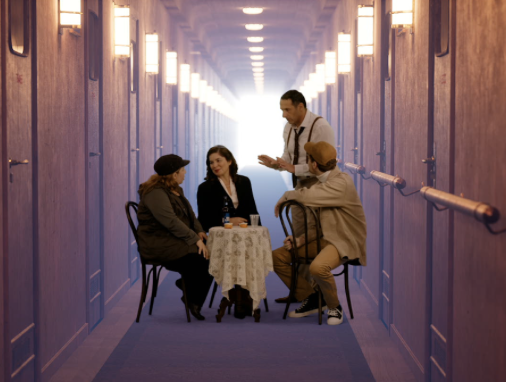
Multimedia artist Wong Ping’s current shows at the New Museum in SoHo and Tanya Bonakdar in Chelsea are filled with lovable animated pandas, colorful cartoons, a retelling of Pinocchio, and playful sculpture and installation. But you might want to think twice before bringing the kids, as Wong’s work tackles income inequality, sexual repression and expression, police corruption, dating and desire, climate change, and sociopolitical aspects of contemporary life, particularly in his native Hong Kong as its battles with Mainland China since the 1997 handover from the British grow ever-more dangerous, all told in a DIY style inspired by video games and narrated by Wong himself.

At the New Museum, An Emo Nose (2015) reimagines Pinocchio’s proboscis, resembling both a heart and a penis, as its own sentient being, reacting to the protagonist’s negative thoughts by stretching out and going off on its own, depicting humanity’s vulnerability of both mind and body. In the two-channel The Other Side (2015), projected onto a screen and a small television monitor in front of it, the narrator journeys across treacherous terrain, has soup with Granny Meng (forgetfulness goddess Meng Po), and ponders his future, a parable of emigration from Hong Kong filtered through the Beatles’ Yellow Submarine. A 3-D printed text panel relates self-affirmations in tiny letters, including “I am the last drop of period blood before menopause” and “I am the last rebellious punk.”

The retrospective is centered by four videos projected onto four screens on all sides of one large room; visitors sit on comfy beanbag chairs or a round couch as they rotate to watch the short films, which total forty-three minutes. In Jungle of Desire (2015), an impotent man is powerless when his wife becomes a prostitute to satisfy her sexual desire and is exploited by a cop. In Who’s the Daddy? (2017), a man considers himself an outcast because his penis is straight, not bending to the left or right, and confuses politics and sex as things go wrong with a woman he hooked up with on a dating app. “People even deny its existence,” he opines about his member.

Wong Ping’s Fables 2 (2019) follows the trials and tribulations of a special cow and three conjoined rabbit siblings attempting to make their own way in life. And in Sorry for the Late Reply (2021), commissioned for this show, a fisherman becomes obsessed with an elderly saleswoman’s varicose veins. “If you’ve ever stepped into the supernatural world during a hike, or have gotten lost in the parking lot and couldn’t find the exit, or have stared into the eyes of a black chicken standing outside your door through the peephole late at night, then you would know how I feel,” he says.

Wong Ping is a curator researching the Great Tantalizer in show at Tanya Bonakdar

Over at Tanya Bonakdar, Wong’s “The Great Tantalizer” is a multimedia installation structured around a mockumentary about a scientist who had been determined to increase sexual desire in pandas and bring that information on their mating techniques to humans, particularly in China, given its former one-child policy and overall preference for boys. The relentless drive to tantalize may be commenting as well on the current tangping movement, or “lying flat,” in which many younger Chinese have opted out of the pressures of modern life by declining to engage in the endless competition for personal and professional success, a high-quality education, a good job, a happy marriage, a beautiful home, and lovely children.

The gallery has been reimagined as the Great Tantalizer’s abandoned laboratory, with a stack of white plastic chairs and a labcoat, an exhibition poster and bamboo pole that declare, “EAT.SLEEP.POOOOOP.DIE,” and The Tender Rider, a cute old kiddie vehicle with a panda head that now serves as a projector, beaming highly sexualized images onto the walls in a back room. It’s all organized around a screen showing a Zoom-like panel discussion featuring Wong in a panda outfit, hosting the virtual talk with the GT’s former laboratory staff, one-night stand, and main competitor, whose identities are disguised. Visitors can sit on rolls of bound bamboo sticks as Wong explores who the GT was and what his legacy is.

The thirty-seven-year-old Wong is quickly building up an impressive legacy of his own with these presentations at the New Museum and Tanya Bonakdar, expanding his breadth with his distinctive approach to exposing society’s ills.

TWI-NY TALK: AYA OGAWA AND THE NOSEBLEED

Aya Ogawa portrays their son and father in new play at Japan Society (photo by Maria Baranova)

THE NOSEBLEED
Japan Society
333 East 47th St. at First Ave.
October 1-3 & 7-10, $30
212-715-1258
www.japansociety.org
ayaogawa.com

The Nosebleed chronicles my journey of confronting what I think is one of the biggest failures of my life, which is that when my father died almost fifteen years ago, I failed to do anything to honor him or his life because of the nature of our relationship,” Japanese American playwright-director Aya Ogawa says in a promotional video for their latest work, the final version of The Nosebleed, running October 1-3 and 7-10 at Japan Society. The absurdist, comic show, previously known as Failure Sandwich and in which four actors play Ogawa while Ogawa portrays their own son and father, serves as a healing ritual for Ogawa and the audience, especially as the coronavirus crisis continues and nearly everyone has experienced some kind of loss.

Over the summer, the Tokyo-born, Brooklyn-based Ogawa, a 2021 Barbara Whitman Award finalist, mounted an online version of Ludic Proxy, an interactive virtual play that takes place in the past (Pripyat, post-Chernobyl), the present (Fukushima, post-disaster), and the future (New York, underground), inspired by the death of their mother. Ogawa previously adapted the text for Alec Duffy’s Our Planet, an immersive production that led a small audience through the historic Japan Society building; they have also directed Haruna Lee’s Obie-winning Suicide Forest at the Bushwick Starr and A.R.T./New York Theatres (where its run was cut short by the March 2020 lockdown) and have written and directed Oph3lia at HERE, Journey to the Ocean at the Rubin Museum, Artifact at the Performance MIX Festival, and A Girl of 16 at Clemente Soto Velez’s Latea Theater.

Copresented with the Chocolate Factory, The Nosebleed is performed by Ogawa, Lee, Drae Campbell, Peter Lettre, Aya Saori Tsukada, and Kaili Turner. I have seen Ogawa at numerous events at Japan Society, where they used to work in the Performing Arts department, but now they are returning as the center of attention. “To be able to come back there, as an artist, and to be so welcomed by former colleagues, is a huge blessing,” they explained. Opening night will be followed by a reception with the artists.

Taking a break from rehearsals, Ogawa discussed motherhood, family relationships, the immigrant experience, theater during the pandemic, and more with twi-ny.

twi-ny: The Nosebleed deals with your complex relationship with your father; Ludic Proxy was partly inspired by the loss of your mother. In researching and writing each work, did your thoughts about your parents, and your relationship with them, change?

aya ogawa: Ludic Proxy was an exploration of my own grieving process — an exercise in imagining how to find the strength to continue living after the death of my mother — had I not had children of my own. It was less about my actual relationship with her, so I would say in that case, my relationship with her did not change.

The Nosebleed, however, is explicitly about my father and my relationship with him — my perceptions and memories of him (which are subjective and flawed). The process of writing the play forced me to recall and examine a lot of things I had not thought of for many years, and this revisiting and especially the embodying of his character has definitely changed my feelings toward him.

twi-ny: How has The Nosebleed developed from earlier iterations at BAX and the Public?

ao: The script is not that different from when it was presented at the Public. (I wrote in a new character after my showing at BAX). However, the staging for each presentation has been unique and tailored to each space. I’ve been blessed to retain most of the original cast. I’ve had to replace one actor (who is now in grad school abroad), and I feel blessed again to have found someone who is not only a stellar performer but a collaborator who is able to bring her whole self and lived experience into the rehearsal room.

twi-ny: What was the rehearsal room like?

ao: We have very strict COVID safety protocols in place, which I discussed with the company before we began this process. I’d heard nightmares about other shows shutting down or having to replace actors, etc. I can’t afford to replace actors, or stop a rehearsal process and pick it up again at another time, so I had to plan for the most conservative measures to keep us all safe. Everyone on my team is fully vaccinated, rehearse masked, take PCR tests every week, and have rapid home tests available if anyone is feeling under the weather.

Despite all of these measures, or perhaps because of the assurance and safety they provided, the process has been joyful and very productive. The piece was originally conceived as an immersive performance, but we have decided to prioritize safety and put the audience in the house.

twi-ny: In the show, you play your son and your father, linking three generations. What is that experience like every night onstage?

ao: This is the first time I have ever appeared in my own play. It was never something I craved doing; in fact, the thought is kind of embarrassing. I decided to appear in the play as my father because the piece demanded it. The crux of this piece, and for it to work as it was intended — as something transformative and healing — I had no choice but to take responsibility for it and play the part. The experience of playing my son and my father is cathartic and exhausting.

One thing that really came to the forefront when creating an autobiographical play was just how violent the act of embodying a character can be. It takes a great deal of responsibility and trust to hand over the portrayal of my life to other people, and trust is needed in both directions.

Aya Ogawa wrote, directed, and stars in The Nosebleed (known as Failure Sandwich in an earlier iteration above) (photo © Ryutaro Mishima)

twi-ny: For your work in progress Meat Suit, you describe motherhood as a “shit show.” You have two children; what was the pandemic lockdown like for you and your family?

ao: At first, it was kind of wonderful. Suddenly we had so much time together, so much unstructured time. There was no panic to make lunches or rush to get them to school on time, etc. We spent time gardening, cleaning the house, cooking. But then, of course, we figured out how to function in the lockdown. School happened on Zoom, as did a lot of my work. I was grateful to have work, and it was a fruitful time, in many ways, to be forced to develop work with great limitations, but it was also exhausting. Pandemic parenting continues right now — and remains pretty trying.

twi-ny: Do you still have family in Tokyo? If so, how often do you generally go back, and have you been able to do so recently?

ao: I am the only person in my immediate blood family living in the U.S. All of my relatives and family are in Japan. Since having kids, I have made it a point to visit every summer. We have not been able to visit since 2019 and it’s really painful.

twi-ny: This past March, you reimagined Ludic Proxy as an interactive online production. What are your thoughts about streaming theater? Do you see it as just a stopgap, or do you anticipate creating more online work in the future?

ao: The second act of Ludic Proxy was conceived with video game mechanics embedded into the script, so it was clear to me that it could very naturally translate to the screen as long as we could retain the audience interactivity. I actually don’t think the pandemic is going to ever “go away,” so it is important for theater-makers to think about how our medium is being transformed. As soon as The Nosebleed closes, I’m going into a video shoot for a puppet play that was originally conceived as a live, in-person puppet show but is now a performance film made for camera.

twi-ny: One of your themes throughout your career has been immigration and cultural identity. How has that changed for Japanese Americans since your first works, going back twenty years?

ao: The experience of the immigrant is not a static, monolithic story. It is varied and complex and ever-changing — so I can only speak for myself, not the larger Japanese-American population. I happen to be positioned in a particular place where I feel like I have access to multiple lenses — I am an immigrant myself but pass as a child of an immigrant. I have Japanese-Taiwanese-American children who I’ve made sure have access to their Japanese culture, but I’m also torn between wanting them to have their own experiences and interactions with the culture and sharing my experience of leaving Japan, a deeply sexist culture. Japan can be rich and beautiful. It can also be toxic and suffocating. So can America.