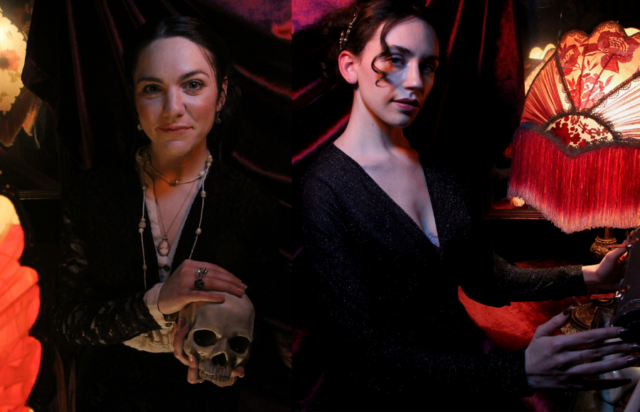
spit&vigor’s Ectoplasm opens January 13 at the Players Theatre (photo by Nick Thomas)
ECTOPLASM
The Players Theatre
115 MacDougal St. between West Third & Bleecker Sts.
Wednesday – Sunday, January 13 – February 6, $52-$99
www.spitnvigor.com
Sara Fellini is proud of being old school, but that doesn’t mean she’s old-fashioned. The actress, playwright, director, and amateur historian started the New York City–based spit&vigor theater company in 2015 with executive producer Adam Belvo, “dedicated to makeshift, skin-of-your-teeth, ad hoc theater — bringing modern voices and perspectives to the wild, chaotic, irreverent, burlesque roots of theater.”
The company has performed such works as Casey Wimpee’s The Brutes, about the three Booth brothers staging Shakespeare’s Julius Caesar, at the Players Club, which was founded by Edwin Booth; Fellini’s NEC SPE / NEC METU, in which Fellini portrayed seventeenth-century painter Artemisia Gentileschi and Belvo played Caravaggio, at the Center at West Park; Fellini’s The Wake of Dorcas Kelly, a period piece about the death of a real-life Dublin madam in 1762 and the riot that followed; and Thomas Kee’s Mary’s Little Monster, about Lord Byron, Percy Bysshe Shelley, and Mary Shelley. During the pandemic, they created the site-specific Luna Eclipse, which was livestreamed using one camera from the Center at West Park.
Next up for spit&vigor is Ectoplasm, running January 13 through February 6 at the Players. (The opening was delayed more than a week because of Covid.) Written and directed by Fellini, the phantasmagoric show is set in 1912 around a séance involving a famous magician, a spiritual medium, a madame, and an uninvited guest. The title refers to the eerie white substance, supposedly spiritual energy, that would emerge from the mouths of psychics as they contacted the deceased.
Below Fellini discusses her fascination with history, creating theater during the coronavirus crisis, taking risks, and more.
twi-ny: What was your initial reaction to the March 2020 pandemic lockdown?
sara fellini: Initially, I just absolutely could not fathom it. I just didn’t believe we’d go into lockdown. My reference point at that time was SARS, so I thought the panic would die down and we would continue on as we were. spit&vigor had two productions coming up at that time — as a small company, we can’t always control where or when we produce because we have to go where residencies are offered, so through no lack of desire on our part we hadn’t actually produced anything for a while and we had spent the better part of the year prepping for the productions at the New Ohio, and then our off-Broadway debut in March and May of 2020, respectively.
I could not imagine a world in which shows would be canceled. Before Covid, I’d never even heard of a rehearsal being canceled, and now two shows of ours were dropped in a matter of months. My entire worldview was changed.
twi-ny: The company is very much about site-specific, immersive productions. What were you working on at the time that couldn’t proceed?
sf: At the New Ohio, we were working on an “embedded” version of The Wake of Dorcas Kelly. We use the term embedded to mean that the audience is kind of sitting inside the brothel, like flies on the wall, watching the production. The actors don’t see or interact with the audience, but they’re very up-close and personal. So we were going to re-create the brothel inside of the New Ohio.
Then, at the Players Theatre, which is a proscenium, we were expanding our vision to create a diorama-esque version of another “embedded” play we’ve produced several times in the past, Mary’s Little Monster by Thomas Kee. We’ve produced that play before at the Mudlark Public Theatre, a one-room puppet theater in New Orleans owned by the genius Pandora Gastelum, and at Torn Page, the historic home of Rip Torn and Geraldine Page.
The Players is a great space to do very intimate-feeling shows even though it’s a larger theater, because it’s very long, and you kind of get sucked into the stage. The stage becomes your entire vision when you sit facing forward. So we were planning on doing a very intimate production of a very intimate and sultry play, with a lot of sex, drugs, and rock-and-roll . . . which now with Covid restrictions is an absolute NO for a while. Even if we staged it quite safely, I don’t think audiences are ready to see that kind of closeness onstage for a while.
twi-ny: Was Luna Eclipse already in process as an in-person show?
sf: No, I wrote Luna Eclipse as a response to the pandemic. I’ve always wanted to write a walk-through play (in person), and the pandemic gave me an opportunity to stretch that muscle. Luna Eclipse was a series of monologues exploring inherited mental illness (and the different historic perceptions of mental illness — are you a mystic visionary, or a failure to society?) through one family’s history, going all the way back to Roman times.
So I wrote the monologues, and we staged it at the Center at West Park as part of their incredible residency program. We did a lot of work to film the production, and livestream it, as a walk-through experience — like you were walking through the tunnel of time and encountering the different experiences of all of these ghosts. We essentially created a one-shot film in the vein of Russian Ark and 1917, except we did it live, as theater artists are wont to do.
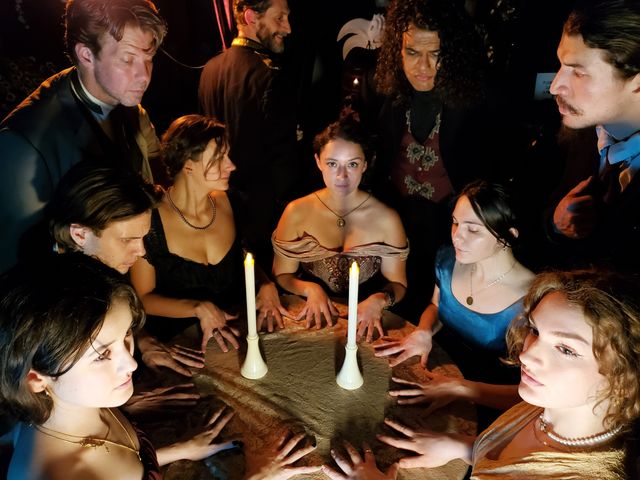
Ectoplasm centers around a séance involving a famous magician (photo by Claire Daly)
twi-ny: Did you watch a lot of online theater during the lockdown?
sf: Um, no. I didn’t watch a lot of online theater. I hate to admit that, but I really dislike online theater. It’s so safe. And it completely misses the mark of what theater is supposed to be. I understand the impulse people have to stay safe physically, but online theater seems safe emotionally and I can’t really abide that. But you’re also talking to a person who doesn’t really like movies, either, so I’m already biased. We did Luna Eclipse, and we also did some live Zoom readings of classic TV shows for fun, but I am glad to be back in a theater and I wouldn’t ever really do online theater again in a serious way.
twi-ny: There have been a slew of recent works about Mary Wollstonecraft Shelley and Frankenstein, including s&v’s Mary’s Little Monster. What do you think it is about her that has stimulated such interest in the past few years?
sf: In my historical research, I’ve noticed there are cycles of time where people suddenly become interested in women creators. The story of a young woman in competition with titans of literature Lord Byron and Percy Bysshe Shelley is irresistible, especially when you factor in their libertine sexual practices.
I think Mary Shelley herself interests people today for a few reasons: because she was the daughter of the legendary feminist Mary Wollstonecraft, which shows a writing dynasty we rarely see through the mother’s line. She seems to have been sexually liberated in a way that we think we understand today, and she seems uniquely forgotten because her (male) creation is so ubiquitous while her name is not as well known. I think that’s a little bit of a false impression because fewer people could tell you that John Polidori rewrote the vampyre legend for popular Western culture, and, off the top of my head, I have no idea who created the mummy legend.
[Ed. note: Jane Louden’s novel The Mummy! A Tale of the Twenty-Second Century was published in 1827, while Bram Stoker’s The Jewel of Seven Stars, about an archaeologist trying to revive a mummy, came out in 1903, six years after Dracula.]
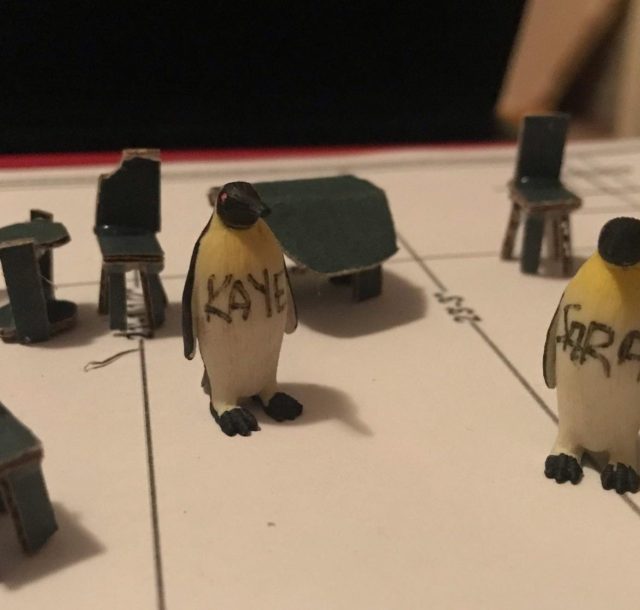
Writer-director Sara Fellini used models during rehearsals for Ectoplasm (photo courtesy spit&vigor theatre company)
twi-ny: You returned to in-person shows first with Dorcas Kelly, then Hit Your Mark / Die Beautiful. What was that transition like?
sf: It was incredible to be back in a theater, with people. I wouldn’t ever go back. The first few rehearsals were very emotional.
twi-ny: How has the omicron variant, which is spreading throughout New York City (I now have it too), impacted the rehearsal process for Ectoplasm?
sf: I’m so sorry to hear that, I hope you recover quickly!
We have had to be extremely creative with rehearsals. Around the holidays, we moved rehearsals to Zoom to restrict exposure, which was torture. I created a replica set out of cardboard and used little rubber penguins as actors to go over staging, which was a nightmare. But I’m glad we did it because two of our cast members actually contracted omicron and had to continue to Zoom into rehearsals as they quarantined, even while the rest of us met in person.
Beyond that, we are testing frequently, hiring swings, which we’ve never really done before, and just doing our best and working hard, both to create a beautiful production and to keep everyone safe.
twi-ny: You also have a bent for historical re-creations, with plays involving such real-life figures as Shelley, the Booth family, Caravaggio and Gentileschi, Kelly, and now Houdini. Were you always into history?
sf: Yes, I’ve always been into history. I have trouble relating to the modern world. Ever since we started spending most of our time online, people have become irritable and impatient, turning the slightest friction or conflict into all-out war, zero to sixty, and it is so frustrating to me.
So, while a lot of the ideas and prejudices of the past are nonsense and based in ignorance and inexperience, I do think there’s a lot to be learned from people who spent all of their time noticing, negotiating, and navigating other human beings. We need that human interaction as much as we need food or water — and it’s becoming harder and harder to find it, because even when you’re in the same room as someone, after the Covid pandemic (and the pandemic of computers), people turn their faces away or fidget and squirm when they’re in the presence of other humans, myself included.
I want to rediscover our shared humanity, and I think one way to do so is turning back the clocks and finding the root source. If we combine the social aspect of the past with modern perspectives on gender, race, sexual orientation, we could have an incredibly rad world to live in.
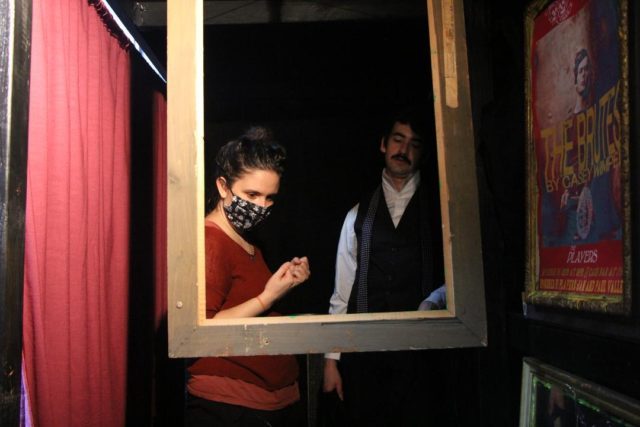
Sara Fellini checks out part of the set for new work at Players Theatre (photo courtesy spit&vigor theatre company)
twi-ny: What other historical figures might play a part in future s&v productions?
sf: I’m developing a play at the moment about the women pirates Anne Bonny and Mary Read, which is turning into a real romp.
twi-ny: You are a writer, director, costume designer, and actor. How do you juggle the four disciplines? When you are writing something, do you know immediately whether you will direct and/or star in it?
sf: I write plays for our company, so I generally have a good idea of who I want to be in it, what I want them to be wearing (from our costume stock), and how I would like the play to look. I think more writers should write like this, in a practical way — it’s very Shakespearean, or old Victorian theater.
A lot of theater productions seem a lot like film sets, with bloated production personnel and everybody in niche roles. We prefer to have an intimate team working together to create something personal. It’s riskier, because it means you take on a lot of the responsibility when something goes wrong and you can’t hide in your niche, but I think art is supposed to be risky, and I hope we don’t lose that mentality after all this time.