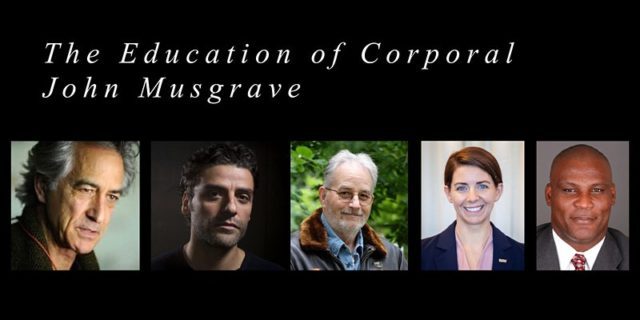
Who: John Musgrave, Oscar Isaac, Greg Gadson, Ashleigh Byrnes, David Strathairn, Bryan Doerries What: Book launch of war memoir Where:Theater of War Productions online When: Wednesday, April 13, free with RSVP, 7:00 Why: Theater of War Productions regularly produces live readings of classic and classical plays, tying them to what is happening in the world today. On April 13 at 7:00, they will be presenting something a little different, a free event built around John Musgrave’s 2021 memoir, The Education of Corporal John Musgrave: Vietnam and Its Aftermath (Knopf, $27, November 2021). Musgrave (Notes to the Man Who Shot Me: Vietnam War Poems) is a permanently disabled war veteran who has been awarded two Purple Hearts and two Vietnamese Crosses of Gallantry.
He writes in the first chapter: “Service was in my DNA from the very beginning. I was born because of my parents’ service, and I was born to serve. World War II brought my mother and father together, compelling them both to join the effort right after the United States declared war against Japan. My father served as a pilot and my mother as a secretary at a nearby aviation plant, where they first met. So, in a very real way, my older brother, Butch, and I both owe our lives to the bombing of Pearl Harbor. My first conscious memory of our nation being at war was forged when I was just three or four years old, around 1951.”
Actors Oscar Isaac, Greg Gadson (a retired colonel), and David Strathairn will read excerpts from the book, along with Musgrave and Ashleigh Byrnes, the deputy national communications director of Disabled American Veterans (DAV). The readings will be followed by a panel discussion and audience Q&A about war and healing; the evening is directed and facilitated by Theater of War artistic director Bryan Doerries.
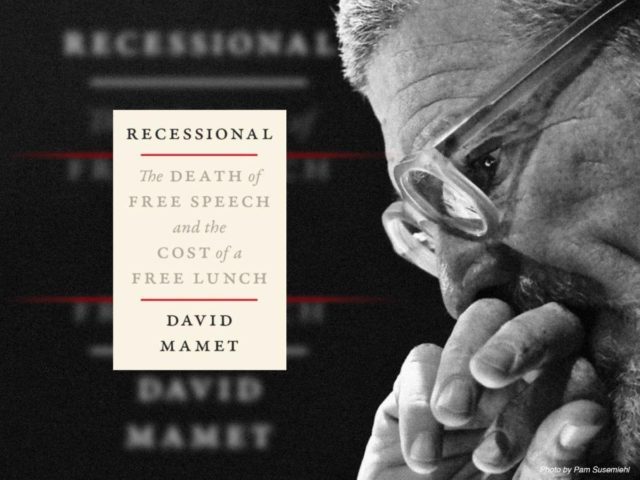
Who: David Mamet, Bari Weiss What: Livestreamed book discussion Where:The Temple Emanu-El Streicker Center online When: Monday, April 11, free with advance RSVP, 7:00 (with option to purchase book) Why: “President Trump has been calling out the fake news since he declared he’d run. I’m with him there. In fact, an excellent preparation for dealing with blacklisting (my own) is a career as a playwright. The science of history burgeoned with the invention of movable type; it is now dying through the application of ink eradicator known as ‘the media.’ Soon it will be no more.”
So writes David Mamet in his latest book, Recessional: The Death of Free Speech and the Cost of a Free Lunch (HarperCollins, $28.99, April 2022), in which he pulls no punches about the sorry state of our world. In such chapters as “The Fountain Pen,” “Cause and Effect,” “Reds, Pinks, and Goo-Goos,” and “What’s in a Name,” Mamet delves into religion, politics, the social contract, and his personal life, unpredictably skewering all sides as only he can. For more than fifty years, the Chicago-born Pulitzer Prize winner has been challenging us in such plays as American Buffalo,Glengarry Glen Ross,Speed-the-Plow, and Oleanna, such films as House of Games,The Spanish Prisoner,Things Change, and State and Main, and such books as Bambi vs. Godzilla: On the Nature, Purpose, and Practice of the Movie Business; The Secret Knowledge: On the Dismantling of American Culture; and The Wicked Son: Anti-Semitism, Jewish Self-hatred, and the Jews.
He will be launching Recessional with a free livestreamed event on April 11 hosted by the Temple Emanu-El Streicker Center, moderated by Bari Weiss, the journalist and author of How to Fight Anti-Semitism and The New Seven Dirty Words who famously resigned from the New York Times, explaining, “The lessons that ought to have followed the election — lessons about the importance of understanding other Americans, the necessity of resisting tribalism, and the centrality of the free exchange of ideas to a democratic society — have not been learned. Instead, a new consensus has emerged in the press, but perhaps especially at this paper: that truth isn’t a process of collective discovery, but an orthodoxy already known to an enlightened few whose job is to inform everyone else.” Get ready for a lively conversation that is likely to both enlighten and infuriate but never bore you.
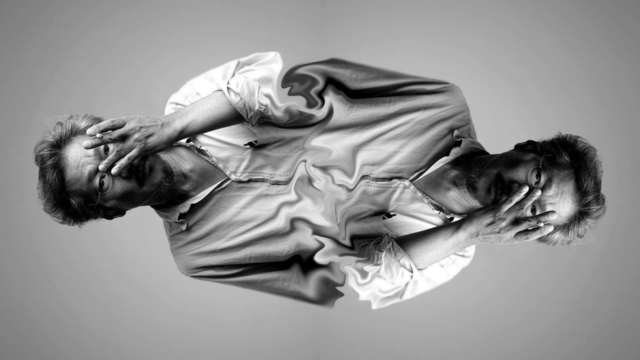
The many dualities of the films of Hong Sangsoo will be explored in two-part double feature series (photo by Sandro Baebler / image by Jasmine Abbasov)
THE HONG SANGSOO MULTIVERSE
Film at Lincoln Center, Walter Reade Theater
144 West Sixty-Fifth St. at Amsterdam Ave.
April 8-17, May 4-10 (two-for-one pricing) www.filmlinc.org
In a July 2017 interview in Film Comment, which is published by Film at Lincoln Center, South Korean auteur Hong Sangsoo, when asked about connected themes and autobiography in his works, noted, “I’m a person who only responds to ‘what is given’ (at least in important choices), and the ‘what is given’ should be intrinsically something that I cannot know why and how it comes. . . . All my films are autobiographical in a sense that whatever I do, they all end up showing something of myself; all my films are not autobiographical in a sense that I’ve never meant to make a film that represents my life or a part of my life.”
For more than a quarter century, Hong (whose surname is sometimes spelled Sang Soo or Sang-soo) has been making fascinating films that cleverly question reality, playing with the concepts of time and space, often set in the world of film. His protagonists are writers or directors who develop different kinds of relationships with actors, fans, students, and other admirers amid a lot of drinking and smoking. His complex narratives are deeply intellectual, exploring the dual nature of life and art. When a character in one says, “I don’t think you really understood the film,” she’s talking to the audience as well, but not in a condescending way; Hong’s works are almost always satisfying on the surface, but there are myriad pleasures to uncover the more you dig.
Film at Lincoln Center is celebrating Hong’s career — and the dualities he exposes — with the two-part series “The Hong Sangsoo Multiverse: A Retrospective of Double Features,” running April 8-17 and May 4-10, consisting of pairings from his entire oeuvre, including rarely shown shorts and many works that are not available on streaming platforms. In addition, on April 8 at 6:00 in the Amphitheater, the free talk “The Hong Show with Dennis Lim” will examine Hong’s world, with Film Comment editors Clinton Krute and Devika Girish, and on May 7 at 5:00 Hong himself will be at the Walter Reade Theater for a talk with Lim, the author of the Hong monograph Tale of Cinema. Hong will also be on hand for several Q&As following screenings in the second half of the series. Oh, and there is a secret screening on May 10, the title of which will not be revealed until the film is about to start. Below are select reviews; keep watching this space for more insight into this extraordinary filmmaker who you need to discover if you haven’t already.
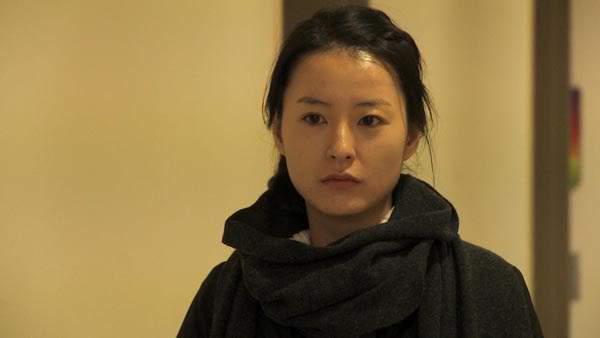
Oki (Jung Yumi) walks the fine line between fiction and reality in Oki’s Movie
OKI’S MOVIE (Hong Sangsoo, 2010)
Friday, April 8, 7:30 (with In Another Country)
Friday, April 15, 6:30 (with Tale of Cinema)
Throughout his prestigious career, Korean director Hong Sangsoo has explored the nature of his craft, using the creative process of filmmaking as a setting for his relationship-driven dramas. He examines the theme again in Oki’s Movie, a beautifully told tale told in four sections built around film professor Song (Moon Sung-keun) and students Jingu (Lee Sun-kyun) and Oki (Jung Yumi). Each chapter — “A Day for Chanting,” “King of Kiss,” “After the Snowstorm,” and “Oki’s Movie” — features a different point of view with a different narrator while walking the fine line between fiction and nonfiction. As in Tale of Cinema, certain parts are films within the film, shorts made by the characters for their class. Hong keeps viewers guessing what’s real as Oki balances a possible love triangle between her, Jingu, and Song; the final segment is a poetic masterpiece that brings everything together.
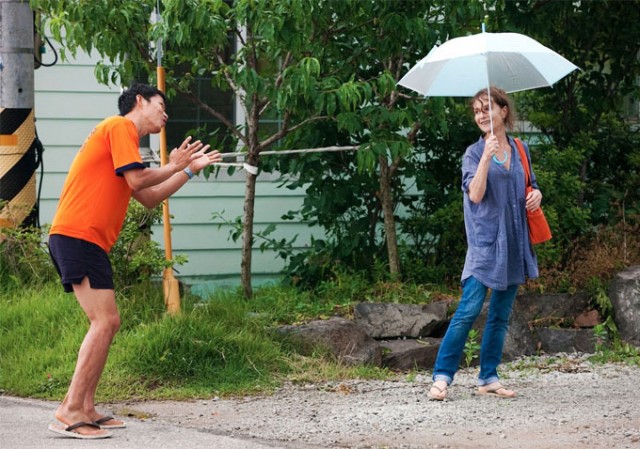
A lifeguard (Yu Jun-sang) makes the first of several offers to Anne (Isabelle Huppert) in In Another Country
IN ANOTHER COUNTRY (Hong Sangsoo, 2012)
Friday, April 8, 9:00 (with Oki’s Movie)
Saturday, April 9, 7:15 (with Our Sunhi and List)
Hong Sangsoo continues his fascinating exploration of cinematic narrative in In Another Country, although this one turns somewhat nasty and tiresome by the end. After being duped in a bad business deal by a family member, an older woman (Youn Yuh-jung) and her daughter, Wonju (Jung Yumi), move to the small seaside town of Mohjang, where the disenchanted Wonju decides to write a screenplay to deal with her frustration. Based on an actual experience she had, she writes three tales in which a French woman named Anne (each played by an English-speaking Isabelle Huppert) comes to the town for different reasons. In the first section, Anne is a prominent filmmaker invited by Korean director Jungsoo (Kwon Hye-hyo), who has a thing for her even though he is about to become a father with his very suspicious wife, Kumhee (Moon So-ri). In the second story, Anne, a woman married to a wealthy CEO, has come to Mohjang to continue her affair with a well-known director, Munsoo (Moon Sung-keun), who is careful that the two are not seen together in public. And in the final part, Anne, whose husband recently left her for a young Korean woman, has arrived in Mohjang with an older friend (Youn), seeking to rediscover herself.
In all three stories, Anne searches for a lighthouse, as if that could shine a light on her future, and meets up with a goofy lifeguard (Yu Jun-sang) who offers the possibility of sex, but each Anne reacts in different ways to his advances. Dialogue and scenes repeat, with slight adjustments made based on the different versions of Anne, investigating character, identity, and desire both in film and in real life. Hong wrote the film specifically for Huppert, who is charming and delightful in the first two sections before turning ugly in the third as Anne suddenly becomes annoying, selfish, and irritating, the plot taking hard-to-believe twists that nearly undermine what has gone on before. Hong once again weaves together an intricate plot that is soon commenting on itself and coming together in unexpected, surreal ways, but he loses his usual taut narrative thread in the final, disappointing section.
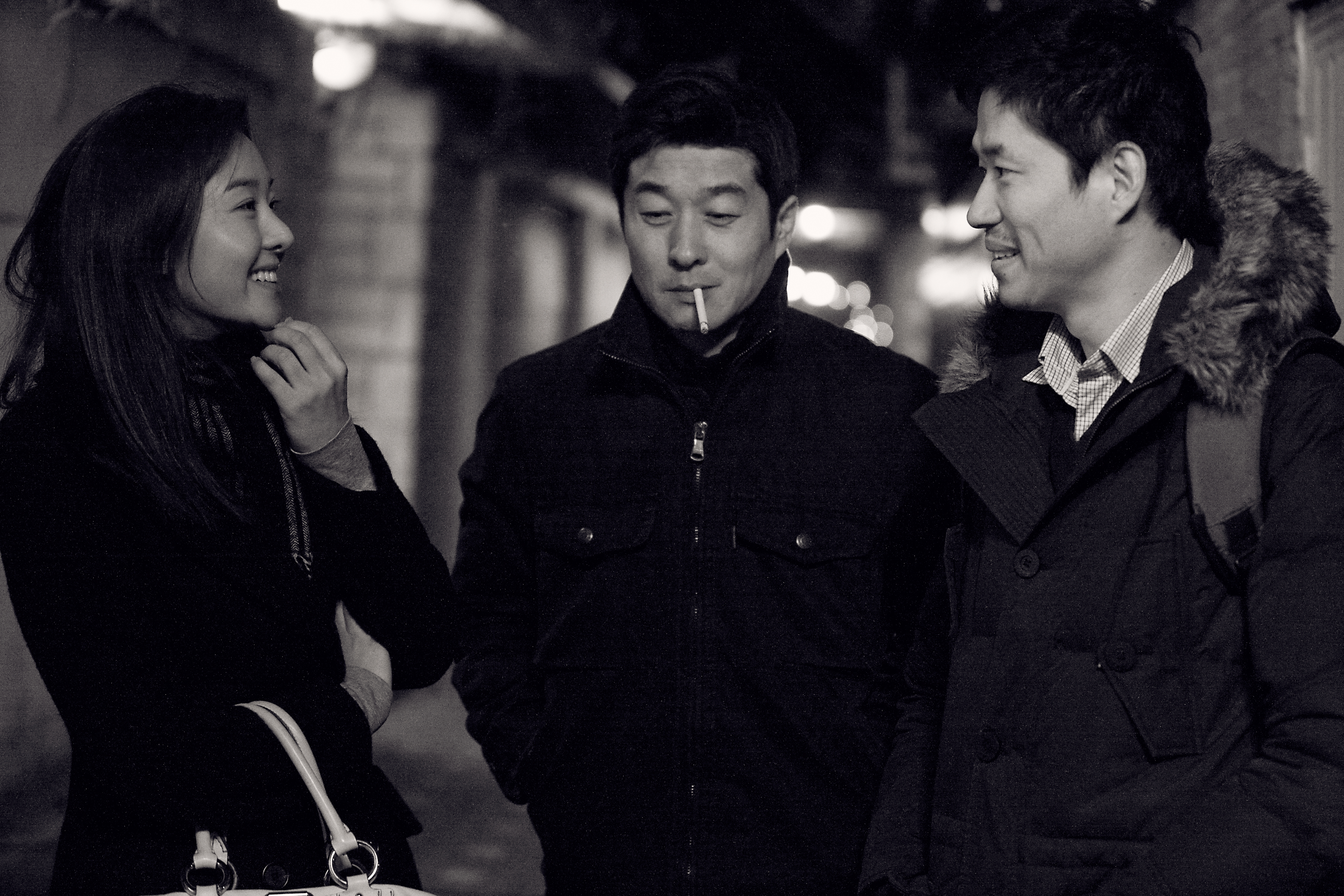
Boram (Song Sun-mi), Youngho (Kim Sang-joong), and Seongjun (Yu Jun-sang) examine their lives in fascinating ways in The Day He Arrives
THE DAY HE ARRIVES (Hong Sangsoo, 2011)
Saturday, April 9, 3:00 (with The Day After)
Monday, April 11, 6:30 (with Yourself and Yours)
For most of his career, South Korean auteur Hong Sangsoo has been making films about filmmakers, although not always about the filmmaking process itself. Often he delves into the more personal side of lead characters who are established or emerging directors. Hong reached a career peek with The Day He Arrives, a deeply intuitive, vastly intelligent, and surprisingly existential exploration of a young man at a crossroads in his life. After having made four little-seen films and deciding to become a country teacher instead, director Seongjun (Yu Jun-sang) returns to his hometown in Seoul to visit his friend Youngho (Kim Sang-joong), a film critic who has just left his wife and is hanging out with a film teacher named Boram (Song Sun-mi). Seongjun stops by to visit his old girlfriend, Kyungjin (Kim Bok-yung), keeps bumping into an actress who appeared in one of his films, goes drinking with a trio of fans, and meets Yejeon (also played by Kim Bok-yung), the owner of a local bar where Youngho and Boram take him.
As all of the main characters examine their lives, each one lacking something important, Hong has several scenes repeat multiple times with slight differences, as if they are alternate takes imbued with new meaning as the audience continues to learn more about the protagonists. Each revised scene contributes more insight and develops the characters further, even if the story seems to have backtracked in time. The nonlinear narrative and beautiful black-and-white cinematography evoke aspects of Woody Allen’s Stardust Memories, Harold Ramis’s Groundhog Day, and François Truffaut’s Day for Night, exceptional films that, like The Day He Arrives, carefully balance fantasy and reality, fiction and nonfiction while depicting the inherent dual nature of cinema and humanity. Earlier in his career, Hong seemed to have trouble ending his films, which would linger on well past the two-hour mark, but with the outstanding, poetic Oki’s Movie and its follow-up, The Day He Arrives, both of which run approximately eighty minutes, he has found an excellent length for his work — one that now almost feels too short, as he clearly has so much to say.
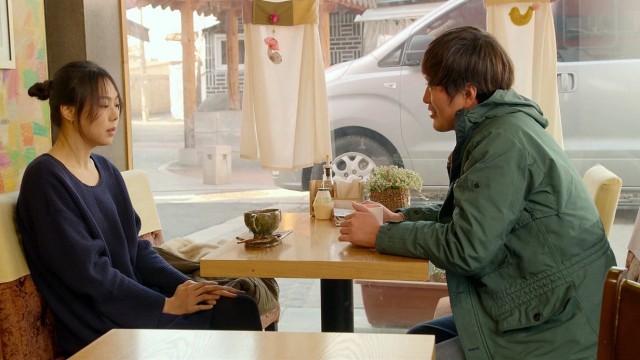
Yoon Heejung (Kim Minhee) and Ham Chunsu (Jung Jaeyoung) get to know each other twice in Right Now, Wrong Then
RIGHT NOW, WRONG THEN (Hong Sangsoo, 2015)
Sunday, April 10, 3:00 (with The Power of Kangwon Province)
Wednesday, April 13, 3:15 (with Virgin Stripped Bare by Her Bachelors)
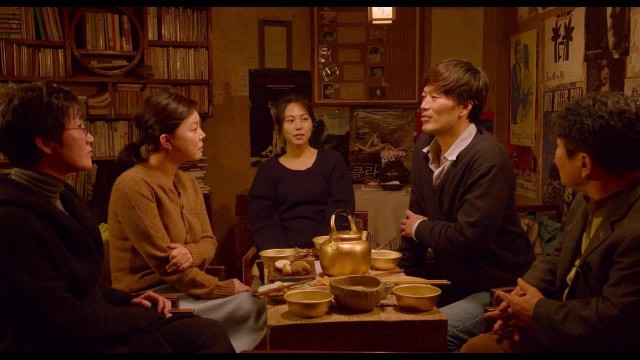
It’s déjà vu all over again in another of Hong Sangsoo’s masterpieces, Right Now, Wrong Then. Hong’s previous films explored the nature of cinematic storytelling: often, a film director is the protagonist, and scenes and characters repeat from different points of view. In Right Now, Wrong Then, Hong again plays with the temporal aspects of narrative; he essentially starts the film over at the halfway point, switching around the words of the title and repeating opening credits. Jung Jaeyoung won several Best Actor awards for his portrayal of art-house director Ham Chunsu, who has accidentally arrived a day early to the Korean province of Suwon, where he will take part in a Q&A following a screening of one of his films. Wandering around the town, he enters the blessing hall of an old palace and meets Yoon Heejung (Kim Minhee), a shy, aspiring painter. They talk about their lives, their hopes and dreams, as they go out for coffee and tea, eat sushi and drink soju, and meet up with some friends of Heejung’s. And then they do it again, primarily scene by scene, with variations in dialogue and temperament that offer sly twists on what happened in the first half. It’s as if Chunsu and Heejung are given the kind of second chance that one doesn’t get in real life, only in movies, or maybe Hong is showing us an alternate universe where myriad possibilities exist.
Art-house director Ham Chunsu (Jung Jaeyoung) doesn’t mind being the center of attention in award-winning Right Now, Wrong Then
Winner of the Golden Leopard for Best Film at Locarno, Right Now, Wrong Then moves at the patient, naturalistic pace and rhythm of real life, with numerous long scenes lasting between five and ten minutes with no cuts. Cinematographer Park Hongyeol, who has photographed six other Hong films, occasionally zooms in on a character, a tree, or other objects, the movement of the camera often slightly awkward, reminding us that we are watching a movie. However, the camera placement and movement, which are decided by Hong, is not what we’re used to in conventional cinema; Park and Hong eschew standard speaker-reaction back-and-forth shots, instead allowing the camera to linger in the same spot for a while, or focus in on the person not talking, or concentrate on a minute detail that appears insignificant. Adding to the film’s vitality, Hong writes each scene the same day that it’s shot, resulting in a freshness that is intoxicating. Jung (Our Sunhi, Moss) is a marvel as Chunsu, a quirky, jittery figure who is not quite as cool or humble as he might think he is, while former model Kim (Hellcats, Very Ordinary Couple) is sweetly engaging as the tentative Heejung, who is trying to find her place in the world. Meanwhile, popping up every once in a while is Jeong Yongjin’s playful, carnivalesque music, as if we’re watching life’s endless circus, which, of course, we are.
Young-soo (Kim Joo-hyuk) tries to win back Min-jung (Lee Yoo-young) in Yourself and Yours
YOURSELF AND YOURS (Hong Sangsoo, 2016)
Monday, April 11 at 8:00 (with The Day He Arrives)
Monday, May 9, 4:15 (with On the Occasion of Remembering the Turning Gate)
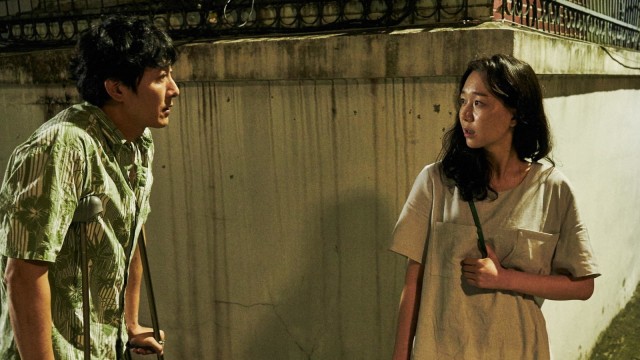
“Don’t try to know everything,” Min-jung (Lee Yoo-young) says in Hong Sangsoo’s latest unusual and brilliant romantic drama, Yourself and Yours. It’s impossible to know everything that happens in Hong’s films, which set fiction against reality, laying bare cinematic narrative techniques. With a propensity to use protagonists who are directors, it is often difficult to tell what is happening in the film vs. the film-within-the-film. He also repeats scenes with slight differences, calling into question the storytelling nature of cinema as well as real life, in which there are no do-overs. In the marvelous Yourself and Yours, scenes don’t repeat, although the existence of a main character might. Min-jung is in a relationship with painter Young-soo (Kim Joo-hyuk), who is dealing with the failing health of his mother when he is told by a friend (Kim Eui-sung) that Min-jung was seen in a bar drunk and arguing with another man. Young-soo refuses to believe it, since he and Min-jung are facing her drinking problem by very carefully limiting the number of drinks she has when she goes out with him. But when the friend insists that numerous people have seen her in bars with other men and imbibing heavily, Young-soo confronts her, and she virulently defends herself, claiming that they are lies and that he should have more faith in her. She leaves him, and over the next several days she has encounters with various men, but she appears to be either a pathological liar or have a memory problem as she tells the older Jaeyoung (Kwon Hae-hyo), a friend of Min-jung’s, that she is a twin who does not know the painter; later, with filmmaker Sangwon (Yu Jun-sang), she maintains that they have never met despite his assertion that they have. Through it all, Young-soo is determined to win her back. “I want to love each day with my loved one, and then die,” he explains with romantic fervor. He also acknowledges Min-jung’s uniqueness: “Her mind itself is extraordinary,” he says.
Min-jung (Lee Yoo-young) tells Jaeyoung (Kwon Hae-hyo) she has a twin in Yourself and Yours
Yourself and Yours is an intelligent and witty exploration of fear and trust, built around a beautiful young woman who might or might not be lying, as she seems to reboot every time she meets a man, erasing her recent past. Lee (Late Spring, The Treacherous) is outstanding as Min-jung, keeping the audience on edge as to just what might be going through her “extraordinary” mind. Kim (Lovers in Prague, My Wife Got Married) plays Young-soo with just the right amount of worry and trepidation. As with most Hong films, there is a natural flow to the narrative, with long shots of characters just sitting around talking, smoking, and drinking — albeit primarily beer in this case rather than soju — with minimal camera movement courtesy of regular Hong cinematographer Park Hong-yeol (Hahaha, Our Sunhi), save for Hong’s trademark awkward zooms. There’s also an overtly cute romantic comedy score by Dalpalan to keep things light amid all the seriousness. Hong continually works on his scripts, so the actors generally get their lines the day of the shoot, adding to the normal, everyday feel of the performances. Many writers have compared the film to Luis Buñuel’s grand finale, 1977’s That Obscure Object of Desire, in which Carole Bouquet and Angelina Molina alternate playing a flamenco dancer, postulating that there are numerous Min-jungs wandering around town, a series of doppelgängers hanging out in bars. That’s not the way I saw it at all (and at the San Sebastian Film Festival, Hong denied it was a direct influence); instead, I see it as one Min-jung, dealing with the endless aspects of relationships, and one Young-soo, an artist who desperately wants to believe in true love and who does not want to be alone, particularly with his mother on her deathbed. There’s the smallest of cues near the end that explains it all, but I’m not about to give that away. And I’m not sure how much it even matters, as regardless of how many Min-jungs might populate this fictional world, Hong has crafted another mesmerizing and mysterious look at love and romance as only he can.
Kim Tae-woo is outstanding as annoying, self-obsessed auteur in Like You Know It All
LIKE YOU KNOW IT ALL (Hong Sangsoo, 2009)
Tuesday, April 12, 8:45 (with Virgin Stripped Bare by Her Bachelors)
Thursday, April 14, 6:30 (with On the Beach at Night Alone)
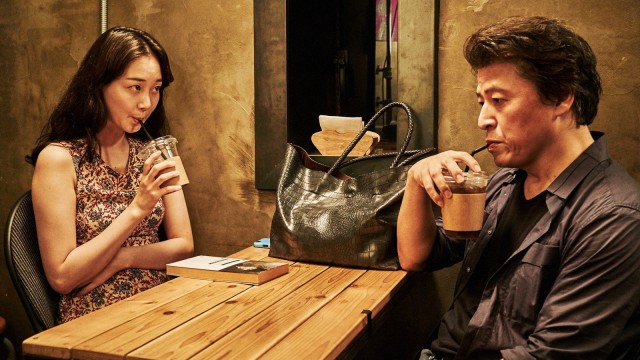
Hong Sangsoo’s Like You Know It All is another intriguing examination of art and sex in contemporary society from the South Korean auteur. Hong, who has served as a juror at several film festivals and whose work has screened at fests all over the world, sets his latest self-reflexive story at the real Jecheon International Music and Film Festival, where director Ku will be part of the jury. But it turns out that Ku is a self-absorbed, insensitive, and subtly obnoxious filmmaker who cares only about himself, walking away from fans and colleagues in the middle of a conversation or in the midst of signing an autograph, interested only in listening to people praise his own talent, which has been relegated to art-house films that few people see and even fewer understand.
After leaving the festival to teach a class at a school on Jeju Island, he visits with a famous painter and former mentor who has unknowingly married Ku’s first love, setting the stage for the creepy Ku to perform yet more selfish acts. Kim Tae-woo is outstanding in the lead role, playing the self-obsessed director with an unerring casualness that makes him more absurdly ridiculous than conniving and mean-spirited. With a little bit of Federico Fellini’s 8 1/2 here and a touch of Woody Allen’s Stardust Memories there, Hong once again reveals the soft underbelly of ego within the film industry, but he also needs to edit himself more, as the bittersweet, slyly ironic Like You Know It All, made for a mere $100,000, is yet another of his films to clock in at more than two hours (though it feels longer).
Woman on the Beach in another beautifully shot though overly long drama about art and love from Hong Sangsoo
WOMAN ON THE BEACH (Hong Sangsoo, 2006)
Saturday, April 16, 1:00 (with Nobody’s Daughter Haewon)
Sunday, April 17, 7:45 (with Woman Is the Future of Man)
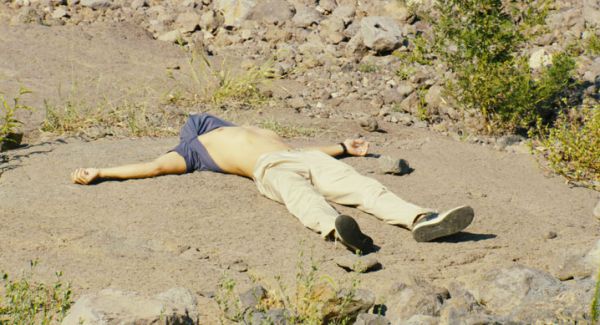
In another film set in the world of cinema, Hong Sangsoo’s Woman on the Beach centers on director Joong-rae (Kim Seung-woo), who is having trouble with the script for his next project, so he gets production designer Chang-wook (Ki Tae-woo) to drive him out to Shinduri Beach for some quiet relaxation, away from the hustle and bustle of Seoul. Chang-wook brings along his girlfriend, Moon-sook (Ko Hyun-joung), an aspiring composer and singer who is immediately attracted to Joong-rae. As Chang-wook’s jealousy grows and Moon-sook and Joong-rae wonder if they have a future together, the director meets Sun-hee (Song Sun-mi), a soon-to-be divorcée who also has eyes for Joong-rae. Writer-director Hong Sang-soo’s moving romantic comedy features beautiful locations shot by Kim Hyung-koo, a sweet score by Jeong Yong-jin, and unusual but believable characters. At 127 minutes, the film, which was selected for the 2006 New York Film Festival, is far too long, not quite knowing how to end, but stick with it nonetheless.
A drunken night at a sake restaurant reveals some hard truths in another bittersweet cinematic tale
NOBODY’S DAUGHTER HAEWON (Hong Sangsoo, 2013)
Saturday, April 16, 3:30 (with Woman on the Beach)
Friday, May 6, 3:45 (with In Front of Your Face)
In South Korean director Hong Sangsoo’s bittersweet tale Nobody’s Daughter Haewon, nearly everyone who meets college student Haewon (Jeong Eun-chae) tells her that she’s “pretty,” from her mother (Kim Ja-ok), who has decided to pack up and move to Canada, to legendary star Jane Birkin (playing herself), whom she bumps into on the street, to a hot bookstore owner, to fellow students and teachers. Rather stuck up and direct on the outside but much more tender and lost on the inside, Haewon reaches out to a former lover, film professor Seongjun (Lee Sun-kyun), who is married with a baby. As they contemplate rekindling their affair, they wind up getting drunk on sake with a group of Seongjun’s students, who suspect the teacher-student romance and clearly do not like Haewon. Meanwhile, Haewon, who is reading Norbert Elias’s The Loneliness of the Dying, is intrigued by the flirtations of another film professor, Jungwon (Kim Eui-sung), who teaches in San Diego. From Seoul’s West Village to the historic Fort Namhan, Haewon tries to find her place in the world as writer-director Hong employs a chronological narrative that combines her dreams with reality over the course of a few weeks in springtime. Hong has explored similar terrain in previous films, but there’s just enough of an edge to Nobody’s Daughter Haewon to prevent it from feeling repetitive and more of the same. As always, Hong favors long establishing shots and a stationary camera that suddenly and awkwardly zooms in, instantly reminding viewers that they are watching a film. However, the scene in the restaurant goes on for several minutes with no cuts or camera movements, letting the acting and the dialogue tell the story without cinematic interference. Nobody’s Daughter Haewon also clocks in at a mere hour and a half, much shorter than most of his earlier work, which tends to go on way too long, but this one feels a little lighter in substance as well.
Sungam (Kim Young-ho) battles displacement and loneliness in Night and Day
NIGHT AND DAY (Hong Sangsoo, 2008)
Saturday, May 7, 6:30 (with On the Beach at Night Alone)
Sunday, May 8, 8:00 (with Claire’s Camera)
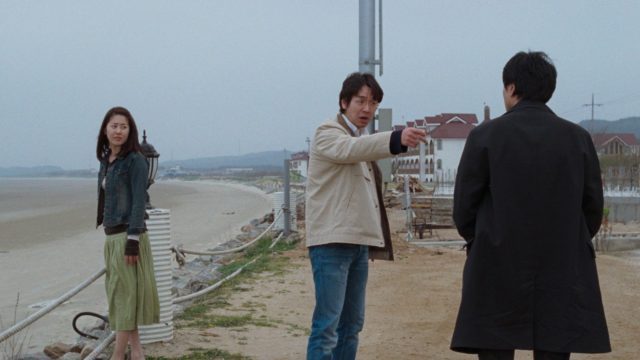
Hong Sangsoo returned to the New York Film Festival for the fifth time with Night and Day, a character-driven tale about displacement and loneliness. Kim Young-ho stars as Sungam, a married painter in his forties who flees South Korea for France after having been turned in for smoking marijuana with U.S. tourists. A fish out of water in Paris, he settles into a Korean neighborhood, spending most of his time with two young art students, Yujeong (Park Eun-hye) and Hyunju (Seo Min-jeong). He also meets an old girlfriend, Minsun (Kim You-jin), who is still attracted to him. And every night he calls his wife, Sungin (Hwang Su-jung), wondering when he’ll be able to return home. Hong tells the story in a diary-like manner, with interstitials acting like calendar pages. Sometimes a day can be filled with talk of art, a party, and a chance encounter, while others can consist of a brief, random event with no real bearing on the plot, reminiscent of Jim Jarmusch’s Stranger Than Paradise, just without the existential cynicism and dark humor. As with 2006’s Woman on the Beach, Hong lets Night and Day go on too long (it clocks in at 141 minutes), with too many inconsequential (even if entertaining) vignettes, but it’s so much fun watching Kim’s compelling performance that you just might not care about the length.
Seven Sins is another hot and sexy night with Company XIV (photo by Mark Shelby Perry)
SEVEN SINS
Théâtre XIV
383 Troutman St., Bushwick
Thursday – Sunday through June 26, $95 – $640 companyxiv.com/sevensins
[Ed. note: Following a two-year pandemic break, Company XIV’s Seven Sins has returned to Bushwick; the below review is from March 2020.]
Company XIV founder and artistic director Austin McCormick outdoes himself with his latest baroque burlesque sensation, the decadently delightful Seven Sins. It’s so tailor-made for the extremely talented troupe that the only question is, what took them so long?
The company has previously staged outré cabaret adaptations of such fairy tales as Pinocchio,Cinderella,Snow White, and Queen of Hearts in addition to Paris! and the seasonal favorite Nutcracker Rouge. They now turn their attention to the original fairy tale itself, the story of Adam and Eve in the Garden of Eden. Serving as host for the evening is the Devil (a fab Amy Jo Jackson), all glammed out in horns, sequins, and heels. Shortly after Adam (portrayed alternately by Scott Schneider or Cemiyon Barber; I saw the former) arrives on Earth, he is joined by Eve (Danielle Gordon or Emily Stockwell; I saw Gordon) through a bit of magic, leading to a lovely duet that incorporates contemporary dance and classical ballet to Dean Martin’s rendition of “If You Were the Only Girl in the World.” Temptation threatens in the form of a long snake carried aloft by several performers; Adam and Eve are offered a glittering red apple, feel shame in their (near-)nakedness, and cover their naughty bits with fig leaves to Paul Anka singing “Adam and Eve.”
Pretty Lamé delivers an aria in latest bawdy baroque burlesque cabaret from Austin McCormick (photo by Mark Shelby Perry)
In the next two acts, they encounter Vanity, Wrath, Lust, Jealousy, Sloth, Greed, and ultimately Gluttony, each sin getting its own scene involving dance, acrobatics, and/or song, all bursting with an intense sexuality and a wicked sense of humor. The music includes original songs by Lexxe along with classical instrumentals, opera, and tunes by Cherry Poppin’ Daddies, Nancy Sinatra, Cab Calloway, Florence and the Machine, Cardi B, the Beatles, and others. Pretty Lamé lets loose with a pair of gorgeous arias, while the awe-inspiring Marcy Richardson struts her stuff in an aerial cage and on a swinging pole and Troy Lingelbach and Nolan McKew dangle over the audience on a double lyra.
There are multiple ways to see the show, which is staged in Théâtre XIV in Bushwick, where the sexy baroque motif extends to the two bars and every nook and cranny. There are bar chairs, petite chairs, couches, small tables, and deluxe tables where patrons are served food and drink by the performers within the narrative. The set and costumes are by the awesomely inventive Zane Pihlström, with sensual lighting by Jeanette Yew and mischievous makeup by Sarah Cimino. Conceived, choreographed, and directed by McCormick, who also curated the special cocktail menu, Seven Sins encompasses all the best parts of Company XIV, immersing the audience in a lush and lascivious fantasy world where anything can happen. It does lose a bit of its momentum with two intermissions — the total running time is about two hours and fifteen minutes — and there are no bawdy vaudeville-like acts during the breaks, as there have been at previous shows of theirs. But let him/her/them who is without sin cast the first stone. And don’t be surprised if you experience all seven sins yourself during this fantabulous evening.
Andrea Arnold’s Cow follows one extraordinary bovine on a cattle farm
COW (Andrea Arnold, 2021)
IFC Center
323 Sixth Ave.
Opens Friday, April 8 www.ifccenter.com
Throughout her nearly two decades as a filmmaker, British writer-director Andrea Arnold has focused on strong women facing such commonplace issues as love, romance, motherhood, and poverty, often portrayed by actors at the beginning of their career. Arnold, a single mother who left school at the age of sixteen to become an actor — and whose own mother had four children by the time she was twenty-two — has created such unique and memorable characters as Zoe (Natalie Press) in the Oscar-winning 2003 short Wasp, Jackie (Kate Dickie) in 2006’s Red Road, Mia (Katie Jarvis) in 2009’s Fish Tank, the young Cathy (Shannon Beer) in 2011’s Wuthering Heights, and Star (Sasha Lane) in 2016’s American Honey. (Females also take the lead in Arnold’s early shorts Milk and Dog.)
But the three-time Cannes Jury Prize winner might have found her truest, most poignant protagonist in her stunning debut documentary, Cow, opening April 8 at IFC. I can’t remember the last time I was so deeply affected by a film, from start to finish; it absolutely exhilarated and pulverized me.
Made over the course of six years, the nonfiction work follows an extraordinary dairy cow named Luma on a cattle farm in the English countryside. Cinematographer Magda Kowalczyk zooms in on Luma’s hooves as she walks through thick mud, her hind quarters (complete with number ID) when she squeezes into a tight area to eat, her udders when she is milked, and her powerful, expressive eyes. Luma often looks right at the camera (or gives great side-eye) as if she knows that her life is on view for all to see as she goes about her daily business, which is decidedly not glamorous.
The unforgettable Cow is Andrea Arnold’s nonfiction debut
We witness Luma giving birth twice; it’s both edifying and heartbreaking watching her clean her newborn calves with her tongue, realizing that she will only see them again in large, anonymous groups, not as mother and daughter. We share her sense of freedom when the cows are given free rein of a vast pasture, although they are eventually gathered up and marched back to their more confined spaces. At one point, it seems that Luma is considering running away; standing at an entrance gate, she looks back and forth between the outside world and the inside ranch before despondently listening to the farmers and returning to her duties.
Are Arnold and Kowalczyk, and therefore the audience, humanizing an animal that is not nearly as sentient as it appears? Luma does seem to be keenly aware of her surroundings and what is happening to her, even more so than the other cows. Her eyes speak volumes, and she calls out often, perhaps complaining about her circumstances, knowing there has to be more to life. Arnold cuts numerous times to point-of-view shots, as if we are seeing this world through Luma’s eyes, interpreting her thoughts.
In their 2017 study “The Psychology of Cows,” Lorin Marino and Kristin Allen wrote, “Domestic cows (Bos taurus) are consumed worldwide as beef and veal, kept as dairy product producers, employed as draft animals in labor, and are used for a long list of other products, including leather and manure. But despite global reliance on cows for thousands of years, most people’s perception of them is as plodding herd animals with little individual personality and very simple social relationships or preferences. Yet, a review of the scientific literature on cow behavior points to more complex cognitive, emotional, and social characteristics. . . . Moreover, an understanding of the capabilities and characteristics of domestic cows will, it is hoped, advance our understanding of who they are as individuals.”
Arnold has not made the film merely to highlight one bovine with extraordinary cognitive abilities; at its heart, Cow is about the connection between humans and nature, as well as between animals (and humans) themselves. There are no experts talking about farming, no screen text sharing facts and information about milk and meat or unsanitary and cruel conditions; although we occasionally see the farmers, we don’t know their names or exactly what they’re doing at certain times. They just keep performing their tasks as if the camera were not on, knowing that Luma is the subject, not them.
Arnold lays everything out there, and we can make our own decisions. She is not trying to convert us to veganism, but she is asking us to take a deeper look into our lives and how we treat other living, sentient beings. The ending will shock, if not surprise, you, and you are likely to never forget it.
Cow deserves to enter the pantheon of memorable films about animals, from Sounder,Old Yeller, and National Velvet to The Black Stallion,Okja, and First Cow, which are all fictional. Here Arnold has given us the real deal, a film that is not always easy to watch but is innately, unforgivingly human.
On Site Opera returns to site-specific productions with Gianni Schicchi at the Prince George Ballroom (photo courtesy On Site Opera)
GIANNI SCHICCHI
The Prince George Ballroom
15 East Twenty-Seventh St. between Fifth & Madison Aves.
April 7-10, $50 osopera.org
Since 2012, On Site Opera has been presenting immersive works in unique locations around New York City, including Benjamin Britten’s The Turn of the Screw at Wave Hill, Gian Carlo Menotti’s Amahl and the Night Visitors at the Holy Apostles Soup Kitchen, Gregg Kallor’s Sketches from “Frankenstein” in the Green-Wood Cemetery catacombs, and Michi Wiancko and Deborah Brevoort’s Marasaki’s Moon at the Astor Chinese Garden Court at the Met.
But when the coronavirus crisis led to a pandemic lockdown and people quarantining at home, barely venturing outside (or leaving the city entirely), the NYC-based company had to reevaluate its immediate future. Cofounding artistic director Eric Einhorn decided to continue making opera, but instead of fans coming to them, OSO would deliver the works straight to the audience, wherever they were sheltering in place.
The result was a series of innovative productions conveyed live over the phone for one person at a time (To My Distant Love); a mailed diary box featuring music by Dominick Argento, Juliana Hall, and Leoš Janáček and text by Anne Frank, Osef Kalda, and Virginia Woolf (The Beauty That Still Remains); and a live Zoom opera based on Georg Philipp Telemann’s Der Schulmeister (Lesson Plan).
Then, just as the troupe was preparing for its first site-specific indoor work in more than two years, Giacomo Puccini’s 1917–18 Gianni Schicchi at the Prince George Ballroom, Einhorn contracted Covid, forcing him to direct rehearsals over Zoom. The first of Puccini’s Il trittico (“The Triptych”), the fifty-minute comic opera tells the story of a family fighting over a will; the original was set in 1299 Florence, but Einhorn has reimagined it for the Roaring Twenties. OSO plans on staging the next two works, Il tabarro and Suor Angelica, in the coming years.
As opening night approached — Gianni Schicchi runs April 7-10 — Einhorn discussed the past, present, and future of OSO in this new age.
twi-ny: Okay, let’s start with the pandemic. What are the immediate thoughts of the head of a site-specific opera company when a health crisis suddenly shuts down indoor and outdoor venues everywhere and people lock themselves inside?
eric einhorn: I had two immediate thoughts when the pandemic hit: First, what does it now mean to be a company built on the idea of gathering in a specific space? And second, how can we as a company serve our community in these troubling times? The first question led us down a road of fascinating exploration about what constituted a site. The safest choice seemed to be to create projects that allowed each audience member’s own location to serve as the “performance site.” So many arts companies were defaulting to digital media as a way to maintain production, which made a lot of sense for most proscenium-based companies, but it did not for us. Looking at audience sites that did not involve patrons sitting on their computers (a must-have thanks to pretty immediate Zoom and YouTube fatigue) led us to create projects over the phone, through the mail, and via mobile app.
The second question of serving our community was answered through the fantastic collaborative efforts of our staff, board, advisory councils, and past artists. We offered free live watch parties of some previous productions, hosted industry panels, and offered free virtual performance coaching. All of this was rolled out in an effort to help our community remain together and offer experiences that could allow us all to focus on the things that brought us joy in the midst of the terrifying first months of the pandemic.
Eric Einhhorn directs via Zoom for latest OSO site-specific production (photo courtesy On Site Opera)
twi-ny: The phone project was To My Distant Love, a Beethoven song cycle performed for one listener at a time over the phone. How did that come about?
ee: Early in the pandemic, I was sitting in my home office going through my score collection, hoping to find some thread of inspiration in these newly troubling times. I pulled out my copy of Beethoven’s An die ferne Geliebte, which I had once performed when I was pursuing my vocal performance degree many years ago. I had always loved the song cycle for its compact pathos. Rereading the text in 2020, though, resonated in a totally new way. The poetry was about two lovers at a forced distance and the burning desire to be together again. If I didn’t know it was nineteenth-century poetry, I easily could have thought it was brand new and of the moment. Around the same time, I had been made aware of theater companies that created interactive telephone plays for an audience of one. After experiencing one for myself, I became convinced that opera (or a song cycle) could be delivered the same way. We commissioned playwright Monet Hurst-Mendoza to create an interactive script around the song cycle to allow performer and audience member to connect even more, as well as preshow love letters that elicited some fantastic, in-character replies from audiences.
twi-ny: You continued this idea of delivering the company to the audience instead of the audience coming to OSO with the diary box The Beauty That Still Remains, which was mailed out. How did people respond?
ee: After our “low tech” success with the Beethoven phone project, we continued to explore the various ways that we could connect with audiences that were not truly computer-based. Inspiration for The Beauty That Still Remains came from the phenomenon of subscription boxes that now permeate every market and taste. We didn’t know how audiences would respond to a project that was mailed in installments and featured both a tactile element (the box contents) and a digital one (the prerecorded musical performances). It turns out audiences loved it! As with all of our productions, every experiential element was tied into the story, which made it all that much more immersive. Patrons from all over the world engaged with this project, and it gave us yet another opportunity to explore the boundaries of site-specific performance during a time when gathering at a site was not possible.
twi-ny: Last summer you were finally able to gather at a site with The Perfect Pig and Tapestry of New York, at the Glade at Little Island. What did you think about the performance space and Little Island itself?
ee: Performing on Little Island as part of the NYC FREE festival was an incredibly special opportunity. Little Island is such a special place, and the Glade is a magical corner of the park that is perfect for performing. While we were in rehearsals for a full, outdoor production at the same time, the performances on Little Island were actually our first in-person performances since the pandemic began. It was really quite emotional to bring this particular repertoire to Little Island for our first in-person performances in two years. The Perfect Pig is a lovely short opera for families about the self-acceptance, and Tapestry of New York was a concert of selections highlighting many of the incredible communities that make up our city. Seeing audience members of all ages gather again and to be able to perform opera for them was truly a gift. For as much as audiences needed live music again, performers and creators needed to produce again.
twi-ny: If I’m not mistaken, your first Zoom show was Lesson Plan this past January. Had you previously been using Zoom for rehearsals or other reasons?
ee:Lesson Plan was, indeed, our first Zoom-based production. We had been using Zoom since the start of the pandemic for meetings and some select rehearsals but never for a full production. When most opera companies went fully digital in 2020, we did a significant amount of self-reflection to consider what it meant to be site-specific in these times of forced distance. In exploring the idea of the audience’s own location as the “site,” as you mentioned, we created productions for the phone and through the mail. We also created a self-guided walking tour program [The Road We Came] that explored Black music history in New York City through a mobile app with prerecorded performances. When planning our 2022 season, specifically the January slot, I took the general consensus of the scientific community to heart when they said that there could very well be another Covid surge during the winter of 2021. It seemed prudent to plan another remote project rather than face the possibility of having to cancel an in-person production.
For a while, I had wanted to create something around Telemann’s cantata Der Schulmeister — a charming comedy about a curmudgeonly music teacher attempting to teach children to sing. There were some jokes in the piece with the kids singing out of sync with the music teacher that immediately made me think of Zoom delays. This seemed like the perfect project for Zoom to become the site. We wanted to expand the piece a bit and create an English translation. For that, we commissioned Rachel J. Peters, who created something incredibly special with Lesson Plan. Our cast and team of engineering wizards brought it to life in such an amazing way — and it was fully remote and live over Zoom. This production choice proved prescient, as Omicron was in full force during the production period.
twi-ny: OSO is getting down to the site-specific business again with Gianni Schicchi at the Prince George Ballroom. Why that opera in that space?
ee: The Prince George Ballroom has been on my list of potential production venues for several years, but we couldn’t quite decide on the perfect piece to perform there. In planning the 2022 season, some of our programming goals were to keep our repertoire on the shorter side and skew towards comedy. We wanted to allow our audiences to ease back into the experience of being back “on site” and, given what the last two years have been like, we wanted to make sure laughter played a significant role in that. [OSO music director] Geoff McDonald and I arrived at Gianni Schicchi for several reasons: It’s funny, under an hour, and filled with some of the best music in opera. In matching the piece to a space, the Prince George Ballroom immediately came to mind as an opulent room perfect to serve as the home of Buoso Donati, the wealthy patriarch of the opera. The large ballroom also accommodates the audience, orchestra, and performers with plenty of room to spare, making sure that no one feels cramped — another important consideration given Covid.
twi-ny: What were the rehearsals like?
ee: Rehearsals were fantastic! To be in a rehearsal studio with so many wonderful artists working on such a masterpiece was really a joy that almost made one forget about the pandemic. That said, we adhered to strict health and safety protocols that included multiple tests every week for everyone involved in the production and fully masked rehearsals — all under the supervision of a Covid compliance manager hired specifically for the production.
twi-ny: The company is currently celebrating its tenth anniversary. What were your expectations when the company started in 2012? What are your plans for the next ten years?
ee: Back in 2012, On Site Opera was a side project for me. It was an experiment in producing and directing in the crazy format of site-specific production. I never could have imagined it would turn into my full-time job, nor be able to grow to support a staff and as many productions as we now do. There are still moments when I have to pinch myself. The next few years will bring several new commissions, the completion of the Puccini Trittico cycle, and further exploration of the most exciting sites in NYC and beyond. One of the great aspects of the company is its nimbleness. This allows us to remain incredibly flexible in our programming and create productions and initiatives that can serve our community most immediately. In our second decade we will remain committed to our values of equity, diversity, inclusion, and accessibility as well as rich collaborations with our community of patrons, volunteers, artists, and audiences.
twi-ny: You’ve been a leader in the digital opera movement, incorporating apps, Google Glass, and other cutting-edge technology. How is this impacting your audiences?
ee: Adoption of our various technological initiatives has been quite high across all demographics. I think that it is, in part, due to the way our tech is always integrated into our productions. Whenever we decide to include new technology, we evaluate how the tech will interact with the show, what the adoption process might be, and if it could potentially be distracting. We also are mindful that it does not create a barrier for entry for any audience members. By approaching technology from this people-first angle, our initiatives have been quite successful.
Google Glass was an incredibly exciting experiment that brought together the tech and opera communities. I was disappointed when Google changed Glass’s focus to enterprise versus retail, as it essentially closed the door to further operatic applications. Our mobile app, though, and specifically the supertitle translation module, has had an extremely positive impact on our audiences. Before the app, many of our productions did not feature projected English translations (an industry staple these days) due to our immersive seating arrangements or simply a lack of surfaces onto which we could project in our various venues. The app now allows us to always offer English translations for patrons, as well as other languages — we are now consistently offering Spanish translations and have offered Japanese on a previous show. Plans are in the works for multiple language offerings for all of our productions. Since the app is very intuitive and smartphone-based, most audiences find the use of it in performances quite easy and fun.
twi-ny: When you have time to go out, are you seeing opera, or do you have other guilty pleasures?
ee: The pandemic has made me even more of homebody than I was before. However, when I do go out, it is typically to go on some crazy adventure with my kids or see a musical with my partner.
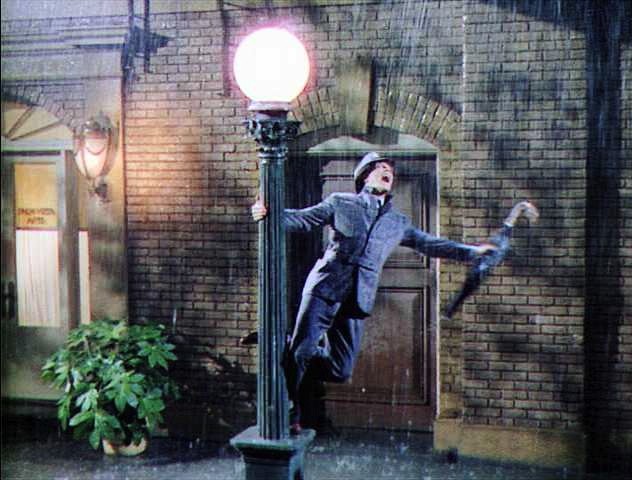
Gene Kelly dazzles during unforgettable solo scene in classic MGM musical Singin’ in the Rain
SINGIN’ IN THE RAIN (Stanley Donen & Gene Kelly, 1952)
AMC Kips Bay 15, Regal Union Square 14, AMC Empire 25, other NYC theaters
Sunday, April 10, and Wednesday, April 13, $18, 4:00 and/or 7:00 www.fathomevents.com www.tcm.com
The MGM musical Singin’ in the Rain is one of the all-time-great movies about movies, in this case focusing on the treacherous transition from silent films to talkies. In honor of its seventieth anniversary — it opened at Radio City Music Hall on March 27, 1952 — Fathom Events and Turner Classic Movies have teamed up to present special screenings across the country, including in such NYC theaters as AMC Kips Bay 15, Regal Union Square 14, and AMC Empire 25. As a bonus treat, there will be commentary before and after the film by TCM host Ben Mankiewicz.
It’s the mid-1920s, and the darlings of the silver screen are handsome Don Lockwood (Gene Kelly) and blonde bombshell Lina Lamont (Jean Hagen). They’re supposedly just as hot offscreen as on, as Don explains to radio gossip host Dora Bailey (Madge Blake, later best known as Aunt Harriet on the Batman TV series) at their latest Hollywood premiere, but in actuality the debonair Don can’t stand the none-too-bright yet still conniving Lina. After accidentally bumping into Kathy Selden (Debbie Reynolds), an independent-thinking young woman who claims to not even like the movies, Don is soon trying to chase her down, determined to get to know her better. Meanwhile, studio head R. F. Simpson (Millard Mitchell) decides he has to capitalize on the surprise success of the first talking picture, The Jazz Singer, by turning the latest Lockwood-Lamont movie, The Dueling Cavalier, into a talkie, with initially disastrous results, threatening to bring everything and everyone crashing down.
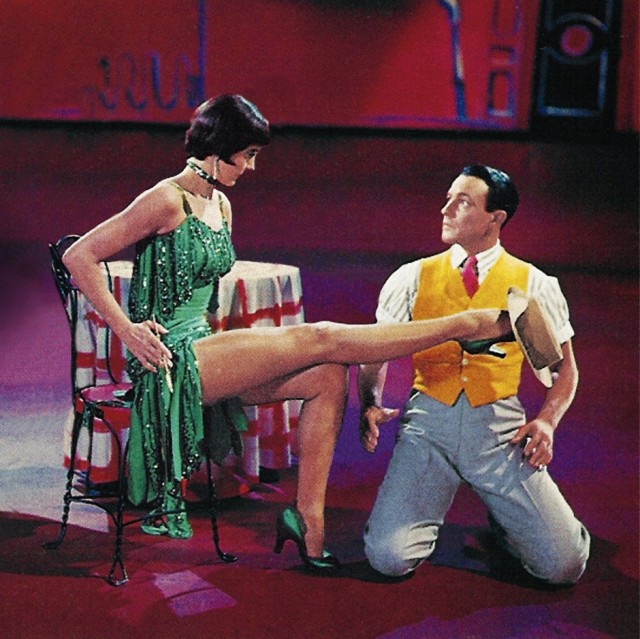
Cyd Charisse joins Gene Kelly for fantastical Broadway Melody ballet in Singin’ in the Rain
Written by the legendary team of Betty Comden and Adolph Green and directed by Kelly and Stanley Donen (On the Town, Charade), Singin’ in the Rain is an endlessly thrilling and entertaining film, featuring gorgeous Technicolor set pieces photographed by Harold Rosson (the Broadway Melody ballet with Cyd Charisse is particularly spectacular), terrific tunes adapted from previous productions (“Fit as a Fiddle [And Ready for Love,]” “Moses Supposes,” “Good Morning”), and delightful performances by Kelly, whose solo foray through the title song is deservedly iconic; Donald O’Connor as Don’s longtime best friend, Cosmo Brown, who dazzles with a comic Fred Astaire-like turn in “Make ’em Laugh”; and Hagen channeling Judy Holliday from Born Yesterday. (Hagen served as Holliday’s understudy when Born Yesterday hit Broadway in 1947.)
While all the elements come together beautifully (although things do get a little too mean-spirited in the end), this is Kelly’s film all the way, his smile and charm dominating the screen as only a genuine movie star can, so to see him playing a movie star merely doubles the fun. (It’s hard to imagine that Howard Keel was supposedly the first choice to play the role.) Curiously, Singin’ in the Rain was nominated for only two Oscars, with Hagen getting a nod for Best Supporting Actress and Lennie Hayton for Best Musical Score.