twi-ny recommended events

WOMEN THAT ROCK: INTERNATIONAL WOMEN’S DAY

Who: Rozzi, Demi Ramos, Stalking Gia, Cloe Wilder, Ok Cowgirl, Scarlet Fiorella
What: Concert in honor of International Women’s Day
Where: Knitting Factory, 361 Metropolitan Ave.
When: Wednesday, March 9, $25, 8:00
Why: The theme of International Women’s Day 2022, taking place March 9, is #BreakTheBias, with a mission to: “Imagine a gender equal world. A world free of bias, stereotypes, and discrimination. A world that is diverse, equitable, and inclusive. A world where difference is valued and celebrated. Together we can forge women’s equality.” Women That Rock, which has been presenting femme-focused concerts since 2018, returns to the Knitting Factory in Brooklyn, the site of its inaugural show, on March 9 for a live event featuring performances by Rozzi, Demi Ramos, Stalking Gia, Cloe Wilder, Ok Cowgirl, and Scarlet Fiorella. WTR “seeks to lift up badass grrrls making waves in the music world and to foster a community of womxn supporting one another through music,” so expect a badass night.

SARA MEARNS: PIECE OF WORK

SARA MEARNS: PIECE OF WORK
Joyce Theater
175 Eighth Ave. at 19th St.
March 8-13, $10-$71
212-645-2904
www.joyce.org
saramearns.com

During the pandemic lockdown, I covered more than a thousand online events created since March 2020. I had many favorite performers over those nearly two years, from actress Kathleen Chalfant and musician Richard Thompson to Arlekin Players Theatre and White Snake Projects to dancer-choreographer Jamar Roberts and Stars in the House hosts Seth Rudetsky and James Wesley. You can check out them and other stalwarts in twi-ny’s three-part Pandemic Awards.

But for me no one stood out like Sara Mearns. The extraordinary New York City Ballet principal dancer expanded her horizons in a series of breathtaking performances, including her Le Cygne (The Swan) variation for Swans for Relief, the Works & Process commission Storm, Lee Mingwei and Bill T. Jones’s durational Our Labyrinth at the Metropolitan Museum of Art, Justin Peck’s Thank You, New York for the New York City Ballet New Works Festival, Christopher Wheeldon’s The Two of Us for Fall for Dance, L.A. Dance Project’s Sonata for Saras (Mearns as her own trio!), Henry Joost and Ariel Schulman’s Another Dance Film shot at the East River Park Amphitheater, and Molissa Fenley’s State of Darkness solo onstage at the Joyce.

Austin Goodwin’s carefully is part of Sara Mearns program at the Joyce (photo by Drew Dawson)

But in October 2021, Mearns had to take a break to deal with a personal issue she eventually discussed on social media several months later: She was diagnosed with depression and extreme burnout and was getting help from a sports psychologist. “This is never something I saw happening to me,” she wrote on Instagram. “I thought I was invincible, that maybe I was just tired, that maybe it’s just a phase, and to get over it. I’m here to tell you it’s a very real thing,”

From March 8 to 13, Mearns will return to performing, and to the Joyce, with her own program, “Piece of Work,” a kind of coming-out, coming-back party in which she will perform with eight dancers in works by six choreographers, including five world or NYC premieres created specifically for Mearns. “I have been lucky enough to perform in the biggest houses in the world, doing grand productions, pouring my heart out. It’s what comes naturally to me. It doesn’t feel like a risk,” she explains in a program note. “Three years ago, I decided it was time to go a different route, a route that was vulnerable for me artistically and that would be the biggest challenge for me thus far in my career. . . . I would like to say that I curated this evening, but the truth is, New York did. It will be raw, honest, and at times messy.”

The evening begins with Jodi Melnick’s Opulence, a duet with Melnick commissioned for the 2019 Jacob’s Pillow Dance Festival, with music by drummer Kid Millions and guitarist Zach Lehrhoff. Choreographer and director Austin Goodwin’s film carefully pairs Mearns with Paul Zivkovich inside an empty house. Mearns teams with Vinson Fraley Jr. in Fraley’s On the Margins, set to an original score by Rahm Silverglade for violin, electronics, guitar, and sax.

Following intermission, Mearns will perform with Melnick, Taylor Stanley, Jaquelin Harris, Chalvar Monteiro, and Burr Johnson in a special JoycEvent, excerpts from “Night of 100 Solos: A Centennial Event” and other works by Merce Cunningham, arranged and staged here by Rashaun Mitchell and Silas Riener, featuring live music by John King. Beth Gill’s SSSara is a solo for Mearns with music by Ryan Seaton. The night concludes with Guillaume Côté’s Spir, a duet with the Canadian dancer and choreographer set to German pianist, producer, and composer Nils Frahm’s “Corn” and Woodkid and Frahm’s “Winter Morning I.” In between each piece will be audio interludes directed and edited by Ezra Hurwitz.

Mearns also wrote on Instagram, “This show has been thru so many lives, revisions, faces, versions, and I wouldn’t take any of it back. A big influence was the pandemic; it gave me a clear path of what I wanted this show to be about. I’m not the same person or artist I was before the pandemic, and I wanted the evening to reflect that & acknowledge it. How art, specifically dance, is created in New York; what artists go thru in New York is unlike anywhere else in the world.” Mearns will talk about that and more in a curtain chat at the March 9 show.

SACRED SCREENS AND SCROLLS: DECODING BUDDHIST SYMBOLS IN SHIKŌ MUNAKATA’S PRINTS

D. Max Moerman will lead a virtual walkthrough of Japan Society exhibition on March 8

Who: D. Max Moerman, Ramona Handel-Bajema, PhD
What: Virtual discussion and walkthrough of “Shikō Munakata: A Way of Seeing,” on view at Japan Society through March 20
Where: Japan Society YouTube
When: Tuesday, March 8, free with RSVP (suggested donation $5-$20), 6:00
Why: On March 8 at 6:00, Barnard College professor and Columbia University Seminar in Buddhist Studies cochair D. Max Moerman will give the online lecture “Sacred Screens and Scrolls: Decoding Buddhist Symbols in Shikō Munakata’s Prints,” a deep dive into the current Japan Society exhibition “Shikō Munakata: A Way of Seeing.” Joined in conversation by Japan Society chief program officer Ramona Handel-Bajema, PhD, Moerman will walk through the show, which features nearly one hundred works by Munakata (1903-75), comprising woodblock prints, calligraphy, sumi ink paintings, watercolors, lithography, and ceramics.

“How does the artist breathe life into his work? By summoning the spirit of the art that lives inside him. . . . Power comes from the artist’s spirit, warmth from his tenderness, and serenity from his prayers,” Munakata explained in Hanga no Hanashi in 1954. Five years later, he came to New York City as a fellow in Japan Society’s Print Artists Program; several of the pieces he created for the institution are also part of the show. Moerman will focus on religious aspects of Munakata’s work, including the six-panel screen Eulogy to Shōkei and the twelve-set hanging scrolls The Ten Great Disciples of Buddha. The exhibit, which will have extended days and hours because of its popularity, also is highlighted by the newly rediscovered Tōkaidō Series from 1964, arranged at Japan Society to evoke the coastal road between Kyoto and Tokyo.

RED BULL THEATER CELEBRATES MARGARET CAVENDISH

Who: Red Bull Theater company
What: Livestreamed Zoom conversation, benefit reading, and Bull Session surrounding Margaret Cavendish’s The Convent of Pleasure
Where: Red Bull Theater website, Facebook Live, and YouTube
When: Conversation Monday, March 7, suggested donation $25, 7:30; benefit reading Monday, March 14, suggested donation $25, 7:30; Bull Session Thursday, March 17, free on YouTube with live chat, 7:30
Why: “Nature is material, or corporeal, and so are all her Creatures, and whatsoever is not material is no part of Nature, neither doth it belong any ways to Nature,” wrote duchess of Newcastle-upon-Tyne and polymath Lady Margaret Lucas Cavendish. Red Bull Theater is turning to the seventeenth-century poet, philosopher, aristocrat, scientist, fiction author, and playwright for Women’s History Month, presenting an online reading and discussions about her 1668 comedy, The Convent of Pleasure. The play, a closet drama not intended to be performed onstage and dealing with women who believe they can live a fulfilling life without men, features wealthy noblewoman Lady Happy, her friend the widow Madam Mediator, the anti-convent Monsieur Take-Pleasure, the married Lady Amorous and Lady Vertue, Mimick the fool, and a cross-dressing prince/princess suitor.

Lady Margaret Cavendish’s The Convent of Pleasure will be explored extensively by Red Bull

“Let me tell you, that Riches ought to be bestowed on such as are poor, and want means to maintain themselves; and Youth, on those that are old; Beauty, on those that are ill-favoured; and Virtue, on those that are vicious: So that if I should place my gifts rightly, I must Marry one that’s poor, old, ill-favoured, and debauch’d,” Lady Happy says early in the play. “Put the case I should Marry the best of Men, if any best there be; yet would a Marry’d life have more crosses and sorrows then pleasure, freedom, or hapiness: nay Marriage to those that are virtuous is a greater restraint then a Monastery. Or, should I take delight in Admirers? they might gaze on my Beauty, and praise my Wit, and I receive nothing from their eyes, nor lips; for Words vanish as soon as spoken, and Sights are not substantial. Besides, I should lose more of my Reputation by their Visits, then gain by their Praises. Or, should I quit Reputation and turn Courtizan, there would be more lost in my Health, then gained by my Lovers, I should find more pain then Pleasure; besides, the troubles and frights I should be put to, with the Quarrels and Brouilleries that Jealous Rivals make, would be a torment to me; and ’tis only for the sake of Men, when Women retire not: And since there is so much folly, vanity and falshood in Men, why should Women trouble and vex themselves for their sake; for retiredness bars the life from nothing else but Men.”

On March 7, Red Bull will host the Zoom discussion “The Closet or the Stage? A Conversation about Margaret Cavendish’s The Convent of Pleasure,” with University of Tennessee professor and author Misty G. Anderson; University of Toronto associate professor Liza Blake, editor of Margaret Cavendish’s Poems and Fancies: A Digital Critical Edition; Columbia University professor Julie Crawford, author of the upcoming Margaret Cavendish’s Political Career; and Carnegie Mellon professor emeritus, curator, and author Kristina Straub.

The reading, directed by Kim Weild (American Moor, Paradise Now), will be held the following Monday at 7:30, in association with the R/18 Collective, which “believes the theatrical repertoire from the 1660s to the 1830s provides insights into the deep histories of race, gender, sexuality, ability, nation, and capital that continue to shape anglophone culture and the world.” The cast includes Heidi Armbruster, Becca Ayers, Talley Gale, Cloteal Horne, Rami Margron, Anthony Michael Martinez, Maria-Christina Oliveras, and Josh Tyson. And then, on March 17, a free Bull Session with Weild, cast members, and scholars will take place on YouTube, with a live chat.

THE MERCHANT OF VENICE

John Douglas Thompson is extraordinary as Shylock in TFANA production of The Merchant of Venice (photo by Henry Grossman)

THE MERCHANT OF VENICE
Theatre for a New Audience, Polonsky Shakespeare Center
262 Ashland Pl. between Lafayette Ave. & Fulton St.
Through March 6, $75-$85
866-811-4111
www.tfana.org

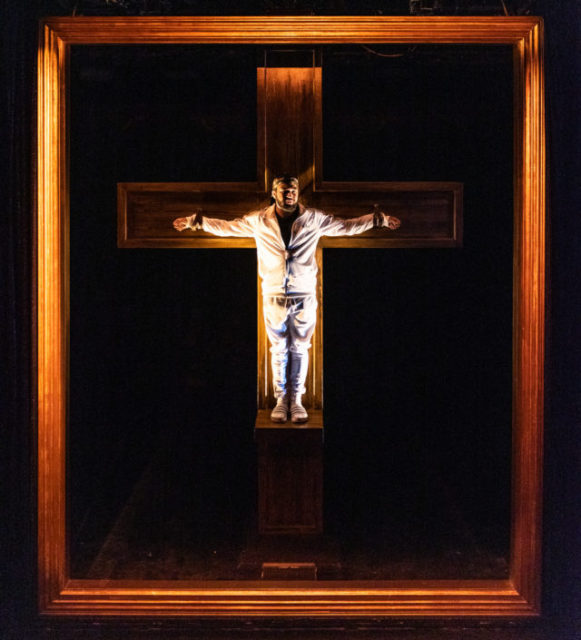
Arin Arbus reimagines a Merchant of Venice for this moment in time in her ingenious adaptation of the Bard’s challenging tragedy, continuing through March 6 at TFANA’s Polonsky Shakespeare Center. A coproduction with DC’s Shakespeare Theatre Company, the play is Arbus’s fourth collaboration with classical treasure John Douglas Thompson, following Macbeth, Othello, Ibsen’s A Doll’s House, and Strindberg’s The Father. Thompson is heart-wrenching as Shylock, the first professional Black actor to play the role in New York City since Ira Aldridge in the 1820s.

When the lights go out, the full ensemble comes out in regular dress, signaling they are performers, not the characters they are about to portray. A moment later the show begins, with the cast in contemporary costumes by Emily Rebholz — blazers, jeans, sneakers, gym clothes, suits. Riccardo Hernandez’s set is an imposing faux marble wall and steps, with a large black hole in the upper center, as if the sun and moon are both gone. The characters enter and leave through two doors, the wings, or the aisles, almost as if they’re part of the audience.

In order to woo the wealthy, beautiful heiress Portia (Isabel Arraiza), the noble Bassanio (Sanjit De Silva) asks his close friend, Venetian merchant Antonio (Alfredo Narciso), to borrow three thousand ducats from respectable Jewish moneylender Shylock. Shylock is tired of being mocked because of his religion, and he lets Antonio know it. He tells the brash Antonio, “Many a time and oft / In the Rialto you have rated me / About my moneys and my usances: / Still have I borne it with a patient shrug, / For sufferance is the badge of all our tribe. / You call me misbeliever, cut-throat dog, / And spit upon my Jewish gaberdine, / And all for use of that which is mine own. / Well then, it now appears you need my help: / Go to, then; you come to me, and you say / ‘Shylock, we would have moneys:’ you say so; / You, that did void your rheum upon my beard / And foot me as you spurn a stranger cur / Over your threshold: moneys is your suit / What should I say to you? Should I not say / ‘Hath a dog money? is it possible / A cur can lend three thousand ducats?’ Or / Shall I bend low and in a bondman’s key, / With bated breath and whispering humbleness, Say this; / ‘Fair sir, you spit on me on Wednesday last; / You spurn’d me such a day; another time / You call’d me dog; and for these courtesies / I’ll lend you thus much moneys’?”

Portia (Isabel Arraiza) works out with her servant Balthazar (Jeff Biehl) in The Merchant of Venice (photo © Gerry Goodstein)

It’s a powerful speech that sets the stage for the relationship between Shylock and the others; he is clearly well educated and eloquent, but despite his passionate entreaty, the Christians treat him with scorn and disdain. Antonio needs to obtain the money for Bassanio, but he cannot help but still belittle Shylock.

“I am as like to call thee so again, / To spit on thee again, to spurn thee too,” he tells him. “If thou wilt lend this money, lend it not / As to thy friends; for when did friendship take / A breed for barren metal of his friend? / But lend it rather to thine enemy, / Who, if he break, thou mayst with better face / Exact the penalty.”

The penalty is a harsh one: Instead of charging Antonio interest, Shylock says he will take a pound of Antonio’s flesh if he doesn’t return the three thousand ducats in three months’ time. Certain that his merchant ships will come back successfully a month before the agreement ends, Antonio signs the contract.

Antonio and Bassiano are often accompanied by their sycophantic bros: snarky, sunglasses-wearing, cocktail-swilling yuppie Gratiano (Haynes Thigpen), who is funny until he isn’t; Solanio (Yonatan Gebeyehu) and Salerio (Graham Winton); and Lorenzo (David Lee Huynh), who wants to elope with Shylock’s daughter, Jessica (Danaya Esperanza), and convert her to Christianity to further her father’s shame. In addition, Shylock’s servant, the goofy Lancelot Gobbo (Nate Miller), who wears his jeans very low, quits his job with the moneylender and moves on to Bassiano. “For I am a Jew, if I serve the Jew any longer,” Lancelot says.

Meanwhile, two suitors beat Bassanio to try to win Portia’s hand. First Prince Morocco (Maurice Jones), then Prince of Aragon (Varín Ayala), must choose wisely among three caskets, one of which holds the key to Portia’s heart — and fortune. On the gold one is inscribed, “Who chooseth me shall gain what many men desire,” on the silver “Who chooseth me shall get as much as he deserves,” and on the lead “’Who chooseth me must give and hazard all he hath.”

Portia is attended by her servant Balthazar (Jeff Biehl) and her maid, Nerissa (Shirine Babb); the latter is supremely efficient, while the former offers comic relief, flirting hysterically with many of the men he meets and, when Portia asks for music, uses his iPhone. (The sound and original music is by Justin Ellington.)

Shylock (John Douglas Thompson) demands a pound of flesh from Antonio (Alfredo Narciso) in Shakespeare tragedy (photo © Gerry Goodstein)

It all leads up to one of the great trial scenes in all of theater, a brutal battle of wits in which Shylock, who is suing Antonio for his pound of flesh, represents not only Jews and Blacks, both of whom have histories of being enslaved and discriminated against up to the present day, but, in essence, all of humanity who have suffered hatred and oppression at the hands of tyrants and bigots.

Throughout its four-century existence, The Merchant of Venice has likely been performed by troupes that glorified anti-Semitism and was cheered on by audiences that agreed with Antonio and his friends’ views of Jews, as well as by companies and audiences that had deep sympathy for Shylock’s plight. But Arbus achieves something different.

The casting is diverse but not random; by having Shylock and Jessica portrayed by Black actors, Arbus is making a powerful statement, particularly in the socioeconomic reckoning that has taken hold in the wake of the police murder of George Floyd. With his gentle cracked whisper of a hoarse voice that comes from deep in his soul, the British-born Thompson (Jitney, The Iceman Cometh) is unforgettable as Shylock, not merely following in the footsteps of Laurence Olivier, F. Murray Abraham, George C. Scott, Al Pacino, Jonathan Pryce, and Patrick Stewart but making the role his own.

When Shylock, who is repeatedly referred to as a dog, a villain, a cur, and the devil, asks, “If you prick us, do we not bleed? / If you tickle us, do we not laugh? / If you poison us, do we not die? / And if you wrong us, shall we not revenge?” Thompson is speaking for all the downtrodden; Shakespeare’s words echo down the ages: Sojourner Truth’s “Ain’t I a Woman?” speech leaps to mind as well. When Shylock tells the court, “Proceed to judgment: by my soul I swear / There is no power in the tongue of man / To alter me: I stay here on my bond,” Thompson speaks for all who resist injustice.

Arraiza shines as Portia, whether working out, dressed in an elegant gown with stiletto heels, or disguised as a learned doctor. Arbus ratchets up the homoeroticism by having Bassanio and Antonio be very good friends, while Biehl practically waves the Gay Pride flag as Balthazar. As serious as the subject matter is, Arbus includes plenty of fun and good humor; Biehl and Miller in particular often make vocal and gestural asides that are hilarious and certainly not in the original script.

“The quality of mercy is not strained, / It droppeth as the gentle rain from heaven / Upon the place beneath. It is twice blest: / It blesseth him that gives and him that takes,” Portia says in Act 4. We are blessed to have such a thrilling production of this dark tragedy; if only all were blessed equally with mercy in these dark times.

DEBATE: BALDWIN VS BUCKLEY

James Baldwin (Teagle F. Bougere) and William F. Buckley Jr. (Eric T. Miller) face off about the American Dream in Debate (photo © Antonio M. Rosario)

DEBATE: BALDWIN VS BUCKLEY
The Great Room at A.R.T./New York, South Oxford Space
138 South Oxford St., Brooklyn
Friday – Sunday, March 5 – April 3, $25
www.theamericanvicarious.org

On February 18, 1965, James Baldwin and William F. Buckley Jr. faced off in a televised debate at the Cambridge Union at the University of Cambridge in England, answering the question “Has the American Dream been achieved at the expense of the American Negro?” MP Norman St. John Stevas introduced the event by saying it could be “one of the most exciting debates in the whole hundred and fifty years of the union history” as he noted that undergraduates had packed the debate hall and were flocking outside to be a part of this seminal happening, which began with arguments from students David Heycock and Jeremy Burford, setting up the two sides of the issue. The forty-year-old Baldwin, essayist, activist, playwright, and author of Go Tell It on the Mountain, Giovanni’s Room, and Another Country, and the forty-year-old Buckley, author of Up from Liberalism and Rumbles Left and Right: A Book About Troubling People and Ideas and founder of the conservative National Review, then made their cases, standing in front of a microphone at a podium one at a time. You can watch the original debate here.

In the fall of 2020, amid the pandemic lockdown, the american vicarious, in collaboration with BRIC, re-created that fascinating evening with Debate: Baldwin vs Buckley, three live, online presentations directed by Christopher McElroen. The show can now be seen in person, with the same team, when it comes to A.R.T./New York’s South Oxford Space in Brooklyn. Teagle F. Bougere (The Tempest, A Raisin in the Sun) plays Baldwin, with Eric T. Miller (Mope, rogerandtom) as Buckley; the cast also features Spencer Hamp and Charlie O’Rourke, with costumes by Elivia Bovenzi, sound by Andy Evan Cohen, and video and graphic design by Adam J. Thompson.

“The objective of the american vicarious in restaging this historic debate is not to inhabit such monumental figures as James Baldwin or William F. Buckley Jr.; their shoes are too large to fill,” McElroen (STATIC APNEA, Piedmont Blues: A Search for Salvation), the founding artistic director of the american vicarious, said in a statement. “Rather, our desire is to simply place their words, which still resonate fifty-five years later, within the voice of contemporary artists.” The debate tackles many issues that are still relevant today, from systemic racism to white supremacy to voter suppression; it is also not anything like the 2020 debates between Donald J. Trump and Joe Biden and then Mike Pence and Kamala Harris. It harkens back to a day when civilized, intellectual discourse was still part of politics and everyday life in an America that is not so recognizable anymore — or has it not really changed that much, for better or worse?

OUT OF TIME

A documentary filmmaker (Page Leong) looks back at her life in Anna Ouyang Moench’s My Documentary (photo by Joan Marcus)

OUT OF TIME
Martinson Theater, the Public Theater
425 Lafayette St. at Astor Pl.
Tuesday through Sunday through March 13, $60
212-539-8500
publictheater.org
www.naatco.org

In Sam Chanse’s Disturbance Specialist, the last of five monologues comprising Out of Time, author Leonie Z. (Natsuko Ohama) says, “You know nothing of what it is to live when you haven’t yet understood that you will die. And none of you really understands that. You get the concept maybe but you don’t actually believe it.”

Out of Time, which opened last night at the Public’s Martinson Theater, is an extraordinary concept: Five Asian American playwrights have written monologues for five Asian American actors over the age of sixty, directed by Les Waters, who is also over sixty. The five stories don’t always focus on aging, although getting older, with fewer years ahead than behind, is an inherent theme throughout the works, as is the call for respect for the elderly from family, friends, colleagues, and strangers. Isolation, loss, and loneliness abound, along with deep pockets of hope and defiance.

Speaking about her longtime producer, the unnamed documentary filmmaker (Page Leong) in Anna Ouyang Moench’s My Documentary explains, “Neil, who hugged me hello and then listened to my carefully crafted pitch about my just-dead husband and passed and hugged me goodbye as though he hadn’t just told a widow in no uncertain terms to go fuck herself because she’s old and no one cares when old people grieve other old people.”

Ena (Mia Katigbak) knows getting older is no mere game in Mia Chung’s Ball in the Air (photo by Joan Marcus)

In Mia Chung’s Ball in the Air, Ena (Mia Katigbak) walks onto the stage playing with a kids’ paddle ball, bouncing a little red ball against a wooden paddle, the two held together tenuously by a thin rubber band. She displays a childlike desire to succeed at the game shortly before describing a horrible accident she was involved in. She worries about feeling confused as different stories merge together in her mind. “Time is no guarantee,” she says. “These moments — when someone sees red when you see blue — well, it can be a stunner. It can seem as if something has vanished. In an instant.”

Glenn Kubota is the only male in the cast, portraying Taki in Naomi Iizuka’s Japanese Folk Song. The Scotch- and cigar-loving, jazz-hating Taki details how he nearly died in every decade from his teens to his seventies — “I must be pretty tough,” he acknowledges. “And lucky. I must be lucky.” — before telling a version of the Japanese ghost story “Yuki-onna,” which was famously retold in Masaki Kobayashi’s classic film Kwaidan. Taki is straightforward and practical even as he ventures into the realm of the fantastic.

Carla (Rita Wolf) is a voice from the past discussing the history of cancer among the women in her family in Jaclyn Backhaus’s Black Market Caviar. The piece is structured as a video the character made on December 31, 2019, offering advice to a descendant watching decades later. “Time is moving more quickly than I’d like,” she says. Carla is sitting behind a translucent curtain; we watch her on a video monitor at the corner of the stage. Ena, Taki, and the documentarian all sit in chairs front and center, evoking Waters’s direction of Lucas Hnath’s Dana H., in which Deirdre Connell performs the play sitting down (and lip-syncing the dialogue). Leonie Z. stands at a podium, delivering a fiery lecture to students who have already canceled her. (The spare scenic design is by dots.)

Leonie Z. (Natsuko Ohama) fights back in Sam Chanse’s Disturbance Specialist (photo by Joan Marcus)

Commissioned and produced by NAATCO, Out of Time is a play for the ages. Inspired by Anne Teresa De Keersmaeker’s Mitten wir im Leben sind/Bach6Cellosuiten, a piece choreographed for older dancers (including De Keersmaeker herself, who is in her early sixties), Waters (Big Love, The Thin Place) gives agency to each of the actors, and each of the characters, who look back at their lives in personal ways that are poignant and gripping, especially amid a rise in anti-Asian hate crimes and during a pandemic in which nursing home deaths related to Covid-19 were seen by many as the cost of doing business as a society.

The basic conceit of the play itself is a bold act of resistance, proving that actors over sixty are fully able to present long monologues and inhabit complex characters who are a lot more than elderly grandparents ready to be put out to pasture. Each of these characters is imbued with an inner strength and purpose even as they recognize their approaching fate — and we know the same is in store for the rest of us.

“Think about death, but remember life: our long lineage,” Carla says. “Because of you, our mother, our grandmother, I am here. Today. Today I am alive. I revel in all of it.” The titular “disturbance specialist” in Leonie Z.’s lecture is a volcano mouse “that flourishes, revels, in ruined environments.” The canceled author sternly proclaims, “And in all this, what you have to tell me is that I’m not welcome. I, Leonie Z., am not welcome here, that I should go home. Delete my account. Shut up and erase myself. Roll over and quietly die?” In Out of Time, none of those are acceptable options.