Oscar Howe, Dance of the Heyoka, casein on paper, 1954 (Philbrook Museum of Art, Tulsa, Oklahoma)
DAKOTA MODERN: THE ART OF OSCAR HOWE
National Museum of the American Indian
George Gustave Heye Center, One Bowling Green
Through Sunday, September 11, free
212-514-3700 americanindian.si.edu
In April 1958, after Oscar Howe’s work had been rejected by the Philbrook Art Center, the Yanktonai Dakota artist wrote a letter to curator Jeanne Snodgrass: “Who ever said that my paintings are not in the traditional Indian style has poor knowledge of Indian Art indeed. There is much more to Indian Art than pretty, stylized pictures. There was also power and strength and individualism (emotional and intellectual insight) in the old Indian paintings. Every bit in my paintings is a true studied fact of Indian paintings. Are we to be held back forever with one phase of Indian painting that is the most common way? We are to be herded like a bunch of sheep, with no right for individualism, dictated as the Indian has always been, put on reservations and treated like a child, and only the White Man knows what is best for him. . . . Well, I am not going to stand for it.”
Born in 1915 on the Creek Sioux Reservation in South Dakota, Howe (his tribal name was Mazuha Hokshina) had a distinguished career as an artist, teacher, advocate, and activist. His life and work are explored in the sensational exhibit “Dakota Modern: The Art of Oscar Howe,” which continues at the National Museum of the American Indian through September 11. Howe’s canvases evoke the color and angular graphic style of Jacob Lawrence, but they depict the American Indian experience, particularly his Očhéthi Šakówiŋ (Sioux) culture, instead of that of African Americans. Many of the works, in watercolor, gouache, tempera, and casein on paper, require longer viewing as their subjects emerge from an initially abstract image.
“We are finally at a point in the twenty-first century where we can recognize the impact and complexity of Oscar Howe’s incredible work as both Native American and modern American art,” curator Kathleen Ash-Milby said in a statement. “This project is a long overdue recognition of his contribution to the field that we hope will establish Howe’s place as a twentieth-century modernist.”
Sensational Oscar Howe exhibit continues through September 11 (photo by twi-ny/mdr)
The show follows Howe from his high school years up to his death in 1983 at the age of sixty-eight. The paintings are supplemented with substantial biographical information, including archival film footage, highlighted by a 1960 appearance on This Is Your Life, the television series hosted by Ralph Edwards; Howe collector Vincent Price introduced the artist, who came to regret his participation because it only furthered stereotypes.
In Fleeing a Massacre, an Indian on horseback is caught within a swirling storm of ghosts and the American flag. Wounded Knee Massacre features armed American soldiers on land in the top half, with Indians flailing below in a bloody pit. At first, Fighting Bucks looks like a kind of acid trip until the antlers and bodies of two deer become evident. Dance of the Heyoka comes at you in a barrage of complex geometric shapes and bold colors.
“Dakota Modern: The Art of Oscar Howe” is an exceptional, revelatory show, arriving right on time as a reckoning is underway in the art world, reexamining work done by underrepresented and misrepresented creators. The rediscovery of Howe is nothing less than thrilling; the exhibition is accompanied by a deluxe catalog with essays by Janet Catherine Berlo, Christina Burke, Philip J. Deloria, Erika Doss, Emil Her Many Horses, John Lukavic, Inge Dawn Howe Maresh, Anya Montiel, Denise Neil, and Joyce Szabo that shed new light on this extraordinary artist.
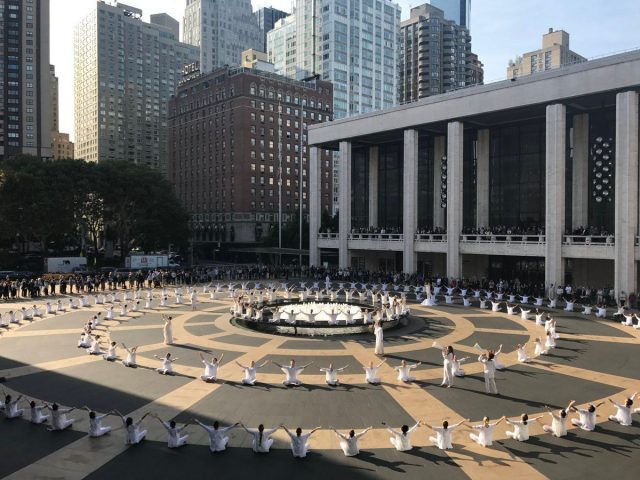
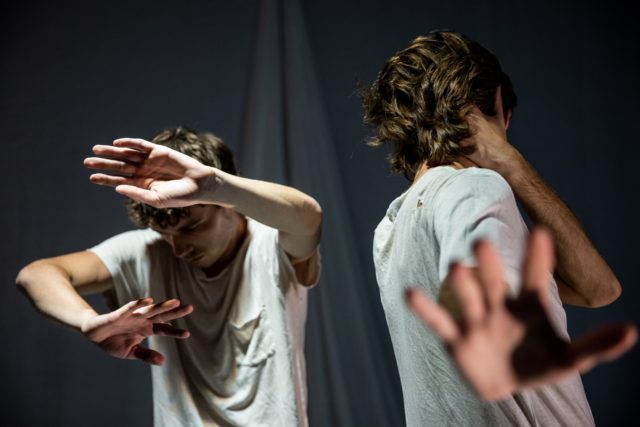
Annual “Table of Silence Project” performance ritual of peace returns for twelfth year to Josie Robertson Plaza (photo courtesy Lincoln Center)
TABLE OF SILENCE PROJECT
Josie Robertson Plaza, Lincoln Center
65th St. between Broadway & Amsterdam Ave.
Sunday, September 11, free, 8:10 – 8:46 am www.tableofsilence.org lincolncenter.org
Every September 11, there are many memorial programs held all over the city, paying tribute to those who were lost on that tragic day while also honoring New York’s endless resiliency. One of the most powerful is Buglisi Dance Theatre’s “Table of Silence Project,” a multicultural public performance ritual for peace that annually features more than one hundred dancers on Josie Robertson Plaza at Lincoln Center. It had to be reconfigured during the pandemic but is now back in a hybrid format, available to be experienced in person or streaming live here.
On Sunday morning from 8:10 to 8:46, the time the first plane hit the World Trade Center, BDT will present the full piece, around the Revson Fountain. “The strength of the work is found in the gestures, patterns, and repetition that mirrors our daily lives and is accesssible to all. We would not return to the work each year if it were not so universally meaningful as a tool for storytelling through which the audience can recognize itself,” BDT artistic director Jacqulyn Buglisi, who recently received the President’s Medal from Juilliard, said in a statement. “Your passionate belief makes this ritual a powerful testimonial of freedom for all people suffering oppression and is an imperative at this time in our history.”
CROSSING THE LINE FESTIVAL
FIAF and other locations
55 East 59th St. between Madison & Park Aves.
September 9–October 28, free – $75
212-355-6100 fiaf.org
FIAF’s fifteenth annual Crossing the Line Festival is another journey into exciting, challenging, and experimental music, dance, and theater from the French-speaking world. Running September 9 through October 28, the programs take place at such venues as Abrons Arts Center, New York Live Arts, the Chinese Consolidated Benevolent Association, the Joyce, and BAM in addition to FIAF’s Gallery, Florence Gould Hall, and Skyroom.
“For our first year curating this festival, we wanted to honor its founding principles: presenting compelling multidisciplinary art forms throughout the city, bringing acclaimed cutting-edge French and Francophone productions to our shores, and nurturing dialogue between international and New York-based artists,” curators Mathilde Augé and Florent Masse write in a program note. “The fifteenth edition of the festival features a diverse group of audacious artists engaging with the most pressing issues of our time — including gender, sexuality, human connection, race, and climate change — and exploring new territories in performing arts.”
None of the nine live performances — there were supposed to be ten but Caroline Guiela Nguyen’s FRATERNITY, A Fantastic Tale had to be canceled because of visa problems — has ever been seen before in New York, including several North American, US, and world premieres. The mix of dance, theater, art, music, and literature hails from Senegal, France, South Africa, Rwanda, the United States, and Morocco, examining societal change, Vaslav Nijinsky, science, Cheikh Anta Diop, intergenerational culture, the political views of René Char and Frantz Fanon, and a Detroit rave.
In addition, FIAF is hosting the fall open house celebration Fête de la Rentrée, highlighted by an opening reception for Omar Ba’s “Clin d’oeil” art exhibition on September 9 at 6:00 (free with RSVP) and a Sunset Soirée at Le Bain on October 12 at the Standard Hotel (free with RSVP). Below is the full Crossing the Line schedule.
September 9 – October 28
Exhibition: “Clin d’oeil,” by Omar Ba, FIAF Gallery, free
Wednesday, September 14, and Thursday, September 15
Theater: _ jeanne_dark _, by Marion Siéfert, starring Helena de Laurens, North American premiere, FIAF Florence Gould Hall, $40, 7:30
Wednesday, September 21
Theater: Traces – Speech to African Nations, by Felwine Sarr and Étienne Minoungou, with Étienne Minoungou and Simon Winsé, New York premiere, Abrons Arts Center, $25, 8:30
Thursday, September 22, through Saturday, September 24
Dance: And so you see… our honourable blue sky and ever enduring sun… can only be consumed slice by slice…, by Robyn Orlin, performed by Albert Ibokwe Khoza, US premiere, New York Live Arts, $15-$35, 7:30
Saturday, September 24
Theater: Freedom, I’ll have lived your dream until the very last day, by Felwine Sarr and Dorcy Rugamba, featuring Marie-Laure Crochant, Majnun, Felwine Sarr, and T.I.E., North American premiere, Florence Gould Hall, $40, 7:30
Thursday, September 29, and Friday, September 30
Performance: Fire in the Head, by Christopher Myers, world premiere, Chinese Consolidated Benevolent Association, $20, 7:30
Thursday, October 6, through Saturday, October 8
Dance: The Encounter, by Kimberly Bartosik, performed by Kimberly Bartosik, Claude “CJ” Johnson, Burr Johnson, Joanna Kotze, Ryan Pliss, Kalub Thompson, Mac Twining, River Bartosik-Murray, Logan Farmer, and Ellington Hurd, world premiere, FIAF Skyroom, $30, 7:30
Thursday, October 13, through Saturday, October 15
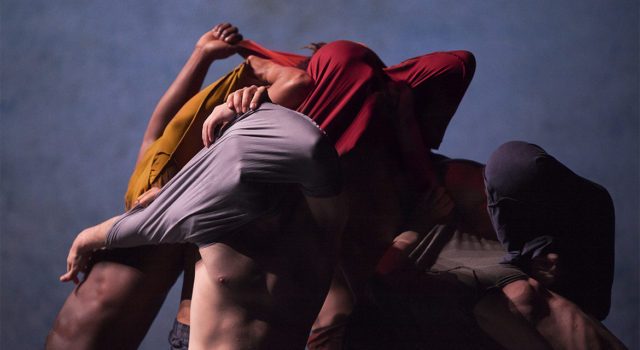
Dance: CROWD, by Gisèle Vienne, US premiere, BAM Howard Gilman Opera House, $35-$75, 7:30
Tuesday, October 18, through Sunday, October 23
Dance: Näss, by Fouad Boussouf, New York premiere, the Joyce Theater, $20-$55
Thursday, October 27, and Friday, October 28
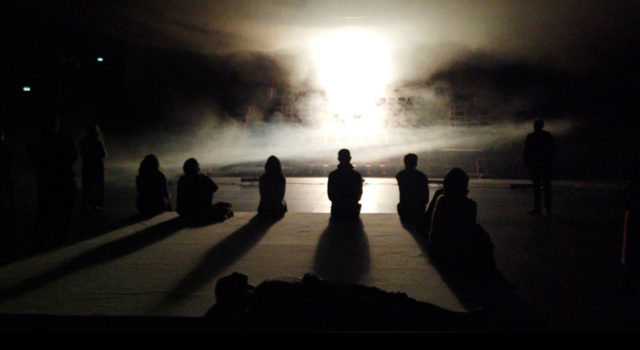
Theater: The Terrestrial Trilogy, a Performance in Three Parts: Inside,Moving Earths, and Viral, by Bruno Latour and Frédérique Aït-Touati, with special guest Bruno Latour, North American premiere, FIAF Florence Gould Hall, $40
MILOŠ FORMAN 90
Film Forum
209 West Houston St.
September 9-22
212-727-8110 filmforum.org
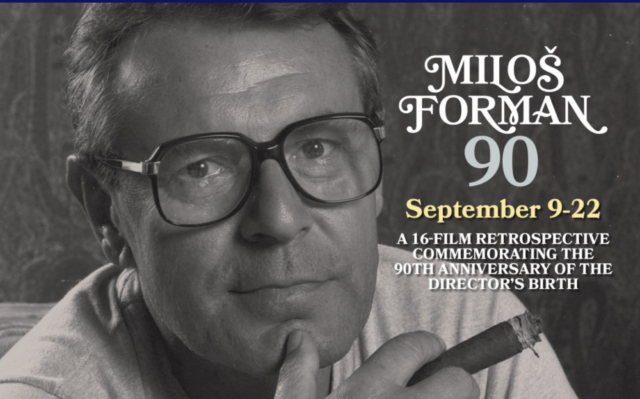
Upon the death of master Czech filmmaker Miloš Forman in 2018 at the age of eighty-six, film curator and producer Irena Kovarova wrote in Czech Film magazine, “When Miloš Forman was a young boy, he and his parents dressed up in their Sunday best and headed over to the cinema in Čáslav for the future filmmaker’s first moviegoing experience. They took their seats and the opera Bartered Bride began on screen — as a silent film. In Forman’s telling of this story, he would always pause when delivering the paradox of this moment. Then he would continue, revealing that to his great delight, the audience, knowing the opera by heart, began to sing along. From that moment on, cinema was forever fixed in his mind as a communal experience. Miloš Forman was a remarkable storyteller. For the screen and in person. You’d hear him tell the same stories from his career on many occasions, but you’d never see him bored with his own words. They were perfectly crafted and he was incredibly generous with his audience. He knew the story worked and he was there to bring his listeners joy with his delivery, which in turn warmed his heart. He was a man larger than life: his baritone voice strong, and his r’s rolled and resounding. One believed when in his presence that his first love was for people, and he made sure that everyone around him could feel it.”
Miloš Forman celebration at Film Forum takes off with Taking Off
Kovarova is serving as the consultant on the Film Forum series “Miloš Forman 90,” celebrating the ninetieth anniversary of the director’s birth in Caslav. The two-week festival consists of all twelve of his feature films, from 1964’s Black Peter to 2006’s Goya’s Ghosts, in addition to several documentaries (Czechoslovakia, 1967) and Alfréd Radok’s 1956 Old Man Motor Car, in which Forman makes a brief appearance. Radok was a major influence on Forman; the two went on to work together at the multimedia theater company Laterna Magika.
The series boasts such beloved classics as One Flew Over the Cuckoo’s Nest,Ragtime, and Amadeus in addition to Man on the Moon,Hair, and Valmont. Kovarova will introduce the September 15 showing of Audition, the September 17 screenings of Old Man Motor CarThe Firemen’s Ball, and the September 20 screening of Věra Chytilová’s 1982 documentary, Chytilová versus Forman. Producer Michael Hausman will introduce the 1968 counterculture favorite Taking Off (starring Buck Henry!) on September 9 at 8:30; screenwriter Michael Weller will introduce Ragtime on September 11 at 3:40; screenwriters Scott Alexander and Larry Karaszewski will introduce the 6:00 screening of Man on the Moon on September 12 and, on the same day, participate in a Q&A following the 8:30 screening of The People vs. Larry Flynt; producer Paul Zaentz will introduce the September 16 screening of Amadeus and the September 19 screening of Goya’s Ghosts.
Fatima Shaik searches for a critical piece of family history in The Bengali
THE BENGALI (Kavery Kaul, 2021)
Quad Cinema
34 West 13th St. between Fifth & Sixth Aves.
Opens Friday, September 9
212-255-2243 quadcinema.com www.thebengalifilm.com
“Why would anybody come from the other side of the world to find somebody who doesn’t even exist anymore?” author Fatima Shaik says at the beginning of The Bengali. “Why not?” asks Kolkata-born American director Kavery Kaul. Armed with a partial ship’s registry and a photograph of her grandfather, Shaik Mohamed Musa, who left his small village in India in 1893 to make a new life in the United States, in New Orleans, where he married a Black woman, Fatima travels to her ancestral country, wanting to know more about where she came from and to see a patch of land that he owned. Joined by Kaul, who is Bengali, and cinematographer John Russell Foster, who is white, they have very little information and face roadblock after roadblock until success is in reach, but everywhere she goes, Fatima is met with resistance, as Indians view her with suspicion, thinking that she, a Christian in a Muslim community, might be there to reclaim her grandfather’s land.
The Bengali is an emotional, deeply personal search for identity, almost to the point of obsession, of seeking out one’s family history in a land where you don’t speak the language and are not immediately welcome. The film opens at the Quad on September 9, with Kaul (Cuban Canvas,Long Way from Home) participating in Q&As following the 7:00 screenings on September 9 and 10 and after the 5:10 show on September 11.
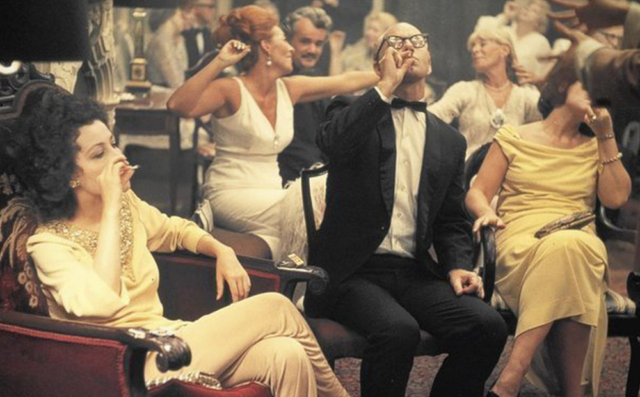
In a May 2012 twi-ny talk, dance artist John Jasperse said, “I would like to see justice in general in the world. I’d like to think that the work that I make is participating in this greater collective effort. Since money is our primary mutually agreed system of valuation, I would like to see more ethics reflected in how money gets spent in the domain of culture.” For more than thirty years, the Manhattan-based Jasperse, who was born in Rockville, Maryland, and graduated from Sarah Lawrence, where he has been the director of dance since 2016, has been choreographing works that challenge the audience while taking on social issues and exploring personal intimacies. In works such as Misuse Liable to Prosecution,Canyon,Fort Blossom,Truth, Revised Histories, Wishful Thinking, and Flat Out Lies, and Becky, Jodi and John, he walks the fine line between fantasy and reality while delving into the human body and the psyche.
For its first evening-length piece in four years, John Jasperse Projects is making its NYU Skirball debut with the world premiere of Visitation, incorporating spiritualism, the occult, ghosts, and camp. Visitation was created in collaboration with performers Tim Bendernagel, Cynthia Koppe, and Doug LeCours, featuring an original score by Hahn Rowe along with fragments from Richard Wagner. The lighting is by Stan Pressner. Visitation was initially developed over Zoom before in-person rehearsals were deemed safe. In a late 2021 email to supporters, Jasperse explained, “I can’t recall a creative process that has gone through so many twists and turns.” Performances take place September 9 and 10 at 7:30; tickets are $35.
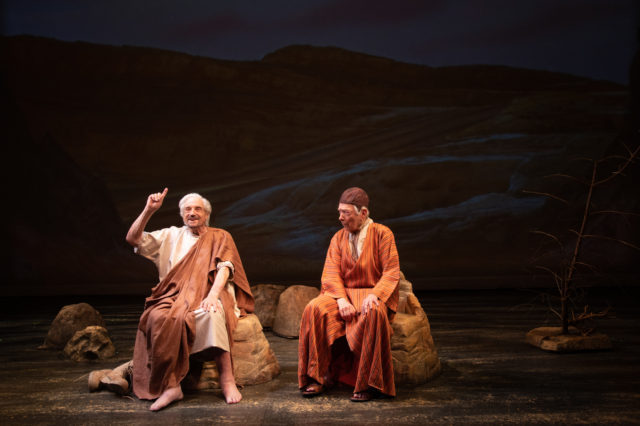
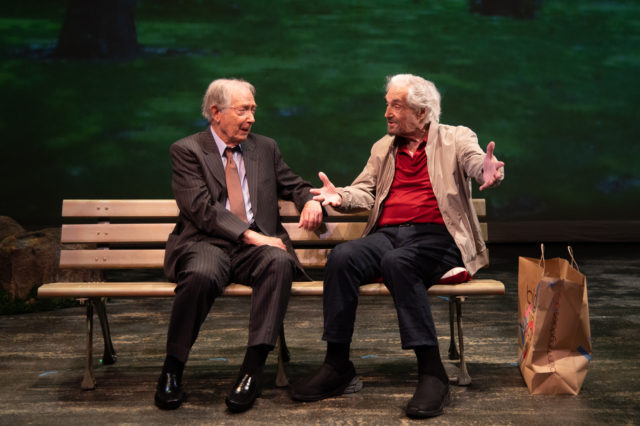
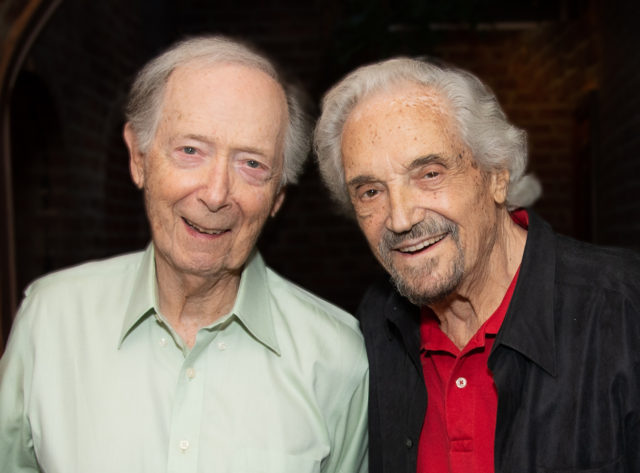
Hal Linden and Bernie Kopell star in Two Jews, Talking at Theatre at St. Clement’s (photo by Russ Rowland)
TWO JEWS, TALKING
Theatre at St. Clement’s
423 West Forty-Sixth St. between Ninth & Tenth Aves.
Friday – Sunday through October 23, $88-$127.50 www.twojewstalking.com
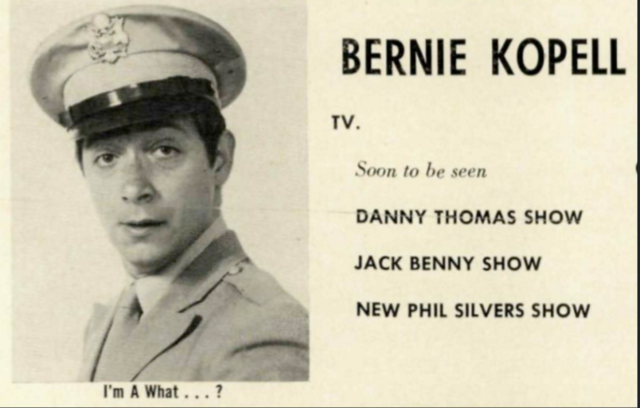
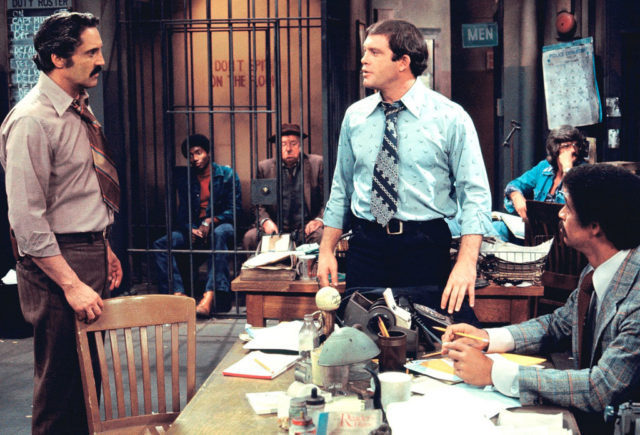
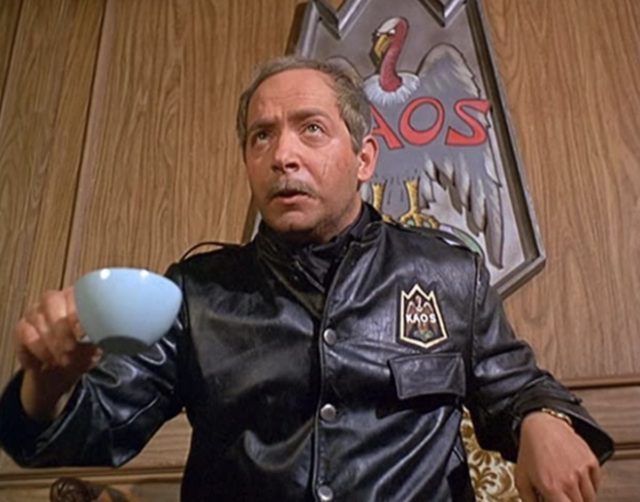
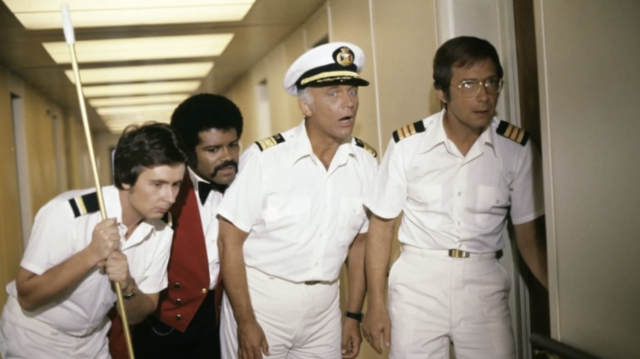
There’s something special happening at the Theater at St. Clement’s right now: Television icons Hal Linden and Bernie Kopell are starring in the two-act comedy Two Jews, Talking. For an hour and a half, the ninety-one-year-old Linden, a Tony and three-time Emmy winner best known for playing the titular New York City police captain in Barney Miller, and the eighty-nine-year-old Kopell, who portrayed the evil KAOS agent Siegfried on Get Smart and charming ship’s doctor Adam Bricker on The Love Boat, argue and complain about life, love, and religion.
In the first act, Kopell is Bud and Linden is Lou — a nod to the classic duo Abbott and Costello — two Jews taking a break as the Israelites are making their way through the desert, having escaped from their Egyptian taskmasters. They discuss the Ten Commandments, the rules of kashrut, and the debauched celebration with the Golden Calf.
“What a night that was,” Lou says. “Our cares, like our robes, thrown to the wind. Then Moses comes down from his mountain and ruins everything.” Bud asks, “What did you expect? He was angry. He turns his back for a minute and all hell breaks loose.” Lou responds, “Four hundred years we were slaves — finally we’re free and we can’t throw a party?”
In the second act, Phil (Kopell) and Marty (Linden) are sitting on a park bench, griping about the state of the world and the pitfalls of aging. “In a million years, you’ll never guess where I was this morning,” Marty says. “Probably not,” Phil answers. “Mount Sinai,” Marty tells him. “The hospital?” Phil asks. “No, the place where Moses handed down the Ten Commandments. Of course the hospital,” Marty says. “You don’t look sick,” Phil adds.
The play was written by seventy-seven-year-old Emmy and Peabody winner Ed. Weinberger, who wrote and cocreated such television classics as Taxi and The Cosby Show, and is directed by Obie winner Dan Wackerman (Ten Chimneys,Morning’s at Seven).
Last week I sat down with Linden and Kopell in one of their dressing rooms at the theater — I had brought rugelach, and Linden immediately partook — and we kibbitzed about the play, Judaism, and their long and distinguished careers in show business, including naming their favorites as well as their not-so-favorites. It all began with me fumbling with my iPhone recorder.
twi-ny: Sorry about this; I’ve only had a phone for about a year.
hal linden: So you never had a phone.
Stage manager Catrina Honadle, pointing at Kopell: That’s him too.
twi-ny: Never had a phone. I always carried around dimes, then quarters.
hl: They don’t have pay phones anymore.
twi-ny: There are actually a few left.
hl: Back in the day, we had answering services, and you had to constantly stay in touch with them. They would get angry at you if you didn’t keep calling in. “You didn’t call in; you missed your appointment!”
bernie kopell: Harvey Korman, we’d call him up and ask, “Anything for Harvey Korman today?” “No, sorry.”
twi-ny: Another funny man.
hl: Another funny man.
bk: I spoke at his memorial. A lovely human.
hl: Yeah. I think was there.
bk: Mel [Brooks] was there.
hl: I think I was there. I’m trying to remember where it was.
bk: Carol Burnett was there.
twi-ny: Do you remember any of what you said about him?
bk: He was a dear friend. We would play ferocious ping-pong, drink vodka, and listen to Mel Brooks’s 2000 Year Old Man again and again. And it was always funny.
twi-ny: It’s funny that you bring that up, because I see your show as a kind of Waiting for Godot meets The 2000 Year Old Man.
[Kopell and Linden both laugh.]
twi-ny: I mean, you’ve got the set with the tree, the boots, two guys waiting to go to the holy land. And, for the most part, Bernie is the straight man and Hal is the one who’s kvetching.
hl: Kvetching.
bk: Kvetching.
twi-ny: I saw the show on the first Saturday night preview. So it was very early, but I wanted to see it before speaking with you both.
hl: That was a little touch and go, that one.
twi-ny: You know what, I had a blast. It was a lot of fun. Okay, so we’re Hal from the Bronx, Bernie from Brooklyn, Mark from Brooklyn — Flatbush — and we’re three New York Jews sitting, talking in a church.
hl: I always thought that was a wonderful irony. Two Jews talking in a church.
bk: Another irony just before I left California, I played a Catholic priest on Grey’s Anatomy. The check cleared; it was wonderful.
twi-ny: Bernie, like you, my father graduated from Erasmus Hall also. He went to Brooklyn College.
hl: Do you know how far Brooklyn was from where I grew up?
twi-ny: It was like a different country, wasn’t it?
hl: I was a Brooklyn Dodger fan. In the Bronx.
twi-ny: Oh, wow.
hl: Yes. Only because I hated the Yankees ’cause they won all the time and it was, you know, Brooklyn was Dem Bums. I only saw one game in Ebbets Field in my life. Do you know how far it would be to go? I was a musician as a young boy, actually; my whole social life was I would be playing in the band and trying to pick up some beautiful girl, and she was interested, but she lived in Brooklyn. We called it GU —
hl & bk: Geographically undesirable.
hl: I couldn’t go out to Brooklyn; it would take me another two and a half hours to get home.
twi-ny: Today, I have friends who go to the theater, go out all the time. And they’ve never been to Brooklyn, even from Manhattan, which is kind of absurd.
hl: There are five planets here.
twi-ny: My parents, when they were dating, could walk to Ebbets Field. They’d also go to Coney Island.
bk: Nathan’s hot dogs.
twi-ny: My wife and I ate at Nathan’s last week. We go to Coney Island every year.
hl: The one thing I had to give up was hot dogs — hot dogs, sausage.
twi-ny: But rugelach is still on the menu.
hl: Rugelach — I’m gonna have to check to see if I can have another one.
Hal Linden, Max Gail, and Ron Glass get real on Barney Miller
twi-ny: So I want to thank you guys for keeping me personally entertained over the course of the pandemic. I watched every single episode of Barney Miller. I watched a whole bunch of Love Boats. Then, all of a sudden I’m watching B Positive and there’s Bernie. I’m watching Better Things and there’s Bernie. Popping up all over the place.
bk: I keep saying, If you don’t fuck up too badly, they let you continue.
twi-ny: So you’ve been busy with lots and lots of appearances like that.
bk: Yes, I have. I’m very grateful.
twi-ny: And Hal, I also saw you in Off Broadway, the virtual play that you did. Where you come in at the end.
hl: Yes. I shot that on my terrace in California. You never saw anybody else. We had to really do it on the fly because I was the only one who was not sitting in front of a computer. That was my suggestion because I didn’t have a computer that I could get out on the balcony. So I said, Why don’t I just do it handheld and put the camera down on the chair. So it was kind of weird. It was interesting. I never did see the whole thing.
twi-ny: What kept you entertained over the last two plus years?
hl: Sports. I’m still a Dodger fan.
twi-ny: So you stuck with them when they moved.
hl: Yeah. I am a Dodger fan from when Red Barber did games out of town on ticker tape. That’s how long. I remember sitting around; my father had a Stromberg Carlson radio — it was this high, that big — and sitting around listening to the World Series with Mickey Owen’s passed ball. It was 1941, I think. So I’ve been a Dodger fan since I was a little boy listening on my little radio next to my bed.
twi-ny: And now the Dodgers and the Mets are playing this week at Citi Field.
hl: I know. I’m trying to go to the game tomorrow.
bk: I’m dittoing the Dodgers, because my kid [Adam, named after Kopell’s character on The Love Boat], he just turned twenty, is a great Dodger fan, and he’s a charming kid. The publicity people have kind of adopted him. He goes to games for free. We watch the games sometimes at home and he’s cheering for the Dodgers. He has a picture with Sandy Koufax, he has a picture with Tommy Lasorda, these great, great people.
twi-ny: I come from one of the families where, if I wanted to do something on Yom Kippur, my parents said, Sandy Koufax wouldn’t pitch on Yom Kippur, so you can’t do that.
hl: That’s right.
twi-ny: And in my father’s office at home, there was only one thing on the wall, a picture of the ’55 Dodgers. But a few years after the Dodgers left, he came over to the Mets.
hl: I went to the Mets for a few years, but then when I went back to LA, I went back to the Dodgers.
twi-ny: Bernie, have you worked at all over Zoom over these two years or online in any way?
bk: I wouldn’t know if it was Zoom or what.
twi-ny: So you didn’t have to even rehearse on Zoom, like when you were preparing for this show?
hl: We lived in California. So we got together and worked on it.
bk: We rehearsed at his place, sometimes we rehearsed at my place.
twi-ny: Avoid that whole computer thing.
hl: Yes.
bk: Can I just throw this in?
twi-ny: Yes, of course. This is just three Jews, talking.
bk: I’ve worked with Maurice Schwartz, the great Yiddish tragedian. The chairman of the drama department at NYU, professor Randolph Somerville, said, If you get a chance, work with Maurice Schwartz. So I’m in the Navy, and finally I catch up with Maurice Schwartz at the Ivar Theater in California. And James Drury, who is a co-student of mine, we zoom over to the Ivar Theater and say, Let’s bring up Somerville and he’ll cast us. So we brought up Somerville and he cast us. The problem was, he was at the end of his mental power, tragically. He was so mean to the actors and actresses. And there was an actor by the name of Philip Cary Jones, who was a little cockeyed.
So he was supposed to say, [in a Yiddish accent] “As a fleeing Jew, the sun is down, the ship, I suppose, will also go down.” It was called A Lonely Ship. So Schwartz didn’t like his reading, says, “Do it this way: The sun is down, the ship, I suppose, will also go down.” He tried it the same way: “The sun is down, the ship, I suppose, will also go down.” Schwartz said, “Mr. Philip Cary Jones, you may have worked with Katharine Cornell, but I’ll tell you the truth. You’re setting the theater back a thousand years.” Oh, this is how he was, at that time in his life.
twi-ny: Well, you know, Yiddish theater is making a comeback over the last ten years or so. There’s the New Yiddish Rep and the National Yiddish Theater Folksbiene.
twi-ny: They do it in Yiddish with Russian and English surtitles.
hl: I’m on the album. They made an album of that [Fiddler on the Roof in Yiddish: 2018 Cast Recording], but they added songs cut from the original. Sheldon Harnick did one. I did one [“Get Thee Out,” with Richard Kind, Tam Mutu, Shaina Taub, and Matthew Sklar].
twi-ny: Well, you know, you need to see it because in Yiddish, “If I Were a Rich Man,” do you know what it translates as?
hl: “If I Were a Rothschild.”
twi-ny: And there’s the Tony that you won, for The Rothschilds.
bk: I saw the film recently and I thought it was brilliant.
twi-ny: And there’s a new documentary about Norman Jewison and the making of the movie [Fiddler’s Journey to the Big Screen]. He tells the story where he admits to the studio, You know, you’re hiring a goy.
bk: They assumed that Jewison is Jewish.
hl: I was not a fan of Topol.
twi-ny: As an actor or as a person?
hl: No, I didn’t like his interpretation after I saw Zero do it.
twi-ny: My parents saw Herschel Bernardi.
hl: I saw Herschel Bernardi.
bk: Norman Jewison directed the first film I ever did, which Carl Reiner wrote, The Thrill of It All.
twi-ny: Well, this is a good time to turn our attention back to Two Jews, Talking. When you guys began working together, did you automatically know who was gonna play which role or did you work that out over time?
hl: It was interesting. I was on it before Bernie and there was a question because it was originally written with Ed Asner in mind.
twi-ny: And Jamie Farr.
hl: That was the original. And when I read it for the first time, it was with Jamie; Ed had died. Ed had been immobile, so he played the two parts where you don’t move. So Ed played Bernie’s part in the second act but my part in the first act. But once I read it, I said, If we’re gonna make a play out of it, you gotta have some continuity, some relationship so that we can enunciate the themes, that I’m the one who’s cynical and skeptical. And the other part is the believer. That was right off the bat. I switched to that part, but then again, I became semi-immobile [laughs] because I just had a hip operation.
bk: Let me throw this in about Ed Asner. One of the sweetest human beings. I guested one time on The Mary Tyler Moore Show. He comes over and says, “Bern, come with me.” He leads me into the prop room and he says, “Whenever you get hungry, we got nuts here, we got cookies. You’ll have a little bite.” I said, “That is so sweet.” But that’s how he was.
twi-ny: He was a mensch.
bk: A mensch.
hl: A mensch, I agree. Yeah. Ed was a poker player. We had a regular poker game.
twi-ny: Can I ask who else was at the game?
bk: Jason Alexander . . . It was a showbiz game, which was about 30% poker and about 70% bullshit. It was just wonderful. Unfortunately, I don’t know if it’s ever gonna be again.
twi-ny: Did you have a usual, big winner?
hl: No, there’s no big winners; you bet for a dollar or two, you couldn’t be a big winner, you couldn’t be a big loser.
bk: I don’t play cards. My father convinced me that as a Jew, I’m the only Jew who can’t count.
twi-ny: Bernie, when I saw the show on that first Saturday night, you said a word that immediately made my heart soar. And then when I read the new script, it’s out.
bk: What did I say?
twi-ny: You said the word “chaos.” It was in the original script, and I remember you saying it.
bk: It reminded me of my organization [KAOS, in Get Smart].
Bernie Kopell starred as devious KAOS agent Siegfried in Get Smart
twi-ny: Right. But I’d never heard you say it without Siegfried’s accent before.
hl: I didn’t even notice it was in or out.
bk: “Without structure there would be anarchy and chaos.”
twi-ny: That’s the line! My heart actually did a flip.
hl: [laughs]
twi-ny: As Hal noted before, Bernie, your characters are the ones that are more faithful — you have faith in Moses, you have faith in God — but Hal, your characters are —
hl: Skeptical. I won’t say cynical. I’ll say skeptical.
twi-ny: Do your personal relationships with Judaism relate at all to your characters’ relationships?
bk: Okay. I have to be truthful here. My father was very rough. He didn’t know that I had dyslexia. So in synagogue, I wasn’t keeping up fast enough in the cheder. He dug his nails into my forearm, just like that motherfucking Danny Kaye did. Danny Kaye was awful. I made a horrible mistake on The Danny Kaye Show: I got a laugh. He was way too rough. And he ended badly. There was some possibility that he might have done his Italian Giovanni character on Love Boat. So all the Love Boat people are at the Beverly Wilshire. And I see Danny there. And by this time he had done [the 1970 Broadway musical] Two by Two, which did not go well.
hl: No, it did not go well.
bk: And he’s having a big argument with our producer. So I go across the room to see my pal Pat Harrington, and as I’m coming back, Kaye is out of control, screaming at our producer, “You’re full of shit!” Not too great.
hl: In answer to your question, I’m a secular Jew. I do not attend synagogue. I am a tribal Jew. I’m the celebrity spokesman for the Jewish National Fund. I’ve been there for twenty-some-odd years, doing appearances for them and things like that. But that’s on the tribal level.
Phil (Bernie Kopell) and Marty (Hal Linden) discuss life and death in Two Jews, Talking (photo by Russ Rowland)
twi-ny: So Bernie, you and your characters are not the same.
bk: No. Vastly different.
hl: I have a lot of skepticism.
twi-ny: It’s hard not to these days, right?
hl: Yeah.
twi-ny: When you deliver certain jokes in the play, can you tell if it’s a more Jewish audience?
hl: We did this as a reading in North Carolina. In Mark Meadows’s district. I mean, western North Carolina.
twi-ny: That’s gotta be a tough audience.
hl: There wasn’t a Jew in miles, and they got a lot of the jokes. A few of the jokes they didn’t understand.
bk: I think part of it was they’re happy to see us, who’d been on television.
hl: But there was way more response than I expected.
bk: Me too.
twi-ny: Well, I know Bill Maher, who was raised Roman Catholic but whose mother was Jewish, talks about taking his political comedy nationwide, and he goes to red states and they laugh sometimes harder than the blue states.
bk: Bill Maher is a genius in my humble opinion. He’s brilliant.
twi-ny: So Hal, you said that you came into the project first. Have you been friends a long time?
hl: We were not that close. We’ve appeared in celebrity events together and things like that. We never worked together.
twi-ny: The only time I could find you guys on a stage at the same time was a 1980 ABC promo where you both danced in white tuxedos, with other stars from the upcoming season.
hl: I don’t remember doing that.
bk: I don’t either. But then again, at our age, what do we remember?
hl: I can’t tell you how many times I’ve seen things, particularly now with YouTube.
twi-ny: Well, that’s where you’ll find this, on YouTube.
twi-ny: Another interesting thing that I discovered was that Hal was on the first Love Boat pilot episode, which Bernie was not in. Dick Van Patten played the ship’s doctor.
bk: Dick was under contract to ABC. So when Eight Is Enough came about, they pulled him out, opening it up for other people. So I tested with a number of other guys.
twi-ny: You know who else was on that pilot episode?
hl: Harvey Korman.
twi-ny: Yes! And Don Adams.
hl: I only interacted with Karen Valentine. Maybe a couple of the regulars, I don’t recall.
bk: Well, let me throw this in. In the first pilot, the captain was an amazingly handsome Australian [Ted Hamilton]. He was gorgeous. But ABC said, No, he’s gorgeous, but he doesn’t have the authority. He doesn’t have the humor. He doesn’t have the kindness. So now we go to the second guy, the second guy worked on soaps. He wrote soaps. He acted in soaps. Quinn Redeker, I think his name was. And they said no. So now ABC is really getting pissed off because it’s so much money they’re putting into it and it’s not happening. So Gavin MacLeod had just come off of McHale’s Navy. And I had met him on McHale’s Navy. He was depressed because he’d done Operation Petticoat with Cary Grant, and he’d done The Mary Tyler Moore Show.
twi-ny: He was in the fabulous Kelly’s Heroes.
bk: Yes. So it opened it up for Gavin, and they were very happy. He had all the qualities they wanted and he became a great friend. A great friend. This was Gavin: There was some kind of a fakakta tradition in film and television that the director will perceive who is the weakest one in the cast.
hl: That’s the story of every play.
bk: And pick on them so that they can assert their authority.
hl: Jerry Robbins was notorious. He would always pick on the weakest link and destroy him.
bk: So Gavin says, Bern, let’s have a little chat with [director] Jack Arnold. Jack, come on over here. And we say in harmony, Jack, you may not behave that way on our set. Is that clear? Okay. Hey. All right. Fine. No problem. So he was a pussycat the rest of the way.
twi-ny: Getting back to Barney Miller, one of the things I noticed was how many of the regular cast members and guest stars I’ve seen recently onstage — Barbara Barrie, Linda Lavin, Kenneth Tigar, James Cromwell, Bob Dishy, Christopher Lloyd, David Paymer.
hl: The thing about Barney Miller, if you watched every episode, I’m sure you noticed this: Danny didn’t give a shit about repeaters.
twi-ny: What struck me is all these repeat actors, it gave it a theatrical feel, and it felt like the way the episodes were shot was very theatrical.
hl:Barney started out like a traditional sitcom. Three days of rehearsal, one day of blocking. And you do two shows on Friday night. Danny Arnold was a perfectionist. He was the head producer, the creator. The scripts were coming out later and later and later and later.
twi-ny: Five minutes before showtime, here you go, new pages.
hl: Yeah. Finally at about, I don’t know, I think it was about the fifth week or so, he didn’t have the last scene and we had to cancel the audience because we didn’t have a full script to do. What are you gonna do? He was still working on it. That’s a sin. People would come from all over the world to see the show — give them an ending. So the question was, Are you gonna have an audience next week? You gotta tell us now. And he wasn’t sure, so we never had an audience again.
twi-ny: Did you miss not having an audience?
hl: Believe it or not, when I was offered Barney Miller, I was offered three pilots. There were two hour shows and Barney Miller, which was a sitcom. I thought since I had spent so much time on Broadway, working to an audience would be easier for me. So that’s why I chose Barney out of the three — good choice, because the other two died. Anyway, the point is I quickly learned that the audiences are really a distraction, that you must close them off and work to the camera. If I’m talking to you, the camera’s over there; onstage, I would talk to you like this because the audience is out here. You know what I mean? The cameraman finally said to me, Hey, over here, because I kept crossing the line, working to the audience. So I quickly was dissuaded from that.
My point is that from then on, it was done actually like a movie. We’d start in the beginning, stage the first scene, work on it, shoot it; we’d only have two days of rehearsal, because that’s all the script we had. And on the third day we’d start shooting the show scene by scene, and because it was an independent production, we’d just do it until we figured it was right. The only people on the set were from the network to make sure we didn’t say anything wrong.
twi-ny: I also noticed how many of the episodes dealt with important issues. I hadn’t remembered it being so political.
hl: I was not a part of the writing of it, but a lot of it, the writers all came in and read the morning newspaper and found things. The atomic bomb, marital rape, racism, police violence. Danny Arnold was the genius behind it. Let me tell you a story. One of the episodes, do you remember the episode where Wojo falls for a hooker? [“Wojo’s Girl”] He keeps arresting everybody in the house to stop her from plying her trade. He finally goes and asks her for a date and she says, Sure, like everybody else, fifty bucks. At the end of the show, we have this kind of father-son-related talk as we’re about to go home. And just as he goes out the door, he turns back to me and says, Uh, Barney, can you lend me fifty bucks to payday?
The network says, You can’t say that. Danny says, Why not? They say, That means he’s going with the girl. Danny says, Very astute, you figured that out. So we’re shooting the show on the soundstage. He’s up in the office arguing with standards and practices. It’s the last line of the show, basically. We shot everything up to there. This was only about the third year; we weren’t a hit. We were still on the borderline. Eventually the director [Noam Pitlick] calls up and says, Okay, we’re about to shoot the last scene. What do we do? And Danny says, Shoot it the way it’s written, and hangs up. He says to the network, I’m shooting the show the way it’s written. If you don’t put it on the air, I’m not gonna make anymore. The network put it on the air: X-rated. Did you ever hear of an X-rated sitcom? It made the show. The ratings went way up and from there on in, they didn’t even come to the set.
bk: Can I do a Danny mishegas?
twi-ny: Absolutely.
bk: Before Barney, he worked with us on The Marlo Thomas Show. And he got very frustrated with lunch. For one hour, everybody zoomed out and they went to some restaurant and it was a big waste of time. He says, No, we’re not gonna do that anymore. So one day he ordered sandwiches and coffee and tea for everybody. But everybody zoomed out because he didn’t tell anybody that he had done this. So all this food is sitting here and Danny ate about half of it himself.
The crew of The Love Boat eavesdrop on the latest superstar guest
twi-ny: So Hal is working with a lot of theater actors while on The Love Boat, Bernie is working with —
bk: Academy Award winners.
twi-ny: Superstars from around the world.
bk: Some were lovely. One in particular was a gigantic pain in the ass.
twi-ny: And you’re gonna tell us.
bk: Yes. No, not mentioning any names. Shelley Winters.
hl: Oh, well, Shelley was a pain in the ass everywhere.
bk: But Ernie Borgnine, he worked with her on The Poseidon Adventure. So he knew her mishegas very intimately. So she’s on the show, and you know, it was so difficult to be on the ship — you gotta get on a little boat, bring all the equipment and all the people to Capri, for example, and then get on a truck. Everybody goes to location. Well, she didn’t like her hair, and she says, These lines are terrible. They don’t really suit me. She was just awful. Awful. Ernie Borgnine ripped into her with every Italian curse. And I think she was looking forward to that. She finally behaved.
twi-ny: New superstars every week.
bk: Eva Marie Saint, this is her personality. Shelley Winters, dreadful human being, couldn’t help it. So I’m outside in the parking lot. Eva Marie Saint comes by. Bernie, what are you doing? Oh, I’m studying. Would you like me to cue you? I said, I couldn’t possibly, you know, you being who you are. She said, I do it for all my friends. She said, Please, I’d love to do it. And she did it. What a mensch.
twi-ny: So there are some sweethearts in the business.
hl: We have two old actors who have worked with —
bk: Everybody.
hl: Everybody. I could tell you, some were magnificent. Judy Holliday was the most generous actress to work with. And some were . . . Ethel Merman. Ugh.
bk: I still have an earache from working with Ethel Merman.
Bernie Kopell and Hal Linden have been in show business a combined 127 years (photo by Russ Rowland)
twi-ny: And now, for the first time, you’re working with each other. What’s that been like?
hl: I put up with it.
bk: [laughs]
twi-ny: You sound like an old married couple.
bk: I’m so great.
hl: Yeah. You should be great.
bk: I am.
twi-ny: It does look like you’re having fun doing it.
bk: It’s fun.
hl: You know, this is not Arthur Miller. This is just two Jews talking and the more laughs, the better. And that’s the way we approached it.
bk: We haven’t said one word yet about our director.
twi-ny: I am a fan of Dan Wackerman’s. I like his shows a lot.
hl: You know, as I said, we did the show only once in North Carolina, that was a reading. And there was only Ed. Weinberger; there’s no staging. So it was hardly directed. We were kind of on our own . . .
bk: Sitting in chairs.
hl: And Dan took it and tried to break it down and put it back together, you know, with some sense of where we’re going. He really turned it from just a conversation into a sketch. Let’s put it that way.
bk: Our director just keeps at us until we continue to improve, to get it right.
hl: It’s been two old guys who get to try again —
twi-ny: And succeed. Standing ovations, right? Selling out?
hl: Ovations aside, our critics are ourselves. “We did it.” “We didn’t do it.” “We gotta work on this.” And the more you do that, the longer you hang around.
twi-ny: Well, thank you for hanging around with me here. I hope the show runs as long as you want it to.
hl: It’s a limited run. He’s already got the next gig.
bk: And so do you.
hl: And I got the next gig.
twi-ny: Can you talk about it yet?
hl: In Kansas City, I’m going to do Come Blow Your Horn, the Lou Jacobi part [Mr. Baker].
bk: We have a cruise honoring Gavin MacLeod, who passed away a few months ago, on the Princess ship, going down to Mexico. That’s where we started: Mexico, Mexico, Mexico. Somebody whispered in Aaron Spelling’s ear, Schmuck, we’re a hit, we can go other places. So we went to the Caribbean, we went to the Mediterranean, we went everywhere in the world.
hl: And I got stuck on one set.
———————————————————————–
[For a behind-the-scenes look at the interview, go here.]