twi-ny recommended events

A STRANGE LOOP

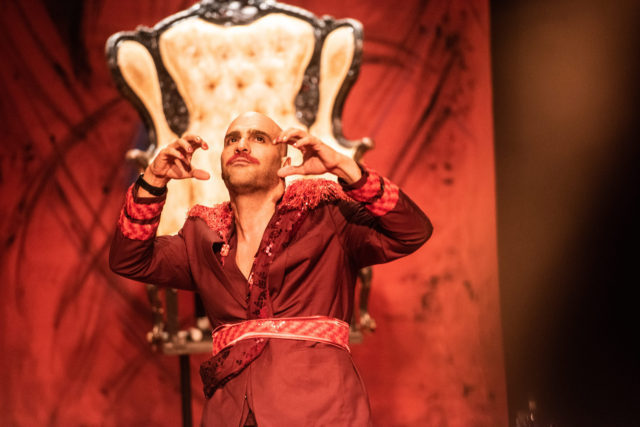
Jaquel Spivey makes his Broadway debut in Pulitzer Prize–winning musical A Strange Loop (photo by Marc J. Franklin)

A STRANGE LOOP
Lyceum Theatre
149 West 45th St. between Sixth & Seventh Aves.
Tuesday – Sunday through January 15, $49 – $225
strangeloopmusical.com

In his 2007 book I Am a Strange Loop, Pulitzer Prize–winning scientist Douglas Hofstadter writes, “In the end, we are self-perceiving, self-inventing, locked-in mirages that are little miracles of self-reference.” In her song “Strange Loop” from her seminal 1993 debut album Exile in Guyville, Liz Phair sings, “The fire you like so much in me / Is the mark of someone adamantly free. . . . I can’t be trusted / They’re saying I can’t be true / But I only wanted more than I knew.”

Hofstadter and Phair are among those who served as major influences on Michael R. Jackson’s dazzling, Pulitzer Prize–winning musical, A Strange Loop, which is bringing down the house at the Lyceum on Broadway following an earlier run at Playwrights Horizons. As the show opens, the protagonist, Usher (Jaquel Spivey), is ushering the audience back to their seats for the second act of The Lion King, adding some unexpected bonus information: “In the background, there will be a young overweight-to-obese homosexual and/or gay and/or queer, cisgender male, able-bodied university-and-graduate-school educated, musical theater writing, Disney ushering, broke-ass middle-class politically homeless normie leftist black American descendant of slaves who thinks he’s probably a vers bottom . . . but not totally certain of that obsessing over the latest draft of his self-referential musical A Strange Loop! And surrounded by his extremely obnoxious Thoughts!” Usher later explains that his self-referential musical is “about a black, gay man writing a musical about a black, gay man who’s writing a musical about a black gay man, who’s writing a musical about a black gay man, etc.”

To bring the loop full circle, Jackson himself is a young overweight homosexual who has been obsessing over his self-referential musical, A Strange Loop, for nearly twenty years; it started off as a monologue in 2003, written when Jackson was working as an usher on Broadway for The Lion King and other Disney extravaganzas and listening to “dat-blasted white girl music” by Phair, Tori Amos, and Joni Mitchell.

Six thoughts come to colorful life at the Lyceum Theatre (photo by Marc J. Franklin)

Usher’s never-ending fears and worries come to life in the form of six thoughts that roil around in his brain and comment on his decisions like a Greek chorus, including Supervisor of Your Sexual Ambivalence (L. Morgan Lee), Daily Self-Loathing (James Jackson Jr.), Head of Corporate Niggatry (Jason Veasey), and Financial Faggotry (Antwayn Hopper); it’s like a queer Black version of the 1990s cis white sitcom Herman’s Head, in which a young magazine employee’s thoughts of professional and romantic success are debated by four actors playing various parts of his psyche. The actors portraying Usher’s thoughts also take turns as his mother (John-Andrew Morrison), father (Veasey), agent (John-Michael Lyles), and various historical Black figures.

Usher is haunted by his consciousness, especially when he is given the opportunity to ghost write a gospel play for Tyler Perry. Usher feels that writing for Perry would compromise everything he believes in, calling Perry “toxic” and arguing, “The crap he puts on stage, film, and TV makes my bile wanna rise.” However, his thoughts and family want him to do it for the money and because “Tyler Perry writes real life” and “Tyler Perry loves his mama.” The guilt runs deep as Usher pursues both professional and personal opportunities, desperate to make himself seen and heard in a world that too often treats him as if he’s invisible, what he refers to as his “exile in Gayville.” Although not all of the details in the show are autobiographical, Jackson shares a lot in common with Usher, except now everyone knows who Jackson is.

A Strange Loop is stylishly directed by Stephen Brackett (Be More Chill, The Lightning Thief) with a balls-out sense of humor that is furthered by Raja Feather Kelly’s wickedly sly choreography, which has fun with Spivey, who is not your typical Broadway leading man. Arnulfo Maldonado’s set isolates Usher, making his loneliness palpable, while giving each Thought its own doorway, like the different compartments of the brain. Montana Levi Blanco’s costumes are highlighted by Usher’s red usher outfit, which is counteracted by his black T-shirt that includes such crossed-out words as “Imperialist” and “White Supremacist” above the clearly legible “bell hooks,” a tribute to the Black author and activist (Black Is . . . Black Ain’t, I Am a Man: Black Masculinity in America) who passed away in December 2021 at the age of sixty-nine.

The ninety-minute show looks and sounds terrific, with colorful lighting by Jen Schriever, vibrant sound by Drew Levy, music direction by Rona Siddiqui, and wonderful orchestrations by Charlie Rosen, played live by a six-piece band. In his Broadway debut, Spivey, taking over for Larry Owens, who played Usher in the off-Broadway production, is an utter delight. From the opening moments, when he declares, “Everyone, please return to your seats; the second act is about to begin!” to his later acknowledgment that “These are my memories / Sweet sour memories / This is my history / This is my mystery,” he has the audience firmly on his side. You don’t have to be a queer Black man to identify with Usher’s fears and desires, to understand his loneliness. Jackson has done a masterful job of making A Strange Loop an inclusive story while also challenging conceptions of what a Broadway musical can be; this is not The Lion King or Aladdin, and it is most certainly not for kids.

In Gödel, Escher, Bach: An Eternal Golden Braid, Hofstadter writes, “The self comes into being at the moment it has the power to reflect itself.” A Strange Loop works because it reflects on itself, and on all of us, in one way or another.

AMERICAN BUFFALO

Sam Rockwell, Darren Criss, and Laurence Fishburne star in latest Broadway revival of David Mamet’s American Buffalo (photo by Richard Termine)

AMERICAN BUFFALO
Circle in the Square Theatre
1633 Broadway at 50th St.
Tuesday – Sunday through July 10, $79.50 – $299.50
americanbuffalonyc.com

In 1981, at the downtown Circle in the Square on Bleecker St., a high school classmate of mine named Rich and I saw David Mamet’s American Buffalo, a searing three-character drama starring Al Pacino, Clifton James, and Thomas G. Waites as a trio of luckless losers in a Chicago junk shop plotting a low-level heist. Last month, Rich and I saw the third Broadway revival of the play, at Circle in the Square in the Theater District, a still-sizzling play with another all-star cast: Sam Rockwell, Laurence Fishburne, and Darren Criss.

A lot has changed over the last forty-one years. Rich and I both moved out of Long Island; he is a married insurance defense lawyer in Queens with two kids, while I’m a married culture writer and managing editor in Manhattan. Mamet, for decades celebrated as one of the country’s most important and talented playwrights and filmmakers — he’s been nominated for two Oscars, three Emmys, and two Tonys and won the Pulitzer Prize for 1983’s Glengarry Glen Ross — has now been turned into a pariah by the left because of his Trumpist political views and condemnation of liberalism, which dates back to around 2011, along with the toxic masculinity and misogyny that appear throughout his work.

The last decade has witnessed a quartet of disasters by Mamet — the oh-so-brief Broadway debuts of The Anarchist and China Doll, an ill-fated revival of Glengarry Glen Ross, and the world premiere of the disappointing The Penitent — but all of that has little to do with Neil Pepe’s powerful new staging of American Buffalo; my only quibble is that the intermission gets in the way of the flow of the drama, which is only eighty-five minutes without the break. (Most of Mamet’s works are between sixty and one hundred minutes, so he certainly has a way of getting right to the point.)

Donny (Laurence Fishburne) gets an earful from Teach (Sam Rockwell) in American Buffalo (photo by Richard Termine)

American Buffalo takes place in an impossibly crowded downstairs junk shop. It’s a Friday morning, and middle-aged store owner Donny Dubrow (Laurence Fishburne) is talking with Bobby (Darren Criss), a young simpleton who helps him out on occasion. In this case, Donny has asked Bobby to keep watch on a guy who had come into the store and purchased a buffalo nickel from him for ninety bucks. Donny compares the stranger to their friend Fletcher, who just won a stash playing cards.

“You take him and you put him down in some strange town with just a nickel in his pocket, and by nightfall he’ll have that town by the balls,” Donny says. “This is not talk, Bob, this is action. . . . Skill. Skill and talent and the balls to arrive at your own conclusions.

While Donny goes out of his way to teach Bobby about life, their friend Walter Cole (Sam Rockwell), better known as Teach, isn’t seeking out any teaching moments. He whirls into the shop, complaining about this and that, finding offense in minor incidents, lashing out with a slew of curses as he recounts supposed wrongs done to him. “Someone is against me, that’s their problem,” he barks. “I can look out for myself, and I don’t got to fuck around behind somebody’s back, I don’t like the way they’re treating me. Or pray some brick safe falls and hits them on the head, they’re walking down the street. But to have that shithead turn, in one breath, every fucking sweetroll that I ever ate with them into GROUND GLASS — I’m wondering were they eating it and thinking ‘This guy’s an idiot to blow a fucking quarter on his friends‘’ . . . this hurts me, Don. This hurts me in a way I don’t know what the fuck to do.” When Donny tries to calm him down, the bloviator says, “The only way to teach these people is to kill them.”

Amid a series of Pinteresque discussions, each more absurd than the last as they talk about English muffins, bacon, the weather, coffee, cheating at cards, pigirons, and loyalty, they plot a heist, deciding to rid the buffalo nickel customer of all of his coins later that night. What could possibly go wrong?

American Buffalo is a character-driven masterpiece about low-level dreams gone awry, about people who started with nothing and have no idea how to get their piece of the pie, or at least not legally. It’s field day for three actors; past productions have featured such trios as Robert Duvall, Kenneth McMillan, and John Savage; William H. Macy, Philip Baker Hall, and Mark Webber; John Leguizamo, Cedric the Entertainer, and Haley Joel Osment; and Damian Lewis, John Goodman, and Tom Sturridge.

Daren Criss holds his own with big-timers Sam Rockwell and Laurence Fishburne in Mamet revival (photo by Richard Termine)

The current Broadway revival, staunchly directed by Neil Pepe (Hands on a Hardbody, Dying for It), who has helmed many of Mamet’s works — including the 2000 revival at the Donmar Warehouse and the Atlantic Theater, which was cofounded by Mamet and Macy and where Pepe has been artistic director for thirty years — is another acting tour de force, with Criss (How to Succeed in Business without Really Trying, Hedwig and the Angry Inch) sublime as the gentle Bobby, Fishburne (Two Trains Running, Riff Raff) steadfast as the straightforward Donny, and a mustachioed Rockwell (A Behanding in Spokane, Fool for Love) right on target as the unsettling, unpredictable Teach, his polyester slacks practically a character unto themselves. (The costumes are by Dede Ayite.)

Scott Pask’s set is like a character unto itself as well, consisting of hundreds of items cluttering the floor and filling the ceiling over the men’s heads; these pieces of junk are like parts of their brain, all the thoughts and desires swimming around their skulls, likely to never come to fruition, just taking up space in these ne’er-do-wells who can’t see clearly ahead of themselves.

Right before the show started, Rich reminded me that when he had taken a stab at acting and stand-up comedy after college, his go-to audition speech was from American Buffalo, Teach’s first words: “Fuckin’ Ruthie, fuckin’ Ruthie, fuckin’ Ruthie, fuckin’ Ruthie, fuckin’ Ruthie.” After experiencing the play with him again after four decades, that choice made perfect sense to me.

JIM FLETCHER ON SCREEN

Jim Fletcher played Frankensteins monster in Tony Ourslers Imponderable (photo courtesy Museum of Modern Art)

Jim Fletcher plays Frankenstein’s monster in Tony Oursler’s Imponderable (photo courtesy Museum of Modern Art)

Who: Jim Fletcher
What: Film series
Where: Anthology Film Archives, 32 Second Ave. at Second St.
When: June 11-16
Why: In a January 2020 twi-ny talk, actor, writer, and editor Jim Fletcher, who is beloved in the experimental theater scene, said of his working with such companies as the New York City Players (NYCP), the Wooster Group, and Elevator Repair Service, “I’m working with people I love. It seems I never asked myself what kind of work I wanted to do, and also never the follow-up question, who best to do it with. In that sense I’m not a productive person. I think when you get close to people, you spontaneously start working in some way . . . out of sheer energy or whatever it is. Surplus.” Fans of Fletcher’s stage work (Pollock, Isolde, Why Why Always) might not realize just how productive the deep-voiced actor is, but they can find out in the Anthology Film Archives series “Jim Fletcher On Screen,” running June 11-16.

The mini-festival consists of eight programs comprising sixteen shorts, documentaries, and features starring the tall, bold Fletcher, from Roland Ellis’s ten-minute Break Down, Nicholas Elliott’s Icarus, and Laura Parnes’s Blood and Guts in High School (an adaptation of the book by Kathy Acker) to Shaun Irons’s Standing By: Gatz Backstage (a behind-the-scenes look at the eight-hour Gatz), Zoe Beloff’s Glass House (based on an unrealized science fiction project by Sergei Eisenstein), and Ellen Cantor’s Pinochet Porn (an episodic narrative that was completed after her death). NYCP founder Richard Maxwell is represented with The Feud Other, The Darkness of This Reading, and Showcase, the latter promising, “Gradually getting dressed, [Fletcher’s character] discusses life on the road, memories, moron jokes, the conference he is attending, business strategies, and a pivotal deal that went down recently under intimate circumstances. He sings.” Yes, Fletcher sings!

The celebration of all things Fletcher concludes June 16 with visual artist Tony Oursler’s 3D Imponderable, which was the centerpiece of a MoMA exhibition in 2016-17 and in which Fletcher portrays his dream role, Frankenstein’s monster. Fletcher will be at Anthology to talk about his work at several screenings, bringing along some of his friends and colleagues. Be prepared to join the ever-growing Fletcher faithful; we are legion.

THE BEDWETTER

Zoe Glick is delightful as a young girl with an embarrassing problem in world premiere musical at the Atlantic (photo by Ahron R. Foster)

THE BEDWETTER
Atlantic Theater Company
Linda Gross Theater
336 West 20th St. between Eighth & Ninth Aves.
Tuesday – Sunday through July 10, $111.50 – $131.50
866-811-4111
atlantictheater.org

Sarah Silverman is a superhero comedian, actress, and activist, and the new musical The Bedwetter is her origin story — and it’s more fab than we could ever have hoped, no mere trickler.

In her 2010 memoir, The Bedwetter: Stories of Courage, Redemption, and Pee (HarperCollins, April 2010, $19.99), Silverman detailed how she dealt as a child with nocturnal enuresis, mixing comedy with heartfelt poignancy as she openly and honestly examined the shame she suffered through. While the world premiere musical, which opened Tuesday night at the Atlantic for a limited run through July 3, also has its tender, emotional moments, it’s mostly a jubilant, hysterically funny tale about a unique young girl (Zoe Glick) and her dysfunctional family as she begins fifth grade in a new school.

Sarah’s parents have recently divorced. Her severely depressed mother, Beth Ann (Caissie Levy), spends all day and night in bed, watching her favorite movie and TV stars, never venturing outside. Sarah’s philandering father, Donald (Darren Goldstein), is the owner of Crazy Donny’s Discount Clothing Store and loves telling Sarah and her older sister, eighth grader Laura (Emily Zimmerman), dirty jokes utterly inappropriate for children. Meanwhile, Sarah’s beloved nana (Bebe Neuwirth) speaks without a filter, smokes like a fiend, and has Sarah regularly mix her Manhattans.

“I’m just really really fucking excited to be here!” Sarah cries out in class on her first day of school, angering her teacher, Mrs. Dembo (Ellyn Marie Marsh), who says, “Sarah! We don’t use language like that!” Sarah responds, “Sorry, Mrs. Dembo! I know that’s an ‘at home’ word.” Well, not at most suburban homes with young kids.

Sarah is a happy-go-lucky girl who manages to smile through all her family weirdness; she is ridiculously cute in her tight black bangs and shiny eyes. (The hair and wig design is by Tom Watson.) When she tries to make friends with a trio of mean girls — Ally (Charlotte Elizabeth Curtis), Abby (Charlotte MacLeod), and Amy (Margot Weintraub) — she has an unusual take on their verbal attacks on her.

“Your arms are so hairy!” Ally sings. “I couldn’t agree more! You should see my back!” Sarah responds. “Your teeth are enormous!” Abby declares. “I couldn’t agree more! To keep them this yellow takes extra plaque!” Sarah joyfully admits. “You’re short and dark and strange and eww-y!” the three girls say. “I know what you mean! I’m totally Jew-y!” Sarah replies with a big grin.

Sarah Silverman (Zoe Glick) and her father (Darren Goldstein) visit the doctor in The Bedwetter (photo by Ahron R. Foster)

At school, Laura prefers to ignore her little sister, but Sarah can’t help but stick around her. Laura explains, “Like do you know the type of person that like wants to smell all the bad smells? Like when the milk goes bad she’s like let me smell it and you say why would you want to and she says she just ‘wants to know’? Or like . . . do you know the type of person that’ll wake you up at 1 am and say, ‘Laura, does the pee come out the baby hole, or its own hole? . . . And how many holes do we have?’” To which Sarah says, “Yeah! And like, do you have a period hole now?”

But as with all superheroes, she has her own personal Kryptonite, in this case the severe shame of wetting the bed every night. When one of her worst nightmares comes true, Sarah’s father takes her to see a hypnotist, Dr. Grimm, then a pill-crazed screwball, Dr. Riley (both played by Rick Crom), but that only makes matters worse as she struggles, like any preteen, to fit in. She tries to find solace in her own superhero, Bedford native Jane Badler, aka Miss New Hampshire (Ashley Blanchet), who shows up at various times as a goddess of perfection, offering tidbits of wisdom in her beauty-pageant costume.

The Bedwetter is a sparkling adaptation of Silverman’s memoir, ready, willing, and able to pull no punches and hold nothing back. It might be about a ten-year-old, but it is most definitely not for kids; a group of children were sitting around us, and they looked rather uncomfortable through much of the show, particularly during Donald’s “In My Line of Work,” in which he proudly proclaims numerous times to several kids, “I fucked your mom!” It’s reminiscent of Silverman’s innovative cable sitcom The Sarah Silverman Program, which ran from 2007 to 2010 and approached her life with a wicked sense of humor as she brilliantly, and often controversially, complete with ferociously funny cringe-worthy moments, faced such issues as racism, anti-Semitism, abortion, and same-sex marriage. (It was a family affair, as her older sister, Laura, portrayed her younger sister.)

A nontraditional musical that brings to mind Fun Home, The Bedwetter features a jaunty pop score by three-time Emmy and Grammy winner and Oscar and Tony nominee Adam Schlesinger (Cry-Baby, “That Thing You Do!”), a founding member of Fountains of Wayne (Utopia Parkway, “Stacy’s Mom”) who died of Covid-19 complications in April 2020 at the age of fifty-two; the playful lyrics, which toy with genre cliches and regularly go to unexpected places, are by Schlesinger and Silverman, set to perky orchestrations by David Chase.

Nana (Bebe Neuwirth) has some choice advice for Sarah (Zoe Glick) in rousing musical (photo by Ahron R. Foster)

But it’s the book that really glows, written by Silverman and Joshua Harmon, one of today’s best playwrights; his recent work includes the extraordinary epic Prayer for the French Republic, the dazzling black comedy Bad Jews, and the moving relationship drama Significant Other. Harmon and Silverman tell the story with charm, incorporating just the right amount of tsuris. And only Sarah Silverman could get away with saying, “Oh, John Lennon. This might sound weird, but your senseless murder has made one little girl very happy.” Bedwetting becomes instantly relatable, resonating with any shame anyone in the audience may be holding inside.

Obie-winning director Anne Kauffman (The Nether, Mary Jane) has a firm grasp of the unusual material, unfolding on Laura Jellinek’s graceful sets, which morph from bedrooms to school hallways to doctors offices. Byron Easley’s choreography nearly brings the house down in a number involving dancing pills.

Glick (Frozen, Les Misérables) is a delight as young Sarah, bursting with confidence in a challenging role; she’s actually fourteen, so it’s a little easier to accept many of the words and ideas that come out of her character’s mouth. Goldstein (The Little Foxes, Continuity) and Levy (Frozen, Caroline, or Change) make a fine pair of dueling exes, while Neuwirth (Chicago, Cheers) is like a queen holding court as Nana. Crom (Urinetown, Merrily We Roll Along) nearly steals the show as the doctors (among other minor roles) when Blanchet (Waitress, Beautiful) isn’t taking center stage as the cryptic Miss New Hampshire. [Ed. note: Jessica Vosk will play Beth Ann and Elizabeth Ward Land will take over the role of Nana from July 5 to 10.]

But mostly, The Bedwetter is about discovering and accepting who you are, making necessary changes as you grow, and becoming part of the world around you. As Phyllis Campbell (Marsh), Amy’s mother, says to the kids at her daughter’s birthday party, “May all your dreams come true! Mine did not!” In The Bedwetter, Silverman dares us to face our fears, and beat them silly.

BLACK DOLLS

Topsy-turvy doll, mixed fabrics, paint, 1890-1905 (photo by Glenn Castellano)

BLACK DOLLS
New-York Historical Society
170 Central Park West at Seventy-Seventh St.
Wednesday – Sunday through June 5, $6-$22
www.nyhistory.org

The New-York Historical Society explores the sociocultural history of black dolls, particularly in regard to slavery and racism, in the revelatory exhibit “Black Dolls,” on view through June 5. The show features more than two hundred items, including more than a hundred handmade dolls dating back to the 1840s. Cynthia Walker Hill’s “Doll representing an enslaved man” depicts a fugitive slave with a slave collar still around his neck. There are several dolls crafted by Harriet Jacobs, author of Incidents in the Life of a Slave Girl: Written by Herself, for the children of white author Nathaniel Parker Willis. There are several topsy-turvy dolls, a Black figure on one side, a white figure on the other; an old advertisement makes a clear distinction between the two.

A row of Black dolls forming a family are lined up in front of photographs of girls with dolls of a different color. Disturbed at seeing two Black girls playing with a white doll, Sara Lee Creech worked with Eleanor Roosevelt and Zora Neale Hurston on a line of Black dolls with positive images, not stereotypes, but they didn’t sell well. In 1908, Richard Henry Boyd and his National Negro Doll Company began manufacturing “Negro Dolls for Negro Children.” In the 1990s, American Girl introduced Addy Walker, a Black doll with her own, smaller Black doll.

“While the names of the women who created these dolls are largely unknown, every stitch that they sewed into place is invaluable evidence of their lived experience, as well as a reflection of the larger historical forces of slavery and its legacy,” New-York Historical Society president and CEO Dr. Louise Mirrer said in a statement. There’s a folk-art quality to the dolls, reminiscent of story quilts, each one forming its own narrative.

In its landmark 1954 decision Brown v. Board of Education of Topeka, the Supreme Court cited Dr. Kenneth Clark’s doll tests, in which he asked questions of Black and white children between the ages of three and seven to find out which doll they felt represented them and which were the good ones. The results were a window into how kids viewed racial stereotypes and their own self-esteem; most of the children preferred the white dolls. “To separate [Black children] from others of similar age and qualifications solely because of their race generates a feeling of inferiority as to their status in the community that may affect their hearts and minds in a way unlikely ever to be undone,” Chief Justice Earl Warren wrote in the opinion. The exhibit demonstrates more than a century and a half of quiet efforts to resist that damage and the resilience of the Black community and a few allies in the ongoing fight to represent themselves.

There will be guided gallery tours on May 29 and June 1 at 1:00. While at the museum, be sure to check out such other exhibits as “Title IX: Activism On and Off the Field,” “Picture the Dream: The Story of the Civil Rights Movement Through Children’s Books,” and “Scenes of New York City: The Elie and Sarah Hirschfeld Collection.”

HUMAN CONDITIONS: THE FILMS OF MIKE LEIGH

The career of Mike Leigh is celebrated in Lincoln Center retrospective

HUMAN CONDITIONS: THE FILMS OF MIKE LEIGH
Film at Lincoln Center, Walter Reade Theater
165 West 65th St. at Amsterdam Ave.
May 27 – June 8
www.filmlinc.org

For more than fifty years, British auteur Mike Leigh has been making character-driven films set in working-class worlds, anchored by memorable performances: Katrin Cartlidge in Career Girls, David Thewlis in Naked, Sally Hawkins in Happy-Go-Lucky, Jim Broadbent and Timothy Spall in Life Is Sweet, Marianne Jean-Baptiste in Secrets & Lies, Imelda Staunton in Vera Drake. His famed style involves the actors immersing themselves in their roles months and months ahead of shooting, resulting in stories steeped in reality, and humanity.

Film at Lincoln Center is honoring the seventy-nine-year-old director with the two-week retrospective “Human Conditions: The Films of Mike Leigh,” consisting of all fourteen of his features and two of his shorts (A Sense of History and The Short and Curlies), ranging from 1973’s Bleak Moments to 2018’s Peterloo. Leigh will be at the Walter Reade Theater for Q&As following the May 27 screening of the 4K restoration of Naked, the May 28 screening of a new restoration of Secrets & Lies, and the May 29 screening of a new restoration of his Gilbert & Sullivan biopic, Topsy-Turvy. Below are select reviews.

BLEAK MOMENTS

A pair of sisters contemplate their miserable lives in Mike Leigh’s first film, Bleak Moments

BLEAK MOMENTS (LOVING MOMENTS) (Mike Leigh, 1971)
Friday, May 27, 4:00
Saturday, May 28, 9:00
Friday, June 3, 1:00
www.filmlinc.org

British master filmmaker Mike Leigh’s feature debut, 1971’s Bleak Moments, is just that, a series of grim scenes involving five main characters who are not exactly the most scintillating of conversationalists. But slowly, the dark, dreary opening evolves into a wickedly funny black comedy about different sorts of relationships (familial, sexual, professional), comprising episodes that help define the film’s alternate title, Loving Moments. It would be hard for Sylvia (Anne Raitt) to live a more boring life. A typist at an accounting firm, she spends most of her free time at home taking care of her sister, Hilda (Sarah Stephenson), who suffers from a kind of autism. Hilda works with Pat (Joolia Cappleman), a strange bird obsessed with movies, Maltesers, and Hilda. Meanwhile, teacher Peter (Eric Allan), who seems terrified of people, shows interest, if you can call it that, in all three women. And Norman (Mike Bradwell), a wannabe singer-songwriter, has moved into Sylvia’s garage, where he plays music that intrigues Hilda. Over a short period of time, the three women and two men sit around, go for walks, eat, drink, and, mostly, say very little to one another, their tentativeness palpable, each one terribly frightened in his or her own way of what life has to offer, of connecting. But Leigh isn’t making fun of them; instead, Bleak Moments is a lovingly drawn story of real life, where people don’t always know exactly what to say or do or how to react in various situations.

BLEAK MOMENTS

Peter (Eric Allan) and Sylvia (Anne Raitt) go on a date to remember in Bleak Moments

Originally mounted as a stage production, Bleak Moments transitioned to the big screen with the financial help of Albert Finney. As became his trademark, Leigh had the actors first embody the roles in rehearsals and preparation, giving the film a believability despite the absurdity of it all. The overwhelming despair and hesitation demonstrated by the characters becomes painfully funny, especially when Peter takes Sylvia to a Chinese restaurant and, afterward, she tries to ply him with sherry.

In January 2013, Leigh discussed Bleak Moments with the Guardian, at first comparing it to watching paint dry and acknowledging that some people thought it was “the most boring film in the world” while also explaining, “From this distance, I cautiously feel I’m allowed to feel a touch of paternal pride in my young self. With such brief life experience, did I really invent this painful, tragic-comic tale of a beautiful but suppressed young woman, tied to her elder, mentally challenged sister? I guess I’m astonished at the maturity and sophistication of my achievement, not to mention its pathos and irony. . . . I’ve tried to vary my films considerably, but I would have to admit that Bleak Moments remains, in some ways, the mother of all Mike Leigh films. And I’m very proud of it.” As well he should be.

Sally Hawkins is unforgettable in Mike Leigh’s Happy-Go-Lucky

HAPPY-GO-LUCKY (Mike Leigh, 2008)
Sunday, May 29, 9:00
Friday, June 3, 3:30
www.filmlinc.org

Mike Leigh’s Happy-Go-Lucky is the most charming of all his films. Sally Hawkins gives a career-making performance as Poppy, the most delightful film character since Audrey Tatou’s Amélie (in Jean-Pierre Jeunet’s 2001 French comedy Le Fabuleux Destin D’amélie Poulain). Poppy is a primary school teacher who has an endearing, seemingly limitless love of life; she talks playfully with strangers in bookstores, teases her sister (Kate O’Flynn) and best friend (Alexis Zegerman) with the sweetest of smirks, takes a flamenco lesson on a whim with a colleague, and, when her bicycle is stolen, simply starts taking driving lessons.

However, her driving instructor, Scott (Eddie Marsan), is a tense, angry man with endless chips on his shoulder, trying to sour Poppy at every turn. But Poppy is no mere coquettish ingenue; when she senses a problem with one of her students, she is quick to get to the bottom of the situation, with the appropriate serious demeanor. As with most Leigh films, much of the dialogue is improvised (following long rehearsal periods), adding to its freshness. But also as with most Leigh films, there are dramatic turning points, but even those can’t wipe away Poppy’s — or the audience’s — endless smile.

MR. TURNER

British painter J. M. W. Turner (Timothy Spall) and his devoted housekeeper, Hanna Danby (Dorothy Atkinson), pause for a moment in biopic

MR. TURNER (Mike Leigh, 2014)
Sunday, June 5, 2:00
Wednesday, June 8, 3:30
www.filmlinc.org

Timothy Spall was named Best Actor at the Cannes Film Festival for his compelling portrayal of British artist Joseph Mallord William Turner in Mike Leigh’s lovely biopic, Mr. Turner. Spall, who played Peter Pettigrew in the Harry Potter series and has appeared in such other Leigh films as Topsy-Turvy, All or Nothing, Life Is Sweet, and Secrets & Lies, portrays Turner as a gruff, self-involved painter who grunts and growls his way through life. At his home studio he is assisted by his aging father, William (Paul Jesson), and his devoted housekeeper, Hanna Danby (Dorothy Atkinson), who he occasionally shags when in the mood. Turner carries his sketchbook wherever he goes, always on the look-out for a beautiful landscape or winter storm that could become the subject of his next painting. With that in mind, he rents a room in a small seaside inn run by Sophia Booth (Marion Bailey), who eventually becomes more than just his landlady. An artist well ahead of his time, Turner becomes frustrated with the men at the Royal Academy of Arts and lisping art critic John Ruskin (Joshua McGuire), who don’t appreciate his work properly, especially when he starts heading toward abstraction.

MR. TURNER

J. M. W. Turner (Timothy Spall) is always on the look-out for a subject to paint in Mr. Turner

Leigh does not paint the kindest portrait of J. M. W. Turner, who turned his back on his former mistress, the shrill Sarah Danby (Ruth Sheen), and their two daughters (Sandy Foster and Amy Dawson); doesn’t have the nicest things to say about such contemporaries as John Constable (James Fleet) and Benjamin Haydon (Martin Savage); and won’t listen to the stern warnings of his doctor (David Horovitch). Turner is an artist first and foremost; everything else takes a backseat in his life. Despite being based on actual events, the film was made in Leigh’s usual style, with the actors improvising within set scenes; Spall, who studied painting for two years in preparing for the role, takes full advantage of the opportunity, often refusing to articulate, grunting and growling as he deals with other people who dare share their thoughts and opinions with him. It’s a very funny conceit that helps define a rather unusual character.

As befits a story about a masterful painter, cinematographer Dick Pope, who has shot most of Leigh’s films, beautifully photographs the sun rising and setting over vast landscapes, capturing its glowing light cast over the sea. Leigh keeps the narrative subtle, as when Turner and Sophia sit for a daguerreotype; almost nothing extraordinary happens in the scene, but from a few groaned questions and Spall’s expression, viewers can sense Turner realizing the changes that photography will bring to realist painting, spurring his controversial switch to more abstract canvases. It is not shown as a eureka moment but just another part of Turner’s development in becoming one of the most important and influential artists of the nineteenth century. And then there are the paintings themselves, glorious works that are always a joy to see, especially in a film that is a work of art itself.

LOWER EAST SIDE FESTIVAL OF THE ARTS: ARTISTS EMBRACE LIBERTY AND JUSTICE FOR ALL

Who: Nearly two hundred performers
What: Lower East Side Festival of the Arts
Where: Theater for the New City, 155 First Ave. at Tenth St.
When: May 27-29, free (donations accepted)
Why: The twenty-seventh annual Lower East Side Festival of the Arts, a wide-ranging, indoor and outdoor celebration of the vast creativity of the neighborhood over the decades, will feature nearly two hundred performers, at Theater for the New City and on Tenth St. Taking place May 27-29, the festival, with the theme “Artists Embrace Liberty and Justice for All,” includes dance, spoken word, theater, music, visual art, and more from such familiar faves as David Amram, the Thunderbird American Indian Dancers, Shakespeare in the Parking Lot, James Rado, La MaMa, Akiko, Folksbiene National Yiddish Theater, Malachy McCourt, KT Sullivan, Eduardo Machado, Austin Pendleton, the Rod Rodgers Dance Company, Melanie Maria Goodreaux, Chinese Theater Works, New Yiddish Rep, Eve Packer, 13th Street Rep, and Metropolitan Playhouse.

The event will be emceed at the various locations by Crystal Field, Robert Gonzales Jr., Danielle Aziza, Sabura Rashid, David F. Slone Esq., and Joe John Battista. There will also be vendors and food booths and special programs for children curated by Donna Mejia and hosted by John Grimaldi, film screenings curated by Eva Dorrepaal, a “poetry jam with prose on the side” curated by Lissa Moira, and an art show curated by Carolyn Ratcliffe. Select performances will be livestreamed here.