twi-ny recommended events

CONEY ISLAND SAND SCULPTING CONTEST 2022

Twenty-fifth annual Sand Sculpting Contest takes place in Coney Island on Saturday (photo by twi-ny/mdr)

Thirtieth annual Coney Island Sand Sculpting Contest should feature some wild creations on Saturday (photo by twi-ny/mdr)

CONEY ISLAND SAND SCULPTING CONTEST
Coney Island
Boardwalk between West Tenth & Twelfth Sts.
Saturday, August 13, free, noon – 5:00 pm
www.coneyisland.com
www.allianceforconeyisland.org

The twice-Covid-postponed thirtieth annual Coney Island Sand Sculpting Contest finally comes to the People’s Playground on August 13, as amateurs, semiprofessionals, and professionals will create masterpieces in the Brooklyn sand, many with a nautical theme. It’s a blast watching the constructions rise from nothing into some extremely elaborate works of temporary art. The event, which features cash prizes, is hosted by the Alliance for Coney Island and features four categories: Adult Group, Family, Individual, and People’s Choice. There are always a few architectural ringers who design sophisticated castles, along with a handful of gentlemen building, well, sexy mermaids. You can register as late as eleven o’clock Saturday to participate. While visiting Coney Island on August 13, you should also check out the Coney Island Museum, the Coney Island Circus Sideshow, Puppets Come Home!’s Body Slam, and the fully restored New York Aquarium in addition to riding the Cyclone and the Wonder Wheel.

MONTHLY CLASSICS: AFTER LIFE

AFTER LIFE

Guides interview the deceased in Hirokazu Kore-eda’s After Life

AFTER LIFE (WANDÂFURU RAIFU) (Hirokazu Kore-eda, 1998)
Japan Society
333 East 47th St. at First Ave.
Friday, August 12, $15, 7:00
www.japansociety.org

Japan Society’s Monthly Classics series continues on August 12 with Hirokazu Kore-eda’s second narrative feature, After Life, an eminently thoughtful film about two of his recurring themes: death and memory. Every Monday, the deceased arrive at a way station where they have three days to decide on a single memory they can bring with them into heaven. Once chosen, the memory is re-created on film, and the person goes on to the next step of their journey, to be replaced by a new batch of souls. The way station is staffed by guides, including Takashi Mochizuki (Arata), Shiori Satonaka (Erika Oda), and Satoru Kawashima (Susumu Terajima), whose job it is to interview the new arrivals and help them select a memory and then bring it to life on-screen. Some want to take with them an idyllic moment from childhood, others a remembrance of a lost love, but a few are either unable to or refuse to come up with one, which challenges the staff. Twenty-one-year-old Yūsuke Iseya declares, “I have no intention of choosing. None,” while seventy-year-old Ichiro Watanabe (Taketoshi Naito) is having difficulty deciding on the exact moment, reevaluating and reflecting on the life he led. As the week continues, the guides look back on their lives as well, sharing intimate details, one of which leads to an emotional finale.

AFTER LIFE

After Life explores life, death, memory, heaven, and the art of filmmaking

Kore-eda, who previously examined memory loss in the documentary Without Memory and explored a family’s reaction to death in the brilliant Still Walking, interviewed some five hundred people about what memory they would take with them to heaven, and some of those nonprofessional actors are in the final cut of After Life, blurring the lines between fiction and reality. After Life is also very much about the art of filmmaking itself, as each memory is turned into a short movie created on a set and watched in a screening room. In fact, the film was inspired by Kore-eda’s memories of his grandfather’s battle with what would later be identified as Alzheimer’s disease; the director has also cited Ernst Lubitsch’s 1943 comedy, Heaven Can Wait, as an influence, and the Japanese title, Wandâfuru raifu, means “Wonderful Life,” evoking Frank Capra’s holiday classic. But Kore-eda never gets maudlin about life or death in the film, instead painting a memorable portrait of human existence and those simple moments that make it all worthwhile — and will have viewers contemplating which memory they would take with them when the time comes.

SUMMER FOR THE CITY: BAAND TOGETHER DANCE FESTIVAL

Who: Ballet Hispánico, Alvin Ailey American Dance Theater, American Ballet Theatre, New York City Ballet, Dance Theatre of Harlem
What: Free dance festival
Where: Lincoln Center for the Performing Arts
When: August 9-13, free, 5:00 & 7:30
Why: Last summer, Lincoln Center presented the inaugural BAAND Together Dance Festival, consisting of five different programs by five of New York’s finest companies: Ballet Hispánico, Alvin Ailey American Dance Theater, American Ballet Theatre, New York City Ballet, and Dance Theatre of Harlem. In a joint statement for the second annual event, the five artistic directors explain, “Last year’s festival was a resounding success, proof that New York audiences are excited for their beloved dance companies to return to the stage. This year we will go beyond performing side by side and do so together, as a unified dance family, through an exciting new work by Annabelle Lopez Ochoa. This new work is a testament to our commitment for building new avenues of cultural innovation, dialogue, and accessibility for our incredible city.”

Banding together August 9-13, each troupe will host one daily workshop at 5:00 for all ages. Below is the complete schedule, with wide-ranging works by Alvin Ailey, Michelle Manzanales, George Balanchine, Ulysses Dove, Helen Pickett, Jessica Lang, Robert Battle, Pedro Ruiz, and Robert Garland.

Tuesday, August 9, 5:00
New York City Ballet Children’s Workshop

Tuesday, August 9, 7:30
One for All, world premiere by Annabelle Lopez Ochoa, with dancers from each of the five companies, set to “Manteca” by Funky Lowlives/Dizzy Gillespie
Alvin Ailey American Dance Theater: Cry, by Alvin Ailey, with music by Alice Coltrane, Laura Nyro, and Voices of East Harlem
Ballet Hispánico: Con Brazos Abiertos, by Michelle Manzanales, with music by Julio Iglesias and others
Dance Theatre of Harlem: When Love, by Helen Pickett
American Ballet Theatre: Children’s Songs Dance, by Jessica Lang, with music by Chick Corea

Ballet Hispánico’s Club Havana is part of free Lincoln Center festival (photo by Paula Lobo)

Wednesday, August 10, 5:00
Ballet Hispánico’s Latin Social Dance Workshop

Wednesday, August 10, 7:30
One for All, world premiere by Annabelle Lopez Ochoa, with dancers from each of the five companies, set to “Manteca” by Funky Lowlives/Dizzy Gillespie
Ballet Hispánico: Con Brazos Abiertos, by Michelle Manzanales, with music by Julio Iglesias and others
New York City Ballet: Red Angels, by Ulysses Dove, set to Richard Einhorn’s “Maxwell’s Demon”
American Ballet Theatre: Children’s Songs Dance, by Jessica Lang, set to music by Chick Corea
Alvin Ailey American Dance Theater: Love Stories finale, by Robert Battle, with music by Stevie Wonder
Dance Theatre of Harlem: Return, by Robert Garland, with music by James Brown and Aretha Franklin

Thursday, August 11, 5:00
Dancing with Ailey on the Plaza!

Thursday, August 11, 7:30
One for All, world premiere by Annabelle Lopez Ochoa, with dancers from each of the five companies, set to “Manteca” by Funky Lowlives/Dizzy Gillespie
Ballet Hispánico: Club Havana, by Pedro Ruiz
Alvin Ailey American Dance Theater and American Ballet Theatre: Pas de Duke, by Alvin Ailey, performed by Jacquelin Harris and Herman Cornejo, with music by Duke Ellington
New York City Ballet: Red Angels, by Ulysses Dove, set to Richard Einhorn’s “Maxwell’s Demon”
Dance Theatre of Harlem: When Love, by Helen Pickett
Alvin Ailey American Dance Theater, Love Stories finale, by Robert Battle, with music by Stevie Wonder

Dance Theatre of Harlem will present Return at BAAND Together (photo by Rachel Neville)

Friday, August 12, 5:00
Dancing in the Street with Dance Theatre of Harlem

Friday, August 12, 7:30
One for All, world premiere by Annabelle Lopez Ochoa, with dancers from each of the five companies, set to “Manteca” by Funky Lowlives/Dizzy Gillespie
Dance Theatre of Harlem: Return, by Robert Garland, with music by James Brown and Aretha Franklin
Alvin Ailey American Dance Theater: Cry, by Alvin Ailey, with music by Alice Coltrane, Laura Nyro, and Voices of East Harlem
New York City Ballet: Allegro Brillante, by George Balanchine, set to Tschaikovsky’s Piano Concerto No. 3
Alvin Ailey American Dance Theater and American Ballet Theatre: Pas de Duke, by Alvin Ailey, performed by Jacquelin Harris and Herman Cornejo, with music by Duke Ellington
Ballet Hispánico: Club Havana, by Pedro Ruiz

Saturday, August 13, 5:00
American Ballet Theatre: ABTKids Story Ballet Workshop

Saturday, August 13, 7:30
American Ballet Theatre: Children’s Songs Dance, by Jessica Lang, set to music by Chick Corea
Ballet Hispánico: Club Havana, by Pedro Ruiz
Alvin Ailey American Dance Theater: Cry, by Alvin Ailey, with music by Alice Coltrane, Laura Nyro, and Voices of East Harlem
Dance Theatre of Harlem: When Love, by Helen Pickett
New York City Ballet: Allegro Brillante, by George Balanchine, set to Tschaikovsky’s Piano Concerto No. 3
One for All, world premiere by Annabelle Lopez Ochoa, with dancers from each of the five companies, set to “Manteca” by Funky Lowlives/Dizzy Gillespie

HAMLET / ORESTEIA

Alex Lawther is impressive as Hamlet in Robert Icke’s dazzling production at Park Ave. Armory (photo by Stephanie Berger)

HAMLET/ORESTEIA
Park Ave. Armory, Wade Thompson Drill Hall
643 Park Ave. at Sixty-Seventh St.
In repertory through August 13, $45-$199
www.armoryonpark.org/hamlet
www.armoryonpark.org/oresteia

An overwhelming sense of grief and severe family dysfunction link Robert Icke’s ingenious pairing of Hamlet and Oresteia, running in repertory at Park Ave. Armory through August 13. You might not immediately think of the two tragedies, one written in English by William Shakespeare around 1600 about an introspective Danish prince, the other a Greek trilogy penned by Aeschylus in the fifth century BCE focusing on the conflicted son of a powerful king, as theatrical brethren, but Icke masterfully weaves them together over the course of seven thrilling hours.

Following up his superb one-person reimagining of Henrik Ibsen’s Enemy of the People starring Ann Dowd in a pandemic-reconfigured Wade Thompson Drill Hall at the armory, Icke returns with this extremely satisfying duo, which tackle similar themes in these contemporary versions. Whereas Icke makes subtle tweaks to Hamlet, he institutes much heavier changes to Oresteia.

They both take place on Hildegard Bechtler’s expansive, relatively shallow horizontal set, with entrances at either side and a glassed-in back room with sliding doors that are alternately transparent, translucent, or opaque. For Hamlet, business chairs and a comfy L-shaped couch are brought on- and offstage in between rectangular marble stanchions, while for Oresteia, the furniture includes a long dinner table with benches, marble Greek pillars with exposed stone walls, and a large bathtub in the rear. Bechtler also designed the modern-day costumes, with intricate lighting by Natasha Chivers and sound by Tom Gibbons.

Hamlet, superbly played with a tender vulnerability by twenty-seven-year-old British actor Alex Lawther, is dismayed to find that his recently widowed mother, Gertrude (Jennifer Ehle), has married her late husband’s brother, Hamlet’s father, Claudius (Angus Wright), who is now the king of Denmark. The two seem very much in love, making out on the couch. But when Hamlet’s father’s ghost (David Rintoul), who appears on closed circuit security cameras wandering the empty, dungeonlike halls of Elsinore castle, tells his son that Claudius murdered him, Hamlet, who has been considering going back to school in Wittenberg, becomes obsessed with revenge, yet he lacks the resolve to take any kind of significant action in his life.

Klytemnestra (Anastasia Hille) and Agamemnon (Angus Wright) face each other across the family dinner table in Oresteia (photo by Joan Marcus)

Meanwhile, he seems destined to marry Ophelia (Kirsty Ryder), the daughter of Claudius’s chief adviser, Polonius (Peter Wight), and sister of the strong-willed Laertes (Luke Treadaway). Soon bodies are piling up, as Hamlet says, “with blood of fathers mothers daughters sons.”

In Oresteia, Agamemnon (Angus Wright), the king of Mycenae, is told by a seer, “By his hands alone. The child is the price. Fair winds.” Agamemnon and his brother, Menelaus (Peter Wight), need to sail their ships to Troy but are becalmed in Aulis, and Agamemnon interprets the prophecy to mean that he must kill his six-year-old daughter, Iphigenia (Elyana Faith Randolph or Alexis Rae Forlenza), in order to appease the gods and get the winds moving. The king is desperate to find another way, but both his brother and his herald, Talthybius (Josh Higgott), insist the deed must be done. When the queen, Klytemnestra (Anastasia Hille), deciphers the prophecy, she is of course furious, declaring, “You’re ill. You’re mad. To kill our child?” But she might not be able to stop him.

Ten years later, when Agamemnon returns from the war, bringing with him teenage captive Cassandra (Hara Yannas), he finds his family vastly changed. Bright young Orestes (Hudson Paul or Wesley Holloway) has grown into a conflicted teenager (Treadaway), daughter Electra (Tia Bannon) is jealous of Cassandra, and cousin Aegisthus (Angus Wright) has usurped Agamemnon’s place in the family. Soon bodies are piling up, and Klytemnestra warns Orestes, with more than a touch of wishful thinking, “You do not want blood on your hands.” Fathers, mothers, daughters, and sons are all in jeopardy.

Fear is central to both narratives. While Hamlet delivers his despair and anxiety directly to the audience in famous soliloquys, Oresteia unfolds in flashbacks as Orestes shares his memories with an unidentified woman (Ryder) who appears to be his therapist. Orestes tells her, “I watch it again, happening for the first time but — too late, too late to stop it. It pours out of me. But what if what’s next is — ? What if it’s better left sealed up, undisturbed?” The doctor responds, “We have to understand the truth.” Orestes: “What if it’s a dream? What if it’s a lie?” Doctor: “Then those lies reveal something about you. ‘Our self’ isn’t an absolute thing. It’s handfuls of memories and moments and people — and we form them into who we think we are. For most of us, it’s only partly true: one version of truth. A story.” Orestes: “A story. A story I’ve been through before. As a child. But I don’t know where it ends —”

Claudius (Angus Wright) and Gertrude (Jennifer Ehle) hold hands, much to Hamlet’s (Alex Lawther) consternation (photo by Stephanie Berger)

Looking backward and forward while fearing the end is also a leitmotif for each play. “I try and look forward rather than backward,” Agamemnon says. Hamlet explains, “I hold it not honesty to have it thus set down / for yourself sir should be old as I am / if like a crab you could go backward.” At dinner, Electra confesses, “I know. I was late. I have apologized. Let’s all just move forward.” When Orestes insists to the doctor that he can’t remember the past, she implores, “You will remember something. We just have to begin. Travel back along the road, all the way back to where it began.” Hamlet says to his mother, “Repent what’s past / Avoid what is to come.”

The words “end” or “ending” are repeated throughout all seven hours. “It’s ending. It is ending,” Agamemnon says. Hamlet explains to Claudius, “We fat all creatures else to fat us and we fat ourselves for maggots / that’s the end.” Talthybius tells Agamemnon and Menelaus, “No one thinks this thing is close to the end. It’s cut in deep, it’s gone too far for that. And our enemy is prepared, planning years beyond — so there’s no road to the end of this that’s swift.” Ophelia, losing control of her wits, babbles to Laertes, “I would give you some violets but they withered all when my father died / they say he made a good end / and will he not come again? / and will he not come again? / no no he is dead.”

Both works also explore the power of dreams. Hamlet famously says, “To die to sleep / to sleep perchance to dream / ay, there’s the rub / for in that sleep of death what dreams may come / when we have shuffled off this mortal coil / must give us pause.” Orestes asks the doctor, “What happens when I dream? What is knotting together with what — what is being made? Fear and wishes and — and if it’s me, if it’s just inside me with no meaning elsewhere, can’t I create something better than this, can’t I choose imagined hope rather than imagined fear?” Shortly after Klytemnestra awakes from a bad dream, Cilissa (Marty Cruikshank), Orestes’s nurse, recalls of him as a baby, “He screamed and screamed at night. Never a good sleeper.”

Icke, who is only thirty-five and was an associate director with the Almeida in London from 2013 to 2019, is now the Ibsen artist in residence at Ivo van Hove’s Internationaal Theater Amsterdam, and he has picked up van Hove’s obsession with using cameras to present live feeds on screens. (The projections are by Tal Yarden for Hamlet and Tim Reid for Oresteia.) In addition to the video surveillance that reveals Hamlet’s father’s ghost, there are news reports about young Fortinbras leading Norway’s military marching toward Denmark; press interviews with Agamemnon; and Claudius closely watching The Mousetrap, the play-within-a-play in which Hamlet discloses to Claudius that he knows he murdered his father. In addition, the screens are used for countdowns, ticking away the seconds during fifteen-, ten-, and five-minute intermissions in Oresteia like a doomsday clock. Meanwhile, articles of evidence and the exact times of characters’ deaths are detailed above the set like breaking news.

Klytemnestra (Anastasia Hille) can’t hold the pain inside any longer in Oresteia (photo by Joan Marcus)

Icke digs into 1960s music icons by featuring several Bob Dylan songs in Hamlet — one does not generally associate Dylan, and such tunes as Things Have Changed (“Standing on the gallows with my head in a noose / Any minute now I’m expecting all hell to break loose / People are crazy and times are strange / I’m locked in tight, I’m out of range”) and All Along the Watchtower (“There must be some kind of way outta here / Said the joker to the thief / There’s too much confusion / I can’t get no relief), as the soundtrack for a party with lots of dancing and balloons (of course, “Masters of War” would not exactly be the best choice either) — while Iphigenia sings verses from the Beach Boys’ “God Only Knows” in Oresteia (“God only knows what I’d be without you”).

The casting between the two plays is shrewdly resourceful. Wright is terrific as Claudius, Agamemnon, and Aegisthus, standing tall, speaking firmly, but not afraid to show the cracks in their armor. Peter Wright is stalwart as the loyal but ill-fated Polonius and Menelaus. Rintoul portrays the Player King and the ghost, haunting Claudius and Hamlet, respectively. Other key dualities that bring the works together include Bannon as Guildenstern and Electra, Treadaway as Laertes and Orestes, Abubakar as Marcellus and Calchas, Higgott as Horatio and Talthybius, Ryder as Ophelia and the doctor, Hara Yannas as Bernardo and Cassandra, and Athene Ross Waiton (in Hamlet only) as Francisco and the gravedigger, who makes a memorable appearance from under the stage, warbling Dylan’s “Sugar Baby.” Lia Williams was scheduled to play Gertrude and Klytemnestra but had to pull out after injuring her Achilles heel; Ehle and Hille are excellent as her respective replacements.

Both Hamlet and Orestes are onstage virtually the entire show, watching the proceedings when they’re not directly involved. They experience devastating loss that rips at their souls, and each has the opportunity to commit murder to avenge wrongdoing. Instead of wielding “a bare bodkin,” Hamlet puts a gun to Claudius’s head, while Orestes pulls a knife on one of his parents. But revenge will not necessarily relieve them of their deep trauma. “You must know your father lost a father / that father lost, lost his, and the survivor bound / in filial obligation for some term / to do obsequious sorrow / but to persever / in obstinate condolement is a course / of impious stubbornness / ’tis unmanly grief,” Claudius tells Hamlet. Referring to a murder in his family, the doctor tells Orestes, “You survived that trauma. We’re barely there in the moment it happens — we hardly feel it as it hollows us out — what hurts is the next second; awakening into what’s left — And I don’t think you’ve woken up. I’m not sure you want to wake up.” Orestes asks, “Why would I?” The doctor responds, “Fear. Of where you might be. Where you might really be.”

In a world turned upside down by a global pandemic that has killed nearly six and a half million people, Russia’s brutal invasion of Ukraine, climate change that is threatening the future of the planet, mass shootings in the United States committed with automatic assault weapons, and an insurrection that continues to jeopardize American democracy, many of us are afraid of where we might really be.

As Electra asks, “How do you mourn?” It’s a question we are all facing these days, in one way or another, a question brilliantly explored in Icke’s dueling plays.

HEDDA LETTUCE PRESENTS THE CLASSICS: STRAIT-JACKET

STRAIT-JACKET

Lucy Harbin (Joan Crawford) doesn’t take kindly to marital infidelity in Strait-Jacket

STRAIT-JACKET (William Castle, 1964)
Village East Cinema by Angelika
181-189 Second Ave. at 12th St.
Friday, August 12, $20, 8:00
www.angelikafilmcenter.com

One of the posters for William Castle’s 1964 camp classic, Strait-Jacket, screams out, “Warning! Strait-Jacket vividly depicts ax murders!” accompanied by a lurid illustration of an ax swinging down and spraying blood. Indeed, when Lucy Harbin (Joan Crawford) comes home early one night and catches her younger husband (Lee Majors) in bed with another woman (Patricia Crest), she grabs an ax and gives them each a nasty whack. After twenty years in an asylum, she returns to her farm to find her daughter, Carol (Diane Baker), engaged to Michael Fields (John Anthony Hayes), whose parents (Howard St. John and Edith Atwater) don’t particularly approve of the union. Soon heads are rolling, and no one is safe.

The first of a handful of low-budget exploitation films made by Crawford at the end of her career — which also included Castle’s I Saw What You Did, Jim O’Connolly’s Berserk! and Freddie Francis’s TrogStrait-Jacket has quite a pedigree, written by Robert Bloch, the screenwriter of Psycho; produced and directed by Castle, who had previously made House on Haunted Hill and The Tingler; photographed in black-and-white by two-time Oscar nominee Arthur E. Arling (The Yearling, I’ll Cry Tomorrow); a Theremin-heavy soundtrack by bandleader and composer Van Alexander; and costarring future Oscar winner George Kennedy, Six Million Dollar Man Majors, WWII navy hero Leif Erickson, and Pepsi vice president and nonactor Mitchell Cox. (Crawford was the widow of former Pepsi president Al Steele and was still on the board of directors of the company, resulting not only in Cox’s appearance but also in overt product placement in the movie.)

But most of all, Strait-Jacket has Crawford, who chews up the scenery with relish, living up to Faye Dunaway’s portrayal of her in Frank Perry’s 1981 cult favorite, Mommie Dearest. Just wait till you see her light a match using a record on a turntable and her reaction to a bust of her that her daughter has made — an actual bust of Crawford from her time at MGM in the 1930s. And be sure not to miss the Columbia Pictures logo at the end. Strait-Jacket is being shown August 12 at 8:00 in the long-running Village East series “Hedda Lettuce Presents the Classics,” hosted by the one and only drag icon Hedda Lettuce (Steven Polito); Hedda Lettuce will be back August 26 with the one and only Mommie Dearest.

HEART: A POETIC PLAY

Jade Anouka shares her personal story in Heart (photo by Trévon James 2022)

HEART
Audible Theater’s Minetta Lane Theatre
18 Minetta Lane between Sixth Ave. and MacDougal St.
Wednesday – Sunday through August 14, $30-$67
www.audible.com/ep/minettalane
hearttheplay.com

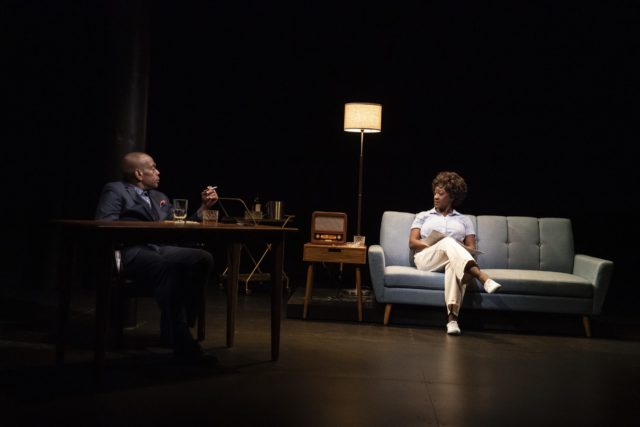
British poet and performer Jade Anouka establishes the parameters of her world premiere one-person show, Heart, from the very beginning, in an explanatory prologue. Standing front and center onstage, she tells the audience at Audible’s Minetta Lane Theatre, “This story was written by a black woman. / But this story has no mention of blackness. / This story is being performed by a black woman. / The fact that she is black / And a woman / Is political enough / And she already takes up much of her life talking about it. / About being black / And how it feels to be a woman. / So this is a just a story / Told by a black woman. / This is not a black story / Or a woman story / This is perhaps a story / For all the misfits, all those who have ever felt ‘other.’”

For the next seventy minutes, through six scenes plus an interlude and an epilogue, Anouka, a self-declared hopeless romantic who was born in London in 1990, shares her deeply intimate tale of her search for who she is, seeking personal and professional success. “I invite you to feel / Feel the rhythms / Of your own heartbeat / As I tell you a story / My story,” she says.

In spoken-word verse that ranges from furious rap to Shakespearean metre, Anouka — who, at the age of only thirty-one, has already appeared in nine works by the Bard, in addition to starring in such British series as Cleaning Up and Turn Up Charlie and portraying witch Ruta Skadi in His Dark Materials — leads us through a failed marriage; being misunderstood by her Bible-thumping Trinidadian mother and Jamaican father; a booze-and-drugs-fueled sexual rampage; using running to escape her issues; and jumping into a surprising new relationship.

Along the way, she offers no apologies for the choices she makes, concentrating on small instances that help define her emotional and psychological journey, like the tender interlocking of fingers. But ever-present is what she calls “the beast,” which she first saw in her husband but now believes is inside her. “I know he’s got a dark side / But sure haven’t we all,” she notes, later admitting, worried about her own mental health, “Precious moments of stillness / Of breath, of noticing / My beast / Realising / My beast.”

Anouka is haunted by thoughts of inadequacy, as a daughter, an actor, and a partner. “Unfortunately / I’m stuck with me / Trying to be / The best version / Of me I can be / But inadequacy / Pulls me inside of me / Can’t see the strengths / Only focus on the bad of me . . . It’s my beast you see / It’s taunting me,” she confesses in a way we can all relate to.

When she falls hard for someone, she attempts to break free of the beast and find joy in a new relationship, opining, “I so wish I was bolder / So wish I was braver / I so wish you could be proud of me / So wish you could love me / So wish you could trust me / So wish you knew just what I do / That I’d shout from the rooftops / And sing from the rafters / I love you I love you I love you! / But I can’t do that / I’m scared to do that.” But this time she’s determined to make things work.

Anouka is no stranger to solo performances. She turned her 2015 poem “Winning,” from her poetry collection Eggs on Toast, into a spirited video and won a Stage Award for Acting Excellence at the 2014 Edinburgh Fringe Festival for Sabrina Mahfouz’s one-person show, Chef. Although the narrative sometimes lapses into the mundane, the staging picks it up, occasionally literally. Heart is gorgeously directed by Ola Ince (The Convert, Poet in da Corner), with a wonderfully transcendent set by Obie winner Arnulfo Maldonado.

Jade Anouka rises high in world premiere one-person show (photo by Trévon James 2022)

Anouka, in a colorful costume by Emily Rebholz, interacts with several rows of fabric hanging from the ceiling alongside narrow, vertical neon bulbs, their hues changing with Anouka’s emotions courtesy of Obie winner Jen Schriever’s majestic lighting. Early on, a swing drops down from above like a gift from heaven, offering Anouka a brief respite of childhood innocence. Later, she climbs atop a tall chair that nearly reaches the rafters, evoking both a lifeguard station and a high chair for infants. The engaging movement choreography is by Annie-Lunnette Deakin-Foster. Tony winner Fitz Patton’s sound design (with original music by Renell Shaw and Patton) serves a key role from the outset, starting with a low drone that murmurs through the theater as the audience enters.

Audible specializes in presenting short runs of one-person shows (with some exceptions, as with the recent truncated, controversial adaptation of Eugene O’Neill’s Long Day’s Journey into Night) that are available as audiobooks. Previous productions include Faith Salie’s Approval Junkie, Lili Taylor in Wallace Shawn’s The Fever, Carey Mulligan in Dennis Kelly’s Girls & Boys, and Billy Crudup in David Cale’s Harry Clarke.

Heart is so dependent on the compelling staging and Anouka’s connection with the theatergoers — she tries to make eye contact with every audience member, never just looking into space — that I can’t imagine simply listening to it through earphones or in the car without those visuals. So get yourselves over to the Minetta Lane to see it in person as soon as you can; your heart will thank you.

[Note: The August 10 performance will be followed by a talkback with Anouka and playwright Dave Harris (Exception to the Rule, Tambo & Bones).]

POOL PARTY: SWIMMING POOL / A BIGGER SPLASH

POOL PARTY
Metrograph
7 Ludlow St. between Canal & Hester Sts.
August 5-14
212-660-0312
metrograph.com
www.focusfeatures.com

With New York City sweltering in a muggy, sweat-drenching summer with temps that have stayed in the nineties, Metrograph offers two things to cool you off that usually don’t go together: air-conditioning and swimming. But that’s just what their new series, “Pool Party,” does, consisting of seven films in which characters go for a dip, for good and for bad.

The series kicks off with François Ozon’s beguiling mystery Swimming Pool, in which Charlotte Rampling shows Ludivine Sagnier that she still has it, followed by Jacques Deray’s 1969 erotic thriller La Piscine, in which Jane Birkin shakes things up between Alain Delon and Romy Schneider. Burt Lancaster swims home through suburban backyard pools in Frank Perry’s 1968 adaptation of John Cheever’s 1964 short story “The Swimmer.” Selena Gomez and friends take a wild road trip in Harmony Korine’s 2012 Spring Breakers, meeting up with a metallic-smiling James Franco. Elsie Fisher finds more trouble than she bargained for as a middle school vlogger in Bo Burnham’s bittersweet debut, Eighth Grade. British artist David Hockney makes a big splash in Jack Hazan’s 1974 hybrid docudrama, A Bigger Splash. And Lucretia Martel traces the fall of a bourgeois family in her 2001 debut, La Ciénaga. Below is a deeper dive into two of the films; get those bathing suits on and jump in to beat the heat!

Jealousy and envy are at the heart of François Ozon’s sexy thriller

Jealousy and envy are at the heart of François Ozon’s sexy thriller

SWIMMING POOL (François Ozon, 2003)
Friday, August 5, 2:45
Sunday, August 7, 12:20
metrograph.com
www.focusfeatures.com

Charlotte Rampling is divine in Swimming Pool, François Ozon’s playfully creepy mystery about a popular British crime novelist taking a break from the big city (London) to recapture her muse at her publisher’s French villa, only to be interrupted by the publisher’s hot-to-trot teenage daughter. Rampling stars as Sarah Morton, a fiftysomething novelist who is jealous of the attention being poured on young writer Terry Long (Sebastian Harcombe) by her longtime publisher, John Bosload (Game of Thrones’s Charles Dance). John sends Sarah off to his elegant country house, where she sets out to complete her next Inspector Dorwell novel in peace and quiet. But the prim and proper — and rather bitter and cynical — Sarah quickly has her working vacation intruded upon by Julie (Ludivine Sagnier), John’s teenage daughter, who likes walking around topless and living life to the fullest, clearly enjoying how Sarah looks at her and judges her. “You’re just a frustrated English writer who writes about dirty things but never does them,” Julie says, and soon Sarah is reevaluating the choices she’s made in her own life. Rampling, who mixes sexuality with a heart-wrenching vulnerability like no other actress (see The Night Porter, The Verdict, and Heading South), more than holds her own as the primpy old maid in the shadow of a young beauty, even tossing in some of nudity to show that she still has it. (Rampling also posed nude in her sixties in a series of photographs by Juergen Teller alongside twentysomething model Raquel Zimmerman, so such “competition” is nothing to her.)

SWIMMING POOL

Julie (Ludivine Sagnier) and Sarah (Charlotte Rampling) come to a kind of understanding in François Ozon’s Swimming Pool

Rampling has really found her groove working with Ozon, having appeared in five of his films, highlighted by a devastating performance in Under the Sand as a wife dealing with the sudden disappearance of her husband. Sagnier, who has also starred in Ozon’s Water Drops on Burning Rocks and 8 Women, is a delight to watch, especially as things turn dark. Swimming Pool is very much about duality; the film opens with a shot of the shimmering Thames river while the title comes onscreen and Philippe Rombi’s score of mystery and danger plays, and later Sarah says, “I absolutely loathe swimming pools,” to which Julie responds, “Pools are boring; there’s no excitement, no feeling of infinity. It’s just a big bathtub.” (“It’s more like a cesspool of living bacteria,” Sarah adds.) Ozon (Time to Leave, Criminal Lovers) explores most of the seven deadly sins as Sarah and Julie get to know each other all too well.

David Hockney

David Hockney works on his masterpiece in Jack Hazan’s A Bigger Splash

A BIGGER SPLASH (Jack Hazan, 1974)
Saturday, August 6, 2:30
Sunday, August 7, 5:00
Saturday, August 13, 7:15
metrograph.com

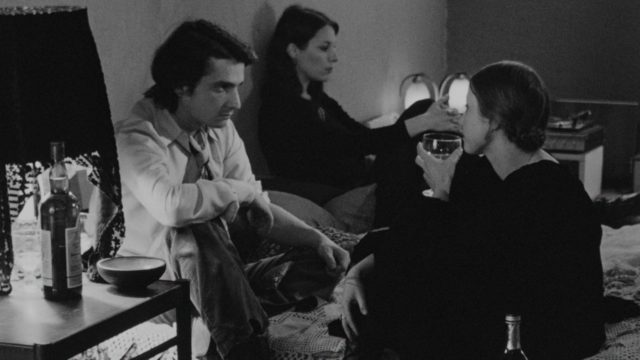
Coinciding with Pride celebrations throughout New York City in honor of the fiftieth anniversary of the Stonewall riots in June 2019, Metrograph premiered a 4K restoration of Jack Hazan’s pivotal 1974 A Bigger Splash, a fiction-nonfiction hybrid that was a breakthrough work for its depiction of gay culture as well as its inside look at the fashionable and chic Los Angeles art scene of the early 1970s. In November 2018, David Hockney’s Portrait of an Artist (Pool with Two Figures) sold at auction for $90.3 million, the most ever paid for a work by a living artist. A Bigger Splash, named after another of Hockney’s paintings — both are part of a series of canvases set around pools in ritzy Los Angeles — takes place over three years, as the British artist, based in California at the time, hangs out with friends, checks out a fashion show, prepares for a gallery exhibition, and works on Portrait of an Artist (Pool with Two Figures) in the wake of a painful breakup with his boyfriend, model, and muse, Peter Schlesinger, who is a key figure in the painting.

It’s often hard to know which scenes are pure documentary and which are staged for the camera as Hazan and his then-parter, David Mingay, who served as director of photography, tag along with Hockney, who rides around in his small, dirty BMW, meeting up with textile designer Celia Birtwell, fashion designer Ossie Clark, curator Henry Geldzahler, gallerist John Kasmin, artist Patrick Procktor, and others, who are identified only at the beginning, in black-and-white sketches during the opening credits. The film features copious amounts of male nudity, including a long sex scene between two men, a group of beautiful boys diving into a pool in a fantasy sequence, and Hockney disrobing and taking a shower. Hockney’s assistant, Mo McDermott, contributes occasional voice-overs; he also poses as the man standing on the deck in Portrait of an Artist (Pool with Two Figures), only to be replaced by Schlesinger later. There are several surreal moments involving Hockney’s work: He cuts up one painting; Geldzahler gazes long and hard at himself in the double portrait of him and Christopher Scott; and Hockney tries to light the cigarette Procktor is holding in a painting as Procktor watches, cigarette in hand, mimicking his pose on canvas. At one point Hockney is photographing Schlesinger in Kensington Gardens, reminiscent of Michelangelo Antonioni’s Blow-Up, which questions the very nature of capturing reality on film.

Hockney was so upset when he first saw A Bigger Splash, which Hazan made for about twenty thousand dollars, that he offered to buy it back from Hazan in order to destroy it; Hazan refused, and Hockney went into a deep depression. His friends ultimately convinced him that it was a worthwhile movie and he eventually accepted it. It’s a one-of-a-kind film, a wild journey that goes far beyond the creative process as an artist makes his masterpiece. Hockney, who turned eighty-five last month, has been on quite a roll of late. He was the subject of a 2016 documentary by Randall Wright, was widely hailed for his 2018 Met retrospective, and had a major drawing show at the Morgan Library in 2020-21. In addition, Catherine Cusset’s novel, Life of David Hockney, was published in English in 2019, a fictionalized tale that conceptually recalls A Bigger Splash.