twi-ny recommended events

NOTHING COMPARES

Sinéad O’Connor explores her past and her legacy in Nothing Compares documentary

NOTHING COMPARES (Kathryn Ferguson, 2022)
Cinema Village
22 East 12th St. between University Pl. & Fifth Ave.
Opens Friday, September 23
212-529-6799
www.cinemavillage.com
www.sho.com/nothing-compares

On October 16, 1992, I was at Madison Square Garden for the Bobfest, an all-star concert celebrating the thirtieth anniversary of Bob Dylan’s first album for Columbia Records. The lineup included Johnny and June Carter Cash, Lou Reed, Willie Nelson, Tracy Chapman, Kris Kristofferson, Tom Petty and the Heartbreakers, Chrissie Hynde, Neil Young, George Harrison, and many others. But the thing that most people remember about the one-of-a-kind concert — especially those of us who were there — was the reaction when the one-of-a-kind Sinéad O’Connor took the stage.

Two weeks earlier, the twenty-five-year-old Irish activist singer-songwriter had torn up a photograph of Pope John Paul II on Saturday Night Live after performing a haunting solo version of Bob Marley’s “War,” a political song whose lyrics come from a 1963 speech by Ethiopian emperor Haile Selassie. At MSG, O’Connor was met with an eerie mix of joyous applause and a building, ominous booing. She stood frozen for a moment, then Kristofferson came out and famously told her, “Don’t let the bastards get you down.” Instead of playing Dylan’s “I Believe in You,” O’Connor reprised “War,” then exited.

I remember being so upset at how she was treated that I wrote my first and only letter to the editor, which was printed in the Daily News, defending her actions. I quickly received several anti-Semitic phone calls from anonymous “bastards.”

O’Connor’s appearance at the Bobfest serves as the frame for the new Showtime documentary Nothing Compares, opening September 23 at Cinema Village before streaming on the cable channel beginning September 30. The film is appropriately unusual and bends genre traditions, in homage to its iconoclastic subject. Director Kathryn Ferguson focuses on O’Connor’s life and career up to 1993, eschewing all that came after, from more albums and tours to an autobiography and her conversion to Islam. We hear a lot from her first husband, record producer John Reynolds, and about their son, Jake, but no mention is made of her subsequent three marriages and three more children.

O’Connor honestly and unabashedly shares critical insight on pivotal events that influenced who she was and what she became, but her contemporary self is mostly not seen, only heard. It’s not until the very end that we get to see her in the present day, with her band, perform an old song specially chosen for the film. In addition, all the other interviewees, from her music teacher and longtime friend to directors, journalists, and fellow musicians, are also heard but not seen on camera. This is a film about Sinead 1.0.

Sinéad O’Connor belts out an early song in the archival-heavy Nothing Compares

Ferguson (Taking the Waters, Space to Be), who will be at Cinema Village for a Q&A following the 5:00 screening on September 23, keeps the Dublin born and raised O’Connor front and center, in a barrage of archival news clips, family photographs, behind-the-scenes recording footage, staged re-creations, and more (courtesy editor Mick Mahon), as O’Connor delves into the horrible abuse she experienced at the hands of her mother (which was ignored by her father), the poor education she received from nuns, her refusal to get an abortion despite demands from her record company, her condemnation of the church because it was turning its back on pedophilia, her support for mental health programs, her insistence the national anthem not be played before a New Jersey gig, and her boycotting of awards shows because of misogyny and racism in the music industry and society at large.

“There was no therapy when I was growing up. So the reason I got into music was therapy,” she tells Ferguson, who previously directed music videos for O’Connor. “Which is why it was such a shock to become a pop star; it’s not what I wanted. I just wanted to scream.”

The film explores her swift rise from her debut album, 1987’s The Lion and the Cobra, to 1990’s I Do Not Want What I Haven’t Got and 1992’s Am I Not Your Girl?, with detailed looks at such songs as “Troy” (a testament that was her first song truly about herself), “Mandinka,” and “Black Boys on Mopeds.” (The Prince estate did not give Ferguson permission to use “Nothing Compares 2 U” in the film, so we only see the video without hearing the music.) Stardom was not easy for her, but she became an international icon fighting the power, particularly for young girls and women, well ahead of her time. “The powers that be weren’t ready for her,” Chuck D says. Kathleen Hanna was influenced by watching O’Connor’s “feminist performance art” on television — the controversial SNL appearance.

O’Connor resisted being stereotyped or talked down to because she was an attractive woman with a shaved head who liked to dress provocatively, and both her attitude and her looks rattled well-known talk-show hosts thirty years ago.

“I just knew that I didn’t want any man telling me who I could be or what I could be or what to sound like,” she declares. “I came from a patriarchal country where I’m being told everything I can and can’t do because I’m a girl. I figured, well, if I didn’t take it from the system, and I didn’t take it from my daddy, I ain’t taking it from anybody else.”

O’Connor’s voice today is deep and mature, not immediately recognizable. She makes no apologies for the choices she made, and she remains firm in her beliefs in fighting social injustice. Her legacy shines through, even given the difficult times, which continue. She offers a compelling, profoundly personal explanation about why she ripped up the photograph of the pope and shares her thoughts on how she came to be regarded as a powerful, influential public figure.

“I didn’t mean to be strong. I wasn’t thinking to myself, I must be strong. I didn’t know I was strong,” she says. “I did suffer through a lot because everybody felt it was okay to kick the shit out of me. I regret that I was so sad because of it. I regret that, that I spent so many years very isolated and lonely, really.”

The song she was scheduled to sing at the Bobfest, “I Believe in You” from 1978’s Slow Train Coming, contains the following stanza: “They show me to the door / They say don’t come back no more / ’Cause I don’t be like they’d like me to / And I walk out on my own / A thousand miles from home / But I don’t feel alone / ’Cause I believe in you.” After all these years, O’Connor is still doing things her own way, not about to be shown to the door by anyone.

BOOK LAUNCH FOR EL ANATSUI: THE REINVENTION OF SCULPTURE

Who: El Anatsui, Chika Okeke-Agulu, Jason Farago, Massimiliano Gioni, Julian Lucas
What: Book launch
Where: New Museum Theater, 235 Bowery
When: Thursday, September 22, $10, 6:30
Why: “The fact that El Anatsui normally expects curators and collectors of his metal sculpture to decide how to install them, but also because they are hand-wrought, flexible things, with numerous parts that can behave in infinite ways when moved, how they are installed determines their composition, affect, and phenomenological presence. Having conceived the work, and invested so much labor along with his many studio assistants to realize it in initial sculptural form, ceding its inaugural and future manifestations to whoever has custody of the work, is an extraordinary power to invest in others, without any instruction or even suggestion of his own authorial intentionality.” So write Okwui Enwezor and Chika Okeke-Agulu in their new book, El Anatsui: The Reinvention of Sculpture (Damiani, $70), about Ghanaian sculptor El Anatsui, who uses discarded items (primarily bottlecaps) in creating large-scale pieces that comment on the relationship between humans and the environment. The works are malleable, able to be displayed in various configurations that El Anatsui leaves up to whoever is showing the piece.

On September 22 at 6:30, the seventy-eight-year-old El Anatsui (“Gravity and Grace: Monumental Works by El Anatsui”), who works in Ghana and Nigeria, will be at the New Museum for the official US launch of the book, highlighted by a panel discussion with Princeton-based artist, critic, and art historian Okeke-Agulu, art critic Jason Farago, and Brooklyn-based critic and essayist Julian Lucas, moderated by New Museum director Massimiliano Gioni. Okeke-Agulu wrote the book, which features such chapters as “El Anatsui and Modern African Art,” “The Aesthetic and Rhetoric of Fragmentation,” and “The Epic and Triumphant Scale,” with beloved Nigerian curator and critic Enwezor, who passed away in 2019 at the age of fifty-five and whose spirit will be felt throughout the evening.

OUR MAN IN SANTIAGO

Maria Troncoso (Presciliana Esparolini) comes between CIA agents Jack Wilson (George Tovar) and Daniel Baker (Nick McDow Musleh) in Our Man in Santiago (photo by Charlie Mount)

OUR MAN IN SANTIAGO
ATM Theater
354 West Forty-Fifth St. between Eighth & Ninth Aves.
Wednesday – Sunday through October 28, $49-$79
ourmaninsantiago.com

Making its New York City debut through October 28 at ATM Theater, two-time Emmy nominee Mark Wilding’s Our Man in Santiago is a good-natured spy thriller spoof of the US government’s possible involvement in the death of Chilean president Salvador Allende on September 11, 1973, but it ends up missing its target.

The play is framed by testimony by CIA agent Daniel Baker (Nick McDow Musleh) to the Senate Select Committee on Intelligence, one year after Allende’s short tenue came to an end. He takes Sen. Harry Rubin back to that fateful day, as the inexperienced Baker and his boss, Jack Wilson (George Tovar), plot to assassinate the democratically elected Allende, who had been president since November 3, 1970. The eager Baker and the self-satisfied Wilson are staying in a room with a balcony at the Carrera Hotel in the Chilean capital of Santiago, across the street from the president’s Moneda Palace. (The effective set is by Jeff G. Rack.) There’s marching in the street as a violent coup is expected at any moment. Baker, a functionary who was previously stationed in New Zealand, has not exactly trained to be an assassin; he fumbles when trying to load his gun, the bullets falling to the floor, a scene witnessed by the maid, Maria Troncoso (Presciliana Esparolini), who had walked into the room but, seeing the gun, backed out.

“How many times . . . You don’t drop bullets, Baker,” he says to himself. “Bullets can’t help you when they’re outside the gun. They need to be inside the gun. Doesn’t matter how fast you pick them up. You’re already dead. The enemy has shot you.”

Maria knocks and then enters despite Baker telling her not to. She shares details of the widespread poverty in Santiago as they try to find a better time for her to come clean the room. “Five is good. I will miss my only meal of the day but it is worth it for you to have a new bar of soap,” she says snidely in broken English. When Wilson shows up, he treats Maria with disdain, ordering her to get out; he then warns Baker that anyone could be a foreign operative and that he should trust no one. The young agent has no idea how true that will soon be.

President Richard Nixon (Steve Nevil) and Secretary of State Henry Kissinger (Michael Van Duzer) supply comic relief in spy thriller spoof (photo by Charlie Mount)

Wilson sees himself on a path to become the next deputy director of the CIA, a carrot dangled by President Richard Nixon (Steve Nevil) and his loyal secretary of state, Henry Kissinger (Michael Van Duzer), who appear as a back wall slides open to reveal them on the phone at the White House. “Number two man at the agency. That’s a pretty good promotion, wouldn’t you say?” Nixon tells Wilson, who is not about to let Baker ruin this opportunity for him.

Soon Baker, armed with a gun, a press pass, and a camera — for proof that he carried out his mission — heads across the street to kill Allende as the coup gets underway.

Baker has a handgun, but in order for the play to work, director Charlie Mount needs the action and dialogue to be like a rapid-fire machine gun; unfortunately, the pacing is too slow, especially when things get hectic. Mount and Wilding, who has produced and/or written for such television shows as Grey’s Anatomy, Scandal, Good Girls, Charmed, and Promised Land, should have injected far more fast slapstick. There were numerous moments when I wanted to be rolling around the floor laughing but instead let out a mere chuckle. The setup is fine, slowly revealing several fun plot twists, but ultimately there are just too many holes in the story, more sitcom than play.

Individually, Musleh is sweetly nervous as the beleaguered Baker, Esparolini is bewitching as the complicated Maria, and Tovar is cool and collected as the calm but not so honorable Wilson, but they don’t light sparks together enough. Nevil and Van Duzer are there to supply comic relief as Kissinger and Nixon, respectively, but they go too far over the top. Wilding, who was inspired to write Our Man in Santiago by the 1974 Harper’s article “The Death of Salvador Allende” by Gabriela García Márquez, about a botched 1970 CIA attempt to oust Allende — the title of the play itself recalls the late-1950s Graham Greene novel and Carol Reed film Our Man in Havana — does cleverly lampoon crass commercialism, US imperialism, and dirty politics. It all makes for a pleasant but underwhelming experience that falls short of what it could have been.

NEW YORK PUBLIC RADIO LIVE: CELEBRATING 40 YEARS OF NEW SOUNDS WITH JOHN SCHAEFER

Who: John Schaefer, Red Baraat, Combo Chimbita, Ira Kaplan, Georgia Hubley
What: Celebrating forty years of New Sounds
Where: Brooklyn Bowl, 61 Wythe Ave.
When: Wednesday, September 21, $51.90 – $1046.71, 7:30
Why: Queens-born Fordham grad John Schaefer began his New Sounds program on NPR in September 1982, introducing listeners to a wide range of musicians from around the world. The fortieth anniversary of the show will be celebrated on September 21 at Brooklyn Bowl as New York Public Radio’s annual fundraiser. The evening will include live performances by Red Baraat and Combo Chimbita, two groups that were recently featured on the program, which proclaims, “Hand-picked music, genre free. 24/7 radio from New York City.” There will also be a DJ set by Ira Kaplan and Georgia Hubley from Yo La Tengo. In a January 2011 twi-ny talk, Schaefer, when discussing how the internet has impacted his relationship with his audience, explained, “Now, if you don’t want to stay up till midnight, you can still hear New Sounds — and hear it anytime you like. And even after all these years, I feel like the digital communication with our listeners is still growing up, unsure of what it’s eventually going to be.” Now you can be part of the fortieth anniversary of New Sounds, in person at Brooklyn Bowl, where various NYPR on-air talent will be hanging out to mingle with.

BURN

Alan Cumming brings his debut solo dance-theater piece, Burn, to the Joyce this week (photo by Jane Blarlow/PA Wire)

Who: Alan Cumming
What: North American premiere of solo dance-theater piece
Where: The Joyce Theater, 175 Eighth Ave. at Nineteenth St.
When: September 21-25, $76-$106
Why: “You must not deny me!” Alan Cumming declares in his portrayal of eighteenth-century Scottish poet Robert Burns in Burn, making its North American premiere at the Joyce this week. The solo dance-theater work was created by Olivier- and Tony-winning actor Cumming with Olivier- and Obie-winning choreographer Steven Hoggett, who choreographed the piece with Vicki Manderson, and is set to the music of British composer Anna Meredith, including such songs as “Solstice In,” “HandsFree,” “Blackfriars,” “Descent,” and “Return.” The set design is by Ana Inés Jabares Pitz, with costumes by Katrina Lindsay, lighting by Tim Lutkin, projections by Andrzej Goulding, and sound by Matt Padden.

In a program note, Cumming — who has appeared on Broadway in Cabaret and a one-man reinterpretation of Macbeth and off Broadway in “Daddy” and has lent his voice to such films as They’ll Love Me When I’m Dead and numerous animated children’s films (while spectacularly lending his body to the hybrid documentary My Old School) — explains, “In 2015, I has just turned fifty and realised I would never be as fit or asked to dance in a show in the same way again. But I still felt I had one more in me! I meant a play or a musical that was dance heavy. Little did I think I would end up making my solo dance theater debut at fifty-seven!” Together, Cumming and Hoggett (Black Watch, Once, Harry Potter and the Cursed Child) point out, “An early intention was to explore the idea of Burns as national icon and a figure who, under modern scrutiny, was becoming something more complex than the beloved face on tourists’ souvenir biscuit tins.” There will be a curtain chat with members of the creative team following the September 21 performance. Some shows are already sold out, so get your tickets now if you want to experience what should be an exhilarating evening of dance, theater, music, and poetry.

SHADOW OF THE SEA

Who: Beau Bree Rhee, Caitlin Scranton, Bria Bacon, Cara McManus, Chaery Moon
What: Free live performances
Where: Madison Square Park
When: Wednesday, September 21, Wednesday, October 12, Thursday, October 20, free, 6:00
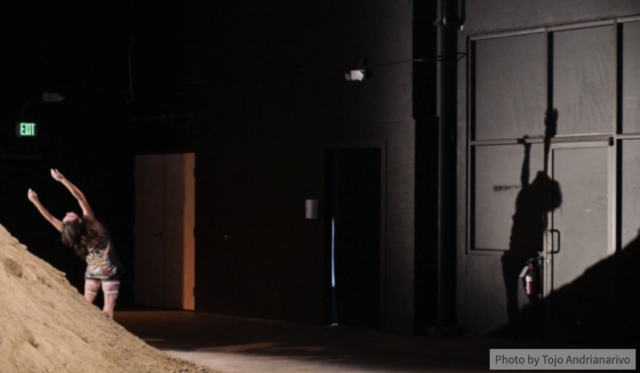
Why: Madison Square Park Conservancy has teamed up with the Kitchen to present three live, site-specific performances by choreographer Beau Bree Rhee activating Cristina Iglesias’s Landscape and Memory installation, which is on view through December 4. Iglesias’s captivating public intervention consists of a stream that winds through the grass in five bronze sculptural pools, referencing Cedar Creek and Minetta Brook, which once upon a time flowed across the park, heading for the East or Hudson River. Each pool offers its own calming respite, with water gently babbling against rocks. The work morphs slowly over time, first as the grass grows wildly over and around it during the summer, while the coming fall will change it yet again.

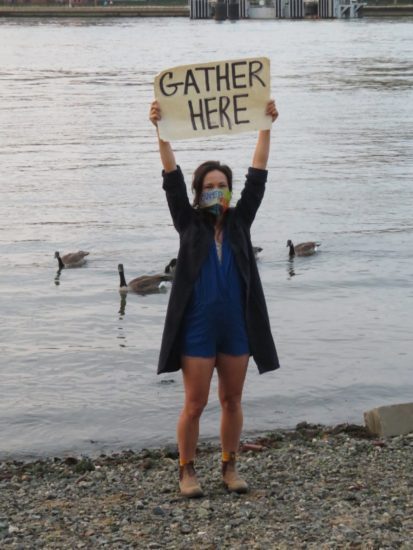
Bree’s eight-stanza dance poem, Shadow of the Sea, begins with thirty-minute coastal-walk preludes, referred to by Bree as a Brutal Meditation, at 5:00 at the East River Promenade at East Tenth St. and Pier 64 in Hudson River Park (attendance free with RSVP), with two migratory processions marching toward the Oval Lawn in Madison Square Park, where Caitlin Scranton, Bria Bacon, Cara McManus, and Chaery Moon will perform at 6:00 on September 21 and October 12 and 20. Bree has previously incorporated nature into such pieces as Les Parages, Figure Void to Lithic Landscapes, and the ongoing Dream Garden in the Anthropocene, so this work should be a natural for her.

ANDREA MILLER AND GALLIM: WHY DO WE DANCE?

GALLIM founding artistic director and choreographer Andrea Miller will be at the National Arts Club on September 20 (photo by Franziska-Strauss / First Republic Bank)

Who: Andrea Miller and dancers
What: Actions and Detail panel discussion
Where: The National Arts Club, 15 Gramercy Park South
When: Tuesday, September 20, free with advance RSVP, 7:00
Why: On September 20 at 7:00, GALLIM founding artistic director and choreographer Andrea Miller will be at the National Arts Club to discuss her company’s approach to dance upon its fifteenth anniversary. Since 2007, the New York City–based company has presented such works as Fold Here, I Can See Myself, Wonderland, Blush, and To Create a World. Miller, a Juilliard graduate, stayed busy during the pandemic lockdown, presenting the site-specific You Are Here outside at Lincoln Center in July 2021, directing Another Dance Film starring Sara Mearns at the East River Park Amphitheater, and continuing to host the livestreamed Gallim Happy Hour featuring such guests as Ayodele Casel, Francesca Harper, Justin Peck, Mimi Lien, Camille A. Brown, Gina Gibney, Wendy Whelan, Alicia Graf Mack, and Kyle Abraham. At the NAC, Miller and some of her dancers will answer the question “Why Do We Dance?,” delving into her philosophy of creation and performance.