Who: Steve Martin, Harry Bliss, Nathan Lane What: Book launch Where:The Town Hall, 123 West Forty-Third St. between Sixth & Seventh Aves. When: Tuesday, November 15, $68, 8:00 Why: Multihyphenate Steve Martin has made films and records and written plays, movie scripts, novels, children’s books, and tongue-in-cheek self-help tomes. He has now entered the graphic novel field with Number One Is Walking: My Life in the Movies and Other Diversions (Celadon, November 15, $30), with the help of black-and-white illustrations by cartoonist Harry Bliss. A follow-up to their 2020 cartoon collection A Wealth of Pigeons, the new book features scenes in which Martin looks back at his career for the first time in print. The title comes from a Hollywood trope; in one panel, Martin explains, “On a movie call sheet, the actors are listed numerically. The lead is number one, the second lead is number two, etc. I was slightly embarrassed on my first film, The Jerk, when I would head toward the set and the assistant director would trail me, transmitting into his walkie talkie . . . ‘Number one is walking.’” Martin points out that he was also “number one” on Bowfinger,Cheaper by the Dozen, and Bringing Down the House, but when he did Nancy Meyers’s It’s Complicated with Meryl Streep and Alec Baldwin, each time he came on set he was horrified to hear: “Number three is walking.”
Longtime New Yorker cartoonist Bliss has illustrated such books as Joanna Cotler’s Sorry (Really Sorry), Doreen Cronin’s Diary of a Worm, and Alison McGhee’s Countdown to Kindergarten as well as writing and illustrating Bailey and Luke on the Loose. On November 15 at 8:00, Martin and Bliss will be at the Town Hall to discuss their collaboration; serving as moderator will be the one and only Nathan Lane, who appears with Martin in Only Murders in the Building. All audience members will receive a signed copy of Number One Is Walking: My Life in the Movies and Other Diversions, courtesy of the Strand.
ALBERT CAMUS’ THE FALL
The Huron Club at SoHo Playhouse
15 Vandam St. between Varick St. & Sixth Ave.
Wednesday – Saturday through November 19, $51, 7:30 www.sohoplayhouse.com/the-fall www.highbrow.net
Theater is all about the connection between audience and performer. During the pandemic lockdown, I watched hundreds of livestreamed or prerecorded shows, but being at home in front of your computer by yourself is not the same as sitting in a dark venue with other people as a story unfolds in front of you, told by live actors.
Among the memorable virtual plays I watched was Albert Camus’ The Fall, Alexis Lloyd’s adaptation of Camus’ final novel, known in French as La Chute. The book was published in 1956; Nobel Prize winner Camus, who also wrote A Happy Death,The Stranger, and The Plague, would die four years later in a car accident at the age of forty-six. The one-man show starred Belgian-born actor Ronald Guttman onstage in FIAF’s Tinker Auditorium on October 1, 2020, with an audience of twenty-five.
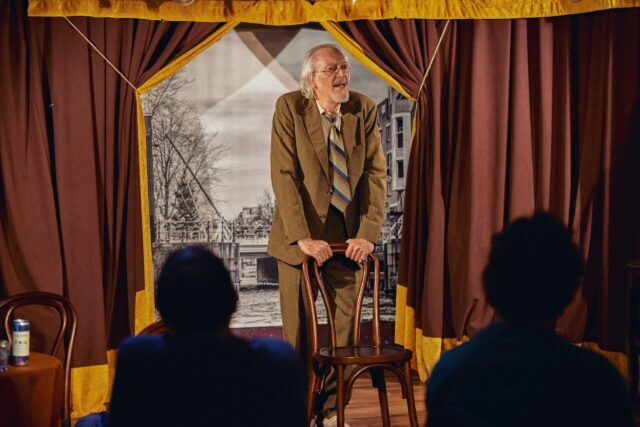
Guttman has been presenting various iterations of The Fall, which he first read when he was seventeen, for more than two decades; the latest version, directed by Didier Flamand, takes place in the Huron Club at SoHo Playhouse, a downstairs bar with a small stage. The audience is seated at round tables, several of which are only a few feet from the stage; there is also a row of barstools. The walls are plastered with images of women, in framed pictures and pages from magazines, along with a few travel posters; the stage features a backdrop of an Amsterdam canal. Guttman, wearing an old brown suit, his long white hair nearly reaching his shoulders, enters from the rear of the room, instantly making eye contact with just about everyone. It’s an exciting moment that can’t be experienced virtually. He walks onstage and then scans the crowd again, deciding which member of the audience will serve as a stand-in for the man his character addresses directly in the book, which is essentially a public confession by Parisian ex-pat former lawyer Jean-Baptiste Clamence, delivered to an unidentified person in a seedy dive bar in Amsterdam’s red light district.
The night I went, he selected me.
“Pleased to make your acquaintance. You’re probably . . . a businessman? Kind of a businessman? We all tend to be kind of, in almost everything,” he says to me at the start, carefully looking me over. “Let me guess, if you don’t mind. You’re in your fifties, you’ve been around, kind of . . . Your hands are clean, and you’re well dressed, kind of. You’re upper-middle class, but . . . sophisticated upper-middle class. And you find me amusing, which means you’re open minded. Kind of.” He didn’t do too bad, although I was wearing a jeans jacket and a black mask. (Masks are optional.) I would nod, shake my head, or laugh in response, confident the best thing was to say nothing.
He then turns to the rest of the audience and explains, “As for me, well, I’ll let you be the judge of that. In spite of my good manners, and my way with words, I am a regular of these sailors dives, here in Amsterdam. There’s only one thing simple about me: I don’t own anything. I used to, I used to be wealthy, back in Paris.”
Looking at me once again, he adds, “Which makes us compatriots, I imagine?”
It’s a fabulous opening to this immersive experience, in which Clamence shares aspects of his private and professional life as he walks around the space, gets drinks from the bartender — who spends the sixty-minute show reading a copy of Playboy — and stops by each table to make sure everyone is involved in his tale. He moves and speaks with an eloquent, elegant poetry as he explores the nature of truth and humanity’s innocence, and its guilt. “I look trustworthy, don’t you think?” he asks. “If thieves were always condemned, honest people would always feel innocent, and that would be a disaster.”
He talks about his success with women, about his insufficiencies, about shame. “Think for a moment about your own life, search your own memories, maybe you’ll find something of that kind,” he says. “Something you’ll tell me later, one day.”
The centerpiece is a rainy November night when Clamence — a play on the word clemence, which means “forgiveness” — passes a woman on a bridge, then hears a loud splash in the river below, along with several screams, followed by silence. “I wanted to run to her, but I didn’t move,” he admits. He walks away, convincing himself there was nothing he could do. It’s a poignant parable for the choices we all have to make every day. Camus is forcing us to put ourselves under the microscope, facing what we’ve done, what we haven’t done, and whether there’s still time to confess and change, how to avoid being judged but still be punished.
“You can never really prove anybody’s innocence, but you can be sure we’re all guilty,” he says. “Every man bears witness to the crimes of all the others, such is my faith, such is my only hope.”
Guttman (Bauer,Patriots) is mesmerizing as Clamence; he embodies the character from the moment he enters the Huron Club. We are not so much watching a one-man show as listening to a stranger telling us about his life and how we can learn from his story as we, perhaps, become friends.
“I don’t have any friends anyway, not anymore. I only have accomplices. But I have a lot of them; they are the whole of mankind,” he tells everyone. He then looked right at me and said, “And within mankind, you. You’re the first of my accomplices. The one who is there is always the first accomplice.”
Shlomi Elkabetz documents the making of Gett: The Trial of Viviane Amsalem with his sister, Ronit
BLACK NOTEBOOKS: RONIT (CAHIERS NOIRS: RONIT) (Shlomi Elkabetz, 2021)
New Plaza Cinema @Macaulay Honors College
35 West Sixty-Seventh St. between Central Park West & Columbus Ave.
Opens Friday, November 11 panoramafilmsus.com newplazacinema.org
About halfway through his award-winning documentary Black Notebooks: Ronit, director Shlomi Elkabetz says in a gentle voice-over, “And so it happened. And I just observe. The parting and final conversations, and last words, if there were any, passed us by, like in a film, above and beneath life, and silence in life is the same as the silence of death.”
Shlomi is talking about his relationship with his sister, Israeli film star Ronit Elkabetz, who can be heard saying, “It’s over.” Shlomi, pensively looking out a window, turns to face the camera and continues, “And the same silences are still there. You and I still speak.” Shlomi then switches to a close-up of Ronit as he concludes, “And we never parted.” He next cuts back and forth between his and his sister’s faces before he gets up and walks away, then shows Ronit sitting by herself at a table with an empty chair.
The companion piece to Black Notebooks: Viviane,Black Notebooks: Ronit is a powerful and often uncomfortably intimate behind-the-scenes story about the making and marketing of the 2014 film Gett: The Trial of Viviane Amsalem, the final work of a trilogy that began with To Take a Wife and Shiva. The three films were cowritten and codirected by the siblings and star Ronit (Late Marriage,The Band’s Visit) as the unhappily married Viviane Amsalem. In Gett, Viviane has filed for divorce in a religious court, the three-man beit din, seeking to obtain a gett, which will grant her freedom from her husband (Simon Abkarian), who refuses to let her go.
Fighting the lung cancer that will eventually kill her in 2016 at the age of fifty-one, Ronit is having difficulty with the movie. She forgets her lines and prefers to spend time with her two young children rather than do yet another take of a scene. “I can’t stand being so exposed anymore,” she tells her brother, explaining that she has lost her desire to act. But Shlomi is determined to finish the film, helping Ronit do the work any way he can, bringing family to visit the set, feeding her dialogue, and giving her extra time between shots. Her costar Menashe Noy, who plays her advocate, Carmel Ben-Tovim, watches her closely, not always sure what to do.
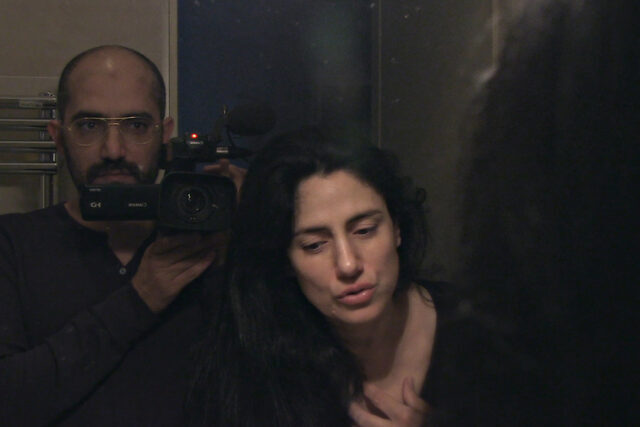
At one point, on the media tour supporting Gett, Ronit is standing in front of a mirror as Shlomi, visible in the reflection, films her with a small handheld camera. “Why not give an interview? Am I afraid? Yes, I’m afraid,” she says. “And I don’t want my fear to run my life. I don’t want that to happen; right away I say to myself: Okay, I don’t want to cooperate with fear.” Through it all, Shlomi holds the camera at chest level as he gazes at his sister, neither looking through the lens nor worrying about the angle. Duality, mirroring, and life versus the depiction of life are the inescapable themes.
“We’ll do the most amazing things, despite and because of the limitations!” Ronit tells her brother, although it’s clear that it won’t be easy. As Ronit becomes sicker, Shlomi grows more poetic, but neither will give up the fight.
Directed by Shlomi and cowritten with frequent collaborator Joelle Alexis, Black Notebooks: Ronit does a beautiful job of paralleling Viviane’s battle to obtain a gett with Ronit’s real-life struggle against cancer. When one of the beit din judges says to her, “Accept your fate. There’s nothing more I can do,” Ronit, as Viviane, shakes her head and covers her face with her hands, a reaction that could be Ronit being given a fatal diagnosis. The audience roots for both women, fictional and real; one melds into the other, lending a hybrid nature to the storytelling.
When Shlomi speaks of casting Noy, he points out, “Here, Menashe plays Carmel Ben-Tovim, who tries to save Viviane. And what I see is myself fighting alongside you. And now, when I look at the two of you” — Shlomi cuts to a shot of Noy looking over at a solemn yet steadfast Viviane — “I see me and you. But when I try to plead for you . . . It’s too much for me.” It’s almost too much for us as well, especially with the sweeping melodramatic score, featuring original music by Dikla and Yiftach Shahaf in addition to the Israel Symphony Orchestra performing Bernard Herrmann’s “Vertigo: Suite,” from the Alfred Hitchcock film in which Kim Novak plays two different women whom Jimmy Stewart’s character tries to make the same.
Winner of the Israeli Ophir Award for Best Documentary, Black Notebooks: Ronit opens November 11 at New Plaza Cinema, with Shlomi Elkabetz participating in Q&As on November 11 at the 7:45 show with American actor John Turturro (Miller’s Crossing,Barton Fink), on November 12 at the 7:30 screening with American novelist Nicole Krauss (Forest Dark,The History of Love), and on November 13 at the 4:30 show with Israeli actress Mili Avital (Dead Man,Prisoners of War).
Who: Edisa Weeks, Taína Asili, Spirit McIntyre, Martha Redbone, Noni Byrd-Gibbs, Steven Jeltsch, Johnnie Cruise Mercer, Devin Oshiro, Brittany Stewart, Marýa Wethers What:Action Songs/Protest Dances Where:Kupferberg Center for the Arts, 153-49 Reeves Ave., Flushing When: Saturday, November 12, 8:00, and Sunday, November 13, 3:00, $20 Why: Given the state of the nation, particularly following the midterm elections, it is a time for action and protest. On November 12 and 13, Queens College will be hosting the timely program “Action Songs/Protest Dances,” featuring an impressive lineup of musicians and dancers. The event was conceived by director and choreographer Edisa Weeks in honor of civil rights activist James Forman (1928-2005), who wrote such books as The Making of Black Revolutionaries,Self Determination: An Examination of the Question and Its Application to the African American People, and High Tide of Black Resistance and Other Political & Literary Writings.
“I started teaching at Queens College in 2010, which is also when the QC Rosenthal Library Civil Rights Archives acquired James Forman’s personal papers,” Weeks said in a statement. “I was incredibly excited as Forman was the first person I heard criticize capitalism as an exploitive economic system. I was a kid at the time, and remember feeling shocked, as I grew up playing Monopoly and believing that capitalism was good and the ‘American Way.’ Since 2010 I’ve been wondering how I can lift up James Forman’s voice, work, advocacy, and sacrifices during the civil rights movement in the 1960s. Then in 2020 the pandemic happened, followed by the murder of George Floyd and Brianna Taylor. I began wondering how as a choreographer I can engage with the protests that were happening across the nation and help address injustices in America. The Kupferberg Center for the Arts Incubator Project provided the opportunity to create ‘Action Songs/Protest Dances,’ which celebrates the life and words of James Forman, and through music and dance advocates for America to be a truly great nation.”
The event features original songs by Taina Asili, Spirit McIntyre, and Martha Redbone, with dancers Noni Byrd-Gibbs, Steven Jeltsch, Johnnie Cruise Mercer, Devin Oshiro, Brittany Stewart, and Marýa Wethers. Each show will be followed by a discussion with the composers and performers, moderated by Miles Grier on November 12 and Natanya Duncan on November 13.
Neil Greenberg will present the world premiere of Betsy this week at La MaMa (photo by Frank Mullaney)
Who:Neil Greenberg, Paul Hamilton, Opal Ingle, Owen Prum What:World premiere dance Where:La MaMa’s Downstairs Theater, 66 East Fourth St. between Second & Third Aves. When: November 12-14, 17-20, $10-$30 Why: “Betsy makes use of projected written text that situates the dance within a two-pandemic landscape of COVID and AIDS, and within the also-ongoing crisis of racism and white supremacy,” dancer and choreographer Neil Greenberg explains on the Kickstarter page for his latest piece, premiering November 12-14 and 17-20 at LaMaMa. “I’m working to expose the cultural rootedness of any performance material in the conditions of its production. The use of text simultaneously gestures toward the kind of meaning-making encouraged by language while also intervening to allow for other perceptual possibilities.” The work features Greenberg, Paul Hamilton, Opal Ingle, and Owen Prum, with an original score by James Lo and Zeena Parkins and lighting by Michael Stiller. A former member of Merce Cunningham Dance Company and dance curator at the Kitchen and currently on the dance faculty at the New School, Greenberg made his La MaMa debut in 1987 with MacGuffin, or How Meanings Get Lost.
“Betsy will engage with the phenomenon of performance itself, in a play with the multiple relational possibilities between performers and spectators, and between a work and its spectators,” Greenberg (Partial View,This) continues. “Betsy will be presented with audience surrounding the performance arena, each viewer necessarily experiencing the performance materials differently due to their distinct vantage point, enabling spectators to watch the dance, themselves, and each other as they watch the dance together.”
Tobias (Manu Narayan), Claire (Carmen M. Herlihy), and Agnes (Mia Katigbak) are stuck with Harry (Paul Juhn) and Edna (Rita Wolf) in Albee revival (photo by Carol Rosegg)
EDWARD ALBEE’S A DELICATE BALANCE
Connelly Theater
220 East Fourth St. between Aves. A & B
Thursday – Sunday through November 19, $35-$75 transportgroup.org
When I let a friend know that I was going to see the first-ever off-Broadway production of Edward Albee’s 1966 Pulitzer Prize–winning A Delicate Balance, he responded that he felt he didn’t need to see it because Pam MacKinnon’s 2015 2015 Broadway revival, starring John Lithgow, Glenn Close, Lindsay Duncan, Martha Plimpton, Bob Balaban, and Clare Higgins, was “perfection.” That’s a shame, because this new adaptation, a collaboration between Transport Group and the National Asian American Theatre Company (NAATCO), continuing through November 19 at the Connelly Theater, is definitely worth a visit.
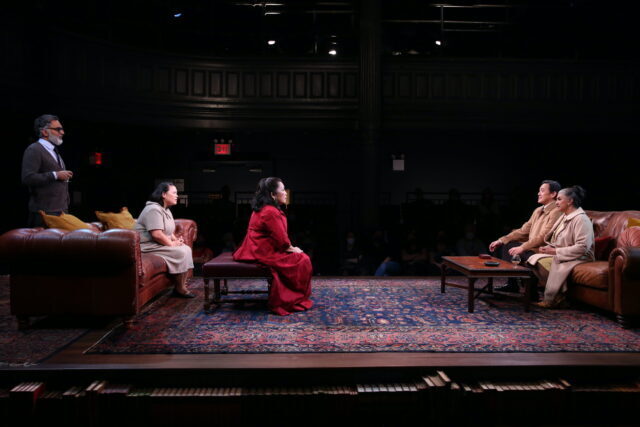
Directed by Jack Cummings III, the three-act, two-intermission show takes place on Peiyi Wong’s horizontal living-room set, which juts out from the stage, where only a tall, impressive staircase resides. The audience sits on either side of the living room, furnished in what might be called midcentury academic WASP, featuring a pair of well-used couches, a few tasteful Ottomans, a small table, an Oriental carpet, and, at the far end, a fashionable bar glittering with cut crystal glasses and decanters. The stage is slightly raised, and below it, running around on all sides, the audience can see a single row of hundreds of immaculately shelved old hardcover books. Below the bookshelf, on the floor, sit carelessly arranged empty glasses of all types, evidence of problems underneath the dysfunctional family’s pristine veneer. (The terrific props are by Rhys Roffey.)
There’s not a lot of warmth in the household, beginning with matriarch Agnes (Mia Katigbak) and patriarch Tobias (Manu Narayan). The play opens with Agnes explaining, “What I find most astonishing — aside from that belief of mine, which never ceases to surprise me by the very fact of its surprising lack of unpleasantness, the belief that I might very easily — as they say — lose my mind one day, not that I suspect I am about to, or am even . . . nearby . . .” Retired businessman Tobias responds, “There is no saner woman on earth, Agnes.” Everyone in the play has their own issues with sanity, which is splendidly conveyed in Albee’s stinging dialogue.
Tobias and Agnes live with Claire (Carmen M. Herlihy), Agnes’s cynical alcoholic younger sister. The couple has just found out that their thirty-six-year-old daughter, Julia (Tina Chilip), is on her way home, as her fourth marriage appears to be over. But before Julia arrives, their best friends, Harry (Paul Juhn) and Edna (Rita Wolf), show up at their doorstep, asking if they can stay with them for an undetermined amount of time.
Claire (Carmen M. Herlihy) and Tobias (Manu Narayan) wonder where it all went wrong in A Delicate Balance (photo by Carol Rosegg)
When Claire asks them why they left their house in the middle of the night, Harry says, “I . . . I don’t know quite what happened then; we . . . we were . . . it was all very quiet, and we were all alone . . . and then . . . nothing happened but . . . nothing at all happened, but . . .” Edna adds, “We got . . . frightened.” Harry: “We got scared.” Edna: “We were . . . frightened.” Harry: “There was nothing . . . but we were very scared.” Edna: “We . . . were . . . terrified.” Harry: “We were scared. It was like being lost: very young again, with the dark, and lost. There was no . . . thing . . . to be . . . frightened of, but . . .” It’s a chilling scene, something that everyone can relate to, a sudden, unexpected fear of the unknown, in this case despite apparent wealth and success. But it’s even more powerful in 2022, delivered by these actors, when anti-Asian hate is rising in the United States and around the world.
Empty nesters Tobias and Agnes take them in and put them up in Julia’s room, news that the daughter greets with loud anger and resentment. Agnes next considers how her life would have better if she were born a man, in which case her only worries would be money and death.
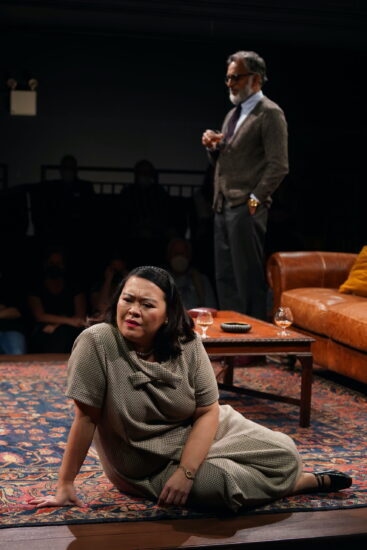
Many cognacs and martinis are sipped as the six characters — haunted by the memory of Tobias and Agnes’s deceased child — mock one another, promise not to reveal secrets, ponder nuclear annihilation, and try to get Claire to stop playing her accordion. “I tell ya, there are so many martyrdoms here,” Claire declares at one of numerous uncomfortable moments. “One to a person,” Edna says.
Through it all, the regal Agnes, who believes strongly in manners and how one presents oneself to others, tries to keep everything from falling apart. She tells Tobias and Julia without much fanfare, “There is a balance to be maintained, after all, though the rest of you teeter, unconcerned, or uncaring, assuming you’re on the level ground . . . by divine right, I gather, though that is hardly so. And if I must be the fulcrum . . . I think I shall have a divorce.” Tobias is stunned, so Agnes clarifies, “No, no; Julia has them for all of us. . . . We become allegorical, my darling Tobias, as we grow older.”
Transport cofounder Cummings III (Come Back, Little Sheba; Broadbend, Arkansas) guides the actors with a steady, assured hand, letting just the right tinge of mystery hover over the proceedings. The all-Asian cast — a first for an Albee play in New York — sparkles in Mariko Ohigashi’s old-school suburban-chic costumes. NYC treasure Katigbak is cool and calm as Agnes, while Narayan portrays Tobias as a stiff-backed man whose nerves threaten to explode at any moment. Herlihy and Chilip are vibrant and noisy as the rowdier relatives, while Juhn and Wolf are like shadowy specters as Harry and Edna, whose fears make our own palpable.
Albee, who would go on to win Pulitzers for Seascape in 1975 and Three Tall Women in 1994, based the sharply drawn characters on relatives of his; I can’t imagine what a dinner party would be like with them. Well, maybe I can. And I’ll be sure to invite my friend who shouldn’t have skipped this revival.
[On November 9, there will be a preshow Casting Conversation with casting directors Stephanie Yankwitt and Andrea Zee and NAATCO creative producer Peter Kim, moderated by NYU professor Michael Dinwiddie.]
Real-life father and son Reed Birney and Ephraim Birney star in Chester Bailey at the Irish Rep (photo by Carol Rosegg)
CHESTER BAILEY
Irish Repertory Theatre, Francis J. Greenburger Mainstage
132 West 22nd St. between Sixth & Seventh Aves.
Wednesday – Sunday through November 20, $50-$70
212-727-2737 irishrep.org
Chester Bailey is one of the best plays of the year, a pristine example of the beauty and power of live drama.
In January 2015, the Irish Rep presented a free staged reading of Emmy-nominated writer and producer Joseph Dougherty’s Chester Bailey at the DR2 Theatre, directed by Emmy and Tony nominee Ron Lagomarsino and featuring Tony nominee Reed Birney as a doctor caring for a young man (Noah Robbins) who has suffered extreme, unspeakable trauma.
The show has been transformed into a touching, gorgeous, must-see production, running at the Irish Rep through November 20. Birney stars as Dr. Philip Cotton, a specialist working with soldiers, including amputees, suffering from battle fatigue and “other injuries that might keep a man from getting back to the life he had as a civilian.” It’s 1945, near the end of WWII, and Dr. Cotton has accepted a position at a Long Island hospital named after Walt Whitman, the poet who served as a nurse during the Civil War.
“The families of the men I was treating wanted their sons and husbands to be the way they were before the Solomons and the Philippines,” Dr. Cotton tells us. “I tried. Tried to take that look out of their eyes. That look acquired in the jungle. My successes were ‘limited.’”
Dr. Cotton’s newest case is Chester Bailey — played by Birney’s son, Ephraim Birney — a man in his midtwenties who refuses to acknowledge that he has lost both eyes and hands in a horrific incident at the Brooklyn Navy Yard, where he worked along the keel of a mine sweeper. Dr. Cotton might technically be unable to take that look out of Chester’s eyes, but the character is played with eyes and hands that are filled with emotion. Chester is overwhelmed with guilt because his parents got him the job in order to keep him out of the war; he had wanted to enlist, like most of the men he knew were doing, but his mother was determined to protect him.
Chester Bailey (Ephraim Birney) creates his own reality out of trauma in superb New York premiere (photo by Carol Rosegg)
“One night, I was reading the paper in the kitchen with the radio on, listening to the war news, and my folks came in and my mother was smiling,” he explains directly to the audience. “She said, ‘We’ve got a late Christmas present for you, Chester. Your father got you a job at the Navy Yards. Isn’t that wonderful?’ When she said job, she meant reserved occupation. She meant I wouldn’t be drafted because I’d be doing war work. Doing my patriotic part, but coming home to Vinegar Hill at the end of my shift. . . . My father looked up at me and I could see in his eyes this was just how it was going to be and there was nothing either one of us could do about it.” The horrible irony was that Chester ended up with the type of injuries men get on the field of battle anyway.
Chester has created a fantasy world in which he can still see and touch things. He describes in detail a copy of van Gogh’s Langlois Bridge at Arles that he thinks is hanging in his room. The 1888 painting relates to Chester’s state of mind: It depicts a woman in black standing on a small drawbridge under blue skies, holding a black umbrella as if in a dark storm. In the actual historical war, the bridge was blown up by the Germans in 1944, so it wouldn’t have existed in 1945 when Chester was supposedly seeing the print of it, made by an artist who would shortly thereafter cut off his own ear and live in an asylum. In fact, Chester believes that the only lasting effect the incident had on him was that he lost one ear. Meanwhile, we learn that Dr. Cotton is color blind, so he cannot process critical aspects of the painting that Chester believes is on the wall.
The first part of the play primarily goes back and forth between Chester and Dr. Cotton talking to the audience, delivering monologues about themselves. Chester discusses his parents and recalls going dancing with a former girlfriend at Luna Park, heading into Manhattan by himself for what he hoped would be a night of revelry, and falling instantly in love with a young red-haired woman selling papers at a newsstand in Penn Station.
Dr. Cotton carefully watches Chester sharing these memories, as if he’s not in the room with him, then adds elements from his own personal and professional life that intersect with similar themes that Chester’s deals with, just from a different angle; the doctor discusses his daughter, Ruthie; his wife’s infidelity and their eventual divorce; his career choices; going to the country club; his flirtation with his boss’s wife; and waiting at Penn Station to get home to Turtle Bay after work.
“It was difficult for Chester’s father to visit him on Long Island,” Dr. Cotton says. “He’d come on weekends, get off the train at the same station I used before I moved, walk the mile and a half around Holy Rood Cemetery to the hospital on Old Country Road. I think of him standing on the platform I used. Each of us waiting for the light of the westbound. Waiting. Not thinking. Trying not to think.”
In the second half, doctor and patient interact, as Dr. Cotton is determined to make Chester face what has happened to him and Chester keeps insisting he has eyes that can see and hands that can touch. Revisiting the incident, Chester tells his incorrect version. “Remember anything else?” Dr. Cotton says. “Nothing real,” Chester responds. “Do you remember anything that isn’t real?” the doctor asks before exploring Chester’s dreams and hallucinations.
The Irish Rep is justly celebrated for its sets, and Chester Bailey is no exception. Two-time Tony winner John Lee Beatty’s (Sweat,Junk) stage design combines a hospital room with bed, wheelchair, and table with the grandeur of old Penn Station, with stanchions in concrete blocks and a curved metal ceiling seemingly made out of railroad tracks. Brian MacDevitt’s lighting includes dangling lightbulbs that glow like stars in the night sky, going on forever in the mirrored walls. “The concourse of Penn Station is like the hull of a ship turned upside down, like you were looking up at the keel,” Chester says. “But instead of being all dark like where I work, it’s light. The light is just in the air. And there are no shadows. You want to know what the light looks like in heaven? You go to the main concourse of the Pennsylvania Station.” Beatty and MacDevitt have captured that image beautifully.
One of New York’s finest, most consistent actors, Reed Birney (The Humans,Man from Nebraska) inhabits the role from the very start, portraying Cotton not as a heroic wartime doctor but as a man with his own shortcomings. Whether he wants to or not, he becomes a kind of father figure to Chester, made all the more palpable since Ephraim (Exploits of Daddy B,Leon’s Fantasy Cut), who was cast first, is his son. While Reed moves slowly and carefully, Ephraim is much more active, jumping around with an eagerness that counters his character’s inability to come to terms with what has happened to him.
Two-time Drama Desk–nominated director Ron Lagomarsino (Digby,Driving Miss Daisy) guides the ninety-minute show with a graceful elegance; there’s nary a stray note in the play, which is not just about the travails of a single man but about family and everyday existence, about the big and small moments. The relationship between parents and their children are echoed here by a doctor and patient who happen to be father and son. At one point, Chester asks Dr. Cotton why he didn’t go into his father’s printing and binding company. “How come it wasn’t Cotton and Son?” he wonders. Dr. Cotton answers, “He wanted me to go to college. I wanted to be a doctor.” It takes on extra meaning in that Ephraim has followed his father and mother, actress Constance Shulman, into the family business. (All three appeared in the offbeat 2022 film Strawberry Mansion.)
Early on, Dr. Cotton states, “If there’s one thing reality can’t tolerate, it’s competition.” It’s a great line in a great play that brilliantly explores the human condition and the realities that each of us creates to help us deal with whatever life throws our way.