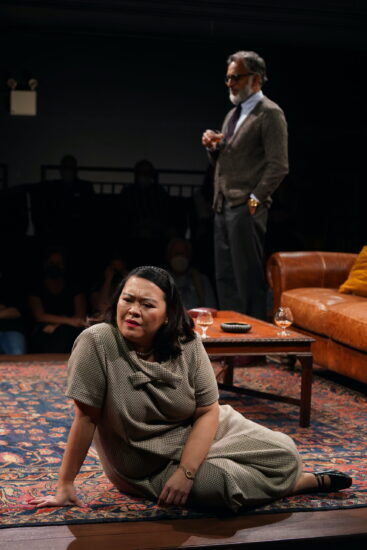
Who: Tom Stoppard, Daniel Kehlmann What:Conversations & Performances discussion Where: Unterberg Poetry Center, 92nd St. Y, Kaufmann Concert Hall, 92Y online When: Sunday, September 18, in person $15-$31, online $20, 4:30 Why: “Anti-Semitism is a political fact. It’s a bit soon for it to be a party platform, but when it is there will be Austrians to vote for it,” a character states in Tom Stoppard’s new Olivier Award–winning play, Leopoldstadt, which opens October 2 at the Longacre Theatre on Broadway. On September 18, Stoppard will be at the 92nd St. Y to inaugurate the eighty-fourth anniversary of the Unterberg Poetry Center — a year younger than he is — to discuss the play, which was partly inspired by his family history. The British playwright and screenwriter will be joined by German and Austrian author and translator Daniel Kehlmann, who has written such novels as You Should Have Left,Tyll, and Fame and translated Leopoldstadt into German.
Stoppard, born Tomáš Sträussler in 1937 in what is now the Czech Republic, is arguably the greatest living playwright of the last sixty years; his works include Rosencrantz and Guildenstern Are Dead,Travesties,The Real Thing,Arcadia,The Invention of Love, and The Coast of Utopia, earning four Tonys and two Oliviers for Best Play. Sir Thomas has also won a Best Original Screenplay Oscar for Shakespeare in Love. His latest play, his most personal, begins in Vienna in 1899, in the Jewish quarter known as Leopoldstadt, and features more than three dozen characters; directed by Tony and Oscar nominee Patrick Marber (Closer,Notes on a Scandal), it is currently scheduled to run through January 29, 2023.
Rose Dewitt Bukater (Alex Ellis) is desperate for a brand-new day in Titanique (photo by Emilio Madrid)
TITANIQUE: UNE PARODIE MUSICALE
The Asylum Theatre
307 West Twenty-Sixth St. at Eighth Ave.
Tuesday – Sunday through November 6, $39-$98
[ed. note: Moved to the Daryl Roth Theatre through February 19, $80-$171] titaniquemusical.com asylumnyc.com
While I may have been severely disappointed with James Cameron’s disastrous Oscar-winning Titanic and I’ve never been known to blast out Canadian superstar Céline Dion’s songs in the shower, I couldn’t help but fall under the bewitching spell of Titanique, a wild and wooly musical parody of the beloved 1997 weepie shipwreck rom-com. Playing to sold-out houses at the basement Asylum NYC nightclub, Titanique is filled with hysterical anachronisms, inside jokes, and campy humor, beginning with the premise itself: A tour guide is leading a group of people through the Titanic Museum when Dion (Marla Mindelle) suddenly shows up, in a fancy gown, declaring that she will tell the real story of the disaster since she was on board at the time of the sinking.
“Bonjour, everybody! It is me, Céline Dion. I am here because this is not how I remember the story of Titanique,” she announces. “But Céline Dion, you just sang the theme song to the movie; you weren’t actually on the Titanic,” the tour guide says. “Or was I?” Dion responds with more than a hint of mystery. “But . . . that would make you at least one hundred and fifty years old,” the tour guide points out. “And you are confused because . . . ,” Dion adds. “People don’t live that long,” the tour guide offers. “Or do they?” Dion wonders with a smirk.
Dion proceeds to tell the tale of the young and lovely Rose Dewitt Bukater (Alex Ellis), who is engaged to marry the rich, pompous Cal Hockley (John Riddle) until she is saved from a possible suicide by the lowly but impossibly handsome Jack Dawson (Constantine Rousouli), who earned his ticket by winning a card game. “Well, Jacqueline, how are the accommodations down in steerage?” Rose’s snobby aunt, Ruth Dewitt Bukater (Ryan Duncan), asks snottily of the unruffled Jack, who replies, “The best I’ve ever seen, ma’am. Hardly any rats. You see, I don’t have any need for caviar and fancy things. All I need is the air in my lungs and my rustic Italian sidekick.” Ruth retorts, “And do you find that sort of rootless existence appealing, you poor unfortunate troll?”
Everyone is hoping their hearts will go on in parody musical (photo by Emilio Madrid)
Also on board is the unsinkable Molly Brown (Kathy Deitch), who is modeled after Kathy Bates, who played the role in the film, and ship builder Victor Garber (Frankie Grande); in the movie, real-life ship builder Thomas Andrews was portrayed by Tony and Emmy nominee Victor Garber. (With danger afoot, Ruth says to Garber, “You’ve been in so many movies and I can never quite say which ones but I’m always like . . . ‘Oh wow, there’s Victor Garber!”)
Garber the character is pushing the pedal to the metal, as Cal has insisted that the builder turn up the speed because he has a critical appointment at an exclusive salon in New York. While Jack and Rose fall in love, a seaman and Molly worry that the ship is going too fast. “Shut it, seaman!” Garber declares. “Cal has a hair appointment in Soho, and they book way out! Get downstairs and put more fire in this boat’s engine or else your ass is gonna be Goldie Hawn in Overboard. Beat it!”
Lo and behold, awaiting all of them is, of course, the Iceberg (Jaye Alexander), who is lying in wait to do just a little bit of damage.
Titanique, cowritten by Mindelle, Rousouli, and director Tye Blue, features seventeen Dion songs (“I’m Alive,” “Taking Chances,” “You and I”) performed by Mindelle and the rest of the cast (including ensemble members Courtney Bassett, Donnie Hammond, and Dimitri Moise), highlighted by two prominent covers, one from a Disney movie (with Peabo Bryson), the other by Ike & Tina Turner (sung here by Alexander). The arrangements and orchestrations by music supervisor Nicholas Connell are tongue-in-chic fun, performed live by a three-piece band and a trio of backup singers. Ellenore Scott’s choreography is playful and fun, making the most of Gabriel Hainer Evansohn’s small set and Alejo Vietti’s swanky costumes. Lawrence Schober’s sound and Paige Seber’s lighting keep the audience thoroughly engaged as they down their cocktails.
Fans of the movie will love the many direct and indirect references, from the extra-large heart of the ocean necklace to the revelation of Jack’s artistic talents, while everyone should get a kick out of the anachronistic mentions of American Horror Story, iPhones, Full House, #metoo, Caesars Palace, Patti LuPone, and Vicky Christina Barcelona.
Titanique, which Dion proudly calls the gayest show in town, is a delicious cruise cabaret extravaganza that pokes fun at Hollywood, and itself, in hysterical ways. And even if you hate the movie — and are not big on Dion and her music — you’ll have no choice but to surrender to the many charms of this unique reimagining of just what happened aboard the unsinkable Ship of Dreams.
STRINGS ATTACHED
Pulse Theatre at Theatre Row
410 West 42nd St. between Ninth & Tenth Aves.
Wednesday – Sunday through October 1, $57.50 pulseensembletheatre.org bfany.org
I decided to take no chances when going to Carole Buggé’s Strings Attached at Theatre Row; I brought along a genuine, dyed-in-the-wool nuclear physicist. You don’t have to bring your own nuclear physicist in order to enjoy the play, but it certainly helped as he confirmed that the various mathematical equations we saw projected onto the closed curtain before the show were correct, and he also explained that an abstract dance at the end of the first act was most likely the performers moving like protons, neutrons, and electrons.
Buggé’s reworking of an earlier play takes place in a large train berth as three scientists travel from a convention to London to see Michael Frayn’s Copenhagen, a Tony-winning, well-researched, but imagined account of the real-life meeting between physicists Neil Bohr and Werner Heisenberg in 1941. In that play, Frayn imagines Bohr and Heisenberg’s discussion of nuclear power, the atomic bomb, the latter’s uncertainty principle, and the responsibilities of the scientific community to the future of humankind.
Buggé’s play, produced by Pulse Ensemble Theatre, is also inspired by an actual event, about three physicists debating the Big Bang while on a train heading to a string theory conference in Cambridge. The lithe rock climber June (Robyne Parrish) and the stoical, upper-class George (Paul Schoeffler) are married cosmologists who recently lost a child in a train accident. They are joined by their friend Rory (Brian Richardson), a prickly, hard-edged particle physicist who has a thing for June. While George is a string theorist, Rory advocates for M theory, leading to lofty jokes and rejoinders.
“Ten dimensions of space but only one of time,” George says when he almost misses the train. “How many physicists does it take to screw in a lightbulb?” Rory asks. “I don’t know,” June responds. “It depends,” Rory adds. “On what?” George asks. “On whether the light is a particle or a wave,” Rory explains. My companion chuckled at what turned out to be the first of several screw-in lightbulb jokes.
The trio is occasionally visited by two strange fan-geek couples (Bonnie Black and Russell Saylor), who turn out to know a surprising amount of science, as well as by George’s, June’s, and Rory’s respective heroes: Sir Isaac Newton (Jonathan Hadley), Marie Curie (Black), and Max Planck (Saylor), who have been keeping up-to-date on what is happening in the world long after their deaths. Topics of discussion range from William Wordsworth, T. S. Eliot, James Joyce, Albert Einstein, Galileo, and William Blake to Schrodinger’s cat, quantum physics, membrane theory, Planck’s constant, and the singularity. The second act explores the concept of alternate parallel universes, with many clever nuances.
At one point, talking about Frayn’s play, Rory tells George, “A bit dodgy, writing about a real event. Seems you’re setting yourself up for failure.” Here Buggé is also referring to herself, but she manages to pull it off, for the most part. Director and Pulse cofounder Alexa Kelly (W. E. B. Du Bois: A Man for All Times, Harlem Summer Shakespeare) maintains order amid the potential chaos, like a train conductor staying on track and on schedule. Buggé and Kelly do a good job incorporating ideas of love, loss, fear, and faith while not getting lost in all the science, making sure to go relatively easy on the technical language, which is helpful even if you’re sitting next to a nuclear physicist — who had seen Copenhagen on Broadway in 2000.
Jessica Parks’s set is an open, tearaway train car that looks like it’s been in a crash itself. Joyce Liao’s lighting and Louis Lopardi’s sound make it feel like the characters are on a moving train. Katerina Vitaly’s projections add to the science. Schoeffler (Sunset Boulevard,Rock of Ages) has a soothing quality as the serene George, while Parrish (A Man Called Otto,Gossip Girl) is thoroughly charming as June; it’s obvious why both George and Rory are in love with her.
Richardson (W. E. B. Du Bois: A Man for All Times,The Lower Depths) is too one-note as Rory, overly severe, while Black (Citizen Wong, Margarethe Bohr in Riverside Theatre’s Copenhagen) and Saylor (Screams of Kitty Genovese,Starlight Express) overplay the two couples, who are overwritten with too much slapsticky humor and seem out of place on the train and in the play itself. Hadley (Jersey Boys,Caesar and Cleopatra) is wonderfully flamboyant as Newton and sweetly endearing as the Irish train conductor.
Describing her love of rock climbing, June tells George and Rory, “It forces you to be in the moment. Time doesn’t exist — there’s only now.” The same can be said about theater — particularly at Theatre Row, where multiple shows are going on at the same time, each creating its own universe.
Who:New Camerata Opera What: French opera double bill Where:Irondale Center, 85 South Oxford St., Brooklyn When: Friday, September 16 and 23, and Saturday, September 17 and 24, $25-$80, 8:00 Why: New Camerata Opera (NCO) will present a double bill of French one-act operas dealing with time on Friday and Saturday at Irondale Center in Brooklyn to kick off the company’s seventh season. With music director and conductor Kamal Khan and stage director John de los Santos, NCO will perform composer Lili Boulanger and librettist Eugène Adenis’s Faust et Hélène, adapted from Johann Wolfgang von Goethe’s retelling and focusing on the deal Faust makes with Méphistophélès. That will be followed by Maurice Ravel’s L’heure espagnole, in which clockmaker Torquemada and his wife, Concepción, take stock of her infidelity. The cast features Eva Parr and Tesia Kwarteng as Concepción and Hélène, Victor Khodadad and Chris Carr as Faust and Gonzalve, Markel Reed and Kyle Oliver as Méphistophélès and Ramiro, Gabriel Hernandez and Anthony Laciura as Torquemada, and Angky Budiardjono and Andy Dwan as Don Iñigo Gomez, with a seventeen-person orchestra and costumes by Ashley Soliman, lighting by Joshua Rose, and projections and set design by Atom Moore.
James Caan puffs on a cigar in Wes Anderson’s Bottle Rocket
THE CAAN FILM FESTIVAL
Museum of the Moving Image
35th Ave. at 36th St., Astoria
September 16 – October 9
718-777-6800 movingimage.us
“Actors have bodyguards and entourages not because anybody wants to hurt them — who would want to hurt an actor? — but because they want to get recognized. God forbid someone doesn’t recognize them,” James Caan once said. He might not have been after fame and fortune, but he quickly became one of the most recognizable men in Hollywood history.
There was an outpouring of grief when Caan died this past July at the age of eighty-two. The Bronx-born, Sunnyside-raised actor appeared in more than ninety films and two dozen television shows, and when he was onscreen, it was impossible to take your eyes off him; he commanded the audience’s attention whether he was the star or making a cameo. Despite his critical and popular success, he was nominated for only one Oscar, for The Godfather, and one Emmy, for Brian’s Song.
The Killer Elite is part of MoMI tribute to James Caan
The Museum of the Moving Image pays tribute to Caan with its fourth not-quite-annual Caan Film Festival, running September 16 to October 9 and consisting of twelve of his films, from Howard Hawks’s 1966 El Dorado with John Wayne and Robert Mitchum and Curtis Harrington’s 1967 Games to Wes Anderson’s 1996 Bottle Rocket and Jon Favreau’s 203 Elf. Caan is his trademark tough guy with a conscience in Sam Peckinpah’s 1975 The Killer Elite, Michael Mann’s 1981 Thief, and Karel Reisz’s intense 1974 The Gambler while showing other sides of himself in Mark Rydell’s 1977 Harry and Walter Go to New York, Rob Reiner’s 1990 Misery, Rydell’s 1973 Cinderella Liberty, and Graham Baker’s 1988 Alien Nation, in which he teams up with a cop from another planet. It all kicks off with The Godfather, Francis Ford Coppola’s 1972 masterpiece that is as powerful as ever, as is Caan’s blazing performance as Sonny Corleone, the role he will always be most recognized for, entourage or not.
Who:Hew Locke, Tumelo Mosaka, Kelly Baum What: Conversation about “The Facade Commission: Hew Locke, Gilt” Where:Metropolitan Museum of Art, Grace Rainey Rogers Auditorium, 1000 Fifth Ave. at 82nd St. When: Thursday, September 15, free with RSVP, 6:30 Why: On September 15, Scotland-born, Guyana-raised, London-based sculptor Hew Locke will unveil his Met Museum facade commission, Gilt, which will be on view through May 23, 2023. The four-piece work references the Met collection, focusing on appropriation, power, and colonialism through a theatrical lens.
“Hew Locke creates emotionally powerful and visually striking work that will stop you in your tracks. This site-responsive commission for the museum’s facade will be informed by Locke’s deep knowledge of the Met’s collection and will reference the institution in ways both direct and indirect, recovering and connecting histories across continents, oceans, and time periods,” Met director Max Hollein said in a statement. Curator Sheena Wagstaff added, “Hew Locke uses a delirious aesthetic of abundance and excess to reflect themes of deep urgency in the past and present, including wealth, imperial power, and prestige, astutely critiquing their visual iconography through reclamation.”
The third facade commission, following Wangechi Mutu’s The NewOnes, will free Us and Carol Bove’s The séances aren’t helping, Locke’s aptly titled Gilt will be explored in a panel discussion September 15 at 6:30 with Locke, Columbia University director and curator Tumelo Mosaka, and Met curator Kelly Baum; you can attend in person at the Met’s Grace Rainey Rogers Auditorium or watch the livestream online.
Visitors race for the crown in the “Love & Lust Deity Derby” at the Museum of Sex (photo by twi-ny/mdr)
SUPERFUNLAND: JOURNEY INTO THE EROTIC CARNIVAL
Museum of Sex
233 Fifth Ave. at 27th St.
Through October 23, $36-$39
212-689-6337 www.museumofsex.com www.superfunland.com
In 2015, I had super fun at the Museum of Sex’s interactive “Funland: Pleasures & Perils of the Erotic Fairground,” a kinky collection of participatory installations that reimagined booths at county fairs, with devilishly delightful twists. That theme reaches new heights in the follow-up, “Super Funland: Journey into the Erotic Carnival,” which is, as its name promises, also super fun, even more so than its predecessor.
Continuing through October 23, the exhibition features more than a dozen sensual, risqué, whimsical, and ribald games, rides, and challenges to titillate the senses. But as with most shows at MoSex, it is well curated, with ample history to accompany the bacchanalian revelry. Miniatures from the collection of Al Stencell, former president of the Circus Historical Society and the author of Seeing Is Believing: America’s Sideshows and Girl Show: Into the Canvas World of Bump and Grind, and a fanciful 180-degree short film help put the eroticism of fairs and carnivals into cultural perspective, going back to ancient Rome and Greece and celebrating the carnal boom of the nineteenth and twentieth centuries.
A two-floor slide ushers adventurous participants to more bawdy installations in “Super Funland: Journey into the Erotic Carnival” (photo by twi-ny/mdr)
“Stardust Lane” is a dizzying erogenous kaleidoscope lined with small dioramas playing archival footage from world’s fairs and Coney Island’s heyday. “Tunnel of Love” is a 4D journey into human orifices. “Jump for Joy” is a bouncy castle of massive mammaries, while “Glory Stall” gives visitors the opportunity to, well, “burp the worm” and “yank that plank.” You can put an image of yourself in the middle of the action at the “Porn-a-Matic” screen-test booth, see how passionate you and your partner are at the very public “Lucky Lips Make Out Challenge,” compete for prizes in the “Love & Lust Deity Derby,” get married (complete with rings) at “AutoWed,” or capture your own reward in the “Claw, Pinch, and Grab” games.
The warmly lit, mirrored “Climbx” Ecstatic Climbing Challenge leads to a steamy slide that deposits you through hot lips and out a striped bottom to a lower floor where you can get your fortune told by a superstar in “RuPaul Speaks,” reveal your G-spot skill to win a CBD love elixir in “The Siren,” and grab some “licker” at the “Carnal Carnival Bar,” including such specialty cocktails as Mosex on the Beach, Penis Colada, and several with names that are too raunchy to print here. You can become a “Pole Star” by following the prompts as you dance on a stripper pole, then engage in various positions with a companion — clothes on, please — in “Kama Ultra.”`
Boasting contributions from Bompas and Parr, Droog, Bart Hess, Rebecca Purcell, Snøhetta, and more, “Super Funland” is indeed super fun, but MoSex also has other, more serious exhibitions that are definitely worth your time. The multimedia “Porno Chic to Sex Positivity: Erotic Content & the Mainstream, 1960 till Today” looks at how the use of erotic content in mainstream culture has developed over the last sixty years, divided into “A Pornographic Avant-Garde,” “Sexualized Marketing,” “Scandalous Scenes of Cinema,” and “Music: an Erotic Form.” MoSex has reached into its permanent collection of more than fifteen thousand objects for “Artifact (xxx): Selections from Secret Collections,” comprising a wide array of items, from a blow-up doll, a lotus shoe, and an intriguing sex chair to various toys, magazines, and even a Picasso etching (10 May 1968). And “F*CK ART: the body & its absence” consists of painting, sculpture, photography, video, and installation by eighteen artists, including Coyote Park, Alina Perez, Cherry Brice Jr., Justin Yoon, Erin M. Riley, and Pixy Liao. Finally, make sure you have plenty of time to browse in the store, which is an exhibition all its own.