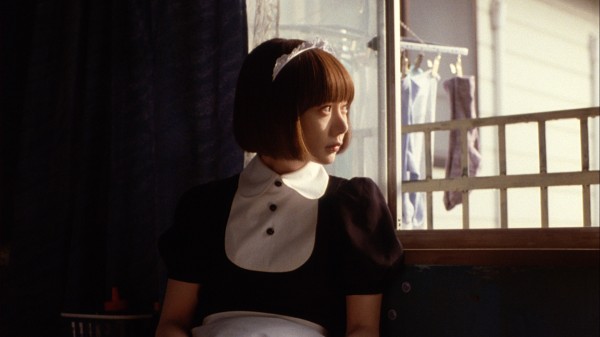
Nozomi (Bae Doona) dreams that there’s more to life in Hirokazu Kore-eda’s AIR DOLL
AIR DOLL (Hirokazu Kore-eda, 2009)
Film Society of Lincoln Center
Walter Reade Theater
70 Lincoln Center Plaza, 65th St. at Amsterdam Ave.
Tuesday, February 23, 6:15; Saturday, February 27, 1:30
Series: February 19 – March 4, $12 per screening, All Access Pass $129
212-875-6500
www.filmlinc.com
 Over the last fifteen years, Japanese filmmaker Hirokazu Kore-eda has compiled a remarkable resume, directing seven narrative features and one documentary that investigate such themes as memory and loss. His latest, AIR DOLL, examines loneliness through the eyes of a blow-up doll come to life. Bae Doona stars as Nozomi, a plastic sex toy owned by Hideo (Itsuji Itao), a restaurant worker who treats her like his wife, telling her about his day, sitting with her at the dinner table, and making love to her at night. But suddenly, one morning, Nozomi achieves consciousness, discovering that she has a heart, and she puts on her French maid costume and goes out into the world, learning about life by wandering through the streets and working in a video store, always returning home before Hideo and pretending to still be the doll. Adapted from a manga by Yoshiie Goda, AIR DOLL is another beautiful, meditative study from Kore-eda. Nozomi’s wide-eyed innocence at the joys of life comes sweet and slowly, played with a subtle wonderment by South Korean model and actress Bae (SYMPATHY FOR MR. VENGEANCE, THE HOST). The film does, however, take one nasty turn and is a bit too long, at more than two hours. But it’s still another contemplative gem from the director of MABOROSI, NOBODY KNOWS, and STILL WALKING.
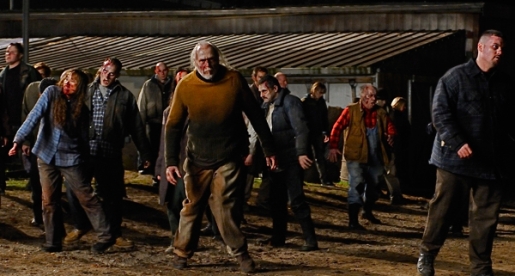
Movie lovers will be flocking to see George A. Romero’s latest zombie flick, SURVIVAL OF THE DEAD, and other underseen, overlooked gems at Lincoln Center
AIR DOLL is screening as part of Film Comment Selects, the cinephile magazine’s tenth annual examination of international works that have been overlooked, have not yet received distribution, or deserve to be rediscovered. The series, held at the Walter Reade Theater, begins February 19 with Jonathan Kaplan’s 1979 drama OVER THE EDGE, which will include a cast reunion (Matt Dillon and Vincent Spano!) and after-party, and ends March 4 with Paul Greengrass’s GREEN ZONE. The festival also includes Edward Yang’s 1991 epic A BRIGHTER SUMMER DAY, a program of Godard rarities, Hong Sang-soo’s insightfully funny LIKE YOU KNOW IT ALL, a four-film focus on Philippe Grandrieux, a Kiyoshi Kurosawa double bill of THE REVENGE: A VISIT FROM FATE and THE REVENGE: A SCAR THAT NEVER FADES, a special screening of THE AVIATOR’S WIFE in honor of the late Eric Rohmer, and even George. A. Romero’s latest zombiefest, SURIVIVAL OF THE DEAD, among other films from Hong Kong, Denmark, France, and Russia. On February 27, AIR DOLL will be shown as part of a $40 Day Pass along with Luc Moullet’s THE LAND OF MADNESS, Patrice Chéreau’s PERSECUTION, and the Romanian compilation TALES FROM THE GOLDEN AGE.


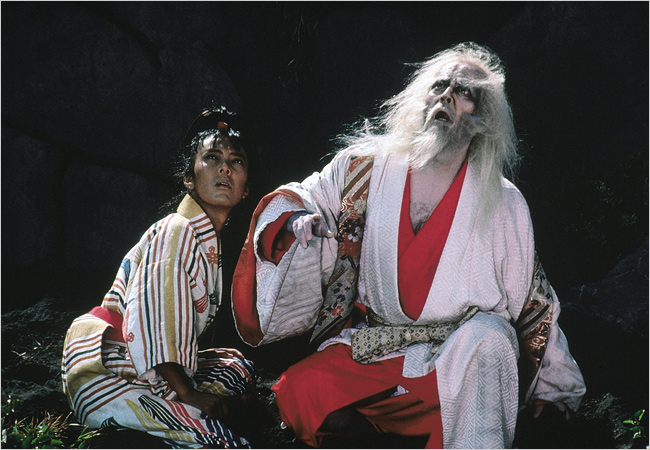
 Inspired by the story of feudal lord Mori Motonari and Shakespeare’s KING LEAR, Akira Kurosawa’s RAN is an epic masterpiece about the decline and fall of the Ichimonji clan. Aging Lord Hidetora (Tatsuya Nakadai) is ready to hand over his land and leadership to his three sons, Taro (Akira Terao), Jiro (Jinpachi Nezu), and Saburo (Daisuke Ryû). But jealousy, misunderstandings, and outright deceit and treachery result in Saburo’s banishment and a violent power struggle between the weak eldest, Taro, and the warrior Jiro. Hidetaro soon finds himself rejected by his children and wandering the vast, empty landscape with his wise, sarcastic fool, Kyoami (Peter), as the once-proud king descends into madness. Dressed in white robes and with wild white hair, Nakadai (THE HUMAN CONDITION), in his early fifties at the time, portrays Hidetaro, one of the great characters of cinema history, with an unforgettable, Noh-like precision. Kurosawa, cinematographers Asakazu Nakai, Takao Saitô, and Masaharu Ueda, and Oscar-winning costume designer Emi Wada bathe the film in lush greens, brash blues, and bold reds and yellows that marvelously offset the white Hidetaro. Kurosawa shoots the first dazzling battle scene in an elongated period of near silence, with only Tôru Takemitsu’s classically based score playing on the soundtrack, turning the film into a thrilling, blood-drenched opera. RAN is a spectacular achievement, the last great major work by one of the twentieth century’s most important and influential filmmakers. Film Forum is screening RAN in a brand-new twenty-fifth-anniversary 35mm print, concluding its terrific six-week-long Kurosawa festival celebrating the auteur’s centennial.