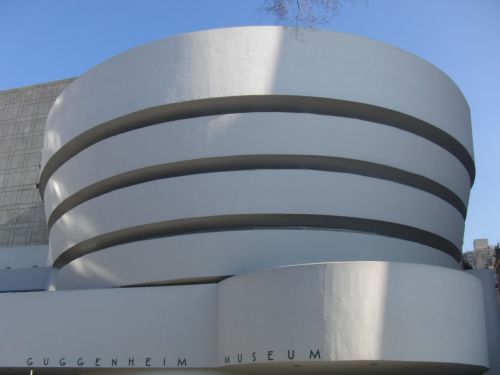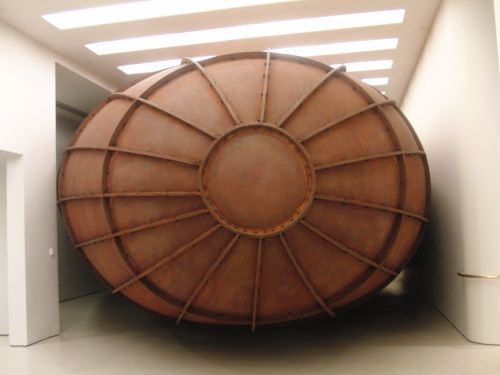
Anish Kapoor’s “Memory” threatens to overwhelm Guggenheim visitors (photo by twi-ny/mdr, image © Anish Kapoor)
ANISH KAPOOR: MEMORY
Solomon R. Guggenheim Museum
1071 Fifth Ave. at 89th St.
Through March 28 (closed Thursday)
Admission: $18 adults, children under twelve free
(pay-what-you-wish Saturdays 5:45-7:45)
212-423-3500
www.guggenheim.org
flickr slideshow
www.aerotrope.com
Throughout his thirty-plus-year career, Indian-born artist Anish Kapoor has been creating site-specific installations that allow the viewer to touch, walk in, under, and around, and see themselves reflected in the pieces’ surfaces. He most often works with shiny mirrorlike materials (Chicago’s “Cloud Gate,” New York City’s “Sky Mirror”) and red PVC (England’s “Taratantara”), incorporating concave and convex shapes that play with physical and psychological space while inviting visitors in. But his latest massive construction, commissioned by the Guggenheim as part of the museum’s fiftieth anniversary celebration, shuts people out. “Memory,” a twenty-four-ton sculpture consisting of 154 eight-millimeter-thick Cor-Ten steel tiles and first displayed by the Deutsche Guggenheim in late 2008, presents what the London-based Turner Prize-winning artist calls a “confrontational dichotomy.”
The sculpture is first encountered at the end of a long, narrow entrance to one of the museum’s annex galleries, where it blocks people from entering a space that is usually wide open and welcoming. Instead, here it offers tantalizing glimpses of what lies beyond. The piece can next be seen in another annex gallery that appears to contain only a dark painting in an otherwise all-white room. In actuality, the dark rectangle has been cut out of the wall and leads inside the sculpture, but again Kapoor has denied access; you can look in — it will take a few minutes for your eyes to adjust — but you cannot enter what could be the piece’s brain. Finally, at the third and final viewing location, the bulk of the work threatens to overwhelm you, its huge, rusty mass trapping you in front, with no way to get around it. At times it appears to be a giant bullet, or maybe even a breast, coming straight at you.
“Memory” is a fascinating conundrum, unable to be seen in its entirety, challenging museumgoers to contemplate both its inside and outside, as if reaching into their own memory system. Manufactured by Centraalstaal B.V., the enormous sculpture was engineered by Brighton-based Aerotrope Limited. The founder and director of Aerotrope, Christopher Hornzee-Jones, who has worked with Kapoor for many years, recently took part in an exclusive twi-ny talk to discuss what went on behind the scenes of “Memory.”
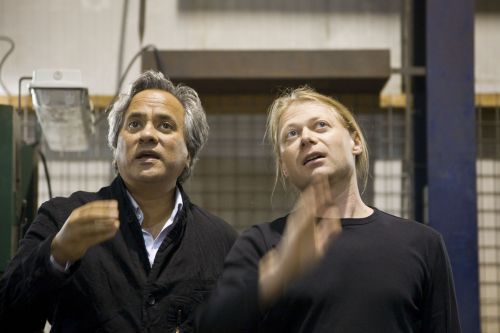
Anish Kapoor and Christopher Hornzee-Jones discuss construction of “Memory” (Photo: Mathias Schormann, © Anish Kapoor, Deutsche Guggenheim)
twi-ny: What was the single hardest part of physically getting “Memory” into the Guggenheim?
CH-J: Anish Kapoor had a very clear idea of how he wanted this sculpture to be: The form of “Memory” had to be such that it would skim the walls and ceiling, effectively filling a whole room and touching its walls. It was our job to find a way of breaking down 24 tonnes of sculpture into 154 pieces, which could travel up to the gallery room via a relatively small elevator. Next, all these pieces of steel had to be fitted neatly together with lots of bolts. Imagine a very thin guy, lying with his arms outstretched on top of the sculpture, in the narrow space left below the ceiling. Armed with just a spanner, this skinny worker would tighten bolts in all the hard-to-reach spaces, until the sculpture finally stood up.
For me as a structural engineer it was also an unusual challenge to resolve its structure in such a way that “Memory” would be able to fit tightly into two very different spaces: Deutsche Guggenheim Berlin and the Guggenheim in New York. This was probably the hardest part. In New York, the team put their trust in our company’s ability to “do the maths right” so that this massive sculpture would be able to rest on just a single floor beam, without any extra support. Now that “Memory” is installed successfully I can say that I have fulfilled a personal dream, to work with the famous Guggenheim Foundation. They even asked me to write an essay for the exhibition catalogue. I felt very honoured.
You also worked with Anish Kapoor on Chicago’s “Cloud Gate.” How is it to work with him? Is he a stern taskmaster, a playful collaborator (given the type of sculptures he makes), or somewhere in between?
There is no doubt that Anish Kapoor is very demanding, and rightfully so. He has a clear artistic vision, but he is also willing to listen to the engineer’s point of view. Anish has a good feeling for what is possible, and then he goes and pushes those limits of possibility. His work often takes us engineers into new territory and out of what has been done before. But this is where the fun starts. I think Anish knows that we don’t like saying that “something cannot be done,” and as an artist he appreciates this attitude.
You can see in the variety of his work that Kapoor is very playful. But he is also very serious. When we meet, the starting point is a model or a sketch. The meetings are often short but intense, and then each party goes away and works on their part: The artist refines his idea, we refine the engineering, and then we reconvene to compare notes. Over the years we have developed a shared language between us that quickly helps us understand each other’s views. Sometimes it’s tough to find the right solution, but being on the same wavelength as Kapoor helps us ride out any stressful phases of the project.
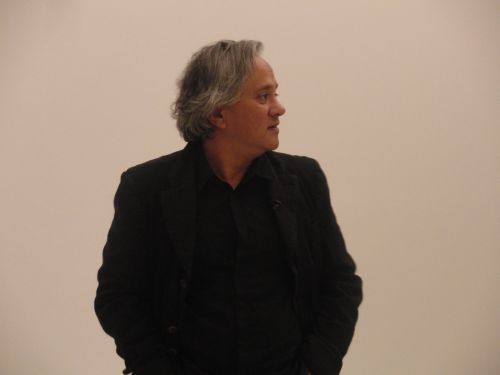
Kapoor checks out installation at exhibition opening (photo by twi-ny/mdr, image © Anish Kapoor)
Do you find you have a particular affinity for his projects?
Yes, definitely! It comes from a love of the kind of forms Kapoor often works with, a love for bold organic shapes. Personally, I am drawn to these because I like forms shaped by nature and the elements. As an engineer I work with objects like yacht hulls, aircraft wings, and wind turbine blades. For me these types of shapes, beyond their industrial functionality, bear an intrinsic aesthetic quality. Kapoor’s art is very powerful in that it challenges how you see things; it questions how you perceive your surroundings and yourself within it. When I saw “Memory” installed for the first time, it was a great moment. All the tools were packed away, the space clean and ready for the opening. I sat down with my back leaning against the same wall that the sculpture’s enormous mass was leaning against. At that moment I definitely felt a great sense of connection with the work.
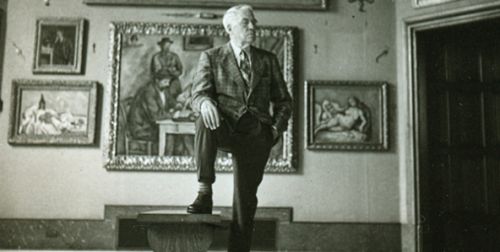
 Director Don Argott details a very different kind of art theft in the gripping documentary THE ART OF THE STEAL. But in this case, it’s not a famous painting that disappears from a museum in the middle of the night but an entire collection, as well as a man’s legacy, absconded with in full view of the art world. In 1922, Dr. Albert C. Barnes established the Barnes Foundation, displaying his remarkable collection of post-Impressionism art in an arboretum in Merion, Pennsylvania, outside of Philadelphia. His goal was to share his magnificent works — including a stunning array of paintings by Cézanne, Renoir, Matisse, Picasso, Seurat, and Van Gogh — with bona fide art lovers and students, setting up a school and denying access to the general public, the mass media, and the rich and powerful. He adamantly refused to let any single piece ever be loaned, sold, or moved, outlining the demand very specifically in his will. After his death in 1951, Violette de Mazia continued to carry out his wishes as the Arboretum School expanded, but when she died in 1988, the trust was put in the hands of small Lincoln University and suddenly the Barnes Foundation, which had treasured its privacy, was put into play as politicians, charities, collectors such as the Annenbergs, the press, and the public at large descended on the Barnes like vultures, everyone wanting a piece of the action. Argott follows the money with archival footage and photographs and new interviews with many of those involved on both sides of the caper — although several of the more prominent “thieves” refused to participate. THE ART OF THE STEAL is a fascinating glimpse into the inner workings of the ritzy art world, a must-see for art lovers who get to peek behind the scenes of a multibillion-dollar heist going on in plain sight.