twi-ny recommended events

EXIT THROUGH THE GIFT SHOP

Banksy reveals only so much of himself in new documentary

Banksy reveals only so much of himself in new documentary

EXIT THROUGH THE GIFT SHOP (A Banksy Movie, 2010)
Landmark Sunshine Cinema, 143 East Houston St.
Lincoln Plaza Cinema, 1886 Broadway
Opens Friday, April 16
www.banksyfilm.com
www.landmarktheatres.com
www.lincolnplazacinema.com

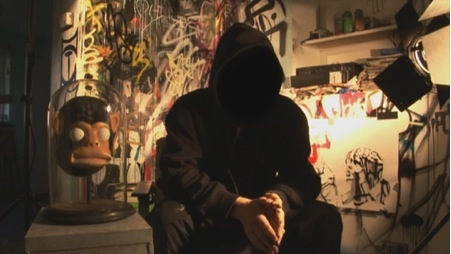
In 1999, L.A.-based French shopkeeper and amateur videographer Thierry Guetta discovered that he was related to street artist Invader and began filming his cousin putting up his tile works. Guetta, who did not know much about art, soon found himself immersed in the underground graffiti scene. On adventures with such famed street artists as Shepard Fairey, Swoon, Ron English, and Borf, Guetta took thousands of hours of much-sought-after video. The amateur videographer was determined to meet Banksy, the anarchic satirist who has been confounding authorities around the world with his striking, politically sensitive works perpetrated right under their noses, from England to New Orleans to the West Bank. Guetta finally gets his wish and begins filming the seemingly unfilmable as Banksy, whose identity has been a source of controversy for more than a decade, allows Guetta to follow him on the streets and invites him into his studio. But as he states at the beginning of his brilliant documentary, EXIT THROUGH THE GIFT SHOP, Banksy—who hides his face from the camera in new interviews and blurs it in older footage—turns the tables on Guetta, making him the subject of this wildly entertaining film.

Guetta is a hysterical character, a hairy man with a thick accent who plays the jester in Banksy’s insightful comedy of errors. Billed as “the world’s first Street Art disaster movie,” EXIT, which is narrated by Welsh actor Rhys Ifans (DANNY DECKCHAIR) and features a soundtrack by Portishead’s Geoff Barrow sandwiched in between Richard Hawley’s declaratory “Tonight the Streets Are Ours,” is all the more exciting and intriguing because the audience doesn’t know what is actually true and what might be staged; although the film could be one hundred percent real and utterly authentic, significant parts of it could also be completely made up. Who’s to say that’s even Banksy underneath the black hood, talking about Guetta, who absurdly rechristens himself Mr. Brainwash? It could very well be Banksy’s F FOR FAKE, Orson Welles’s marvelous 1974 pseudo-documentary about art forger Elmyr de Hory, or it could be on the straight and narrow from start to finish. No matter. EXIT THROUGH THE GIFT SHOP is riotously funny, regardless of how you feel about street art, Banksy, and especially the art market itself (as the title so wryly implies).

For information on Banksy’s sole New York City exhibition, held in fall 2008, visit here.
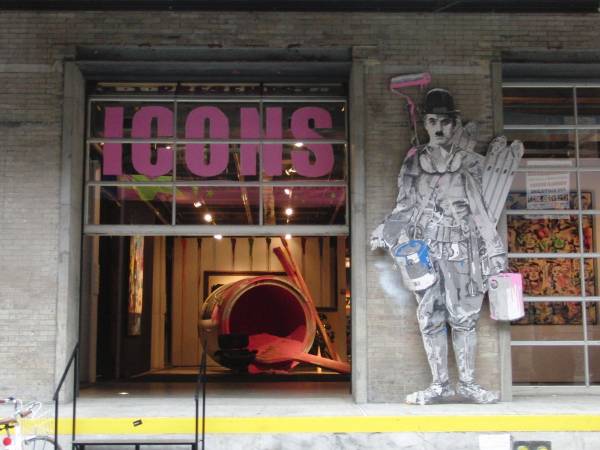
MR. BRAINWASH: ICONS

Banksy protege Mr. Brainwash invites art lovers -- and collectors -- to his show in the Meatpacking District (photo by twi-my/mdr)

Banksy protégé Mr. Brainwash invites art lovers — and especially collectors — to his show in the Meatpacking District (photo by twi-ny/mdr)

415 West 13th St. at Washington St.
Through April 30
Monday – Thursday 12 noon – 9:00 pm, Friday – Saturday 12 noon – 12 midnight, Sunday 12 noon – 7:00 pm
www.mrbrainwash.com
icons slideshow

SPOILER ALERT: DO NOT READ ANY FURTHER IF YOU ARE PLANNING ON SEEING THE NEW BANKSY MOVIE, EXIT THROUGH THE GIFT SHOP, WHICH OPENS APRIL 16

In EXIT THROUGH THE GIFT SHOP, the British street artist known as Banksy challenges amateur French videographer Thierry Guetta to become an artist instead of just taping others putting up their pieces. As depicted in the brilliant documentary, Thierry turns himself into Mr. Brainwash, staging a huge show in Los Angeles called “Life Is Beautiful.” In February he opened his first East Coast exhibit, “Icons,” covering some fifteen thousand square feet in a vast space in the Meatpacking District. Whereas Banksy has great skill, a vast imagination, and a unique sense of humor, Mr. Brainwash has, well, Banksy. There is not one shred of an original idea in the two-floor “Icons”; Mr. Brainwash blatantly borrows and steals from such giants as Jeff Koons, Damien Hirst, Jean-Michel Basquiat, Claes Oldenburg, and, of course, Andy Warhol (and Banksy as well), some of whom show up in places of honor on silk-screened canvases. At least his art is environmentally friendly, recycling used tires, paint cans, and vinyl records (even if he did break the black discs himself). Like Warhol, Mr. Brainwash has his own factory of workers repurpose pop culture images, from Michael Jackson and Madonna to John Lennon and Charlie Chaplin, from enormous Campbell’s Soup cans to a giant Starbucks cup, from the Statue of Liberty and Albert Einstein to Bruce Springsteen and Warhol himself. With prices ranging from the tens of thousands to the hundreds of thousands, Guetta is making out quite well for himself. There are all sorts of debates over whether any of this is really art, whether Guetta is in fact Banksy, and whether it’s just one big practical joke by one of the world’s great practical jokers. We guess that the unanswered questions, the whole mystery surrounding Banksy, “Icons,” and Mr. Brainwash, are what makes it all so much fun, regardless of what it is or if it means anything. We’d like to think that it’s all a stunt perpetrated beautifully by Banksy, pulling the wool over everyone’s eyes, including Mr. Brainwash’s, commenting yet again on the absurd state of the art market.

MAD, BAD . . . & DANGEROUS TO KNOW: THREE UNTAMED BEAUTIES OF JAPANESE CINEMA — THE AFFAIR

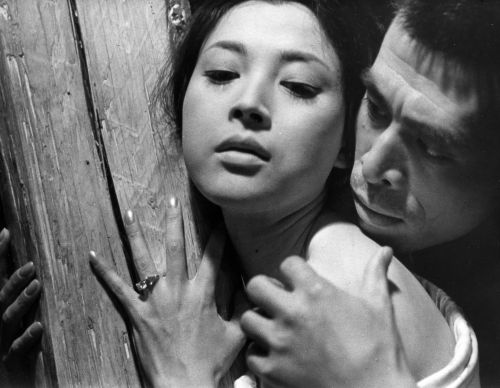
Mariko Okada shows off her discreet charm in Yoshishige Yoshida’s steamy tale THE AFFAIR (© Shochiku Co., Ltd.)

Mariko Okada shows off her discreet charm in Yoshishige Yoshida’s steamy tale THE AFFAIR (© Shochiku Co., Ltd.)

THE AFFAIR (JOEN) (FLAMES OF LOVE) (Yoshishige Yoshida, 1967)
Japan Society
333 East 47th St. at First Ave.
Thursday, April 15, 7:30
212-715-1258
www.japansociety.org

“Mariko Okada: The Discreet Charm of the Adulteress,” the final section of the Japan Society’s three-part “Mad, Bad . . . & Dangerous to Know: Three Untamed Beauties” film series, begins on April 13 with a screening of Yoshishige Yoshida’s fifth collaboration with Okada and continues on April 14 with the fascinating erotic tale THE AFFAIR. In the latter, also known as FLAMES OF LOVE, Okada stars as Oriko, an unhappily married woman who wants a divorce from her cheating husband, Furuhata (Tadahiko Sugano). In a flashback, she shows her displeasure with her widowed mother (Yoshie Minami), who is carrying on a heated affair with young sculptor Mitsuhuru (Isao Kimura); in the current day, she seeks out the Noguchi-like artist to find out about his relationship with her now-dead mother but learns a lot more than she expected. Meanwhile, Furuhata’s sister, Yokio (Shigako Shimegi), tries to get the traditional, old-fashioned Oriko out of the house and partying with her three male friends, who smoke cigarettes, drink beer, and break out in sudden groovy dances at the spur of the moment. But when Oriko—who still wears kimonos and worries about what is considered proper in a society that is changing drastically all around her—spies on Yokio having hot, casual sex with a common worker (KILL!’s Etsushi Takahashi in his film debut), her own hidden sexuality is awakened. Yoshida, who trained at Shochiku under Nagisa Oshima (CREUL STORY OF YOUTH, IN THE REALM OF THE SENSES), incorporates Bergmanesque touches with a Nouvelle Vague sensibility and more than a hint of Teshigahara (WOMAN IN THE DUNES) in this strikingly visual, highly stylized tale, including sweeping, dreamlike flashbacks, gorgeous long shots, and a haunting theme of duality evident in his use of mirrors and windows, light and dark. “Mad, Bad . . . & Dangerous to Know” concludes on April 18 with Yoshida’s WOMAN OF THE LAKE (ONNA NO MIZUUMI) and Yasuzo Masumura’s highly charged TWO WIVES (TSUMA FUTARI), which has never before been screened outside of Japan.



TWO BY KUROSAWA: DERSU UZALA

Maxim Munzuk stars as the remarkable title character in Kurosawa classic (courtesy Kino International)

Maxim Munzuk stars as the remarkable title character in Kurosawa classic (courtesy Kino International)

DERSU UZALA (Akira Kurosawa, 1975)
Film Forum
209 West Houston St.
April 14-22
212-727-8110
www.filmforum.org

In this stunning film, director-cowriter Akira Kurosawa has fashioned one of cinema’s greatest characters, a worldly wise, deceptively simple charming man who understands life, nature, responsibility, and helping others. Maksim Munzuk gives a marvelously understated performance as the title character, who is suddenly taken out of his quiet life of solitude when a Russian army troop comes to Siberia. Film Forum is screening the film as part of its continuing celebration of the centennial of Kurosawa’s birth; it will be followed April 23-29 by his 1970 epic DODES’KA-DEN, in a new 35mm print.

JOIN THE ECO-SEXUAL REVOLUTION

ecosex

Bar 13
35 East 13th St.
Thursday, April 15, no cover, 9:00 pm – 4:00 am
www.ten-speed.crownpublishing.com
www.stefanieirisweiss.com

In her new book ECO-SEX: GO GREEN BETWEEN THE SHEETS AND MAKE YOUR LOVE LIFE SUSTAINABLE (Ten Speed Press, March 2010, $14.99), New York-based writer Stefanie Iris Weiss combines environmental awareness with romance, taking on such topics as eco-courtship, eco-gorgeousness, eco-fashion, eco-safe sex, and ecolicious aphrodisiac foods. In the book’s introduction, Weiss offers the “dirty truth: If you haven’t thought about greening your sex life, you’re still a total environmental disaster. Your compost heap isn’t worth dirt if your bedroom is a toxic waste dump. Sex can be one of the lowest-impact forms of entertainment (and exercise) on the planet, but only if you do it right.” You can seek to do it right on April 15 at Bar 13 at the official after-party celebrating the book’s release, featuring DJ sets from Standenco, John Dill, and Vadim, who will be spinning tunes as attendees pick up signed copies of the book and hook up over Sustainable Orgasms—drinks made with organic vodka.

SPA WEEK 2010

L'Institut Sothys New York in Midtown will be offering a trio of $50 specials during Spa Week

L’Institut Sothys in Midtown is one of more than two hundred area spas offering $50 specials during Spa Week

Through April 18, $50 per treatment
www.spaweek.com

Spa Week is an annual festival of $50 facials, massages, manicures, pedicures, and other health and beauty treatments designed to spread knowledge about spas to a broader range of people. Since its inception in 2004, the event has booked more than 350,000 customers across the country, allowing average Americans to sample cutting-edge clinical skin and body therapies such as photo (light-based) facials and microdermabrasion as well as good old-fashioned pampering. The special $50 spots, which can regularly run from $75 to $500, sell out early, so find the one you want fast and make your reservation. The promotion features more than two hundred spas, most in Manhattan but also in Brooklyn, Queens, Long Island, and Westchester. Among the ritziest is Caudalie Vinispa at the Plaza Hotel, one of fewer than half a dozen outposts of this groundbreaking French skincare line; using the active ingredient in grapes, reservatrol, the spa will be offering such treatments as the Vinitherapie facial and pedicure. For water rather than wine, the downtown Great Jones Spa on Great Jones Street can’t be beat; all three of their Spa Week treatments, including bikini wax, mani/pedi, and blowout, include passes to the sumptuous Water Lounge. On 57th St. and Sixth Ave., the American flagship of the venerable French L’Institut Sothys is featuring forty-five-minute massages, bikini waxes, and their signature seasonal facial. Every season Sothys changes the natural ingredients in their skin treatments: this spring is the raspberry and rhubarb facial, chosen for the fruit-and-vegetable combo’s skin-healing and rejuvenating benefits, not just their tasty tastes and scents. Exhale Spa, with locations on Central Park South, in the Meatpacking District, and on the Upper East Side, offers their usual slate of mind/body wellness activities, including yoga classes with well-known teachers Susan Orem and Dana Strong; for Spa Week they are offering full-length hour-long fusion massages and true facials. But that’s only the tip of the iceberg; log on to the official Spa Week website to choose from among the many unusual treatments available.

WILLIAM KENTRIDGE: FIVE THEMES

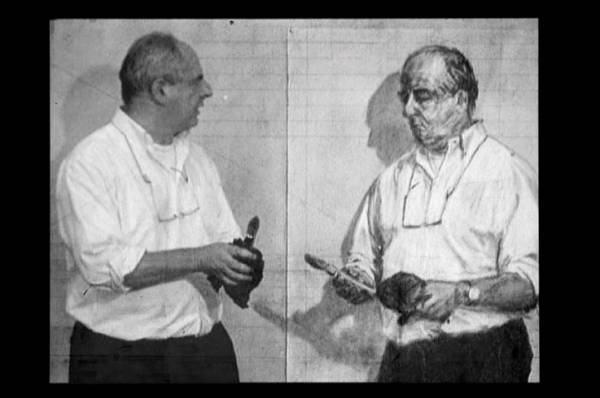
William Kentridge, from “7 Fragments for Georges Méliès,” 35mm and 16 mm animated film transferred to video, 2003 (courtesy of the artist and Marian Goodman Gallery)

William Kentridge, from “7 Fragments for Georges Méliès,” 35mm and 16 mm animated film transferred to video, 2003 (courtesy of the artist and Marian Goodman Gallery)

Museum of Modern Art
West 54th St. between Fifth & Sixth Aves.
Through May 17 (closed Tuesdays; Fridays free from 4:00 to 8:00)
Admission: $20 (includes same-day film screening)
212-708-9400
www.moma.org

In 2001, William Kentridge burst onto the New York art scene with an awe-inspiring show at the New Museum of Contemporary Art in SoHo, introducing to many the unique style employed by this South African artist who creates remarkable films made from charcoal drawings. Nearly ten years later, Kentridge is back with a bang, as multiple exhibits and special events have displayed the breadth of his work and his ingenuity, from his production of Shostakovich’s THE NOSE at the Met and his book of watermarks at Dieu Donné to screenings of his films with live music at the World Financial Center to a quartet of his “Drawings for Projection” series opening at the Jewish Museum on May 2. The centerpiece is the sensational display at MoMA, which continues through May 17. Arranged in a beautifully “generous layout,” as curator Klaus Biesenbach noted at the opening, “William Kentridge: Five Themes” features a bevy of rooms dedicated to the many worlds the artist has created via drawing, film, and a pair of model theaters. Kentridge himself is evident in much of his work, either as a character in his films or through the smudges, erasures, and new markings visible in his animation as he moves from page to page, revealing his unique and fascinating methods, laying himself—Jewish, white, a descendant of a well-known legal family in Johannesburg—bare. “The studio is an enclosed space, not just physically but also psychically, like an enlarged head; the pacing in the studio is the equivalent of ideas spinning around in one’s head, as if the brain is a muscle and can be exercised into fitness, into clarity,” he writes in the exhibition catalog, to which he has contributed several essays alongside a major examination by Mark Rosenthal, who organized the show at its first stop, SFMoMA.

William Kentridge, “Man with Megaphone Cluster,” “Untitled (Man with Megaphone),” etching, aquatint, drypoint, and engraving with roulette and crayon additions, 1998, and “Drawing for the film ‘Stereoscope,’” charcoal and pastel on paper, 1998-99 (photo by twi-ny/mdr)

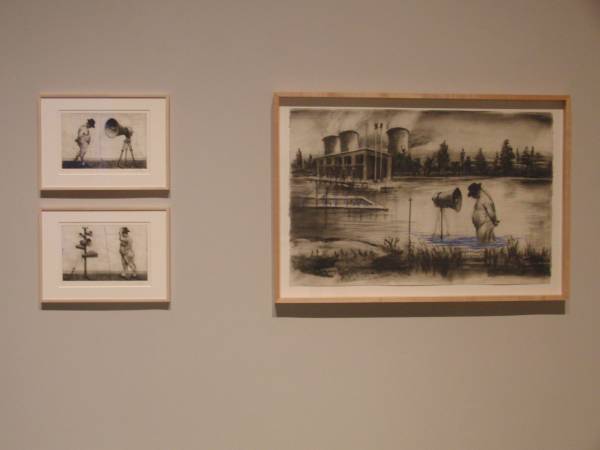
William Kentridge, “Untitled (Man with Megaphone),” “Man with Megaphone Cluster,” etching, aquatint, drypoint, and engraving with roulette and crayon additions, 1998, and “Drawing for the film ‘Stereoscope,’” charcoal and pastel on paper, 1998-99 (photo by twi-ny/mdr)

At the heart of Kentridge’s oeuvre is his series of films depicting wealthy industrialist Soho Eckstein, naked dreamer Felix Teitlebaum, and the woman caught in between, Mrs. Eckstein. In such short films as “Stereoscope,” “Monument,” “History of the Main Complaint,” and “Mine,” all made without a script or a storyboard, Kentridge relates their continuing tale in an abstract narrative bursting with emotion, incorporating greed and loneliness, love and loss, and the division of the self. (It is not a coincidence that both Soho and Felix resemble the artist himself.) But “Thick Time: Soho and Felix” is only one of the themes that runs through the exhibit. “Ubu and the Procession” includes two films that harken back to Alfred Jarry’s Ubu character, reimagining him in South Africa; “The Magic Flute” and “The Nose” take visitors behind the scenes of Kentridge’s recent productions of the two operas, the first held at BAM in 2007, the latter at the Met in March. “Artist in the Studio” consists of “7 Fragments for Georges Méliès,” seven films on view together in one room, all of which reveal the artist at work. The excellent catalog contains a must-have DVD that goes even further into Kentridge’s process, presenting discarded snippets, fascinating revelations about his method, and complete versions of his first experimental short as well as the full-length “Tide Table.” “I believe that in the indeterminacy of drawing—the contingent way that images arrive in the work—lies some kind of model of how we live our lives,” Kentridge has said. “The activity of drawing is a way of trying to understand who we are and how we operate in the world.” This exciting survey at MoMA is all that and more.