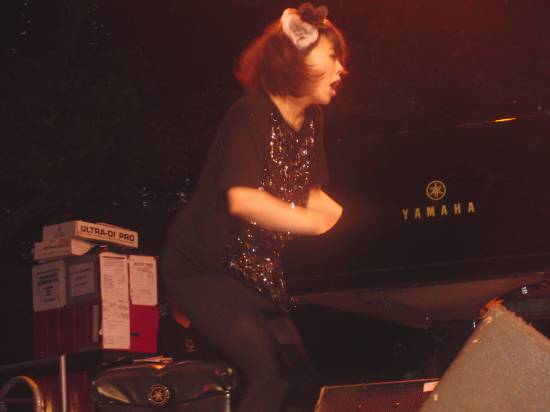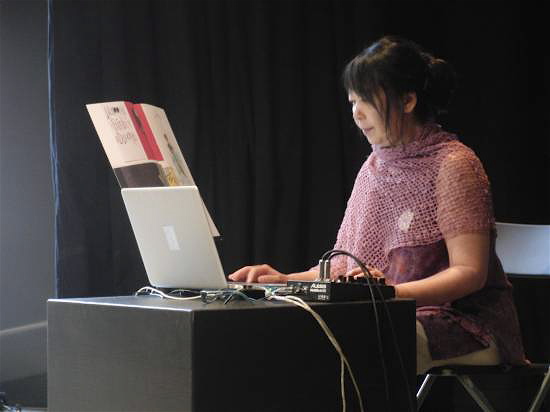
Electronic musician Ikue Mori interprets Christian Marclay’s “Ephemera” score at the Whitney with pianist Sylive Courvoisier (photo by twi-ny/mdr)
Whitney Museum of American Art
945 Madison Ave. at 75th St.
Wednesday – Sunday through September 26
Admission: $12-$18 (pay-what-you-wish Fridays from 6:00 to 9:00)
212-570-3600
www.whitney.org
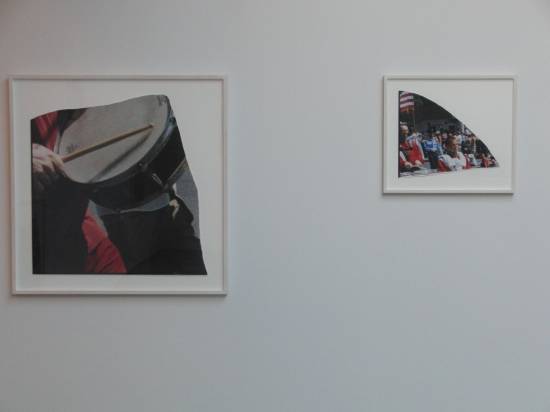
Since the late 1970s, New York-based multidisciplinary artist Christian Marclay has been exploring the intimate connection between sound and image through sculpture, video, photography, live music, collage, and site-specific installation. His unique approach to this relationship is on view at the Whitney in the thrilling interactive exhibition “Festival,” which includes dozens of Marclay’s highly original scores, including “Graffiti Composition,” comprising graffiti scribbled on posters by passersby in Berlin; “Pret-a-Porter,” consisting of clothing that has musical notations on them; “Zoom Zoom,” a slideshow of photographs of signs that contain onomatopoeiac language; “Mixed Reviews,” translated music reviews that run around one gallery space in a seemingly endless line of text; “Covers,” a collection of empty record sleeves; “The Bell and the Glass,” a double video projection that draws comparisons between the Liberty Bell and Marcel Duchamp’s “The Bride Stripped Bare by Her Bachelors”; and “Chalkboard,” in which visitors are encouraged to write or draw anything they want on a giant musical staff. All of these scores and more are meant to be interpreted and improvised by musicians, guaranteeing that no two performances will ever be the same. Live events, all free with paid museum admission, continue daily through August 27, with such upcoming “concerts” as Peter Evans and Zeena Parkins performing “Box Set” on August 18 at 1:00, David Moss taking on “Manga Scroll” on August 20 at 7:00, Kato Hideki, Zeena Parkins, Sara Parkins, and Nels Cline teaming up for “The Bell and the Glass” on August 21 at 1:30, Robin Holcomb and Wayne Horvitz interpreting “Graffiti Composition” on August 25 at 4:00, and Bill Frisell playing “Wind Up Guitar” on August 26 at 1:00. There will also be Artist’s Talks every Friday afternoon, with Moss on August 20, Marina Rosenfeld on August 27, and Guy Klucevsek on September 3 and 17. “Festival” is indeed a festival of word, sound, and image, a fascinating celebration of aural and visual language by a masterful artist whose reach knows no boundaries.
In conjunction with “Festival,” which runs through September 26, Marclay’s “Fourth of July” has been extended at the Paula Cooper Gallery in Chelsea through August 24. (Also currently at the Whitney are “Jill Magid: A Reasonable Man in a Box,” “Off the Wall: Part 1 — Thirty Performative Actions,” and “Collecting Biennials.”)
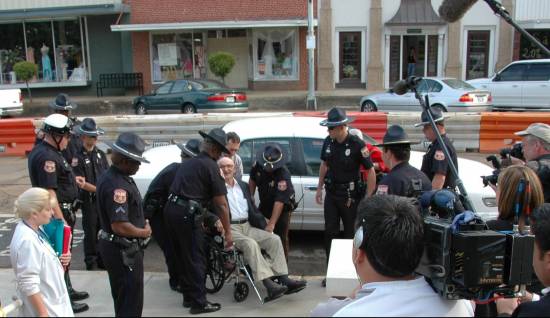
 In 1964, civil right workers James Chaney, Andrew Goodman, and Michael Schwerner were murdered in cold blood in Neshoba, a small county in Mississippi. Although everyone in the town seemed to know that the atrocity was committed by a group of twenty-one members of the Ku Klux Klan, no one had been convicted of the crimes, which were famously fictionalized in Alan Parker’s 1988 film MISSISSIPPI BURNING. In 1999, Carolyn Goodman, Andrew’s mother, approached documentary filmmaker Micki Dickoff and shared her story and her continuing battle for justice. Five years later, as the fortieth anniversary of the killings led to new investigations, Dickoff (DEADLY AMBITION, STEP BY STEP) teamed up with cinematographer Tony Pagano (20/20) and turned their cameras on the citizens of Neshoba and the families of the victims as state attorney general Jim Hood and local activist group the Philadelphia Coalition sought to reveal the truth about what had happened and bring those responsible to justice. They focused their attention on eighty-year-old preacher Edgar Ray Killen, believed by many to have incited the mob to murder. Killen, who gave the filmmakers unlimited access to himself, boldly declares his innocence — while also proclaiming that Goodman and Schwerner, who were white New Yorkers, and Chaney, a black Mississippi native, got what they deserved. Dickoff and Pagano meet with an alarming number of elderly white locals who feel exactly the same way, in addition to younger Neshobans who would rather let the story go away, seeing no reason to go after the eight surviving alleged perpetrators. NESHOBA: THE PRICE OF FREEDOM, which has won awards at film festivals all around the country, is a frightening, disturbing look into the heart of racism, which is still alive and well in such places as Neshoba, Mississippi. It is also a fascinating examination of a courageous battle for justice, closure, and the truth. As Barack Obama has said about the victims, “Their legacy is our heritage.”