twi-ny recommended events

WILLIAM SHATNER: STILL BOLDLY GOING

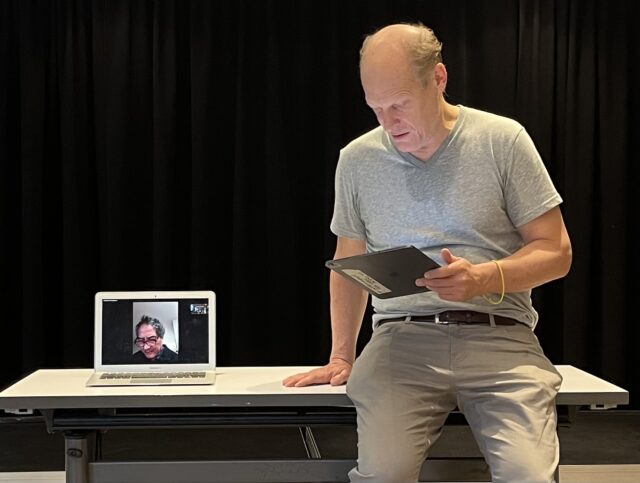
Who: William Shatner, Joshua Brandon, Rabbi Joshua M. Davidson
What: Livestreamed discussion
Where: Temple Emanu-El Streicker Cultural Center online
When: Thursday, October 6, free with RSVP ($28 with a copy of the book), 7:00
Why: “I love the mystery of the universe. I love all the questions that have come to us over thousands of years of exploration and hypotheses. Stars exploding years ago, their light traveling to us years later; black holes absorbing energy; satellites showing us entire galaxies in areas thought to be devoid of matter entirely . . . all of that has thrilled me for years. Where matter in the universe came from, where it’s going, why it’s expanding . . . I know very little, but I know just enough about the universe to be in its thrall, in awe of its mystery.”

So writes William Shatner in his latest book, Boldly Go: Reflections on a Life of Awe and Wonder (Atria, October 4, $28), which includes such essays as “We Belong Together,” “Listen to the Animals,” and “There’s Beauty in Everything.” Now ninety-one, the actor, singer, horseman, and astronaut, whose grandparents emigrated from Ukraine and Lithuania, will launch the tome in a virtual presentation from the Temple Emanu-El Streicker Cultural Center on October 6 at 7:00, speaking with his coauthor, Joshua Brandon, and moderator Rabbi Joshua M. Davidson. Registration is free, or you can order the book with the RSVP for $28. “I probably say wow more now than when I was a child, and I am absolutely enchanted by that fact,” Shatner explains in the introduction. “I don’t know how not to be doing. I really would regret not giving myself a chance to experience something new and to learn in the process.” Words to live by from a living legend.

BALDWIN AND BUCKLEY AT CAMBRIDGE

James Baldwin (Greig Sargeant) and William F. Buckley (Ben Jalosa Williams) face off about the American dream at the Public (photo by Joan Marcus)

BALDWIN AND BUCKLEY AT CAMBRIDGE
Anspacher Theater, the Public Theater
425 Lafayette St. at Astor Pl.
Tuesday through Sunday through October 23, $60-$70
212-539-8500
publictheater.org

During the pandemic lockdown, I watched the american vicarious’s virtual Debate: Baldwin vs Buckley, a sharp re-creation of the famous debate between liberal Black author James Baldwin and conservative white author William F. Buckley that was held at the University of Cambridge in England on February 18, 1965, addressing the question “Has the American Dream been achieved at the expense of the American Negro?” Presented in collaboration with BRIC, the show premiered in person at the Great Room at A.R.T./New York in March 2022 and continues its five-borough tour October 10 at the Old Stone House and November 11 at the Queens Theater. The online performances took place on a dark, spare stage with Baldwin (Teagle F. Bougere) and Buckley (Eric T. Miller) on either side of a small table; the in-person play moved the proceedings to a wood-paneled conference room with a black-and-white television occasionally showing clips of the original debate.

I also watched that original debate, which can be found on YouTube. It is a thrilling event, as mostly white male students in suits and ties pack the Cambridge Union; there’s barely room for the two main competitors to walk to their places at their opposing lecterns. The multiple cameras cut between the crowd and close-ups of Baldwin, in a narrow tie, and Buckley, in a bowtie, as they state their cases and react to each other’s points.

When I heard that Elevator Repair Service, one of the city’s most adventurous and daring companies for more than thirty years, was doing its own version, titled Baldwin and Buckley at Cambridge, at the Public’s Anspacher Theater, I was excited by the possibilities; ERS has previously staged unique interpretations of such classics as The Sound and the Fury, The Seagull, Ulysses, Measure for Measure, and The Great Gatsby (the eight-hour Gatz). Alas, perhaps I was expecting too much.

James Baldwin (Greig Sargeant) and Lorraine Hansberry (Daphne Gaines) have a drink while discussing racism in Baldwin and Buckley at Cambridge (photo by Joan Marcus)

Directed by ERS founding artistic director John Collins, Baldwin and Buckley at Cambridge turns out to be, more or less, a straightforward adaptation of the debate, with small little touches. The introductions by Cambridge students David Heycock (Gavin Price) and Jeremy Burford (Christopher-Rashee Stevenson) are delivered in contemporary dress (the costumes are by Jessica Jahn) and include a land acknowledgment and references to the Public, which opened on Lafayette St. in 1967. Heycock quotes Martin Luther King Jr. and shares frightening numbers about voting and prison that immediately bring to mind current attempts at voter suppression and the Black Lives Matter movement. Burford argues that “the American dream has been very important indeed in furthering civil rights and in furthering freedom for the American Negro,” a controversial statement, especially as delivered by Stevenson, who is Black. (Price is white.)

The bulk of the show are the two long monologues by Baldwin and Buckley, portrayed by Greig Sargeant and Ben Jalosa Williams, respectively; neither actor tries to fully embody their character, although Williams throws in a few lines doing a mock impression of the erudite Buckley’s upper-class accent. Although the words resonate with what is happening today, I wasn’t grabbed by the proceedings. Perhaps it was because I was too familiar with it all, having so recently seen the american vicarious version and the original. It also felt distant; the 1965 debate was filled to the gills with students, shoulder to shoulder in chairs and on the floor, while at the Anspacher we were sitting quietly in our seats, experiencing a fictionalized play, not actual history.

The play did not end with the conclusion of the debate; ERS adds a coda that initially stirred me but eventually left me confused. The brief scene takes place in a living room (the sets are by dots), where Baldwin is joined by his good friend, playwright Lorraine Hansberry (Daphne Gaines), as they discuss four hundred years of racism and the need for societal change. “We’ve got to sit down and rebuild this house,” Baldwin says. “The charge of impatience is simply unbearable,” Hansberry explains.

Mixing past and present, they then turn into Sargeant (who conceived the project) and Gaines, the actors, who recall working together at the Public in ERS’s The Sound and the Fury and discuss white and Black casting. While they make interesting points, reminding us how far we still have to go, it felt tacked on to score sociopolitical points; it also made me think about how Hansberry’s A Raisin in the Sun, which deals with a Black family in 1959 trying to find the American dream, is playing now in the Public’s Newman Theater.

“HELLZAPOPPIN’: WHAT ABOUT THE BEES?”

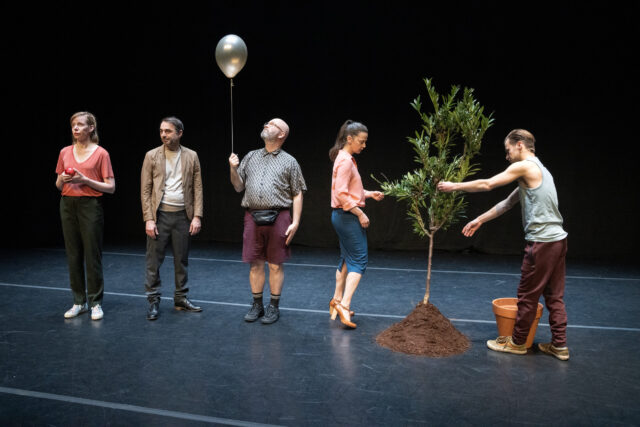
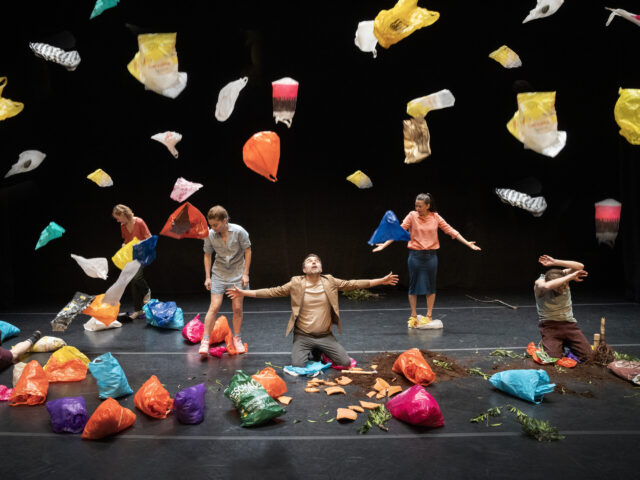
Yvonne Rainer’s “last dance” includes a pillow fight at New York Live Arts

Who: Emily Coates, Brittany Bailey, Brittany Engel-Adams, Patricia Hoffbauer, Vincent McCloskey, Emmanuèle Phuon, David Thomson, Timothy Ward, Kathleen Chalfant
What: World premiere
Where: New York Live Arts Theater, 219 West Nineteenth St. between Seventh & Eighth Aves.
When: October 5-8, $15-$85
Why: Legendary dancer, choreographer, filmmaker, author, and activist Yvonne Rainer asks, “What about the bees?” in what she has announced will be her “last dance.” Premiering October 5-8 at New York Live Arts, “HELLZAPOPPIN’: What about the bees?” takes on systemic racism through text, movement, and live projections, including excerpts from the 1941 Hollywood musical Hellzapoppin’, a reality-busting movie melding film and theater starring Ole Olsen and Chic Johnson, Martha Raye, Mischa Auer, Shemp Howard, Slim and Slam, and Whitey’s Lindy Hoppers, and Jean Vigo’s highly influential 1933 antiestablishment film about boarding school, Zero for Conduct. The evening begins with a screening of Rainer’s 2002 half-hour film After Many a Summer Dies the Swan: Hybrid, which expands on a piece she choreographed for Mikhail Baryshnikov’s White Oak Dance Project incorporating texts by Oscar Kokoschka, Adolf Loos, Arnold Schoenberg, and Ludwig Wittgenstein and rehearsal footage shot by Charles Atlas and Natsuko Inue.

“HELLZAPOPPIN’: What about the bees?” runs October 5-8 at NYLA

A coproduction of NYLA and Performa, “HELLZAPOPPIN’: What about the bees?” will be performed by a mix of dancers and actors, featuring Emily Coates, Brittany Bailey, Brittany Engel-Adams, Patricia Hoffbauer, Vincent McCloskey, Emmanuèle Phuon, David Thomson, Timothy Ward, and Kathleen Chalfant. Rainer also harkens back to her fictional character Apollo Musagetes, leader of the muses, who in 2020 presented “Revisions: A Truncated History of the Universe for Dummies: A Rant Dance, Lecture, and Letter to Humanity.” “I’m going to be veering back and forth between various topics: my aging self-pity, my ‘permanently recovering racism,’ my sometimes evasive appropriation of the notion that not all white people, and not all white women, are racists, and various historical and cultural reflections,” Rainer, who is now eighty-seven, said in a statement. Rainer will participate in a Stay Late conversation with Bill T. Jones following the October 6 show.

BURNING BRIGHT — NEW FRENCH FILMMAKERS 2022: ZERO FUCKS GIVEN

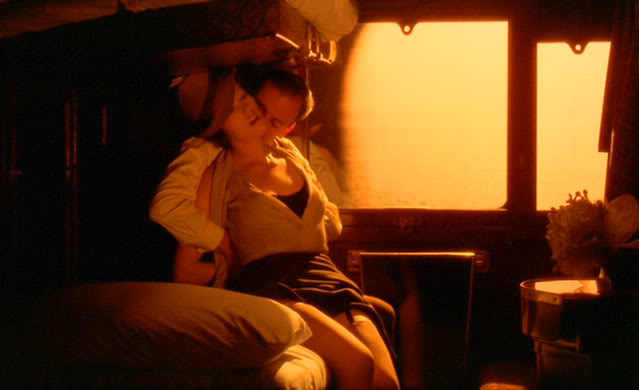
Adèle Exarchopoulos stars as a flight attendant going nowhere in Zero Fucks Given

CinéSalon: ZERO FUCKS GIVEN (RIEN À FOUTRE) (Julie Lecoustre & Emmanuel Marre, 2021)
French Institute Alliance Française (FIAF)
FIAF Florence Gould Hall
55 East 59th St. between Madison & Park Aves.
Tuesday, October 4, 4:00 & 7:30
Series continues Tuesdays through October 25, 4:00 & 7:30
fiaf.org

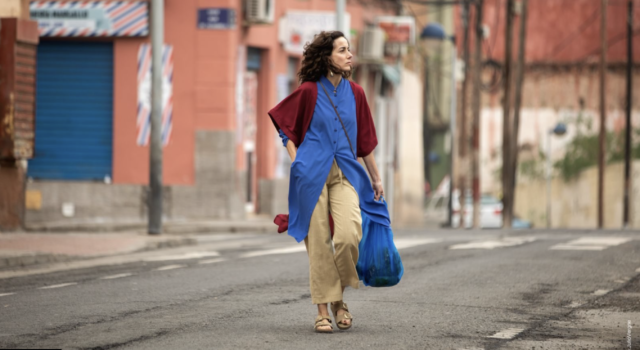
Adèle Exarchopoulos is magnetic as a flight attendant with a loose grip on her life in Zero Fucks Given, the debut directorial collaboration between Paris- and Brussels-based cowriters and producers Emmanuel Marre and Julie Lecoustre. The film is screening October 4 at 4:00 and 7:30 in the FIAF CinéSalon series “Burning Bright: New French Filmmakers 2022,” consisting of nine features and three shorts from up-and-coming and emerging French directors.

Exarchopoulos (Blue Is the Warmest Color, Mandibles) stars as Cassandre, a twentysomething woman who’s unable to commit to anything, but it doesn’t seem to bother her. She considers herself a free spirit, but she doesn’t do much with that freedom. She is based at an airport in Lanzarote in the Canary Islands and wants to get a better airline job in Dubai; she might travel the world, but she spends most of her time in airport hotels and nightclubs, swiping right and left on her cellphone for company. “I like people for two hours and then it’s goodbye,” she tells friends.

As a flight attendant for Wing, she downs vodka before takeoff, usually does the bare minimum at work, and regularly breaks the rules, which she thinks don’t apply to her; when she is offered a promotion, she asserts that she doesn’t want any more responsibilities. After partying, she often wakes up in a blackout about the night before. She might claim to not care, but she is clearly haunted by the death of her mother, who died in a horrific car crash. She has trouble communicating with her father, Jean (Alexandre Perrier), who was devastated by the loss and is trying to sue someone, anyone. When Cassandre — whose name references the Greek mythological figure who was cursed with the ability to prophesize doom that no one listens to — eventually has to return home, suppressed emotions bubble to the surface.

Zero Fucks Given has an infectious, freewheeling atmosphere; the cast includes nonprofessional actors and actual airline personnel, and Perrier, who plays Cassandre’s distraught dad, is one of the associate producers. Marre and Lecoustre (Castle to Castle) eschew rehearsals and encourage significant improvisation while shooting on location with extended breaks in between filming scenes. Exarchopoulos even does her own hair and makeup and wears her own clothing to give the film a more realistic feeling.

Cinematographer Olivier Boonjing zooms in on Cassandre’s face and body as she pretends not to care about what she’s doing, but there’s more to her than she’s allowing herself to acknowledge. “I’m rather lucky,” she says, but she’s going nowhere. She rarely has time to experience the ritzy cities she flies to, traveling back and forth in the enclosed space of airplanes, breathing recycled air. Her mother died in a roundabout, unable to get out of a traffic circle, a stark metaphor for how Cassandre is stuck in life. You might not give a fuck about Cassandre at the beginning, but by the end you’ll be giving more than a few.

“Burning Bright: New French Filmmakers 2022” continues on Tuesdays through October 25 with Audrey Diwan’s Happening, Martin Jauvat’s Grand Paris, and Lina Soualem’s Their Algeria.

NYFF60 MAIN SLATE: TRIANGLE OF SADNESS

Yaya (Charlbi Dean) and Carl (Harris Dickinson) just want to keep enjoying the good life in Triangle of Sadness

TRIANGLE OF SADNESS (Ruben Östlund, 2022)
New York Film Festival, Film at Lincoln Center
Saturday, October 1, Alice Tully Hall, 9:00
Sunday, October 2, Alice Tully Hall, 2:15
Monday, October 3, Walter Reade Theater, 2:30
Monday, October 3, Museum of the Moving Image, 6:00
www.filmlinc.org

About halfway through Ruben Östlund’s brilliant Palme d’Or–winning satire Triangle of Sadness, I let out a sharp, loud laugh that made the people sitting around me wonder if I was okay. I was fine, and there were many more chuckles, snickers, giggles, guffaws, howls, and snorts to come, and not just from me.

In his previous films, Force Majeure and Palme d’Or winner The Square, the Swedish auteur has shown that he never lacks for subtlety as he skewers the lifestyles of the rich but not necessarily famous, mixing fear with farce, pushing both about as far as they can go without breaking.

In Triangle of Sadness, named for the small frown of worry wrinkles between a person’s eyebrows, Östlund channels Luis Buñuel’s The Discreet Charm of the Bourgeoisie and The Exterminating Angel, Monty Python’s The Meaning of Life (the “Autumn Years” segment with Mr. Creosote), and Lina Wertmüller’s romantic class comedy Swept Away . . . by an Unusual Destiny in the Blue Sea of August, resulting in an outrageously over-the-top condemnation of the privilege born of war and colonialism.

The protagonists are semi-successful male model Carl (Harris Dickinson) and female model and social media influencer Yaya (Charlbi Dean), two extremely beautiful people who are at the center of each of the three parts of the 149-minute film. In the first section, Carl auditions for a runway job and the couple argue over who is going to pick up the check after a fancy dinner. In the second chapter, they mostly enjoy their free luxury cruise aboard a yacht even when all hell breaks loose. And in the finale, they have to figure out how far they will go just to stay alive.

Along the way, they meet a fantastic mélange of characters, including vacuous fashion reporter Lewis (Thobias Thorwid), gluttonous Russian capitalist Dimitry (Zlatko Burić), toilet cleaner Abigail (Dolly de Leon), chief ship steward Paula (Vicki Berlin), ridiculously rich single man Jorma Björkman (Henrik Dorsin), ridiculously rich single woman Vera (Sunnyi Melles), ridiculously rich and demure British couple Clementine (Amanda Walker) and Winston (Oliver Ford Davies), the mysterious Nelson (Jean-Christophe Folly), and alcoholic yacht captain Thomas Smith (Woody Harrelson).

Darius (Arvin Kananian) and Captain Smith (Woody Harrelson) try to keep their balance in Palme d’Or winner

Dickinson (See How They Run, Where the Crawdads Sing) and Dean (Spud, Black Lightning) are magnetic together as flawed glitterati who exist in their own reality, until they don’t. (A star in the making, South African actress and model Dean died tragically this past August at the age of thirty-two.) Burić and Harrelson are a riot as their friendship blossoms amid booze and debates over Karl Marx, capitalism, and socialism. As a bonus, the yacht in the film is the Christina O, which was formerly owned by Aristotle Onassis and Jackie Kennedy. The rest of the large cast plays the dark humor with exquisitely calm, mannered demeanors.

Östlund, who has also written and directed Gitarrmongot, Involuntary, and Play, holds nothing back in Triangle of Sadness; the film could use a bit of trimming here and there, but that’s not his style. He puts it all out there, full steam ahead, damn the torpedoes. (The French title is Sans filtre, or “Without Filter.”) Both Force Majeure and The Square left indelible images in my head, and the same is true with his latest film, which still has me breaking out into laughter when I recall several key moments, such as Dimitry boasting, “I sell shit”; ship steward Alicia (Alicia Eriksson) trying not to say no to a demanding passenger; Captain Smith leaning sideways right before the captain’s dinner, next to his stable second in command, Darius (Arvin Kananian); and Abigail asking fellow survivors who’s in charge. It’s all so much unrelenting madness even as it hits you over the head with its political philosophy.

Triangle of Sadness screens October 1-3 at the New York Film Festival, with Östlund, de Leon, and Burić participating in Q&As following the shows on the first two days at Alice Tully Hall. The film opens in theaters October 7.

THEATER TALKS — DEATH OF A SALESMAN: A CONVERSATION WITH WENDELL PIERCE, SHARON D. CLARKE, ANDRÉ DE SHIELDS, AND MIRANDA CROMWELL

Who: Wendell Pierce, Sharon D. Clarke, André De Shields, Miranda Cromwell, Salamishah Tillet
What: Panel discussion on new Death of a Salesman revival
Where: Schomburg Center for Research in Black Culture (NYPL), 515 Malcolm X Blvd., and online
When: Monday, October 3, free with RSVP, 7:00
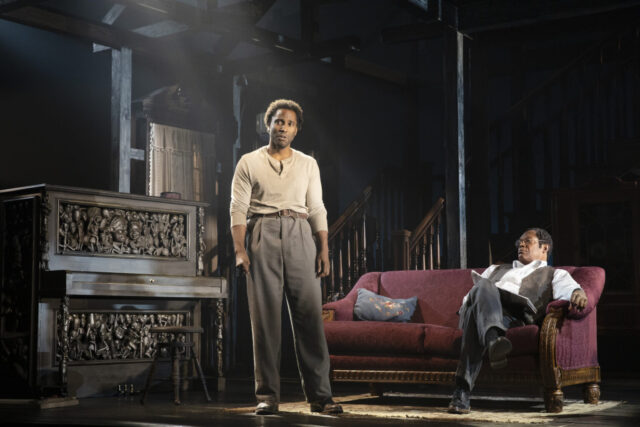
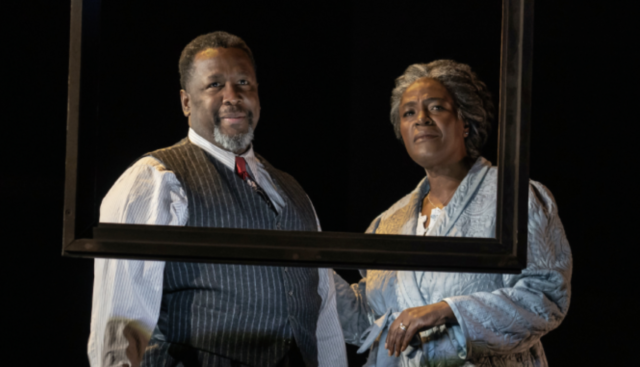
Why: Lee J. Cobb, George C. Scott, Dustin Hoffman, Brian Dennehy, and Philip Seymour Hoffman have all starred as Willy Loman in Broadway productions of Arthur Miller’s Pulitzer Prize–winning 1949 American classic, Death of a Salesman. You can now add to that prestigious list Wendell Pierce, in the latest Broadway revival, now in previews for an October 9 opening at the Hudson Theatre. The cast features Pierce and Sharon D. Clarke as Willy’s wife, Linda — both won Oliviers for their performances in the West End production — along with André De Shields as Ben, Khris Davis as Biff, and McKinley Belcher III as Happy, the first all-Black Loman family on the Great White Way.

On October 3 at 7:00, Pierce (The Wire, The Piano Lesson), Clarke (Holby City, Caroline, or Change), and Tony and Emmy winner De Shields (Hadestown, The Full Monty) will be joined by director Miranda Cromwell (Magic Elves, Pigeon English) and moderator and Pulitzer Prize winner Salamishah Tillet for a discussion at the NYPL’s Schomburg Center for Research in Black Culture; presented in conjunction with the 92nd St. Y’s Unterberg Poetry Center, the free event is being held in person and online, and advance registration is required. “So many of the elements of the play are fundamentally questioning of the American dream, and when you put that through the perspective of the Black experience, that enriches it,” Cromwell said in a statement. “The obstacles are harder, the stakes become higher.”

TAMING THE GARDEN

Taming the Garden follows the uprooting of a mighty oak across land and sea

TAMING THE GARDEN (Salomé Jashi, 2021)
New Plaza Cinema @Macaulay Honors College
35 West Sixty-Seventh St.
Opens Friday, September 30
newplazacinema.org
tamingthegarden-film.com

“I think that I shall never see / A poem lovely as a tree,” Joyce Kilmer wrote in the beloved “Trees,” concluding, “Poems are made by fools like me, / But only God can make a tree.”

Eccentric billionaire and former Georgia prime minister Bidzina Ivanishvili is a kind of unseen god hovering over Salomé Jashi’s profoundly poetic documentary, Taming the Garden. The gorgeously shot film, which evokes the large-scale landscape photography of Edward Burtynsky, is a cinéma verité work that follows the moving of a glorious oak from its native home in the Caucasus to Shekvetili Dendrological Park, where Ivanishvili collects and replants trees that he likes.

Jashi, a former journalist born in Tbilisi, Georgia, in 1981, tells us virtually none of this; she traces the journey with no commentary, no interstitial text, no detailed information about what we are watching. Instead, Jashi, serving as director, writer, producer, and cinematographer (with Goga Devdariani), has us accompany the mighty tree as it ventures across land and sea, first carefully dug up by a somewhat ragtag group of workers, then transported by flatbed and a barge to its ultimate destination.

The beautifully photographed Taming the Garden features scenes that evoke painting and still photography

But in order to arrive there, the tree leaves behind a controversial wake. It is so tall and wide that it often can’t make it through the streets of small towns without other trees that line the blocks having to be severely trimmed or cut down themselves. Ivanishvili offers those trees’ owners money in exchange for chopping down the living, breathing trees; he also improves the quality of the roads the tree travels over. The residents of these villages argue over the decisions they are faced with, mostly speaking Mingrelian.

“Why do these trees have to suffer? Just so Ivanishvili can have his tree!” one declares. “They’re forcing me to do something bad,” another says, feeling he has no choice but to take the cash and let a tree on his property be chainsawed into timber. “They say they’d rather have a tree than a road!” a man complains. “Who gives a fuck about trees!”

“What is there to cry about?” a villager says to an elderly woman who remembers having planted a sapling more than half a century before; she is now in tears as she watches it come down. Someone else shouts out in wonder, “That man really likes trees!”

Beautifully edited by Chris Wright and featuring a natural soundscape by Philippe Ciompi accompanied by music by Karlheinz Stockhausen (“Waage”), Solage, Clément Janequin, and Ute Wassermann (“Strange Songs for Voice and Bird Whistles”), Taming the Garden is a visual and aural marvel. It is filled with images you are likely not soon to forget: the oak floating on a barge in the distance on the Black Sea; rusty piping being pushed into the dirt below the tree; dripping water that evokes the shadows of roots and branches growing; men clearing a path in a lush green landscape reminiscent of a Dutch painting; and the leaves at the top of the tree blowing in the breeze as it is driven down a street, as if moving from Great Birnam Wood to Dunsinane Hill at the end of Macbeth.

At one point a woman, standing in the street as others take cellphone video of the chopping down of a tree, makes the sign of the cross. “A tree that looks at God all day, / And lifts her leafy arms to pray,” Kilmer wrote in his 1914 poem. With Taming the Garden, Jashi (The Dazzling Light of Sunset, Bakhmaro) has created a deeply sensitive and eloquent cinematic experience that deals with one man’s power as it relates to the concepts of home and displacement. “Everything we do in this life will be weighed up in the next life,” one man philosophizes. Joyce Kilmer couldn’t have said it any better.