
The Sweetback Sisters will be part of pscyhedelic cowboy show in Brooklyn on October 9
Union Pool
484 Union Ave. at Meeker St.
Saturday, October 9, 9:00
www.myspace.com/unionpool
www.thesweetbacksisters.com
Union Pool is the place to be on October 9 to catch an evening of eclectic (and electric?) country music. The bill features several bands, including Austin McCutchen, the Five Deadly Venoms, and local favorites the Sweetback Sisters. The Sweetbacks are a uniquely attired and entertaining six-piece. Frontwomen Zara Bode and Emily Miller make for a sweet-voxed, talented duo whose love of the stylings of Roger Miller and the Davis Sisters translates into a rollicking pastiche of country crooning and western swing that won’t disappoint admirers of Patsy Cline or Hank Sr. While the Sweetbacks embrace the genre’s kitsch in all its honky-tonk glory — take, for example, such songs as “My Uncle Used to Love Me but She Died” and “I Want to Be a Real Cowboy Girl” — it’s the combo’s top-flight, engaging music that puts it a “two-step” ahead, leaving schtick behind. The band is rounded out by a cast of characters straight out of Characterville: a polymath composer/fiddler from the deep woods of West Virginny, a swingin’ slap-bassist, a fresh-faced mandolin-playing drummer who looks like he should be walking door-to-door handing out tracts, and a lead guitarist whose propulsive surf leads ring out strong from his Telecaster. It all adds up to a combination of odd, inspired covers and sharp originals in a country vein, wells of achingly sweet harmony, and a strong, friendly stage presence.

 Written, directed, and edited by Julia Bacha, who also served as one of the producers, BUDRUS has been having an impact at film festivals around the world, including Sydney, Dubai, San Francisco, London, Berlin, Jerusalem, and Tribeca. The documentary follows a small group of protesters in the village of Budrus, population 1,500, as they battle the Israeli military, which has been charged with protecting construction workers who are bulldozing the people’s lifeblood, hundreds of acres of olive trees, in order to put up the wall known as the separation barrier, isolating the Palestinians in the West Bank; the “red line” also goes right through the village’s cemetery. But local leader Ayed Morrar decides to try something relatively different for the Middle East, emphasizing nonviolence and even permitting women, including his fifteen-year-old daughter, to participate in their dangerous movement. The Popular Committee Against the Wall’s mission appears destined to fail until they are joined by Jews who believe that the Israeli government needs to reconsider where they are putting up the fence and allow the Palestinians to keep their land and preserve their history. Bacha talks to people on both sides of the struggle, including the Morrars as well as Israeli soldiers Doron Spielman and Yasmine Levi, who all speak honestly about their complex situation. Made by a team of Jews and Palestinians who have formed Just Vision, an organization dedicated to bringing to light nonviolent peacebuilding efforts in the Middle East, BUDRUS could have easily turned into propaganda, but in the end its agenda is something difficult to argue with. The film opens at the Quad on October 8, with Bacha and producer Avni Ronit participating in Q&As following the 8:10 show every night.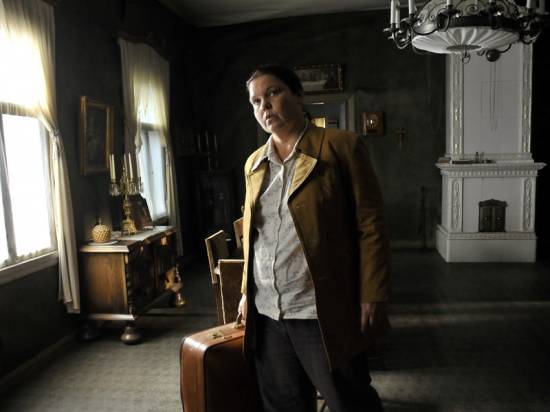
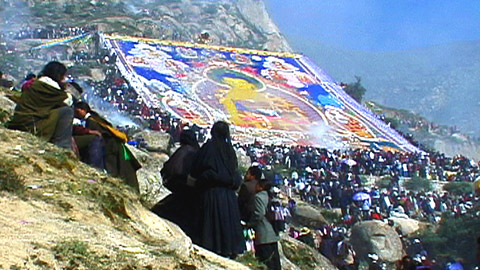
 John Bush’s Yatra Trilogy concludes with VAJRA SKY OVER TIBET: JOURNEY INTO AN ENDANGERED WORLD, a reverential documentary that examines the history of the Tibetan people, focusing on the long-standing battle with China. In 1959, the fourteenth Dalai Lama was forced into exile, finding safe haven in India. Although many Tibetans escaped with him, many stayed behind, where they practice their faith under the sharp watch of the Chinese government, which would like to name their own Dalai Lama in time. VAJRA SKY OVER TIBET is the third part of the Yatra Trilogy by producer/director John Bush, following DHARMA RIVER and PRAJNA EARTH, as Bush completes his Buddhist pilgrimage that previously took him to Southeast Asia. Bush, a Western Buddhist himself, gained remarkable access to some of Vajrayana Buddhism’s holiest palaces and sites of worship, including Jokhang Temple in Llasa, the Potala, and the Norbulinka. Bush winds his way through the Drepung Festival, traveling with a Tibetan guide whose name he can’t share because of possible reprisals. Bush narrates much of the film, along with Tenzin L Choegyal, the nephew of the current Dalai Lama, and Dadon, a popular Tibetan singer. The meditative score is by David Hykes and the Harmonic Choir, supplemented with devotional music by Dadon and other Himalayan musicians. Although it often plays too much like a travel show on PBS or the Travel Channel, VAJRA SKY, which has been personally endorsed by the Dalai Lama, is an illuminating look into a fascinating culture that is in serious danger of disappearing. “Tibetan civilization,” writes the Dalai Lama as the film begins, “forms a distinct part of the world’s precious common heritage. Humanity would be the poorer if it were to be lost.” For nearly ninety minutes, with beautiful cinematography, captivating music, and gorgeous settings, Bush takes viewers deep inside a mysterious, peaceful, and threatened world that you will not soon forget. Bush will be on hand for this special screening at the Interdependence Project to participate in a postscreening Q&A — in addition, there will also be a prescreening optional meditation.

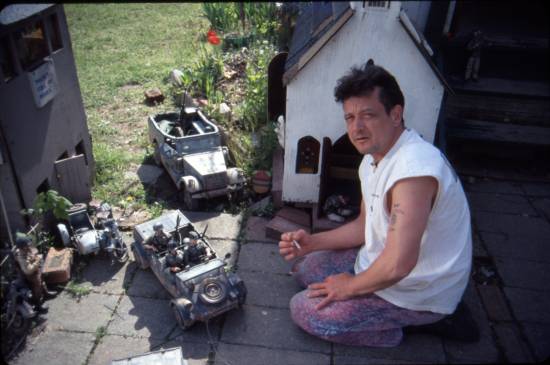
 Named Best Documentary at numerous film festivals across the country, MARWENCOL offers a surprising look inside the creative process and the fine line that exists between art and reality. On April 8, 2000, Mark Hogancamp was nearly beaten to death outside a bar in his hometown of Kingston, New York. He spent nine days in a coma and more than a month in the hospital before being released, suffering severe brain damage that has left his memory a blur. To help put his life back together, he began using toys and dolls — Barbies, celebrity replicas, army men — to re-create his personal journey. He makes dolls of his friends and relatives, the people he works with, and others, constructing an alternate WWII-era universe he calls Marwencol, complete with numerous buildings and plenty of Nazis. He captures the detailed story in photographs that are not only fascinating to look at but that also help him figure out who he was and who he can be. This miniature three-dimensional world is reminiscent of the two-dimensional one carefully fashioned by outsider artist Henry Darger in his fifteen-thousand-page manuscript, The Story of the Vivian Girls, in What is known as the Realms of the Unreal, of the Glandeco-Angelinnian War Storm, Caused by the Child Slave Rebellion, which also features an alternate reality involving military battles set amid stunning artwork. Director, producer, and editor Jeff Malmberg makes no judgments about Hogancamp, and asks the same of the audience. In his first full-length film, Malmberg shares the compelling story of a deeply troubled, flawed man suddenly forced to begin again, using art and creativity to bring himself back to life. He speaks with Hogancamp’s mother, his old roommate, the prosecutor who handled his case, and others who are first seen proudly holding the doll Hogancamp made of them. And Malmberg doesn’t turn away from the more frightening aspects of Hogancamp’s daily existence. MARWENCOL is an unforgettable portrait of lost identity and the long road to redemption.