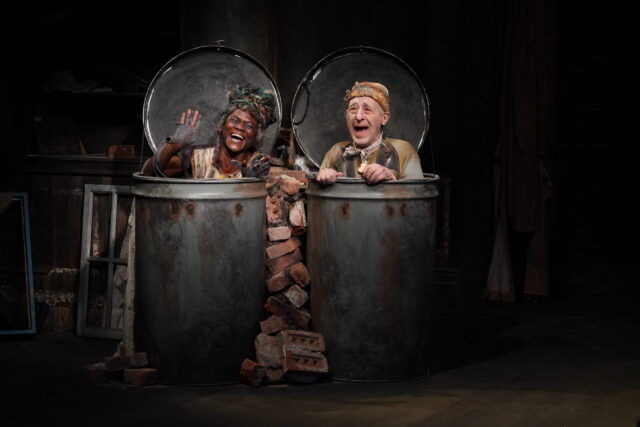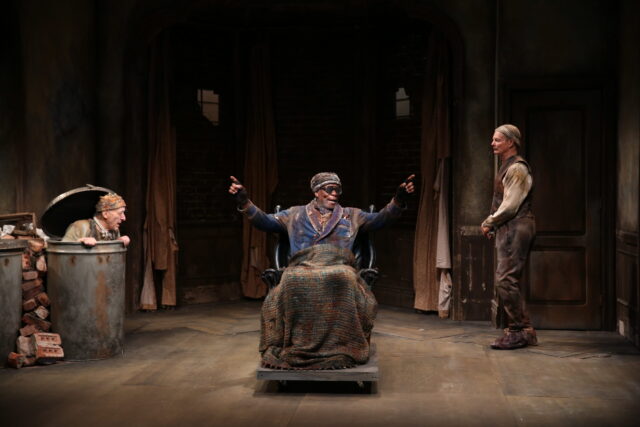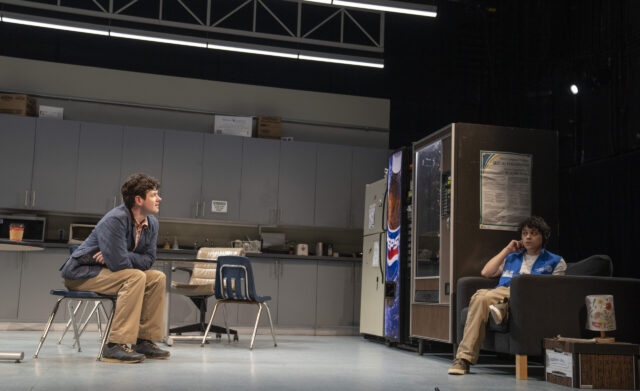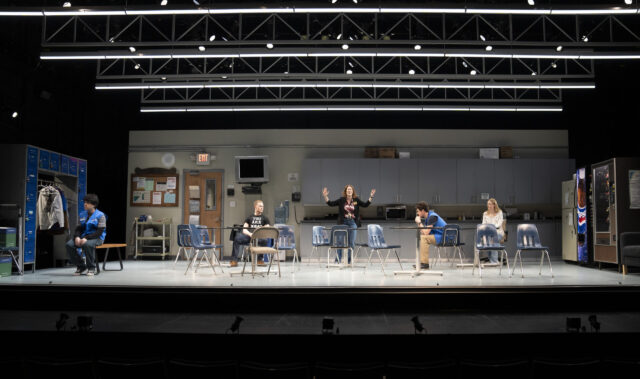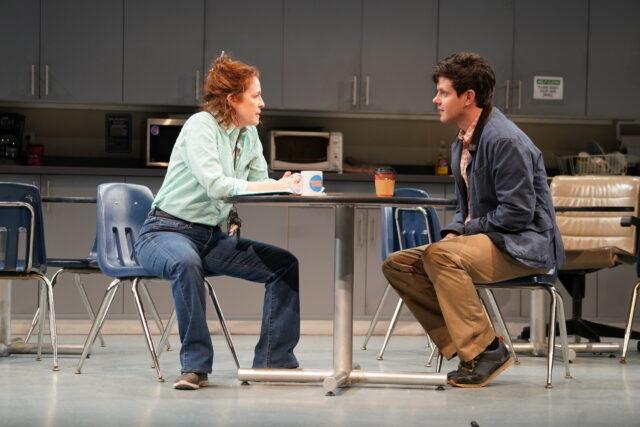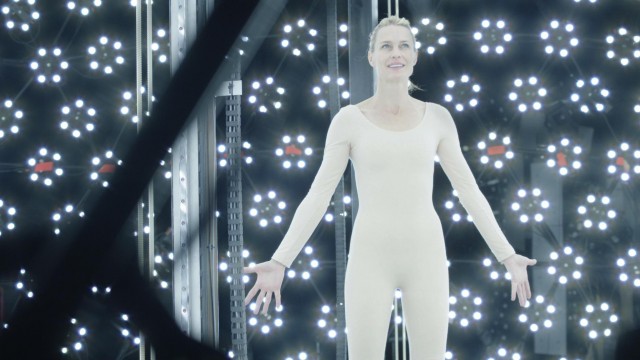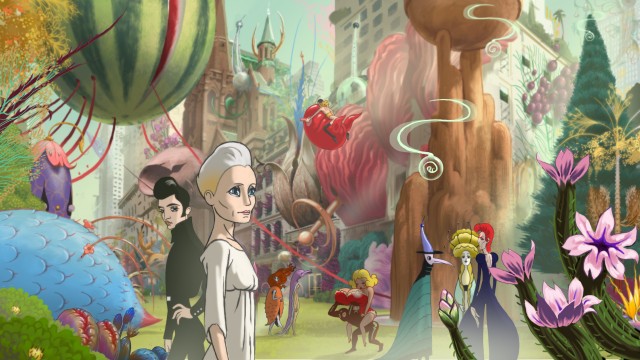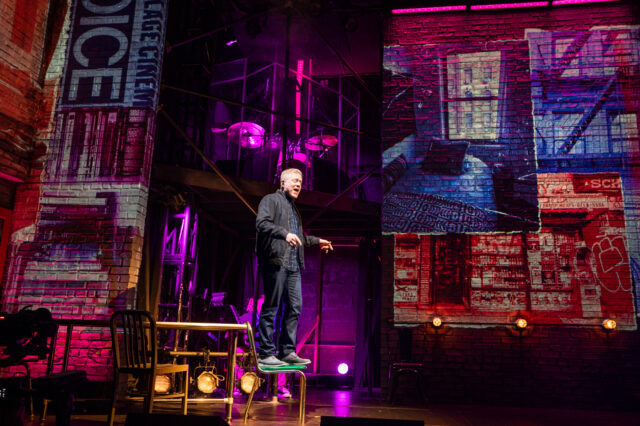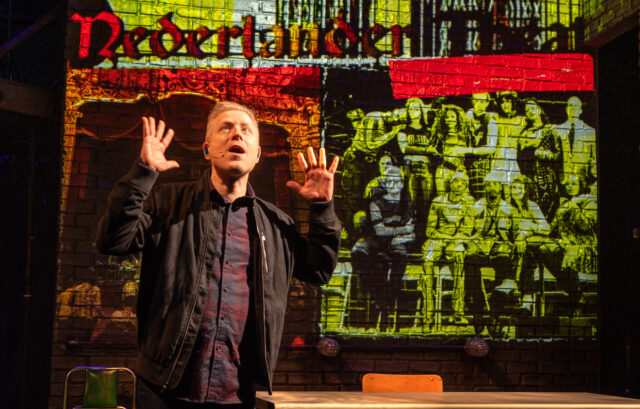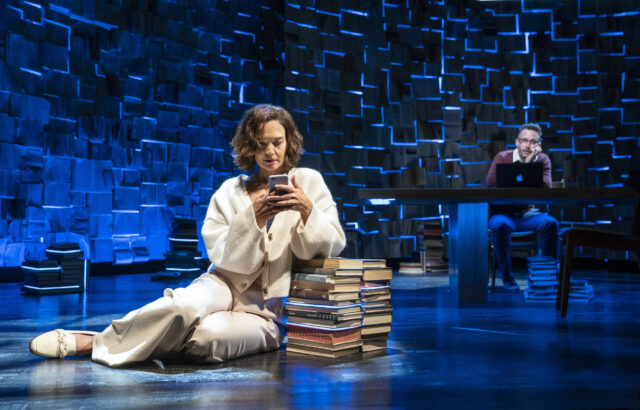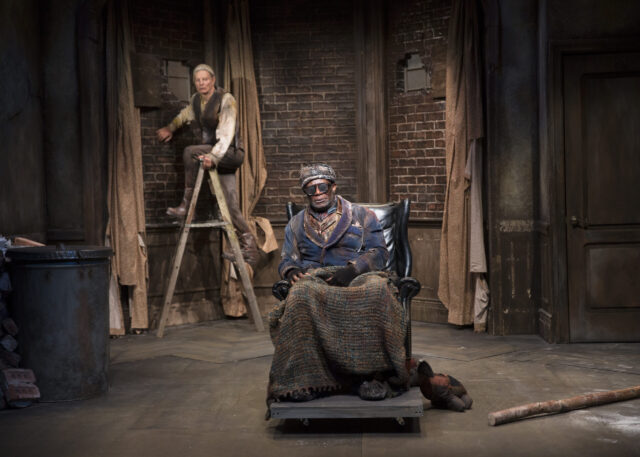
Welcome to imagi*Nation asks the audience to participate in deciding what happens next (photo by Julia Discenza)
WELCOME TO IMAGI*NATION: THE TRILOGY
Sanctuary Space at the Center at West Park
165 West Eighty-Sixth St.
October 27-29, $25, 7:30 www.eventbrite.com www.carmencaceres.com
Audiences get to choose their own adventure in the world premiere of New York-based Argentinian choreographer Carmen Caceres and DanceAction’s Welcome to imagi*Nation, taking place October 27-29 at the Sanctuary Space at the Center at West Park. The three-part work focuses on the the battle over natural resources, labor shortages, and immigration policy, inspired by Caceres’s own story as well as Eduardo Galeano’s 1971 tome Open Veins of Latin America: Five Centuries of the Pillage of a Continent. “The book flows with the grace of a tale,” Isabel Allende writes in the introduction. “His arguments, his rage, and his passion would be overwhelming if they were not expressed with such superb style, with such masterful timing and suspense. Galeano denounces exploitation with uncompromising ferocity, yet this book is almost poetic in its description of solidarity and human capacity for survival in the midst of the worst kind of despoliation.”
Welcome to imagi*Nation is performed by Caceres (who also designed the costumes), Israel Harris, Jenna Purcell, Lydia Perakis, Mallory Markham-Miller, Mar Orozco Arango, and Sofia Baeta, playing multiple characters, with video by Daniel Hess and music by Emilio Teubal and others. “From the very beginning of the process, this has been an extremely personal project,” Caceres said in a statement. “Having moved to the US as an immigrant over a decade ago, I’ve been thrown right into a whirlpool of issues that are rarely considered in the policymaking arena but dramatically affect everyone who needs to adapt to a new reality, language, and identity. I learned that for every choice you make, you leave something behind. This work — drawing from my own life and those of my collaborators/performers and inspired by Galeano’s seminal study of the struggle over power, resources, and access between the US and the South American countries — is an invitation for the audience to experience this firsthand, by engaging with potentially life-changing decisions on behalf of my characters.”
Eyes of Laura Mars is part of fashionable Machine Dazzle film series at MAD
Who:Machine Dazzle What:Movie Night with Machine Where: The Theater at MAD, Museum of Arts & Design, 2 Columbus Circle at 58th St. & Eighth Ave. When: October 25 & 27, December 20, January 10, $10, 7:00 Why: Walking around the Museum of Arts and Design exhibition “Queer Maximalism x Machine Dazzle” is like wandering through a glorious movie set, with colorful costumes and artworks that tell one heckuva bizarre story; you fully expect the mannequins to suddenly come to life and enter this surreal world. The retrospective of the work of performance artist Machine Dazzle, on view through February 19, is supplemented with a film series hosted by the queer experimental theater genius, born Matthew Flower in Upper Darby, Pennsylvania, in 1972, consisting of movies that influenced him as a child of the 1970s and ’80s. It kicked off October 13 with the epic Clash of the Titans and continues October 25 with Robert Wise’s underrated Star Trek: The Motion Picture (can’t wait to hear what Machine will have to say about the Federation uniforms!) and October 27 with Irvin Kershner’s tense neo-noir thriller Eyes of Laura Mars, about a glamorous fashion photographer who is being stalked by a serial killer; the cast includes Faye Dunaway, Tommy Lee Jones, Brad Dourif, René Auberjonois, and Raúl Juliá, and one scene takes place in Columbus Circle, where the museum moved in 2008.
Machine will be on hand to introduce the screening and participate in a discussion afterward; it should be too much fun listening to him talk about the costumes and scenery, and there will be giveaways, costume contests, custom-designed step-and-repeats, photoshoots, and other cool stuff. Be sure to come back December 20 for Robert Greenwald’s Xanadu, when we can all pay tribute to the late Olivia Newton-John and celebrate Machine’s fiftieth birthday, followed January 10 by Guy Hamilton’s Agatha Christie adaptation Evil Under the Sun, featuring Peter Ustinov as Detective Hercule Poirot and also starring Maggie Smith, Jane Birkin, James Mason, Roddy McDowall, and Diana Rigg. In addition, on November 8 from 9:00 am to 1:00 pm, the museum will host “Teacher Workshop: Activism and the Art of Machine Dazzle,” comprising a curator-led tour, an art workshop, and refreshments.
Members of the FLN hide from French paratroops in Gillo Pontecorvo’s neo-Realist classic The Battle of Algiers
THE BATTLE OF ALGIERS (Gillo Pontecorvo, 1966)
Aaron Davis Hall
160 Convent Ave.
Thursday, October 27, free with RSVP, 6:00
Series continues monthly through May 11 citycollegecenterforthearts.org
Curated by the great Dr. Jerry Carlson, longtime host of the television show City Cinematheque, City College’s free “Decolonizing Movies: Un-Tarzan Series” believes that “movies were never innocent in the colonial enterprise. Yet brave filmmakers continue to push back and create alternative decolonizing visions.” The series opened September 29 with Ousmane Sembène’s Black Girls and returns October 27 with a screening of Italian director Gillo Pontecorvo’s The Battle of Algiers.
In Pontecorvo’s gripping neo-Realist war thriller, a reporter asks French paratroop commander Lt. Col. Mathieu (Jean Martin), who has been sent to the Casbah to derail the Algerian insurgency, about an article Jean-Paul Sartre had just written for a Paris paper. “Why are the Sartres always born on the other side?” Mathieu says. “Then you like Sartre?” the reporter responds. “No, but I like him even less as a foe,” Mathieu coolly answers. In 1961, French existentialist Sartre wrote in the preface to Frantz Fanon’s Wretched of the Earth, the seminal tome on colonialism and decolonialism, “In Algeria and Angola, Europeans are massacred at sight. It is the moment of the boomerang; it is the third phase of violence; it comes back on us, it strikes us, and we do not realize any more than we did the other times that it’s we that have launched it,” referring to European colonization. “There are those among [the oppressed creatures] who assert themselves by throwing themselves barehanded against the guns; these are their heroes. Others make men of themselves by murdering Europeans, and these are shot down; brigands or martyrs, their agony exalts the terrified masses. Yes, terrified; at this fresh stage, colonial aggression turns inward in a current of terror among the natives. By this I do not only mean the fear that they experience when faced with our inexhaustible means of repression but also that which their own fury produces in them. They are cornered between our guns pointed at them and those terrifying compulsions, those desires for murder which spring from the depth of their spirits and which they do not always recognize; for at first it is not their violence, it is ours, which turns back on itself and rends them; and the first action of these oppressed creatures is to bury deep down that hidden anger which their and our moralities condemn and which is however only the last refuge of their humanity. Read Fanon: you will learn how, in the period of their helplessness, their mad impulse to murder is the expression of the natives’ collective unconscious.” Sartre’s brutally honest depiction of colonialism serves as a perfect introduction to Pontecorvo’s film, made five years later and then, unsurprisingly, banned in France. (In 1953, the Martinique-born Fanon, who fought for France in WWII, moved to Algeria, where he became a member of the National Liberation Front; French authorities expelled him from the country in 1957, but he kept working for the FLN and Algeria up to his death in 1961. For more on The Wretched of the Earth, see the documentary Concerning Violence: Nine Scenes from the Anti-Imperialistic Self-Defense.)
Terrorism and counterinsurgency take to the streets in Oscar-nominated THE BATTLE OF ALGIERS
In The Battle of Algiers, Pontecorvo (Kapò, Burn!) and screenwriter Franco Solinas follow a small group of FLN rebels, focusing on the young, unpredictable Ali la Pointe (Brahim Haggiag) and the more calm and experienced commander, El-hadi Jafar (Saadi Yacef, playing a character based on himself; the story was also inspired by his book Souvenirs de la Bataille d’Alger). Told in flashback, the film takes viewers from 1954 to 1957 as Mathieu hunts down the FLN leaders while the revolutionaries stage strikes, bomb public places, and assassinate French police. Shot in a black-and-white cinema-vérité style on location by Marcello Gatti — Pontecorvo primarily was a documentarian — The Battle of Algiers is a tense, powerful work that plays out like a thrilling procedural, touching on themes that are still relevant fifty years later, including torture, cultural racism, media manipulation, terrorism, and counterterrorism. It seems so much like a documentary — the only professional actor in the cast is Martin — that it’s hardly shocking that the film has been used as a primer for the IRA, the Black Panthers, the Pentagon, and military and paramilitary organizations on both sides of the colonialism issue, although Pontecorvo is clearly on the side of the Algerian rebels. However, it does come as a surprise that the original conception was a melodrama starring Paul Newman as a Western journalist.
All these years later, The Battle of Algiers, which earned three Oscar nominations (for Best Foreign Language Film in 1967 and Best Director and Best Original Screenplay in 1969) and underwent a 4K restoration for its fiftieth anniversary, still has a torn-from-the-headlines urgency that makes it as potent as ever. “Decolonizing Movies: Un-Tarzan Series” continues November 12 with Tomás Gutiérrez Alea’s The Last Supper, December 7 with Robert M. Young’s The Ballad of Gregorio Cortez, and January 26 with Lino Brocka’s Manila in the Claws of Light.
A young woman reexamines critical decisions she made about her future and grief over her mother’s death in Melis Aker’s Hound Dog, an entertaining if scattershot mishmash that opened tonight at Ars Nova @ Greenwich House for a limited run through November 5.
Anneh, aka Hound Dog (Ellena Eshraghi), is a Harvard grad and guitarist-singer who returns to her home in Turkey while considering whether she should attend the Royal Academy, which has accepted her after her successful audition. Her father, the rock-and-roll-loving Baba (Laith Nakli), has been suffering since the loss of his wife, lost in a fog of alcohol and television as he dreams of going to Graceland.
Anneh’s best friend, Ayse (Olivia AbiAssi), is thrilled that she’s back, but Anneh seems distracted. She is more interested in talking with Yusuf (Jonathan Raviv), the neighborhood garbage man and flute player, than she is in creating music with Ayse. Anneh also is attracted to Charlie Callahan (Matt Magnusson), an American who was her former piano teacher.
Frank J. Oliva’s set offers a surreal fantasy in Ars Nova / PlayCo world premiere (photo by Ben Arons)
Anneh travels between reality and what appears to be some kind of fantasy world that exists inside her house, the interior of which turns into an aluminum-foil-covered concert and dance hall as music and life merge in a surreal way that seems normal to everyone but her. Amid the phantasmagorical scenes, her confusion mounts when Professor Feliz, her musicology professor at Harvard, tells her that Elvis Presley was “born in the majestically boring city of Ankara, Turkey, in the year 1961” and “was often seen strutting around Seymenler Park, accompanied by his friend, the local garbage collector and traditional Turkish instrument maestro, Yusuf.”
Through it all, a singer-songwriter and her band keep entering scenes, playing such songs as “There She Goes,” “Where It’s All Gone,” “The Groove Is on the Loose,” and “An Emptying Thing,” serving as outside observer and muse. (The songs were written by Aker and brothers Daniel and Patrick Lazour.) Channeling Joni Mitchell, Liz Phair, and others, the singer shares such thoughts as “Time is lost / In my room / While you break free / From the gloom / Waking hours / You stay up late / What is life / But the breaking of the days” and “So if we choose to let you go / How will you know / That I remember / How to feel alive / Only in time / Only in time.”
As decision time approaches, Anneh’s mind is flooded with confusion, trying to figure out what to do next and where she belongs in a world where she thinks she doesn’t fit.
Directed by Machel Ross, the ninety-five-minute Hound Dog, a coproduction of Ars Nova and PlayCo, wanders all over the place, the nonlinear narrative often hard to follow. It takes a while to warm up to the characters, although eventually they become familiar and their struggles legitimate. Frank J. Oliva’s set is the star, a facade of a home with three sets of double doors on the ground floor and three sets of windows above, lit in different colors by Tuçe Yasak. Sound designer Avi Amon also serves as music director, with costumes by Qween Jean.
The crack band features Maya Sharpe on guitar, Mel Hsu on bass, Ashley Baier on drums, and Sahar Milani on lead vocals. The cast, several of whom are making their off-Broadway debuts (Eshraghi and Magnusson) and another an Emmy winner (Raviv), is fresh and engaging as they navigate a few too many awkward plot devices.
The story is a deeply personal one to Aker; in the script, she refers to Hound Dog as “me,” the setting as “a version of my hometown . . . through time and space,” and several characters as “alternate versions” of her father, childhood best friend, and teachers. Aker might be a little too close to the material; although she tackles universal issues, they don’t always gel cohesively.
In celebration of its twentieth anniversary season, Ars Nova is introducing “What’s Ars Is Yours: Name Your Price,” with tickets for Hound Dog running $5 to $100, depending on what you can afford.
Who: Al Pacino What: Benefit screening and Q&A for the Actors Studio Where:United Palace Theatre, 4140 Broadway at 175th St. When: Thursday, October 27, $35-$1000, 7:00 Why: The Actors Studio is celebrating its seventy-fifth anniversary with a special event at United Palace Theatre on October 27 at 7:00, a screening of Sidney Lumet’s classic Brooklyn-set drama Dog Day Afternoon, followed by a conversation with the star of the film and current Actors Studio copresident, Al Pacino. “This incredible institution, founded by Elia Kazan, Cheryl Crawford, and Robert Lewis, followed by Lee Strasberg, has left an indelible mark on the world of film and theater,” the East Harlem-born Pacino said in a statement. “It’s where actors are given the freedom to take chances and explore their work and craft. Anyone can audition for the Actors Studio. I’m surprised more people don’t know that. Once an actor becomes a member of the Actors Studio, it doesn’t cost anything, it’s totally free, and membership is for life. It’s going to be a great night at the United Palace. I look forward to watching Dog Day Afternoon and engaging, live, with an audience of New Yorkers, some who will be seeing it for the first time and others who will be seeing it for the first time in years.”
The 1975 film, based on a true story, earned six Oscar nominations, including Pacino for Best Actor, and won one statuette, for Frank Pierson’s original screenplay. Pacino stars as Sonny Wortzik, who leads a bank robbery with his friends Sal (John Cazale) and Stevie (Gary Springer) for a very special reason; the cast also features Chris Sarandon, Carol Kane, Lance Henriksen, Judith Malina, Dominic Chianese, James Broderick, Penelope Allen, and Charles Durning. Tickets for the event range from $35 to $1000; the other copresidents of the Actors Studio, the home of Method acting, are Alec Baldwin and Ellen Burstyn. “There are actors all over the world [who] regardless of their circumstances, professional or personal, regardless of whatever difficulties they are facing, whatever problems or changes — there is one thing they can rely on and that is that eleven o’clock on Tuesday and Friday mornings come rain, shine, snow, or what have you there is a session in the Actors Studio. And the fact that actors can count on that, that they know that that exists, can help them get through,” longtime studio artistic director Strasberg, who played Hyman Roth in The Godfather II opposite Pacino’s Michael Corleone, explained once upon a time.
Dustin (Jeremiah Garcia), Mike (Jeffrey Laughrun), and Lucas (Jamir Brown) prepare for battle in Stranger Sings! The Parody Musical (photo by Evan Zimmerman_MurphyMade)
STRANGER SINGS! THE PARODY MUSICAL
Playhouse 46 at St. Luke’s
308 West Forty-Sixth St. between Eighth & Ninth Aves.
Thursday – Tuesday through August 13, $39-$111 www.strangersingsthemusical.com playhouse46.org
Fans of Stranger Things — and I am proudly one of them — can’t get enough of the Netflix series, an engrossing horror story that premiered in 2015 and will present its fifth and final season in 2024. In addition to books, comics, video games, and podcasts, there is also Stranger Things: The Experience, an immersive presentation that has traveled to New York, San Francisco, Atlanta, Los Angeles, and London, and Stranger Sings! The Parody Musical, which has returned to Manhattan, continuing at Playhouse 46 at St. Luke’s through August 13.
Stranger Things takes place in the mid-1980s in the small, close-knit all-American town of Hawkins, Indiana. “We wanna welcome you to Hawkins / Where everything is a total cliché! / We’re just like folks from classic films and TV shows / It’s nostalgic and you love us that way! / We live a safe, simple life here in Hawkins / Our government says there’s nothing to fear! / Expect nothing but the everyday normal / Cuz stranger things have never happened here,” the cast announces at the beginning.
Nerdy twelve-year-olds Lucas Sinclair (Jamir Brown), Dustin Henderson (Jeremiah Garcia), and Mike Wheeler (Jeffrey Laughrun) stop their Dungeons & Dragons game to help find the missing Will Byers, a shy young boy who has disappeared. Will’s mother, Joyce (usually played by Caroline Huerta but I saw the vibrant Hannah Clarke Levine; the actor portraying Joyce also operates Will, a small puppet), is distraught and determined to locate her son, with or without the support of the local sheriff, Jim Hopper (Shawn W. Smith), who has his own scars when it comes to family. Also involved are Will’s older brother, Jonathan (Garrett Poladian), an oddball aspiring photographer; the oh-so-cool and handsome Steve Harrington (Poladian), who has the hots for Nancy Wheeler (Harley Seger), Mike’s adorable older sister; and Barb Holland (SLee), Nancy’s best friend and perpetual third wheel.
Joyce Byers (Caroline Huerta) is determined to find her son in playful parody (photo by Evan Zimmerman_MurphyMade)
Strange things start occurring following the mysterious appearance of Eleven (Seger), a young girl with scary powers. “She looks like an escaped mental patient,” Dustin says. He’s not that far off; Eleven, whose real name is Jane, has run away from a government-run testing facility where she was under the care of Dr. Brenner (Poladian), known as Papa. “I always wanted a dad / Who never would make me cry / One who’d tell me, ‘Kid, I’m so proud of you,’ / Instead of ‘Stay in your cell til July,’” she sings. Throughout the show, Dr. Brenner and two men in white lab coats keep trying to track down Eleven and bring her back to the facility, supposedly for her own safety.
Oh, there’s also a murderous demogorgon hanging around, an evil creature in tight spandex that has emerged from the Upside Down, a creepy hell where Will and Barb have been taken.
You don’t have to be a big fan of Stranger Things to get a kick out of the parody musical, but it does help, as it is filled with inside jokes and aural and visual references to the show as well as the 1980s themselves. Audience members, a few of whom arrive dressed like some of the characters, sit on all four sides of the central staging area, which is surrounded by tree branches, as if the Upside Down is ever-present (the set is by Walt Spangler), and dozens of props (courtesy Brendan McCann) that are used in the show, from a 1980s telephone and bicycle handlebars to gynormous walkie-talkies and a boombox. There are also four beanbag chairs for audience members who want occasional interaction with the performers.
Barb Holland (SLee) stands up for herself and lets everyone know it in Stranger Sings! (photo by Evan Zimmerman_MurphyMade)
Jonathan Hogue wrote the book, music, and lyrics, which are lots of fun, with arrangements and orchestrations by Michael Kaish and playfully goofy choreography by Ashley Marinelli. The production, which features such musical numbers as “Hopper Triggered,” “Getting Closer,” and “Where There’s a Will,” is too long at 110 minutes with intermission, but director Nick Flatto keeps it all from descending into chaos; the creepy lighting and sound are by Jamie Roderick and Germán Martínez, respectively, and Matthew Solomon’s costumes immediately identify who is who. (You can come in your own costume October 21-31 and qualify for audience-voted prizes each night.)
The engaging cast captures the essence of the series, the feeling of constant impending doom along with the promise that comes with adolescence as the residents of Hawkins explore who they are and who they might be. Levine is terrific as Joyce, although a scene about Winona Ryder, who plays the mother on the show, although funny, jars you out of the narrative. Smith is fab as the brave, heroic sheriff, and Poladian is a hoot switching between the heartthrob Harrington and the weird Jonathan. Eleven is relegated to a relatively small role in the parody and, curiously, Dr. Brenner, played by a composed and careful Matthew Modine on Netflix, is portrayed here as a bumbling idiot.
Stranger Sings! does seek to right a terrible wrong from the streaming series in resurrecting Barb, who is mostly forgotten after a pool party; she doesn’t even make the cut in the nineteen-character cast list on Wikipedia. But the parody gives her several star turns, complete with well-deserved grudges. When Jonathan asks, “I’m confused . . . who is that?” Barb replies, “That’s right. Who IS that? Could that be poor Barb Holland, the throw-away plot device who not one person thought to look for??” SLee brings down the house a few times, but there ends up being too much of Barb; I wanted more Eleven. And for fans of Max, as I am, the show primarily stays within the first season, with some Easter eggs of what is to come.
Chen Chen & Kai Williams’s Blue Heron Triangle floats on the Brooklyn Botanic Garden’s Japanese pond (photo by twi-ny/mdr)
FOR THE BIRDS
Brooklyn Botanic Garden
900 Washington Ave. at Eastern Parkway
Through October 23, $25-$30 (children under twelve free), 10:00 am – 6:00 pm
718-623-7200 www.bbg.org/forthebirds online slideshow
One of the most delightful outdoor exhibits of the year is “For the Birds,” concluding this weekend at the Brooklyn Botanic Garden. The show consists of more than three dozen birdhouses created by artists, architects, and others, placed throughout the garden’s fifty-two-acre expanse. Even with a map, finding each creation can be a bit like a treasure hunt as you make your way through the Native Flora Garden, Japanese Hill-and-Pond Garden, Magnolia Plaza, Ginkgo Allée, Shakespeare Garden, Bluebell Wood, Herb Garden, Belle’s Brook, Rose Garden, Bamboo Grove, Cherry Esplanade, and other lovely locations.
Each birdhouse is accompanied by a sign identifying the title, artist, and materials and including a brief background on the work. A Palace for the Eastern Bluebird by SO – IL, Dalma Földesi, Jung In Seo, and Eventscape was “inspired by the intricate and haphazard way that birds weave their nests. We chose to make a birdhouse made of 3D-printed clay because it can produce textures evocative of woven structures. We are interested in seeing how birds, particularly the eastern bluebird, will interact with this kind of material. We hope that the earth tones of the clay will be highly attractive to them.”
Kevin Quiles Bonilla’s Pal’ campo honors his Puerto Rican heritage (photo by twi-ny/mdr)
Nina Cooke John’s Oh Robin! “is an abstracted interpretation of the robin’s act of nest weaving. Robins have become invisible to us, like the grocery store cashier, Amazon delivery worker, bus driver, and other workers who are critical to the running of our city but have faded into the background of our lives. The robin shows us its scrappiness by making its nest almost anywhere.” Tom Sachs says about his contribution, Swiss, a red plywood version with a white Swiss cross, “To find home or shelter in Switzerland is the dream. If those damn birds are so above it all, why not let them share our burden? Let’s ground the birds in that reality.”
Andy Holden’s The Auguries, a kind of miniature avian sculpture park, was made by cast resin from 3D prints of waveforms created by recordings of rare bird songs. Shun Kinoshita + Charlap Hyman & Herrero’s simply named Birdhouse “is for all birds, including the spirits of birds long gone.” Kevin Quiles Bonilla’s dazzling Pal’ campo honors his family home in Puerto Rico and explores “the idea of both birds and humans as migrating beings, the memories we keep during our travels, and the notion of what home is to those who move from one place to another.”
Julie Peppito’s United Birds of America (E Pluribus Unum) is a condo of curiosities (photo by twi-ny/mdr)
Others pay tribute to the downy woodpecker, the Carolina wren, little bluestem grass, Olivier Messiaen’s use of birdsong in his compositions, scarecrows, the blue heron, the barn owl, and others while taking on climate change and extinction, envisioning birdhouses as safe havens and sanctuaries.
Many of the birdhouses are beautiful works of art all by themselves. Chen Chen & Kai Williams’s Blue Heron Triangle floats on a raft constructed of bamboo reeds tied to empty plastic containers. Sourabh Gupta’s woven offers multiple birds a place to gather. Jessica Maffia’s A Home for Flickers features a trompe l’oeil blue sky with clouds and surreal hands emerging as if holding out protection. Also look out for Pat McCarthy’s Batloft, Joey’s Coop, Babylon Coop, Niknak’s City Cart, funkmaster George Clinton’s Come Fly, Flock Together, Barry McGee’s Untitled, Luam Melake’s Descendants, Suchi Reddy’s The Nest Egg, Amy Ritter’s Safe Space, and Julie Peppito’s wildly engaging United Birds of America (E Pluribus Unum), “one big bird condo [that is] a metaphor for the United States, because we must learn to live together or divided we fall,” a robotlike form filled with tiny delights.
Sourabh Gupta’s woven hides out in BBG’s Overlook (photo by twi-ny/mdr)
In addition, most of the birdhouses are accompanied by a tune as part of the Birdsong Project, curated by Randall Poster, with specially selected songs by Michael Penn, Balmorhea, Kurt Vile, Dan Deacon, Uwade, Terry Riley, Suzzy Roche, Loudon Wainwright III, Laurie Anderson, Beck, and others. “So while in quarantine, I became much more aware of the birds and the birdsong around me,” Poster explains on the website. “I spent a lot of time listening to the birds singing. I was not alone. It was something that we began to talk about. The beauty of birds, the joy and mysteries of birdsong. Given that the situation in the fall of 2020 was sad, strange, and frightening, as plagues tend to be, this fascination with the birds was a magical distraction. Thank God for the birds. . . . And so we are building a community, joined to celebrate and protect the birds. We are birds.”
Finally, as They Might Be Giants advised once upon a time, “Make a little birdhouse in your soul.”