twi-ny recommended events

SHADOWS OF THE RISING SUN: CINEMA AND EMPIRE

Harrowing war drama kicks off weekend series at Japan Society

FIRES ON THE PLAIN (NOBI) (Kon Ichikawa, 1959)
Japan Society
333 East 47th St. at First Ave.
Friday, December 10, $12, 7:30
Series runs through December 12
212-715-1258
www.japansociety.org

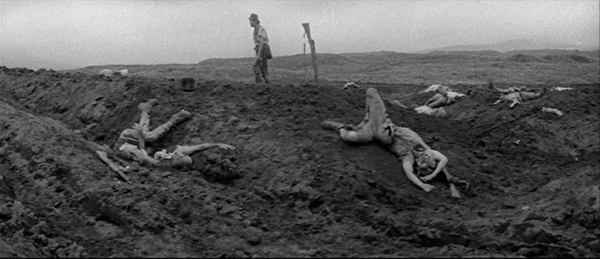
Kon Ichikawa’s FIRES ON THE PLAIN is one of the most searing, devastating war movies ever made. Loosely based on Shohei Ooka’s 1952 novel and adapted by Ichikawa’s wife, screenwriter Natto Wada, the controversial film stars Eiji Funakoshi as the sad sack Tamura, a somewhat pathetic tubercular soldier on the island of Leyte in the Philippines at the tail end of World War II. After being released from a military hospital, he returns to his platoon, only to be ordered to go back to the hospital so as not to infect the other men. He is also given a grenade and ordered to blow himself up if the hospital refuses him, which it does. But instead of killing himself, Tamura wanders the vast, empty spaces and dense forests, becoming involved in a series of vignettes that range from darkly comic to utterly horrifying. He encounters a romantic Filipino couple hiding salt under their floorboards, a quartet of soldiers stuffed with yams trying to make it alive to a supposed evacuation zone, and a strange duo selling tobacco and eating “monkey” meat. As Tamura grows weaker and weaker, he considers surrendering to U.S. troops, but even that is not a guarantee of safety, as the farther he travels, the more dead bodies he sees. FIRES ON THE PLAIN is a blistering attack on the nature of war and what it does to men, but amid all the bleakness and violence, tiny bits of humanity try desperately to seep through against all the odds. And the odds are not very good.

FIRES ON THE PLAIN begins Japan Society’s weekend-long Shadows of the Rising Sun: Cinema and Empire series, comprising a quartet of Chinese and Japanese films that examine Japan’s futile attempts at creating an empire through war. The impressive lineup includes the New York premiere of Koji Wakamatsu’s CATERPILLAR, being screened on Saturday night at 7:00; Jiang Wen’s 2000 Cannes Grand Prize winner, DEVILS ON THE DOORSTEP, scheduled for Sunday at 4:00; and Nagisa Oshima’s 1983 WWII drama MERRY CHRISTMAS, MR. LAWRENCE, starring David Bowie, Ryuichi Sakamoto, Tom Conti, and Takeshi Kitano, on Sunday at 7:00. FIRES ON THE PLAIN is also part of Japan Society’s Zen & Its Opposite: Essential (& Turbulent) Japanese Art House festival of monthly classics, which continues January 11 with Nobuo Nakagawa’s HELL and February 18 with Kihachi Okamoto’s SWORD OF DOOM.
WHAT IS THIS THING CALLED LOVE? A NIGHT WITH GENE WILDER

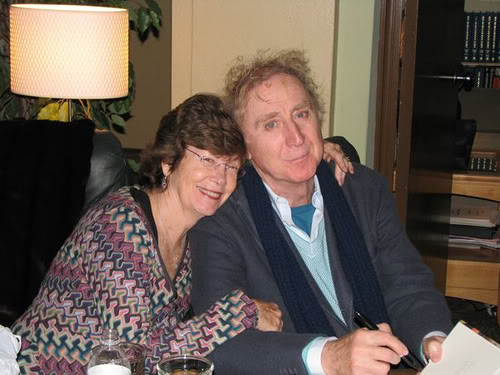
Gene Wilder will be interviewed by his wife, Karen, at special evening at the JCC

JCC in Manhattan
334 Amsterdam Ave. at 76th St.
Wednesday, December 15, $15, 8:00
646-505-4444
www.jccmanhattan.org

Comic actor Gene Wilder, who made his film debut in BONNIE AND CLYDE and went on to star in such hits as THE PRODUCERS, BLAZING SADDLES, and WILLY WONKA AND THE CHOCOLATE FACTORY, is also the author of such books as KISS ME LIKE A STRANGER: MY SEARCH FOR LOVE AND ART, THE WOMAN WHO WOULDN’T, and MY FRENCH WHORE. His latest, WHAT IS THIS THING CALLED LOVE? (St. Martin’s, March 2010, $19.99), features a dozen stories about love and romance, including “The Lady with the Red Hat,” “The Flirt,” and “My Old Flame.” In the prelude, Wilder admits, “Apart from the 1929 Cole Porter song, this is a ridiculous title and I know it; sounds a little like some egotistical guru telling the rest of the world about love and lovemaking and broken hearts.” Wilder’s goal, instead, is to give readers “a little pleasure and a laugh.” He’ll be looking to do all that and more on December 15 at the JCC in Manhattan, when he’ll be interviewed by his wife, Karen, about love and other topics in a special event held in conjunction with the Center for Hearing and Communication.

JACK FERVER: RUMBLE GHOST

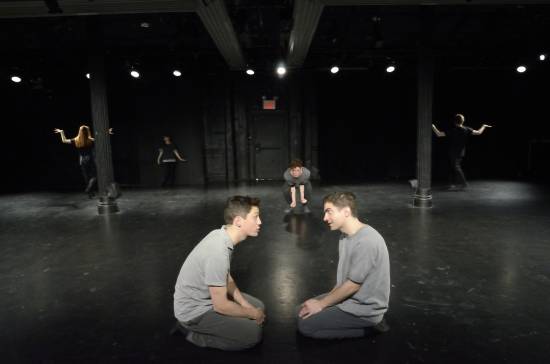
Jack Ferver’s RUMBLE GHOST searches for the inner child within us all (photo by Liz Ligouri)

Performance Space 122
150 First Ave. at Ninth St.
Through December 12, $20
www.ps122.org

The 1982 frightfest POLTERGEIST has become part of the American zeitgeist, representing the death-in-life horror of suburban living, complete with child abduction by an evil creature from another dimension. That’s where writer-choreographer Jack Ferver, who has made critics and audiences uncomfortable in such works as DEATH IS CERTAIN, MEAT, and WHEN WE WERE YOUNG AND FILLED WITH FEAR, found his inspiration for the hour-long RUMBLE GHOST, as he once again makes viewers squirm for a whole range of reasons. Fortunately, he also leaves them vastly entertained. As the audience filters into P.S. 122’s second-floor theater, Ferver and Christian Coulson are conducting a barely audible conversation, walking around and around the dark stage, populated by five unmoving figures. As the two men keep repeating the scene, their voices rise, and their journey continually shrinks; it is soon apparent that they are acting out the scene from POLTERGEIST in which Steve (Coulson) shows off their new house to his wife, Diane (Ferver). After each repetition, Ferver approaches the audience and pauses, as if to say, yes, get ready, because we’re going to do it again, and the audience, shifting in their seats, can’t help but think that they might be in for a whole lot more of this. After eight or nine trips, each more spatially confined than the previous (a clever way to evoke people’s familiarity with a movie they may have watched over and over and over again), the piece moves on, as the dancers — Benjamin Asriel, Reid Bartelme, Carlye Eckert, Michelle Mola, and Breanna O’Mara in addition to Coulson and Ferver — break off into experimental solos and duets as Carol Anne is sucked into a television set and a psychic (Eckert) is called in to try to find her. Save for two mirrors and two fluorescent lights, there are no other props or special effects, but Ferver is able to create tense — and funny — action playing off the audience’s memory of the film. If you’ve seen POLTERGEIST, you’ll be visualizing what is only being referred to onstage.

Just as Steve and Diane are about to go in after Carol Anne, the production shifts abruptly, as the seven players bring out chairs and sit in a circle for an Inner Child Work therapy session in which they all use their real names, ostensibly no longer in character. Ferver has brilliantly turned the movie family’s search for their child into the dancers’ search for their own inner child (while also equating a house with the psyche). By allowing the audience to watch this psychodrama, which is based on his personal experiences, Ferver once again evokes strong emotions ranging from the uncomfortable to the exhilarating, regardless of how “true” any of it might be. We are used to seeing performers perform onstage; we are not, however, used to seeing how they interact with one another offstage, and Ferver has playfully let us inside a rarely seen part of the creative process. Throughout RUMBLE GHOST, he continually surprises with his ability to challenge us by defying expectations, getting both into our faces and into our heads.

AS THE EYES OF THE SEAHORSE

Live music and dance collide and intersect at HERE Arts Center

HERE Arts Center
145 Sixth Ave. at Dominick St.
December 9-11, $15-$20
212-352-3101
www.here.org

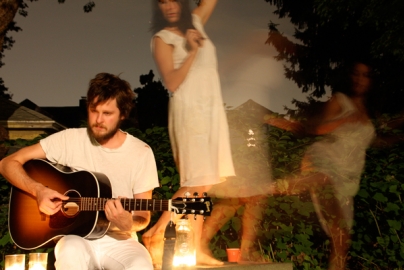
Two Philadelphia groups will create a unique performance piece in the round December 9-11 at HERE Arts Center, combining indie folk rock with experimental dance in AS THE EYES OF THE SEAHORSE. Music group the Mural and the Mint, consisting of Corey Duncan, Eliza Jones, Michael Kiley, Jebney Lewis, and Joshua Ramey, and the Nichole Canuso Dance Company, featuring Nichole Canuso, Niki Cousineau, Meg Foley, John Luna, Shannon Murphy, and Christina Zani, will collaborate on a stage surrounded by candlelit Mason jars and various odds and ends. The Mural and the Mint released their debut album, PRIVATE POCKETS, in 2008, and have just made the first single from their upcoming disc (also called AS THE EYES OF THE SEAHORSE), a light-hearted song called “Ripe,” available for free online. Canuso’s previous productions include TAKES, WANDERING ALICE, and THE ROYAL WE. The collaboration is part of HERE’s hemispHEREs initiative, which brings together visiting artists and the institution’s resident artists in a series of workshops, open rehearsals, discussions, and performances.

SMALL GIFT: CELEBRATING 50 YEARS OF SANRIO

The Sanrio mobile pop-up truck pulls into Herald Square on Thursday and Friday, but you better get there before they sell out of all their cute stuff

Herald Square, 36th St. & Broadway
Thursday, December 9, 12 noon – 8:00 pm
Friday, December 10, 11:00 am – 7:00 pm
www.sanrio.com

Back in 1960, the Yamanashi Silk Center was founded by Shintaro Tsuji, who changed its name thirteen years later to the more familiar Sanrio. The makers of such internationally beloved branded kawai characters as Hello Kitty, Strawberry, and My Melody have been celebrating their fiftieth anniversary this year by sending a mobile pop-up truck across the country, beginning in San Francisco on October 23 and pulling into Herald Square on Thursday and Friday (too late for Hanukkah!), offering limited-edition collectibles organized into a menu divided into Special Starters, Main Dishes, Happy Hour, Sweets, Sides, and Snacks. The items on sale — games, T-shirts, stickers, calendars, plush toys, keychains, a fisheye camera, a flash drive, and other ridiculously cute accessories — promote the company’s “Small gift, big smile” philosophy. (Oh, and be sure to save some Chococat stuff for us.)

FILMS ABOUT NOTHING: THE SEVENTH SEAL

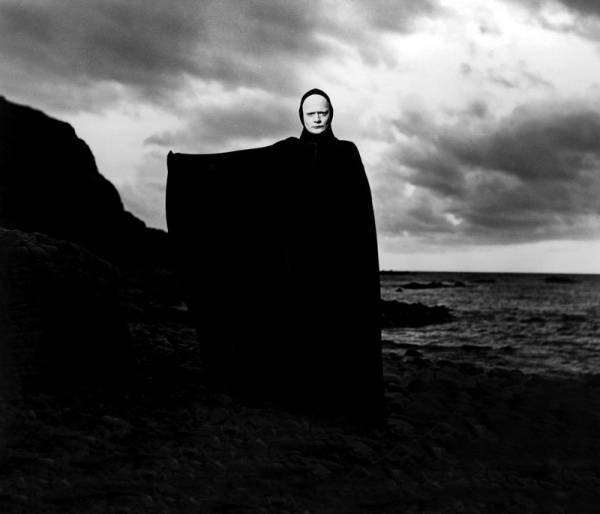
Death (Bengt Ekerot) is not exactly holding out the red carpet in Bergman classic


THE SEVENTH SEAL (Ingmar Bergman, 1957)

Cabaret Cinema
Rubin Museum of Art
150 West 17th St. at Seventh Ave.
Friday, December 10, free with $7 bar minimum, 9:30
212-620-5000
www.rmanyc.org

It’s almost impossible to watch Ingmar Bergman’s THE SEVENTH SEAL without being aware of the meta surrounding the film, which has influenced so many other works and been paid homage to and playfully mocked. Over the years, it has gained a reputation as a deep, philosophical paean to death. However, amid all the talk about emptiness, doomsday, the Black Plague, and the devil, THE SEVENTH SEAL is a very funny movie. In fourteenth-century Sweden, knight Antonius Block (Max von Sydow) is returning home from the Crusades with his trusty squire, Jöns (Gunnar Björnstrand). Block soon meets Death (Bengt Ekerot) and, to prolong his life, challenges him to a game of chess. While the on-again, off-again battle of wits continues, Death seeks alternate victims while Block meets a young family and a small troupe of actors putting on a show. Rape, infidelity, murder, and other forms of evil rise to the surface as Block proclaims “To believe is to suffer,” questioning God and faith, and Jöns opines that “love is the blackest plague of all.” Based on Bergman’s own play inspired by a painting of Death playing chess by Albertus Pictor (played in the film by Gunnar Olsson), THE SEVENTH SEAL, winner of a Special Jury Prize at Cannes, is one of the most entertaining films ever made. (Bergman fans will get an extra treat out of the knight being offered some wild strawberries at one point.) The film is screening on December 10 as part of the Rubin Museum’s Cabaret Cinema series Films About Nothing, being held in conjunction with the exhibition “Grains of Emptiness,” and will be introduced by former Vogue editor in chief Joan Juliet Buck. (The series continues December 17 with Lisa Birnbach introducing Robert Redford’s 1980 dysfunctional family drama ORDINARY PEOPLE.)

PASS THE BLUTWURST, BITTE

La MaMa Ellen Stewart Theatre
66 East Fourth St. between Second Ave. & Bowery
Thursday – Sunday through December 19
Tickets: $25-$30
212-475-7710
www.lamama.org

In 1928, Austrian painter Egon Schiele died at the age of twenty-eight. Perhaps not coincidentally, visual artist John Kelly is retiring his masterwork, a dance-theater piece about Schiele’s life and career, in its twenty-eighth year. PASS THE BLUTWURST, BITTE was first performed in a very different, much shorter version back at the Pyramid Club in 1982. The constantly evolving piece earned Kelly an Obie for its 1986 run at Dance Theater Workshop, then was revived in an expanded version at La MaMa in 1995. As part of La MaMa’s fortieth anniversary season, founder and artistic director Ellen Stewart convinced Kelly to once again bring back BLUTWURST, which is now running at the Ellen Stewart Theatre through December 19. Kelly has vowed that this will be the last time he ever performs the show, which in its fourth version features several new dances and videos. It’s a thrilling production about art and love that pits the bohemian lifestyle against a repressive culture, told in brilliant and unique ways. The rubbery-limbed Kelly marvelously embodies the sharp, angular Schiele, accompanied by a pair of Alter Egons (Luke Murphy and Eric Jackson Bradley) as he first woos free-spirited Wally Neuzil (Tymberly Canale), whom he meets in a café chugging beer and eating sausage, as his muse and mistress, and later the more traditional Edith (MacKenzie Meehan), who soon becomes his wife. Kelly alternates between silent-movie-like vignettes, set dance pieces, and short Expressionistic film segments, including a marvelous one in which he incorporates glass, his own drawing, and one of Schiele’s most famous self-portraits. The scenes between Schiele and Wally are particularly effective, as Kelly and Canale nearly melt into each other despite Schiele’s social awkwardness. Kelly has kept the show decidedly low-tech, with lo-fi music played on an old record player, the videos choppy and old-fashioned, and Huck Snyder’s sets sparse and intimate. BLUTWURST, which also garnered Kelly an NEA American Masterpieces Award, is playing Thursdays through Sundays through December 19.

Although you don’t have to know anything about Schiele’s extraordinary work to fall in love with the show, we suggest you do just a bit of homework before you go; you can find numerous images and an excellent essay on Schiele online from his New York dealer, Galerie St. Etienne, and several of his works are usually on view at the Neue Galerie. In addition, “Schiele-Kelly,” a collection of new photographs of Kelly posing as Schiele as well as ephemera from the show’s history, continues December 9-12 at La MaMa La Galleria at 6 East First St.