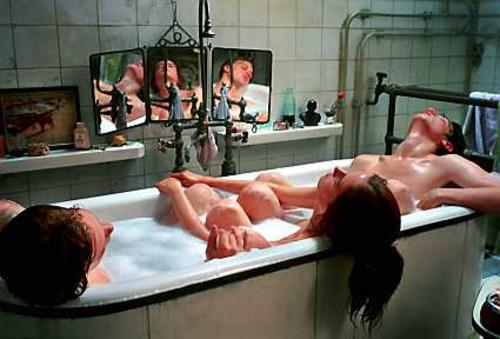
Nina, Nina, ballerina discovers that the mirror has at least two faces in BLACK SWAN
BLACK SWAN (Darren Aronofsky, 2010)
www.foxsearchlight.com/blackswan
 A companion piece to 2008’s multilayered THE WRESTLER, in which a rejuvenated Mickey Rourke plays an aging athlete trying to regain control of his body and his life while attempting to reestablish a connection with his daughter, Darren Aronofsky’s BLACK SWAN is an even more complex psychological study of just how far the mind and body can go to get what it wants and needs. Natalie Portman stars as Nina Sayers, a member of a Manhattan-based ballet company who is vying for the lead role in a new production of Tchaikovsky’s classic 1877 ballet, SWAN LAKE, the tragic tale of a princess transformed into a white swan who must find true human love to be released, complicated by an evil magician, a black swan rival, and a handsome prince. Nina lives a sheltered existence dominated by her failed-ballerina mother, Erica (Barbara Hershey), squeezed into a cramped New York City apartment and not allowed to have a social life. Womanizing choreographer Thomas Leroy (Vincent Cassel) is convinced that Nina can dance the white swan but has severe doubts that she has it within her to dance the black swan, even after selecting her to replace former prima ballerina Beth MacIntyre (Winona Ryder). Desperate to bring out Nina’s dark side, Leroy creates a competition between her and free-spirited dancer Lily (Mila Kunis), a sexy, tattooed young dancer who lives life on the edge. As opening night approaches, Nina must reach deep inside herself if she is to attain her dream, leaving all her fears and insecurities behind.

Lily (Mila Kunis) helps Nina (Natalie Portman) explore her darker side in BLACK SWAN
A gripping thriller that works on multiple levels, BLACK SWAN is a superbly crafted examination of innocence and experience, good and evil, loyalty and betrayal that goes far beyond the basic black and white. Aronofsky and co-screenwriters Mark Heyman and Andrés Heinz delve into the nature of duality and the very creation of art itself, as the story of BLACK SWAN mimics that of SWAN LAKE, and Nina continually sees doppelgangers of herself in mirrors and other people, especially Lily and Beth. As Nina struggles to bring out the black swan within her, her body literally bleeds, evoking both birth and death, her hallucinations and fantasies walking the fine line between dream and nightmare. As serious and frightening as BLACK SWAN can be, however, Aronofsky has also infused it with cheesy horror-movie scares, referencing such diverse films as CARRIE and THE TURNING POINT, ALL ABOUT EVE and SINGLE WHITE FEMALE, REPULSION and THE RED SHOES, THE FLY and ROSEMARY’S BABY, a potent mix of Polanski and Cronenberg filtered through Balanchine and Baryshnikov. (The cheesiness factor also extends to character names; it takes both gumption and supreme confidence to name your star ballerina Nina.) Even the casting touches on the idea of the double; Nina is replacing Beth much the way Portman is now getting the kind of roles Ryder used to get. Once again Aronofsky (PI, REQUIEM FOR A DREAM) has proved himself to be one of cinema’s most inventive directors, a master visual storyteller not afraid to take chances both with himself and with the audience.

 In 1995, Disney/Pixar released its first movie, John Lasseter’s CGI-animated TOY STORY, about a boy (voiced by John Morris) and his toys, expanded from the short film TIN TOY. Four years later, Lasseter, Lee Unkrich, and Ash Brannon teamed up for TOY STORY 2, continuing the tale of Andy, Buzz Lightyear (Tim Allen), Woody (Tom Hanks), and friends. Now comes TOY STORY 3, directed by Unkrich, the most emotional of the three pictures. Preparing to leave for college, Andy decides to bring Woody with him and packs up everyone else to be stored in the attic. But his mother mistakes the bag for garbage and throws out Hamm (John Ratzenberger), Rex (Wallace Shawn), Jessie (Joan Cusack), Mr. & Mrs. Potato Head (Don Rickles & Estelle Harris), and the rest of the gang. The toys avoid the garbage heap but, feeling unloved and abandoned by Andy, opt to take their chances at Sunnyside Daycare, where, it turns out, unwanted toys are ruled by the iron fist of the evil Lots-O’-Huggin’ Bear (Ned Beatty) — and where Barbie (Jodi Benson) finds out that Ken (Michael Keaton) is not necessarily all he’s cracked up to be. Meanwhile, Woody, knowing that the toys are still important to Andy, ends up in the hands of Bonnie (Emily Hahn), a young girl with a fertile imagination who restores Woody’s faith and increases his determination to reunite Andy and the gang, which is finding itself in more and more trouble at Sunnyside. Michael Arndt’s smart screenplay is about trust, friendship, miscommunication, and growing old, with Buzz, Woody, and the rest of the toys dealing with loss and facing death time and time again. The film, which also features the voices of Kristen Schaal, Bonnie Hunt, Whoopi Goldberg, R. Lee Ermey, Richard Kind, Laurie Metcalf, Jeff Garlin, and Timothy Dalton as Mr. Pricklepants, runs the gamut from exciting chase scenes to tender moments, once again capturing the spirit of childhood better than most live-action movies. TOY STORY 3 is being screened at the Museum of Modern Art on December 28 as part of the series “The Contenders 2010,” a collection of influential and innovative international movies the institution believes will stand the test of time. MoMA has already shown such works as Luca Guadagnino’s I AM LOVE, Christopher Nolan’s INCEPTION, Roman Polanski’s THE GHOST WRITER, and David Fincher’s THE SOCIAL NETWORK, and upcoming films include Debra Granik’s WINTER’S BONE, Lixin Fan’s LAST TRAIN HOME, and Banksy’s EXIT THROUGH THE GIFT SHOP.
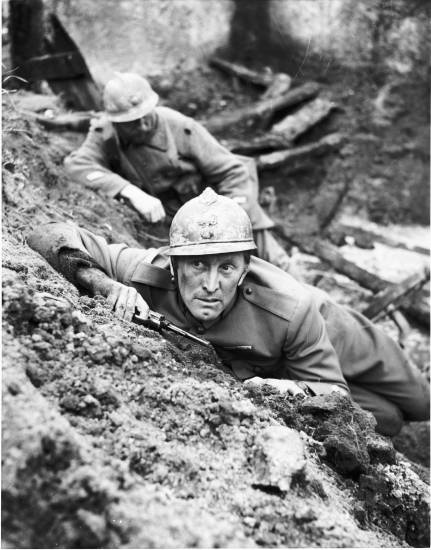
 Stanley Kubrick’s harrowing PATHS OF GLORY, based on the novel by Humphrey Cobb, is quite simply the best English-language antiwar film ever made. Kirk Douglas stars as Colonel Dax, a French military man who disagrees with his superiors’ insistence on sending his men into certain annihilation in order to take a worthless hill during World War I. Dax’s verbal battles with Generals Broulard (Adolphe Menjou) and Mireau (George Macready) are unforgettable, as are the final scenes, in which three random men are chosen to pay the price for what the generals call cowardice. Filmed in stunning black and white, PATHS OF GLORY puts you right on the front lines of the folly of war. Kubrick, who wrote the unrelenting script with Calder Willingham and Jim Thompson, also made the best film about the cold war (DR. STRANGELOVE OR: HOW I LEARNED TO STOP WORRYING AND LOVE THE BOMB), the Roman slave revolt (SPARTACUS), and, arguably, the Vietnam War (FULL METAL JACKET). PATHS OF GLORY is one of the most emotional, powerful stories ever put on celluloid. It’s screening as part of “20 Years of Martin Scorsese’s Film Foundation,” an eighteen-film salute to Scorsese’s ongoing work preserving and restoring more than five hundred films so far. The series runs through January 2 with such highlights as Alfred Hitchcock’s SABOTEUR, Luchino Visconti’s SENSO, Albert Lewin’s PANDORA AND THE FLYING DUTCHMAN, Charles Laughton’s THE NIGHT OF THE HUNTER, John Ford’s HOW GREEN WAS MY VALLEY, and William Wyler’s THE BIG COUNTRY.