DR. MABUSE, THE GAMBLER is an epic document of its time
WEIMAR CINEMA, 1919-1933: DAYDREAMS AND NIGHTMARES
DR. MABUSE, DER SPIELER (DR. MABUSE, THE GAMBLER) (Fritz Lang, 1922)
MoMA Film
Museum of Modern Art
11 West 53rd St. between Fifth & Sixth Aves.
Monday, January 3, 7:30
Saturday, January 8, 7:00
Tickets: $10, in person only, may be applied to museum admission within thirty days, same-day screenings free with museum admission, available at Film and Media Desk
212-708-9400
www.moma.org
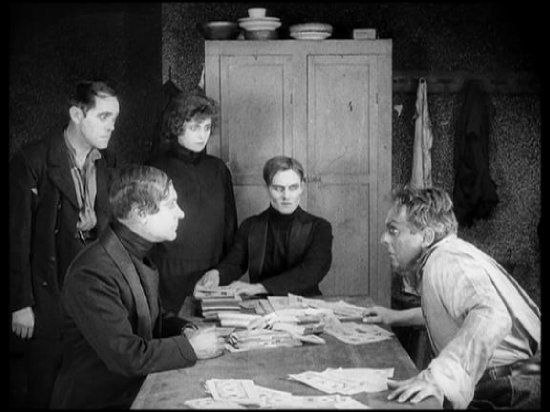
 Fritz Lang’s 1922 expressionist epic, DR. MABUSE, THE GAMBLER, is one of the most thrilling crime dramas ever made. Written by Lang and his wife, Thea von Harbou, based on the popular novel by Norbert Jacques, the film focuses on the title character (Rudolf Klein-Rogge), a criminal mastermind who is a sort of Nietzschean superman able to control his victims using hypnosis and psychoanalysis. Putting his evil gaze on such easy prey as the wealthy Edgar Hull (Paul Richter) and Count Told (Alfred Abel), Mabuse tries to ruin them through a series of card games he manipulates, with the help of nightclub singer Cara Carozza (Aud Egede-Nissen) and a motley crew of assistants that includes Spoerri (Robert Forster-Larrinaga), Georg (Hans Adalbert Schlettow), Hawasch (Charles Puffy), and Pesch (Georg John). Meanwhile, steadfast prosecutor Norbert von Wenk (Bernhard Goetzke) is on the case, attempting to track down and capture the mystery man who is leaving a trail of death and destruction behind him. Divided into two sections, “The Great Gambler, a Picture of Our Time” and “Inferno — A Play of People in Our Time,” DR. MABUSE is indeed a story of its time, a document of the state of mind of the German populace between the two world wars. Mabuse, representing both chaos and tyranny, is a master of disguise, portraying numerous middle-class figures fighting against the upper class and authority. The film is not only about one evil man’s grab for power but the power of cinema itself; just as Mabuse can change characters within the film, all of the characters are merely actors in costume, performing a fiction on stunning sets created by production designer Karl Vollbrecht and photographed by cinematographer Carl Hoffmann. In fact, at one point Mabuse stares directly into the camera, his face hurtling toward the viewer, attempting a kind of mass hypnosis that, presciently, can be said to predict the rise of Nazism in Germany. But most of all, DR. MABUSE, THE GAMBLER, which was followed by THE TESTAMENT OF DR. MABUSE in 1933 and THE THOUSAND EYES OF DR. MABUSE in 1960, is a film about fear — fear of the unknown, fear of technology, fear of psychoanalysis, and fear of what the future holds. The film is screening as part of MoMA’s Weimar Cinema, 1919–1933: Daydreams and Nightmares series, comprising eighty-one films made between World War I and World War II; upcoming screenings include G. W. Pabst’s PANDORA’S BOX, Richard Eichberg’s THE MASKED MANNEQUIN, Wilhelm (William) Dieterle’s SEX IN CHAINS / SEX IN FETTERS, Walther Ruttmann’s IN DER NACHT and MELODY OF THE WORLD, Ernst Lubitsch’s MADAME DUBARRY (PASSION) and THE OYSTER PRINCESS, and Slatan Dudow’s WHITHER GERMANY?



 Britain’s Royal Family is notoriously protective of their personal lives, and for many years they were somehow able to keep from the public the fascinating story of Prince Albert’s difficult battle against a severe stammer. A serious stutterer himself as a child, screenwriter David Seidler (TUCKER: THE MAN AND HIS DREAM), who looked to the man known as Bertie as a role model, uncovered the dramatic tale and even got permission from the Queen Mum herself to pursue a cinematic version, as long as it came out after her death. So after gestating for decades, THE KING’S SPEECH is now a reality, a thrilling film that follows the prince’s (a marvelously vulnerable Colin Firth) struggle to find his voice as his aging father, King George V (Michael Gambon), falls ill and the prince of Wales (a wonderfully snide Guy Pearce) jeopardizes the possibility of his wearing and keeping the crown by falling in love with flirtatious, twice-divorced socialite Wallis Simpson (Eve Best). After having explored numerous ways to cure him of his debilitating and embarrassing stutter, Bertie and his loyal wife, Elizabeth (the resplendent Helena Bonham Carter), turn to an odd, failed actor, Australian speech therapist Lionel Logue (a pitch-perfect Geoffrey Rush), who uses extremely unusual methods that eventually force Bertie to reexamine his childhood while also preparing for a future that could put him on the throne as the country goes to war. Director Tom Hooper (THE DAMNED UNITED, HBO’s JOHN ADAMS miniseries) keeps the tension mounting as Bertie gains more and more public responsibility and his stage fright grows; the scenes between Firth and Rush in Logue’s rather low-rent basement office are thoroughly mesmerizing, a pair of bravura performances built around the slightest mouth twitch from Firth and knowing looks from the craggy-faced Rush. The strong cast also includes Derek Jacobi as Archbishop Cosmo Lang, Jennifer Ehle as Logue’s wife, Myrtle, Timothy Spall as Winston Churchill, Anthony Andrews as Stanley Baldwin, and Claire Bloom as Queen Mary. The only drawback is Alexandre Desplat’s overly melodramatic score, which insists on squeezing unnecessary, treacly emotion from a story where words take center stage.

