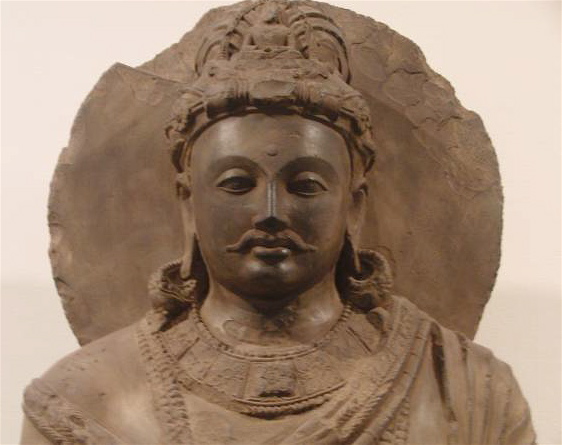
“Large Seated Bodhisattva in Meditation,” Gandhara culture in Pakistan or Afghanistan, grey schist stone, circa ninth century (photo by twi-ny/mdr)
Tibet House US
22 West 15th St. between Fifth & Sixth Aves.
Extended through January 7, free, 12 noon – 5:00 pm
212-807-0563
www.tibethouse.us
Originally scheduled to end October 20 and then November 16, Tibet House’s revelatory five-part exhibition, “The Buddha Image: Out of Uddiyana,” has been extended yet again through January 7, and you should do whatever it takes to make sure you see it before it closes. Investigating the origin of the Buddha image, which some believe began in the Uddiyana (“royal garden”) kingdom of Northern Pakistan, the show includes dozens of remarkable artifacts divided into five sections: Gandharan Stone Sculptures, Stupas and Reliquaries, Gandharan and Swat Metal Buddhas, Pilgrimage, and Silk Road. Accumulated by Nik Douglas for the Buckingham Collection over the course of some forty-four years, the objects date back back more than nineteen centuries. Walking through the many treasures, you’ll wonder why they’re not part of a permanent museum collection. Among the most unusual of the sculptures are bronze and stone depictions of bodhisattvas with mustaches, in addition to fasting, emaciated buddhas, nearly skeletal as they continue to meditate. Glass cases display rock crystal stupas with gold/electrum alloy from the first and second century, while others contain Chinese gilt bronze buddhas from the sixth century. You can almost feel the electricity emanating from several works that depict a buddha and his consort staring deep into each other’s eyes, including the many-armed “Large Chakrasamvara Yabyum (‘Wheel of Becoming’)” and “Large Amitayus Yabyum (‘Buddha of Boundless Life’).” The early-nineteenth-century Sino-Tibetan “Huge Figure of the Kurukulla Dakini” features a central figure surrounded by fire, wearing a necklace of shrunken heads, standing on a woman. One of the most spectacular pieces can be found just to the left of the entrance, nearly hidden away in its own alcove: “Large and Complete Yamantara (‘Remover of the Fear of Death’),” a bull-headed, multi-armed, many-faced bodhisattva surrounded by mysterious, exciting iconography. In his foreword to the exhibition catalog, Tibet House president Robert Thurman writes, “We hope that the manifestations gathered in the exhibition will find their way here and there to continue to inspire individuals to use their precious human lives in the evolutionarily most meaningful way to create real human values in themselves and others.” We feel exactly the same way.
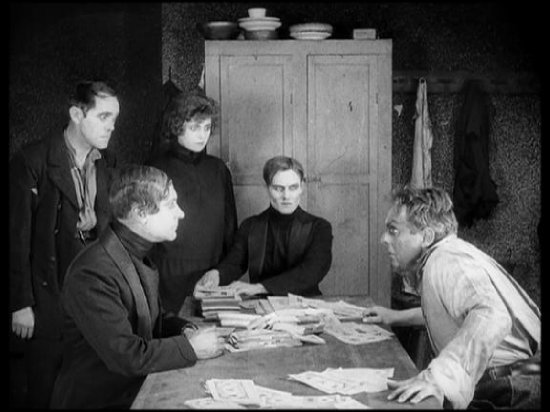
 Fritz Lang’s 1922 expressionist epic, DR. MABUSE, THE GAMBLER, is one of the most thrilling crime dramas ever made. Written by Lang and his wife, Thea von Harbou, based on the popular novel by Norbert Jacques, the film focuses on the title character (Rudolf Klein-Rogge), a criminal mastermind who is a sort of Nietzschean superman able to control his victims using hypnosis and psychoanalysis. Putting his evil gaze on such easy prey as the wealthy Edgar Hull (Paul Richter) and Count Told (Alfred Abel), Mabuse tries to ruin them through a series of card games he manipulates, with the help of nightclub singer Cara Carozza (Aud Egede-Nissen) and a motley crew of assistants that includes Spoerri (Robert Forster-Larrinaga), Georg (Hans Adalbert Schlettow), Hawasch (Charles Puffy), and Pesch (Georg John). Meanwhile, steadfast prosecutor Norbert von Wenk (Bernhard Goetzke) is on the case, attempting to track down and capture the mystery man who is leaving a trail of death and destruction behind him. Divided into two sections, “The Great Gambler, a Picture of Our Time” and “Inferno — A Play of People in Our Time,” DR. MABUSE is indeed a story of its time, a document of the state of mind of the German populace between the two world wars. Mabuse, representing both chaos and tyranny, is a master of disguise, portraying numerous middle-class figures fighting against the upper class and authority. The film is not only about one evil man’s grab for power but the power of cinema itself; just as Mabuse can change characters within the film, all of the characters are merely actors in costume, performing a fiction on stunning sets created by production designer Karl Vollbrecht and photographed by cinematographer Carl Hoffmann. In fact, at one point Mabuse stares directly into the camera, his face hurtling toward the viewer, attempting a kind of mass hypnosis that, presciently, can be said to predict the rise of Nazism in Germany. But most of all, DR. MABUSE, THE GAMBLER, which was followed by THE TESTAMENT OF DR. MABUSE in 1933 and THE THOUSAND EYES OF DR. MABUSE in 1960, is a film about fear — fear of the unknown, fear of technology, fear of psychoanalysis, and fear of what the future holds. The film is screening as part of MoMA’s Weimar Cinema, 1919–1933: Daydreams and Nightmares series, comprising eighty-one films made between World War I and World War II; upcoming screenings include G. W. Pabst’s PANDORA’S BOX, Richard Eichberg’s THE MASKED MANNEQUIN, Wilhelm (William) Dieterle’s SEX IN CHAINS / SEX IN FETTERS, Walther Ruttmann’s IN DER NACHT and MELODY OF THE WORLD, Ernst Lubitsch’s MADAME DUBARRY (PASSION) and THE OYSTER PRINCESS, and Slatan Dudow’s WHITHER GERMANY?