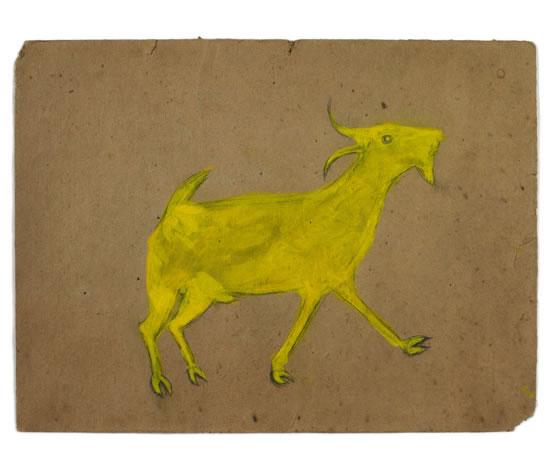
Just Folk will be exhibiting works by Bill Traylor at the nineteenth annual Outsider Art Fair (Bill Traylor, “Yellow Goat,” poster paint and graphite on cardboard, ca. 1939-42)
The Mart
7 West 34th St. off Fifth Ave.
February 11-13, $20 (includes catalog)
www.sanfordsmith.com
The nineteenth annual Outsider Art Fair gets under way tonight with an advance preview benefiting the Creative Growth Art Center, which “serves adult artists with developmental, mental, and physical disabilities,” and the Fountain Gallery, which “provides an environment for artists living and working with mental illness to pursue their personal visions and to challenge the stigma that surrounds mental illness.” The show, held at the Mart at 7 West 34th St., opens to the general public on Friday, featuring more than thirty galleries displaying works by outsider, visionary, and self-taught artists who paint, draw, and sculpt without specific training and education. Among the exhibitors are the Electric Pencil, Ricco/Maresca, Carl Hammer, Just Folk, Yukiko Koide Presents, Marcia Weber Art Objects, and Maxwell Projects. Special events include a Friday-night after-party ($50), a presentation by Dr. Thomas Röske of the Prinzhorn Collection on Saturday at 1:30 ($25), and a panel discussion on the role of artists with disabilities in outsider and contemporary art on Sunday at 2:00 ($25). Outsider Art Week continues at the American Folk Art Museum, with Anna Panszczyk delivering the Nathan Lerner Annual Lecture, “Reading Ephemera (and Fairies) in the Artworks of Henry Darger,” Friday at 4:30 (free with museum admission), followed Sunday at 10:00 by the Anne Hill Blanchard Symposium, “Uncommon Artists XIX: A Series of Cameo Talks,” with Laurel Gitlen speaking on Michael Patterson-Carver, Brett Littman on Eugene Von Bruenchenhein, Kendall Messick on Gordon Brinckle, and Tom Whitehead on Clementine Hunter connoisseurship ($35), and a 1:00 screening of Kendall Messick’s 2003 film, THE PROJECTIONIST, followed by a Q&A with the filmmaker (free with museum admission).
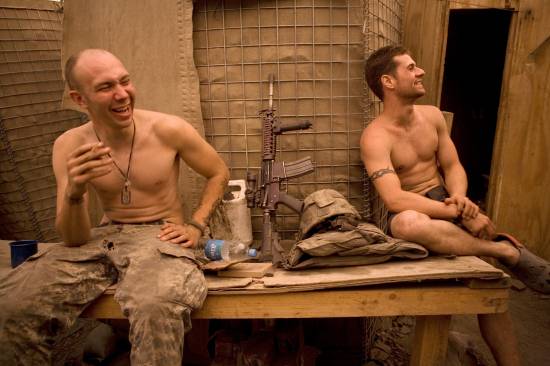
 From June 2007 to July 2008, journalists Sebastian Junger (THE PERFECT STORM) and Tim Hetherington (LIBERIA: AN UNCIVIL WAR) made a total of ten trips to the dangerous Korengal Valley in Afghanistan, documenting the full deployment of Battle Company of the 173rd Airborne Brigade. With snipers hidden all around them, the fifteen soldiers of Second Platoon built a remote, strategic outpost they named Restrepo after PFC Juan Restrepo, the well-liked company medic who was killed early on. Junger and Hetherington film such men as Captain Dan Kearney, Staff Sergeant Kevin Rice, and Sergeant Brendan C. O’Byrne as they go about their daily duties, joking around, playing the guitar, meeting with Afghan locals to get information about the Taliban, and digging trenches while prepared to be shot at at any moment. The journalists took more than 150 hours of footage, supplemented with interviews with several of the soldiers after they were safely back at home base in Italy, talking about what they went through. There is nothing political about RESTREPO, nor does it pull at the heartstrings with melodramatic, overemotional scenes; instead, it depicts the harsh realities of battle, including the long stretches of boredom punctuated by sudden life-or-death situations. There is no narration, no one discusses the possible merits of the war, and no generals or politicians are on hand to defend America’s involvement in the region. There’s no ethnocentric yahooism, nor is there racist treatment of the mostly unseen enemy. It’s just war, pure and simple, seen from the perspective of men who chose to join the army and risk their lives for their country. The film won the documentary Grand Jury Prize at last year’s Sundance Festival and also screened at the Human Rights Watch Film Festival at Lincoln Center. Nominated for an Oscar for Best Documentary, RESTREPO is having a special presentation February 10 at the Paley Center, followed by a panel discussion with Junger, Hetherington, and THE WRONG WAR author Bing West, moderated by Foreign Affairs’ Gideon Rose.