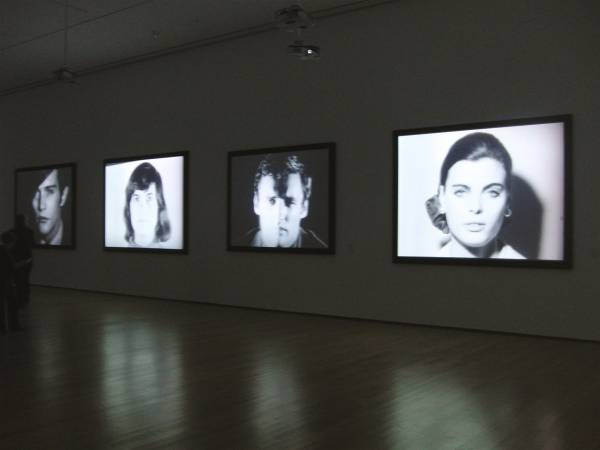
“Andy Warhol: Motion Pictures,” installation shot, 16mm film (black and white, silent), © 2010 The Andy Warhol Museum, Pittsburgh, PA, a museum of Carnegie Institute. All rights reserved (photo by twi-ny/mdr)
Museum of Modern Art
The International Council of the Museum of Modern Art Gallery, sixth floor
11 West 53rd St. between Fifth & Sixth Aves.
Wednesday – Monday through March 21, $20 (includes admittance to same-day film programs)
212-708-9400
www.moma.org
From 1964 to 1966, Andy Warhol attempted to film nearly everyone who entered the Factory, capturing them in four-minute silent black-and-white segments he called “Screen Tests,” with the subjects usually just staring directly into the camera the entire time. MoMA has turned one of its sixth-floor spaces into a moving-portrait gallery, as twelve of the Screen Tests are being shown concurrently, hung on the walls like a series of large-scale paintings, with visitors feeling like they’ve just walked into a (rather introspective) Factory gathering. Shot at twenty-four frames per second but projected at sixteen, the shorts have a beautiful, slow, loving pace to them, but several of them have tragic elements if you are familiar with the person’s ultimate fate. For this rare display, curator Klaus Biesenbach has selected the following Factory celebrities and would-be Superstars: poet-activist Allen Ginsberg; musician Lou Reed; actor and painter Dennis Hopper; Kathe Dees; actress and art collector Baby Jane Holzer (who brushes her teeth); Japanese actress Kyoko Kishida; writer-activist-theorist Susan Sontag; art patron Ethel Scull; actress and socialite Edie Sedgwick, who died of an overdose of prescription medication and alcohol in 1971 at the age of twenty-eight; model-actress Donyale Luna, who died of an overdose in 1979 at the age of thirty-three; actor Paul America, who died in a car accident in 1982 at the age of thirty-eight; actress and Velvet Underground singer Nico, who died from a cerebral hemorrhage in 1988 at the age of forty-nine; and Italian actor and musician Gino Piserchio, who died in 1989 of an AIDS-related infection at the age of forty-four. The Screen Tests are supplemented by several of Warhol’s heavily influential, controversial films, from the same early 1960s period, that deal with humanity’s deepest needs and desires, including BLOW JOB, EAT, SLEEP, and KISS, the latter shown in the seated back screening room. On March 2, the full five-and-a-half-hour SLEEP will be screened in the rear gallery, while the complete eight-hour EMPIRE will be shown on alternate Fridays, February 18 and March 4 and 18. Also, in conjunction with the exhibit, there will be a MoMA Talk on March 3 at 6:00, “Warhol, On Screen, Off Screen,” with writer John Giorno and artist Conrad Ventur, moderated by curator Klaus Biesenbach. And finally, if you visit the above website, you can even make your own Warhol Screen Test.





 Returning to the screen for the first time in sixteen years, legendary Korean actress Yun Jung-hee is mesmerizing in Lee Chang-dong’s beautiful, bittersweet, and poetic POETRY. Yun stars as Mija, a lovely but simple woman raising her teenage grandson, Wook (Lee David), and working as a maid for Mr. Kang (Kim Hi-ra), a Viagra-taking old man debilitated from a stroke. When she is told that Wook is involved in the tragic suicide of a classmate (Han Su-young), Mija essentially goes about her business as usual, not outwardly reacting while clearly deeply troubled inside. As the complications in her life grow, she turns to a community poetry class for solace, determined to finish a poem before the memory loss that is causing her to forget certain basic words overwhelms her. Winner of the Best Screenplay award at the 2010 Cannes Film Festival, POETRY is a gorgeously understated work, a visual, emotional poem that never drifts from its slow, steady pace. Writer-director Lee (PEPPERMINT CANDY, SECRET SUNSHINE) occasionally treads a little too close to clichéd melodrama, but he always gets back on track, sharing the moving story of an unforgettable character. Throughout the film he offers no easy answers, leaving lots of room for interpretation, like poems themselves.
 Orgasms are supposed to be a lot of fun, and that’s precisely what Liz Canner’s documentary, ORGASM INC., is. But it also shows how serious the business of sexual pleasure can be. Hired by a drug company to edit a video about Female Sexual Dysfunction, Canner discovered just how ridiculous the race to come up with “Viagra for women” is. Canner speaks with a wide range of people, from scientists and psychiatrists to activists and PR flunkies, who all have different angles on the success or failure of the female orgasm. She follows the exploits of Dr. Stuart Meloy and his Orgasmatron surgery in Winston-Salem (take that, Woody Allen!), Dr. Carol Queen showing off objects in San Francisco’s Good Vibrations Antique Vibrator Museum, Suzanne Roth operating the Genito-sensory Analyzer in Chicago, Lisa at a convention questioning the procedure she is hyping, Designer Laser Vaginal Rejuvenation, and sexologist Leonore Tiefer, PhD, going in front of FDA committees leading the fight against approval of Big Pharma’s latest suuposed female orgasm miracle drug, which has included the topical cream Alista and the testosterone patch Intrinsa. Jay Beaudoin and Nicholas Fischer add goofy animation throughout the film, depicting a cartoon race across a bed to be the first one to come up with the magic bullet. Canner infuses the hot-button topic with charm and humor, letting the absurdity of it all play out in all its glory. Titillating and shocking, infuriating and revealing, ORGASM INC. is a surprising and satisfying foray into the billion-dollar world of female sexual pleasure. Canner will be at the Quad for the 4:20, 6:15, and 8:10 shows Friday through Sunday, then at the 6:15 shows Monday through Thursday.