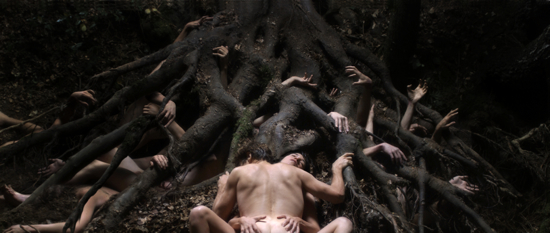
Lars von Trier’s ANTICHRIST is part of “Sex in Cinema” series at the Quad
Quad Cinema
34 West 13th St.
Saturday, February 19, 1:00
Tuesday, February 22, 9:55
Series runs February 18-24
212-255-2243
www.quadcinema.com
www.antichristthemovie.com
 Generally, Danish Dogme practitioner Lars von Trier makes films that critics and audiences alike are either repulsed by or deeply love. Controversial works such as Breaking the Waves, The Idiots, Dancer in the Dark, and Dogville win international awards while also driving people out of theaters. In fact, at his New York Film Festival press conference for Antichrist, he was asked how he feels when no one walks out on his work: “Then I have failed,” he replied with a sly grin. Well, there are sure to be many walkouts during Antichrist, a harrowing tale of grief, pain, and despair that begins with a gorgeously shot, visually graphic sex scene followed by a tragic accident. The rest of the film details how the unnamed couple (Willem Dafoe and Charlotte Gainsbourg) deal with the loss of their young child; a therapist, he opts to treat her more as a patient than as his wife, a highly questionable decision that threatens to tear them apart — both psychologically and physically, as the film turns into an extremely violent horror flick in the final scenes. Somehow, we found ourselves pretty much right in the middle of this one, neither loving it nor hating it while admiring it greatly despite its odd meanderings, loose holes, sappy dialogue, and occasionally awkward scenarios. In certain ways, it’s a bizarre amalgamation of Alfred Hitchcock’s Spellbound, Ingmar Bergman’s Scenes from a Marriage, Stanley Kubrick’s The Shining (and various other Stephen King stories), Roman Polanski’s Rosemary’s Baby, Richard Donner’s The Omen, Robert Wise’s Audrey Rose, and Tobe Hooper’s The Texas Chain Saw Massacre. Or something like that. Add half a star if you think von Trier is a creative genius; delete two stars if you consider him a certifiable lunatic.
Antichrist is screening as part of the Quad series “A Week of Sex in Cinema,” consisting of seven films that push the boundary of the depiction of sex onscreen, including John Cameron Mitchell’s Shortbus, Kirby Dick’s documentary This Film Is Not Yet Rated, Chyng Sun’s The Price of Pleasure, Michael Winterbottom’s 9 Songs, Jean-Jacques Beineix’s Betty Blue (which opens with one of the most breathtaking sex scenes ever put on celluloid), and the theatrical premiere of Philippe Diaz’s Now & Later; Diaz and the cast will participate in Q&As following select screenings February 18-20.
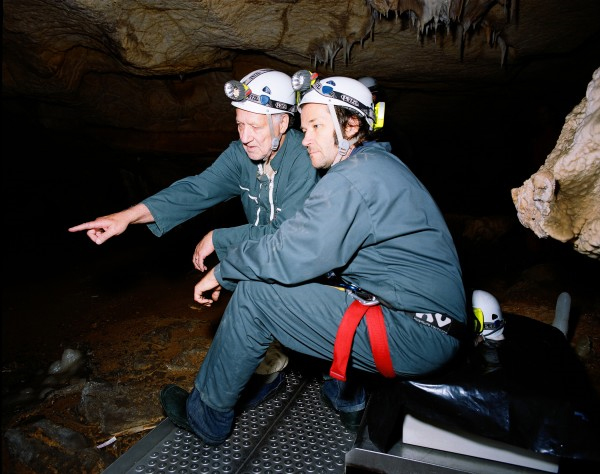
 An adventurer as much as a filmmaker, German director Werner Herzog has headed into the Amazon in Fitzcarraldo (1982), burning Kuwaiti oil fields in Lessons of Darkness (1992), and Antarctica in Encounters at the End of the World (2008). In his latest documentary, Cave of Forgotten Dreams, he goes where few have ever gone before. In December 1994, speleologists Jean-Marie Chauvet, Éliette Brunel, and Christian Hillaire discovered the Chauvet-Pont-d’Arc Cave in France, a vast series of chambers filled with remarkable paintings and engravings as well as animal bones, including the skulls of the extinct cave bear. The works were painted onto and carved into the walls, not limited to flat surfaces but around formations that jut out into the cavern. Dating back more than thirty thousand years, they are the oldest cave paintings ever found, well preserved through crystallization over the centuries and now by the intense and careful protection of the French government. Only a handful of scientists have been given access to the cave, until last spring, when Herzog, who has been entranced by cave paintings since he was twelve years old, was allowed to bring in a shoestring crew using specially devised equipment to film the space over the course of six four-hour sessions. The four-person crew — including Herzog manning the lights and his longtime cinematographer, Peter Zeitlinger, behind the 3-D camera — were not allowed to touch anything and had to stay on a narrow metal walkway that winds through the cave. They were accompanied by a team of specialists on the rare public journey: handprint expert Dominique Baffier, cave bear researcher Michel Philippe, the husband and wife team of Gilles Tosello and Carole Fritz, who map out the social connection between art and archaeology, Jean Clottes, the former director of the Chauvet Cave Research Project, and current director Jean-Michel Geneste. In true Herzog style, he also speaks with a master perfumer and two prehistoric flute archaeologists. Herzog’s decision to use 3-D — for what he says will be the only time in his career — was a stroke of genius, allowing viewers to feel like they’re walking through the cave with him, nearly able to reach out and touch the remarkable drawings, engravings, and skeletons. Herzog’s narration does get too dreamy at times, veering off on philosophical tangents before he adds a cool but silly coda, but, as always, he adds his trademark humor and charm.