twi-ny recommended events

MARTHA GRAHAM DANCE COMPANY: 85th ANNIVERSARY SEASON

The Martha Graham / Isamu Noguchi collaboration EMBATTLED GARDEN is part of MGDC season at the Rose Theater (photo by Nan Melville)

Rose Theater
10 Columbus Circle, Broadway at West 60th St.
March 16-20, $48-$133
212-721-6500
www.marthagraham.org
www.jalc.org

Since 1926, the Martha Graham Dance Company has been one of the most famous and influential dance companies in the world, boasting some 181 works from such choreographers as Merce Cunningham, Paul Taylor, and Pascal Rioult performed by such superstars as Rudolf Nureyev, Mikhail Baryshnikov, and Margot Fonteyn. Under the current leadership of executive director LaRue Allen and artistic director Janet Eilber, MGDC, continuing the legacy of its legendary iconic founder, will be at Jazz at Lincoln Center’s Rose Theater March 15-20, celebrating its eighty-fifth anniversary season by presenting several of its most exciting pieces from throughout its storied history, many of which are either choreographed by Graham or reference her directly. The season begins Tuesday with a gala honoring Robert Wilson and a revival of his Snow on the Mesa, which has not been performed in fifteen years, along with Maple Leaf Rag, Graham’s final ballet. On March 16 & 19, “New Revival / New Work” features Graham’s 1943 Deaths and Entrances and the world premiere of a commissioned piece by Taiwanese choreographer Bulareyaung Pagarlava. On March 17, “The Noguchi / Graham Connection” is explored in three collaborations between Graham and Queens-based Japanese sculptor Isamu Noguchi, Appalachian Spring, Cave of the Heart, and Embattled Garden. On March 18, “Wilson / Graham” includes Snow on the Mesa and Maple Leaf Rag. The March 19 matinee, “Political Dance Project,” features Dance Is a Weapon, a montage by Graham, Isadora Duncan, Jane Dudley, and others, in addition to a performance of Graham’s 1935 Panorama by thirty New York City high school students. The season concludes with the Sunday matinee “Wilson / Graham / Noguchi,” a grand finale of Snow on the Mesa and Embattled Garden in conjunction with the JapanNYC festival.

JOE BOYD AND ROBYN HITCHCOCK: CHINESE WHITE BICYCLES

LIVE AND DIRECT FROM 1967
(le) poisson rouge
158 Bleecker St.
Friday, March 11, $25-$30, 6:30
212-228-4854
www.robynhitchcock.com
www.joeboyd.co.uk
www.myspace.com/lepoissonrougenyc

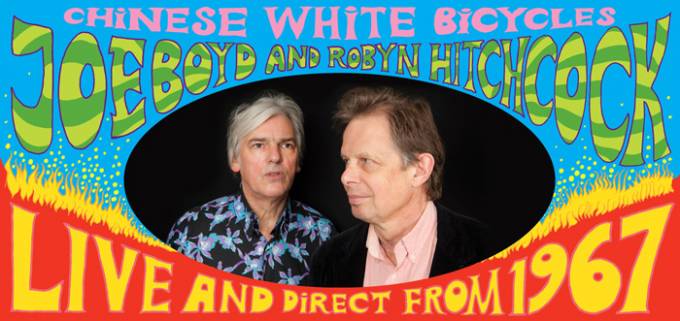
Since the mid-1970s, acerbic singer-songwriter Robyn Hitchcock has been regaling the world with philosophical, intellectual, and downright funny tales as a solo performer and with such bands as the Soft Boys, the Egyptians, and the Venus 3. His live shows, documented in Jonathan Demme’s 1998 documentary, Storefront Hitchcock, are always unusual and immensely entertaining, anchored by his often hysterically rambling between-song chatter in addition to his immense talent at writing a damn good tune. Always up to something different — in June he’ll team up with the Imaginary Band to play a one-off UK tribute to the recently deceased Captain Beefheart, performing the seminal album Clear Spot in its entirety — he’ll be at (le) poisson rouge on Friday night with longtime friend Joe Boyd, the legendary American producer who has worked with everyone from the Incredible String Band, Pink Floyd, Fairport Convention, Nick Drake, Bob Dylan, and Kate and Anna McGarrigle to Toots and the Maytals, Richard Thompson, Billy Bragg, R.E.M., and ¡Cubanismo! Hitchcock and Boyd are in the midst of a brief tour dubbed “Chinese White Bicycles: Live and Direct from 1967,” in which Boyd reads passages from his recently rereleased memoir, White Bicycles: Making Music in the 1960s (Serpent’s tail, December 2010, $14.95), Hitchcock plays songs by the groups mentioned in the book, the music that influenced him when he was growing up in London, and the two just talk about stuff. “Joe had a hand in creating a world that revolutionised mine,” Hitchcock notes on his website. “If he is Dr Frankenstein, then I’m his monster. Or one of them…” Get ready for what should be one very groovy night.

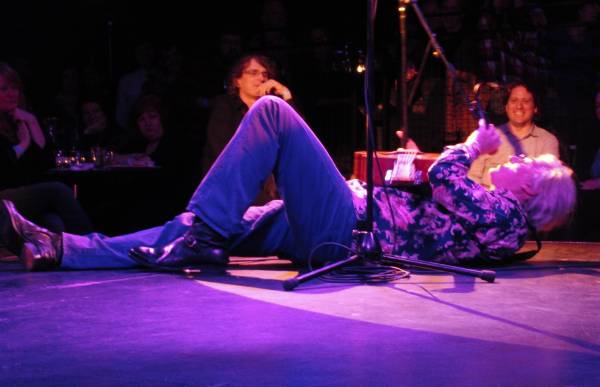
Robyn Hitchcock gets down to the Lovin’ Spoonful’s “What a Day for a Daydream” at (le) poisson rouge show with Joe Boyd (photo by twi-ny/mdr)

Update: It did indeed turn out to be one groovy night, as Joe Boyd told great stories about hanging out with such seminal figures as Zal Yanovsky and Joe Butler of the Lovin’ Spoonful, Robin Williamson and Clive Palmer of the Incredible String Band, Paul Butterfield (with Boyd suggesting he add Mike Bloomfield to the Blues Band), Nick Drake (not looking forward to his songs being overproduced), and Fairport Convention (as they decided to eschew American folk rock and turn to the English tradition after fearing they could never create something as special as the Band’s Music from Big Pink). He talked about putting together a Syd Barrett tribute that ultimately involved Pink Floyd, about losing out on a one-night stand to Bob Dylan, and about Maria Muldaur and Eric Muldaur falling in love. He gave the show a decidedly New York bent, mentioning many of the haunts they used to go to that were just around the corner from (le) poisson rouge; “This is the beating heart of the sixties,” he said of the city. He also apologized for convincing LPR that he and Robyn Hitchcock should perform in the round, resulting in their backs to much of the audience, which boasted Rufus Wainwright. After each tale, Hitchcock introduced and played a song by the respective musicians, including the ISB’s “Way Back in the 1960s,” Dylan’s “All I Really Want to Do,” the Spoonful’s “What a Day for a Daydream” (flat on his back), Fairport Convention’s “Reynardine,” Drake’s “River Man,” and the Floyd’s “Bike.” The encore was a riveting tale of Boyd being at the center of Dylan going electric at Newport, as the evening concluded with Hitchcock offering up Bob’s spiteful “It’s All Over Now, Baby Blue,” followed by Boyd and Hitchcock signing books, CDs, and posters. (For a slideshow of the event, click here.)

SWANN!!!

Jenn Harris, Jack Ferver, and QWAN take on BLACK SWAN at P.S. 122 (photo by Christian Coulson)

Performance Space 122
150 First Ave. at Ninth St.
March 10-12, $15
www.ps122.org

In his solo and company work, choreographer, director, and performer Jack Ferver has twisted and tweaked books, films, and plays in such experimental productions as Rumble Ghost (which reimagined scenes from Tobe Hooper’s Poltergeist), Cliterature and Camille vs. Ken, The Ophelia Project, and A Movie Star Needs a Movie. Last year, Ferver’s QWAN (Quality Without a Name) Company presented a staged parody reading of Richard Eyre’s 2006 romantic thriller Notes on a Scandal, and now they’re riffing all over Darren Aronofsky’s fabulously deep and cheesy piece of nonstop entertainment, the Oscar-nominated Black Swan. Ferver plays the role of bad girl Lily, who introduces good girl Nina (Jenn Harris) to her dark side as she and her mother (Queer as Folk’s Randy Harrison) struggle to convince choreographer Tomas (Christian Coulson) that Nina deserves the lead in a new production of Tchaikovsky’s Swan Lake. Since Black Swan already has plenty of meta-parody in it, there’s no telling where Ferver might take it in this world premiere at P.S. 122.

Update: As at previous Jack Ferver productions, the audience filters into P.S. 122’s upstairs theater to find Ferver and company already onstage, in this case limbering up as if preparing for a dance. But once their latest production, SWAN!!!, gets under way, the five performers primarily stay seated on chairs arranged in a semicircle, reading from a hysterically tweaked script of Darren Aronofsky’s beautifully cheesy, Oscar-nominated thriller, Black Swan, written by Mark Heyman, John McLaughlin, and Andres Heinz. SWAN!!! is every bit as outrageously funny as you’d like it to be as QWAN (Quality Without a Name) pays wonderful homage to the film’s psychological depth and confounding craziness. Front and center is Jenn Harris as Nina, making wacky faces, speaking in a high-pitched voice, and approaching the audience whenever she has to throw up, which is often. Ferver, when he isn’t laughing at the antics of the others, nails the role of Lily, mimicking Mila Kunis to great effect. Christian Coulson’s French accent as womanizing choreographer Tomas gets ever-more over-the-top, as does Randy Harrison’s interpretation of Barbara Hershey as Nina’s overprotective mother. (Just wait till you see how they handle Mom’s obsession with painting pictures of her daughter, while the cake scene might have you rolling on the floor.) And Matthew Wilkas has a blast playing Winona Ryder, who is referred to throughout by the actress’s name, not the character she plays in the film, Tomas’s former prima ballerina, the deeply troubled Beth. (The several references to Lypsinka, however, fall flat, as apparently even this East Village crowd did not know — or care — that Lypsinka creator John Epperson plays the rehearsal pianist in Black Swan.) The cast also has a ball playing off the film’s instantly famous lesbian scene, which here becomes a riotous romp between Ferver and Harris, layered with laughs relating to gender identity and real and on-screen homosexuality. The low-budget SWAN!!!, which is also not afraid to toss in plenty of legitimately low-grade toilet humor — who knew Natalie Portman was such a fine flatulator — is an absolute hoot.

MI AMI

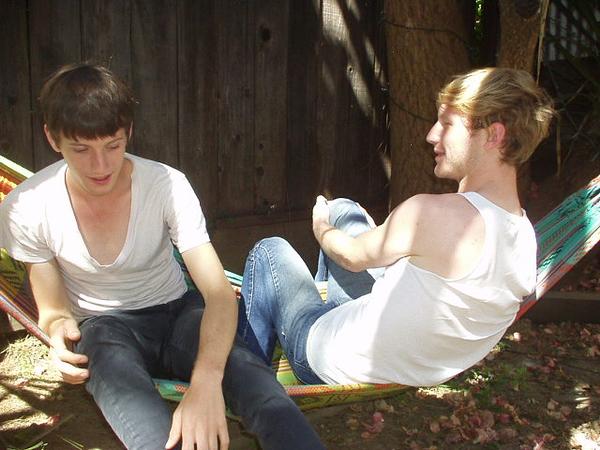
Now a duo, Mi Ami’s Daniel Martin-McCormick and Damon Palermo will play a series of DJ sets and bands shows this month (photo by Lili Schulder)

Thursday, March 10, Shea Stadium, 20 Meadow St.
Friday, March 11, Pianos, 158 Ludlow St., $10, 11:00
Saturday, March 26, Glasslands, 289 Kent Ave. $8-$10, 8:00
Sunday, March 27, Public Assembly, 70 North Sixth St.
www.myspace.com/miamiamiami

Okay, we have to admit that we’re confused here too. Tonight the Miami Dolphins are going to be at Shea Stadium, with a major roster change to boot. Oh, wait a minute; now we get it. Actually, the Baltimore duo Mi Ami, formerly a trio, will be playing a DJ set at the tiny Brooklyn music club Shea Stadium, the first of four area appearances this month. In February 2009, we wrote that on Watersports, guitarist Daniel Martin-McCormick, bassist Jacob Long, and drummer Damon Palermo “rail against the pervasive fear that lies at the heart of America’s psyche, offering a much-needed scream of release,” and in April 2010 we called their follow-up, Steal Your Face, “a thirty-seven-minute freak-out of massive proportions.” But now, with Palermo having left the band, Martin-McCormick and Long have delved deep into the techno-disco part of their sound on their new release, Dolphins (Thrill Jockey, March 15, 2011). Available in a vinyl-only limited edition of 750 copies (with free digital download), the record consists of four extended-length electronic dance tunes, “Hard Up,” “Dolphins,” “Sunrise,” and “Echo,” that take listeners on a space-age ride fueled by computer samples, drum machines, keyboards, and screeching vocals. Of course, by naming the album Dolphins, Mi Ami don’t do themselves any favors; search on “Mi Ami Dolphins” and see how long it takes before they come up. (And Steal Your Face was not exactly a unique name either, as Dead Heads are well aware.) Fortunately, they seem to have quite a sense of humor. The reinvented Mi Ami will be playing a DJ set with members of Jonas Reinhardt tonight (as DJ Magic Touch) at Shea Stadium on a bill with Sex Worker, Big Gold Belt, and Darius, followed by a live band performance March 11 at Pianos with Darius again, Innerglaze, and Wolff. Then they’ll be back in town March 26 for a full show at Glasslands with Laurel Halo and Psychic Reality and another DJ set March 27 at Public Assembly.

SHINJUKU OUTLAW: AUDITION

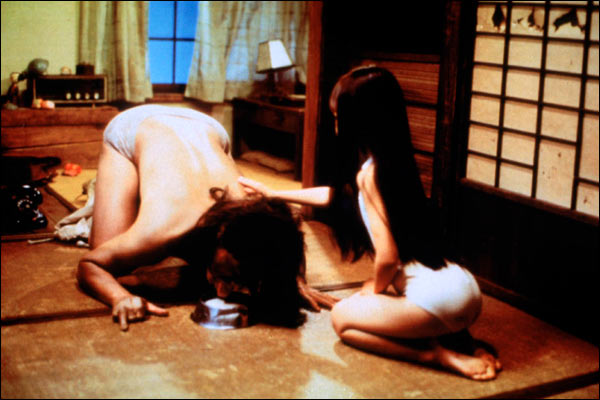
Takashi Miike’s torture-revenge breakthrough, AUDITION, kicks off thirteen-film tribute at Lincoln Center

13 FROM TAKASHI MIIKE: AUDITION (ODISHON) (Takashi Miike, 1999)
Film Society of Lincoln Center
Walter Reade Theater
165 West 65th St.
Wednesday, March 16, 9:30
Series runs March 16-20
212-875-5610
www.filmlinc.com
www.subwaycinema.com

This is one sick flick. Aoyama (Ryo Ishibashi) has been lonely since his beloved wife died seven years earlier, and on the advice of his best friend (Jun Kunimura) he holds a fake audition to find himself the perfect romantic partner. He is immediately drawn to Asami (Eihi Shiina in her stunning film debut), but after they get together once, various events keep them from going out again, and Asami starts taking it pretty personally. So when they eventually do meet up…. This unconventional Japanese horror film, which won two awards at the Rotterdam International Film Festival, had some people running out of Film Forum faster than they lined up around the block to get in in the first place—the last half hour is so brutal, so grotesque, so disturbing, so violent that you should hang on only at your own risk. Audition was New York’s major introduction to Japanese director Takashi Miike, who has made more than ninety films since the early 1990s, including such fab efforts as The City of Lost Souls (2000), Ichi the Killer (2001), Izo (2004), and The Great Yokai War (2005), all of which are part of “Shinjuku Outlaw: 13 from Takashi Miike,” a five-day Lincoln Center tribute, held in conjunction with Subway Cinema, celebrating the New York premiere of his latest, the brilliant samurai drama 13 Assassins. Most well known for the graphic violence in his films, Miike also has a wild sense of humor and a knack for making audiences think, “Oh no he won’t,” and then he does. Miike will be on hand to introduce several of the Walter Reade screenings as well as the March 15 showing of Dead or Alive (1999) that is part of Japan Society’s “Hardest Men in Town: Yakuza Chronicles of Sin, Sex & Violence.” Keep watching twi-ny, as we’ll be reviewing one film a day for the next week as the retrospective — which is sure to sell out, as Miike has a dedicated cult fan base and several of these films rarely appear on the big screen and are not available on DVD — approaches. [Ed. note: Miike was originally scheduled to appear at the Walter Reade Theater to introduce several screenings but has had to cancel because of the catastrophic events occurring in Japan.]

TWI-NY TALK: JANET BIGGS

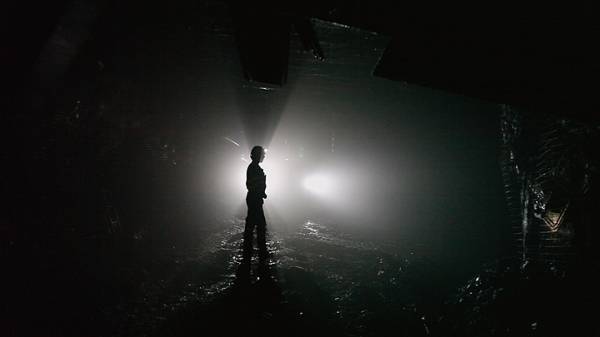
BRIGHTNESS ALL AROUND is one of three stunning videos by Janet Biggs set in the Arctic (photo courtesy Janet Biggs)

JANET BIGGS: THE ARCTIC TRILOGY
Winkleman Gallery
621 West 27th St. between Tenth & Eleventh Aves.
Tuesday – Saturday through March 12
212-643-3152
www.winkleman.com
www.jbiggs.com

New York–based video artist Janet Biggs has traveled around the world capturing remarkable images she pairs with eclectic music, melding physical, often ritualistic movement with investigations into gender identity and the natural environment. Vanishing Point features motorcycle speed-record holder Leslie Porterfield on the Bonneville Salt Flats of Utah and the Harlem Addicts Rehabilitation Center Gospel Choir, Enemy of the Good explores Santiago Calatrava’s City of Arts and Sciences in Valencia, Spain, with concert pianist José Luis Hernández-Estrada, and Duet combines a NASCAR pit crew in Charlotte and an aria from the Léo Delibes opera Lakmé. For her current solo show, continuing at Chelsea’s Winkleman Gallery through Saturday, the former equestrian, who has an undergraduate degree in painting and sculpture and a master’s in glassblowing, has installed “The Arctic Trilogy,” three gorgeous short films that were shot in the vast, isolated Svalbard archipelago: Fade to White cuts between a kayaker and a mournful, operatic song by performance artist John Kelly, Brightness All Around follows the exploits of woman coal miner Linda Norberg along with an original, propulsive dance-floor incantation by Bill Coleman about actual near-death experiences, and In the Cold Edge traces the path of a spelunker emerging from an ice cave. After writing a grant for her next secretive project, Biggs generously answered a series of questions about her creative process for twi-ny.

twi-ny: At Winkleman, Brightness All Around and Fade to White are shown in succession, one after the other, at opposite sides of the main space, creating a sharp contrast between them and a fascinating dialogue that involves performers Bill Coleman and John Kelly as well as a male kayaker and a female engineer. How did that installation choice come about?

Janet Biggs: Brightness All Around and Fade to White are polar opposites in their representations of the Arctic landscape, gender, race, awe and terror, loss and change. I wanted the audience to experience the two videos as counterpoints in their extremes. My decision to project them back-to-back on opposite walls allowed me to place the audience in one immersive, physical space while still emphasizing contrasts. The audience had to physically turn around to view the successive videos, creating both a physical and psychological shift.

In each of these two pieces, I alternate footage of individuals struggling in extreme environments to define their identity with shots of singers performing the music that is heard in the soundtrack. By incorporating performance artist John Kelly and music guru Bill Coleman as both visual and audio elements into my videos, I explore the way these performers’ physical intensity can be interwoven into a narrative to create new meaning.

In Brightness All Around, singer/dancer Bill Coleman, dressed in black leather against a black backdrop, presents a fetishized, macho image as he delivers a demonic chant of near-death experiences. In Fade to White, I integrated the Arctic imagery with countertenor John Kelly, clad in all white, whose age, androgyny, and mournful voice parallel the vanishing Arctic landscape and signal the erasure of male dominance.

I intend to invert the traditional gendered dynamics of heroic exploration by portraying a male explorer as a passive, vulnerable figure, in the white-on-white landscape, while a female Arctic miner aggressively drills, violates, and transforms the black depths of the earth below. The musical performances in the two pieces as well as the juxtaposition of a pristine landscape and the dark, gritty mine interior complicate the power dynamics.

By presenting the two videos back to back I hope to expand the narrative, prompting questions about power hierarchies, social structures, and individual relationships to desire within existential themes.

twi-ny: In many of your videos, including the three in the current exhibition as well as Vanishing Point, Sollipsism Syndrome, and Enemy of the Good, you seem drawn to big, wide-open spaces, usually very bright, with solitary figures primarily in natural environments. Would you consider that a motif of your work, or is it just a coincidence? Like Werner Herzog, would you consider yourself an adventurer as well as a filmmaker?

JB: I tend to revisit elemental and extreme landscapes, from the icy fjord in Glacier Approach, to the broiling hot salt flats of Bonneville in Vanishing Point, to my most recent videos that were filmed in the High Arctic. I am interested in using the landscape as a surrogate character or equal subject to the individuals who struggle to maintain a sense of self within it.
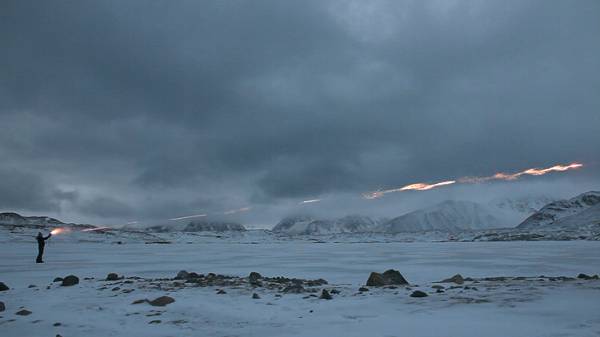
Janet Biggs makes her first on-screen appearance in IN THE COLD EDGE (photo courtesy Janet Biggs)

I am drawn to the ends of the earth. Locations that represent empty lands and blank spaces are ripe for interpretation. Even though these once unknown places have been mapped and surveyed, increased knowledge has not replaced my endless fantasies of discovery in these regions. I am interested in individuals who dedicate themselves to a search for perfection often through athletic pursuits. In their willingness to take risks and endure isolation, they strive to attain an extreme state of being. By filming solitary figures within vast natural environments I am able to focus on both their vulnerable fragility as well as their manifest strength.

I use grand stories and heroic efforts as my point of departure, then slide sideways into small gestures or esoteric tasks as seen from deeply personal perspectives. I am interested in how repetitive or ritualized movements, the incidental, small movements, are as wondrous as the stupefying wild and beautiful landscapes where many of these actions occur.

twi-ny: Seeing humans deep underground in a cave or a mine, the viewer is always aware of your presence as cinematographer, and you get to experience much of what your subjects are experiencing, but in In the Cold Edge, you make a critical appearance at the end. What made you decide to come out from behind the camera at that point?

JB: I’ve hung off the back of trucks in specially made chairs that ride inches above the ground at more than one hundred miles per hour. I’ve paddled kayaks in Arctic weather where water temperatures are so cold you would die of hypothermia in fifteen minutes if you capsized. I have paddled under huge glacial walls, hoping that they wouldn’t calve, and in waters with polar bears swimming nearby. I have squeezed through glacial ice caves so tight that I couldn’t get my head up to see with my headlamp, and I have descended into Arctic coal mines where methane fires ignite with terrifying regularity.

There is clearly a performative side to my work that has to do with me physically and psychologically pushing myself or assuming some kind of risk in order to capture the images and action needed for a piece. I didn’t realize I was such a thrill seeker until I set out to make this kind of work. This part of my process is compelling enough that I often find myself looking for new challenges, although my exploration of the addictive nature of risky behavior is primarily as a witness to someone else’s action and off-camera.

By taking risks and challenging myself in the production of my work, I strive to understand my subjects’ choices and motivations, and also experience some of the thrills that are part of what they do. I hope that this process will translate to the viewer, allowing them a vicarious experience that will become an element in the final reception of the work.

I made my first on-camera appearance at the end of In the Cold Edge. I am seen shooting a flare into an archetypal image of the frozen north. This personal appearance was necessitated by practical considerations (I was the only one of my crew who was certified to shoot a firearm) but also by a personal need to represent my relationship to this haunting location. On my first trip to the Arctic, the landscape kept me in a state of romantic awe. By the second trip, my relationship to the region had changed to include a degree of terror as well as awe. I had a profound sense of displacement in a region that neither needed nor desired human presence. The act of shooting a flare was both an aggressive assertion of self and also a cry for help in a landscape where assumptions about self and reality are radically altered.

JIM JONES REVUE

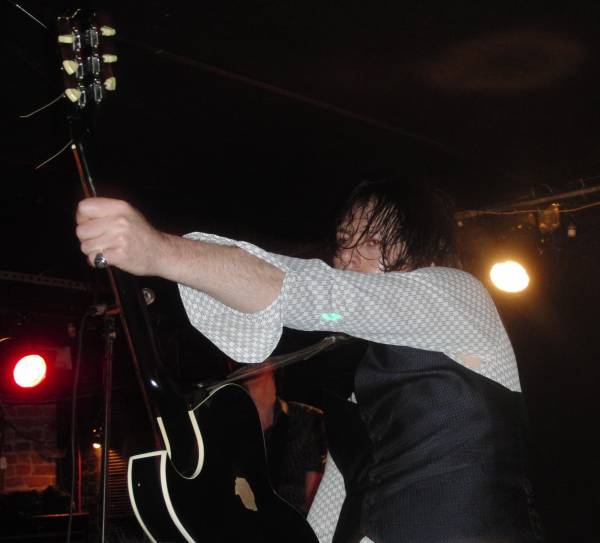
The Jim Jones Revue returns to New York City this week to tear it up at the Knitting Factory (photo by twi-ny/mdr)

Knitting Factory Brooklyn
361 Metropolitan Ave.
Thursday, March 10, $13-$15, 8:00
www.bk.knittingfactory.com
www.myspace.com/thejimjonesrevue
Jim Jones Revue slideshow

Last summer England’s Jim Jones Revue blew into town for three shows that tore the roof off the city. We caught them at the Mercury Lounge, where they played a blistering, frenetic set that filtered Jerry Lee Lewis and Little Richard through the Stooges and the MC5. They ripped it up with such punk R&B barnburners as “Hey Hey Hey Hey,” “Rock ‘n’ Roll Psychosis,” and “Cement Mixer” from their 2008 self-titled debut and “High Horse,” “Elemental,” and “Shoot First” from their September 2010 disc, Burning Your House Down. As fast and furious as they play, they also revealed a goofy sense of humor with “Dishonest John,” a song inspired by the villain in the old Beany and Cecil cartoons. Singer and guitarist Jones might have been front and center, but he had a crazed cohort in Elliot Mortimer, who sliced, diced, and banged away on his piano, sending out maximum thrills and chills. Just this week, however, it was officially announced that Mortimer has left the band to spend more time with his family, and he has been replaced by French-born keyboardist Henri Herbert, so it will be interesting to see how that change impacts this amazing band, which also includes Rupert Orton on guitar, Gavin Jay on bass, and Nick Jones on drums, as they return to New York City for a show March 10 at the Knitting Factory with local groups Freshkills and the hot Hollis Brown, which just sold out Brooklyn Bowl on their own late last month. “2010 was a busy old time for us with an obscene amount of gigs that took us across Europe and America in a blaze of rock n roll fury,” Jay recently wrote on the Jim Jones Revue blog. “Houses were burned down, roofs raised, and speakers exploded in our mission to bring noise, mayhem, and dancing to each and every one of you. And quite frankly, it’s a bit of a blur.”