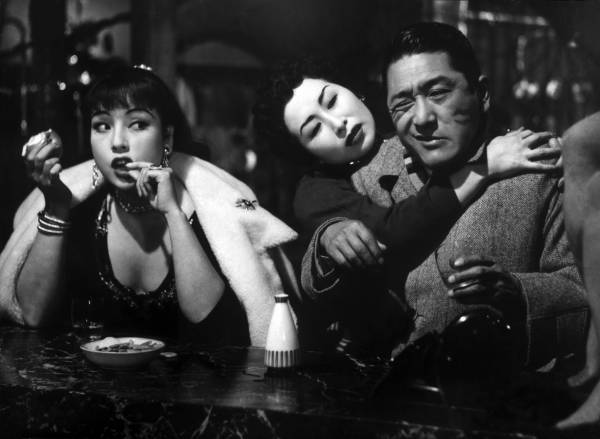
Desperate prostitutes fight over customers in powerful STREET OF SHAME (courtesy Janus Films)
STREET OF SHAME (AKASEN CHITAI) (Kenji Mizoguchi, 1956)
Film Forum
209 West Houston St.
Saturday, April 16, 1:00, 4:30, 8:00
Series continues through April 21
212-727-8110
www.filmforum.org
 Made the same year Japan passed a major anti-prostitution law, Kenji Mizoguchi’s final film, 1956’s Street of Shame, is a brutally honest depiction of the decidedly unglamorous life of a group of courtesans at a Tokyo brothel. “Yoshiwara has been here three hundred years,” the Mamasan (Sadako Sawamura) says early on to a police officer. “Does an unnecessary business last so long?” Originally titled Red-Light District, the black-and-white film features an outstanding cast of women playing desperate geisha with serious family and financial problems that lead them to the embarrassment of trying to physically force men off the dark, dank street and into their rooms. Hanae (Michiyo Kogure) has to deal with aging, a baby, and a suicidal husband, Yumeko (Aiko Mimasu) doesn’t want her son to know what she does to earn money to attempt to give him a decent life, Yorie (Hiroko Machida) thinks a husband in a faraway village will gain her longed-for freedom, Yasumi (Ayako Wakao) has become a loan shark to her coworkers, and young Mickey (Machiko Kyō) is quick to share her opinions about the other women but not so quick to catch on to the debasement she is lowering herself to. The protofeminist director of such previous works as Sisters of the Gion, Osaka Elegy, Women of the Night, and The Life of Oharu as well as the brilliant two-part samurai epic The 47 Ronin, Mizoguchi spent much of his career — which included more than seventy films in thirty-three years, up to his death in 1956 at the age of fifty-eight — making films about the exploitation of women, partly influenced by having seen his sister sold into prostitution by their father. It’s a shame that Street of Shame, one of Mizoguchi’s best, also turned out to be his last, but what a way to go. Street of Shame is screening April 16 with Keisuke Kinoshita’s Carmen Comes Home (1951) as part of Film Forum’s “5 Japanese Divas” series, four weeks of films starring Kyo, Isuzu Yamada, Tanaka, Machiko Kyo, Setsuko Hara, and Hideko Takamine, who play strong, determined women in such classic works as Ozu’s Early Summer (1951) and Tokyo Story (1953), Hiroshi Teshigahara’s The Face of Another (1966), Mikio Naruse’s Okaasan (1952) and Flowing (1956), Akira Kurosawa’s The Idiot (1951) and Throne of Blood (1957), Kinoshita’s Twenty-Four Eyes (1954), and Mizoguchi’s Ugetsu (1953) and Sansho the Bailiff (1954), among others.

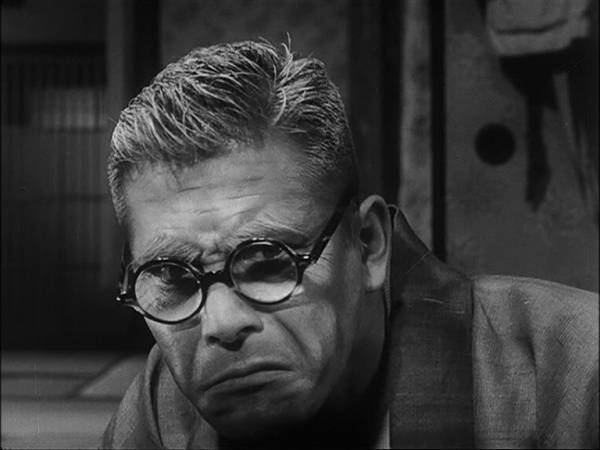
 Akira Kurosawa’s powerful psychological drama begins with a jazzy score over shots of a bustling Japanese city, people anxiously hurrying through as a Theremin joins the fray. But this is no Hollywood film noir or low-budget frightfest; Kurosawa’s daring film is about the end of old Japanese society as the threat of nuclear destruction hovers over everyone. A completely unrecognizable Toshirô Mifune stars as Nakajima, an iron foundry owner who wants to move his large family — including his two mistresses — to Brazil, which he believes to be the only safe place on the planet where he can survive the H bomb. His immediate family, concerned more about the old man’s money than anything else, takes him to court to have him declared incompetent; there he meets a dentist (the always excellent Takashi Shimura) who also mediates such problems — and fears that Nakajima might be the sanest one of all. I Live in Fear is screening this weekend at 11:00 am at the IFC Center as part of its Weekend Classics: Kurosawa series, with fifty percent of ticket sales benefiting the