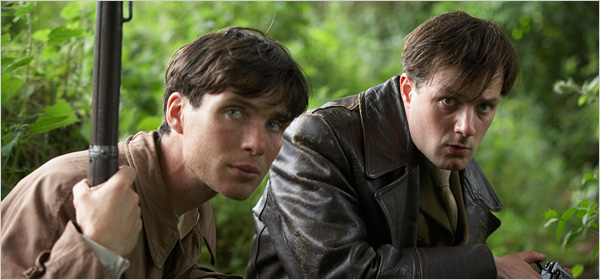
THE WIND THAT SHAKES THE BARLEY is part of MoMA series on films about Ireland, curated by Gabriel Byrne
THE WIND THAT SHAKES THE BARLEY (Ken Loach, 2006)
MoMA Film, Museum of Modern Art
11 West 53rd St. between Fifth & Sixth Aves.
Wednesday, May 25, 8:00
Friday, May 27, 4:30
Series runs May 20 – June 3
Tickets: $10, in person only, may be applied to museum admission within thirty days, same-day screenings free with museum admission, available at Film and Media Desk
212-708-9400
www.moma.org
www.thewindthatshakesthebarley.co.uk
 Winner of the 2006 Palme d’Or at Cannes, The Wind that Shakes the Barley is a brutal masterpiece from director Ken Loach (Riff-Raff, Bread and Roses). It’s 1920, and the English black and tans are running roughshod through Ireland, leaving broken and dead bodies in their wake as they keep the population frightened and in poverty. But poorly armed yet determined local guerrilla armies are forming, prepared to fight for freedom in their homeland. In one small town, Damien (Cillian Murphy) is getting ready to move to London to train as a doctor, but he decides instead to join the burgeoning Irish Republican Army after seeing one too many bloody beatings. Swearing their loyalty to the cause and led by Damien’s brother, Teddy (Padraic Delaney), they set up ambushes of British forces, gathering weapons in a desperate attempt to win back their country. Damien also falls for Sinead (Orla Fitzgerald), one of many women who work as messengers and spies and run safe houses. But when a questionable treaty is signed, loyalty is tested and families torn apart. Written by Paul Laverty and also featuring Liam Cunningham, Mary Riordan, Myles Horgan, and Mary Murphy, The Wind that Shakes the Barley is a fierce, no-holds-barred, if one-sided, look at a violent conflict that has lasted for centuries.
The Wind that Shakes the Barley is screening May 25 and 27 as part of MoMA’s “Revisiting The Quiet Man: Ireland on Film” series, curated by Gabriel Byrne and featuring such other works made in and/or about Ireland as The Magdalene Sisters (Peter Mullan, 2002), The Dead (John Huston, 1987), The Informer (John Ford, 1935), The Butcher Boy (Neil Jordan, 1997), and Into the West (Mike Newell, 1993), with such actors, directors, writers, and experts as Jim Sheridan, Enda Walsh, Dr. Luke Gibbons, and Byrne participating in introductions and postscreening discussions and Q&As that examine the way Ireland has been portrayed on film throughout the years and how that relates to the true social and cultural concerns of the nation.

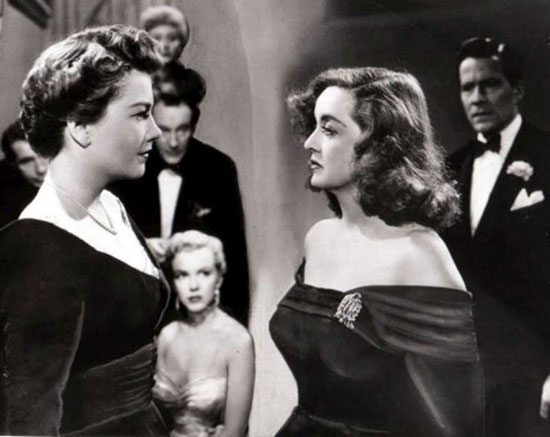
 Nominated for fourteen Academy Awards and winner of six, including Best Picture, Best Director, and Best Screenplay, All About Eve is one of Hollywood’s all-time greatest movies, a searing depiction of naked ambition set on the Great White Way. Based on Mary Orr’s 1946 short story “The Wisdom of Eve,” writer-director Joseph L. Mankiewicz’s flawless drama stars Anne Baxter as Eve Harrington, who is not exactly the mousey wallflower she at first appears to be. She quickly worms her way into an inner circle of Broadway vets populated by superstar Margo Channing (Bette Davis), her younger lover, Bill Sampson (Gary Merrill), playwright and director Lloyd Richards (Hugh Marlowe), and Richards’s wife, Karen (Celeste Holm), who takes Eve under her wing. Joining in on all the fun is powerful theater critic Addison DeWitt (Oscar winner George Sanders), who marvels at all the manipulation and backstage drama, much of which he wickedly orchestrates himself. “There never was, and there never will be, another like you,” DeWitt tells Eve in one of the film’s most poignant moments. All About Eve is filled with classic quotes, including the iconic “Fasten your seatbelts, it’s going to be a bumpy night,” boldly proclaimed by Davis. In a movie about acting and the theater, Mankiewicz never shows anyone onstage; instead, he focuses on the characters and the intrigue with a sly flair that is deliciously entertaining. All About Eve is screening on May 20 at the Rubin Museum as part of the Proverbial Pictureshow series, being held in conjunction with the Tibet carpet exhibit “Patterns of Life,” and will be introduced by writer Anne Christopherson. Admission to the museum is free on Friday nights, so be sure to check out the other current exhibits as well, which include “Masterworks: Jewels of the Collection,” “Body Language,” “Quentin Roosevelt’s China,” and “The Nepalese Legacy in Tibetan Painting.”