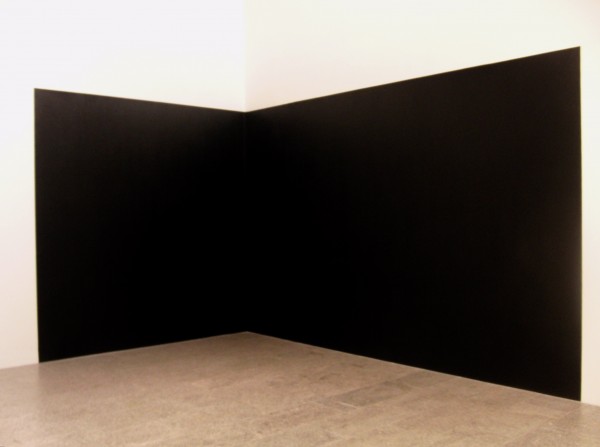
Richard Serra, “Pacific Judson Murphy,” paintstick on Belgian linen, 1978 (© Richard Serra / photo by twi-ny/mdr)
Metropolitan Museum of Art
The Tisch Galleries, second floor
1000 Fifth Ave. at 82nd St.
Tuesday – Sunday through August 28, $20
212-570-3949
www.metmuseum.org
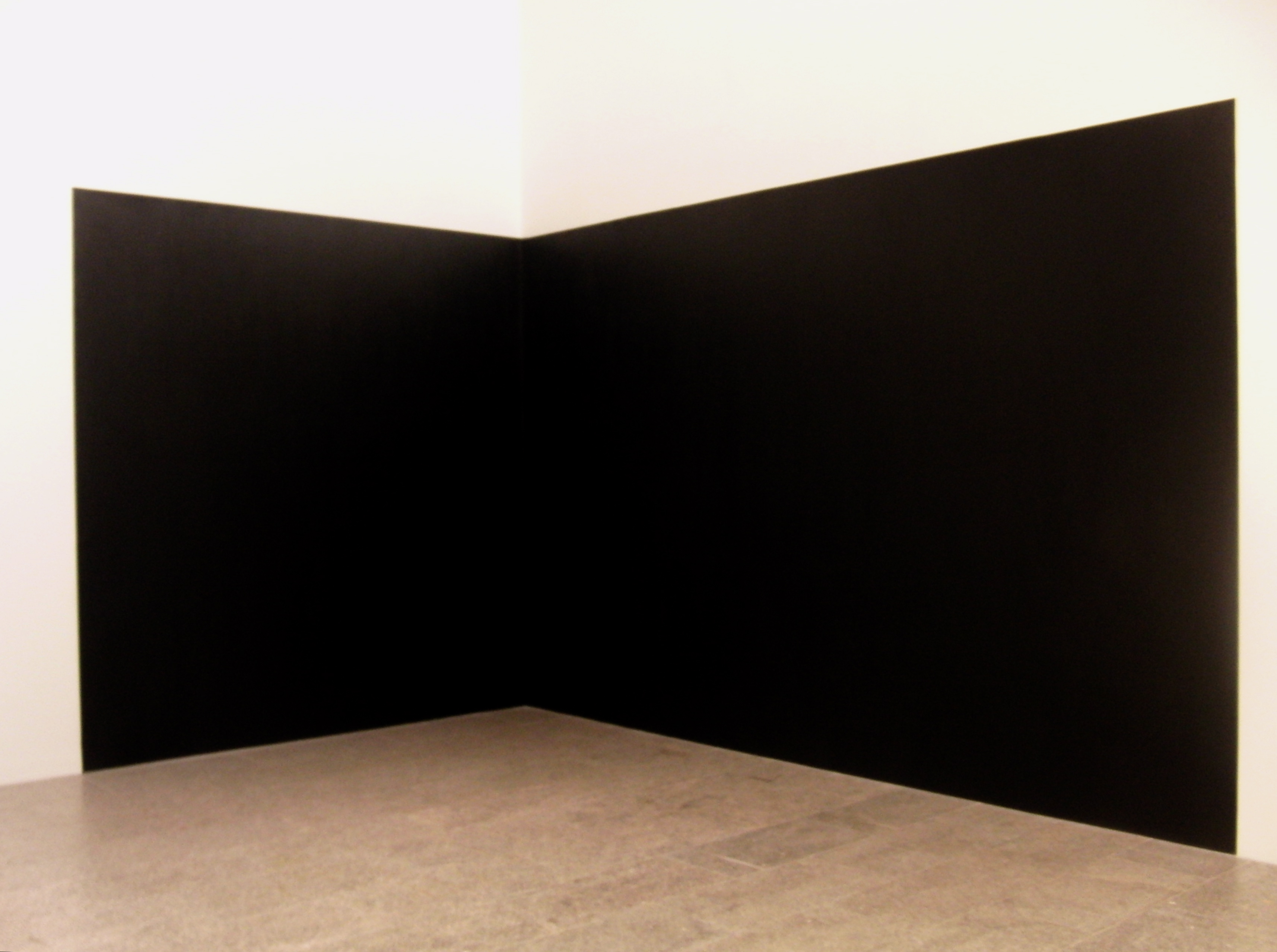
San Francisco-born conceptual artist Richard Serra does things in a big way. Based in New York City and Nova Scotia, Serra is justly celebrated for his enormous Cor-Ten steel curved plates that have been shown at the Gagosian in Chelsea and, most dramatically, at the Museum of Modern Art as the centerpiece of the 2007 retrospective “Richard Serra Sculpture: Forty Years.” But “Richard Serra Drawing: A Retrospective,” on view at the Metropolitan Museum of Art through August 28, sheds a whole new light on his creative thought process and working methods. In 1977, he famously said, “There is no way to make a drawing — there is only drawing.” But he’s more recently said of drawing, “It’s just another way of thinking.” Comprising nearly eighty works, this first-ever retrospective of Serra’s drawings, which is arranged more or less chronologically from a charcoal-on-paper drawing from 1971 to a site-specific piece commissioned for this exhibition, reveals how Serra once again re-creates and reimagines an artistic medium, taking it to new heights, both literally and figuratively. The majority of works were made using paintstick on such materials as Belgian linen, forged steel, and handmade paper. “I’d melt down paintstick, then flood a board or a table with the liquid paintstick and then lay down the screen on top of the heated material, lay the paper over that and work on the reverse side of the paper by applying pressure with a hard tool, usually a piece of metal,” Serra describes on the accompanying audio guide. “The drawings assume a variable density of the material through the liquid suction coming up through the screen, as a way of making a continuous repetitive mark without seeing what I was doing.” The resulting drawings emit a physicality that echoes much of his sculptural work, from “Heir,” which recalls one of his wall-leaning pieces, to “Blank,” an intriguing space in which a pair of ten-foot-by-ten-foot black squares, stapled to the wall, face each other, making the viewer feel like he or she is standing in between two of Serra’s huge plates.
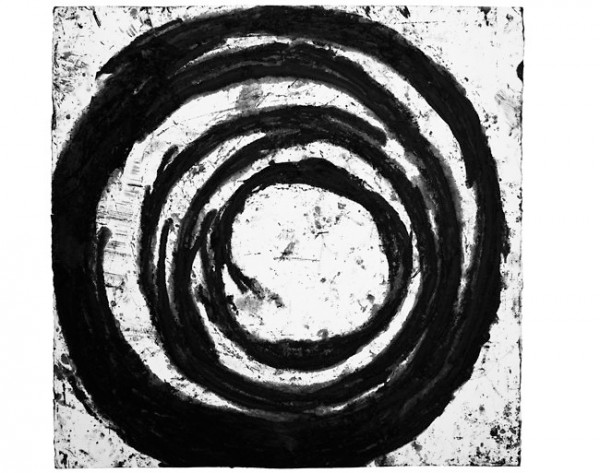
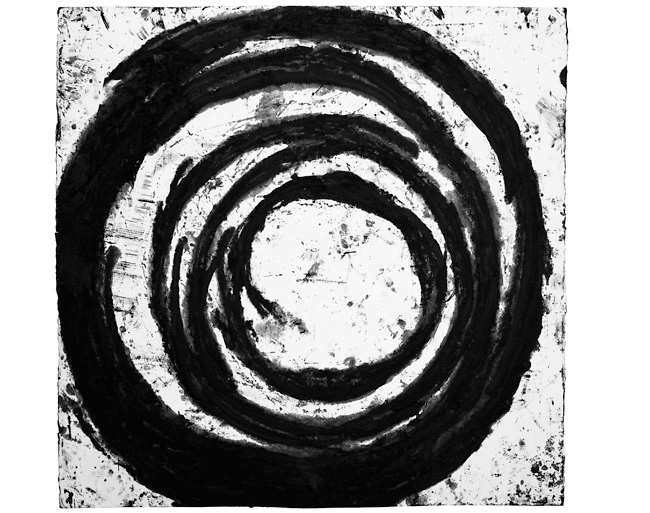
Richard Serra, “September,” paintstick on handmade paper, 2001 (© Richard Serra / photo by Rob McKeever)
In fact, winding through the exhibit as a whole mimics the feeling of moving through Serra’s sculptural installations, only in black and white, but with a new surprise around every corner. A series of Robert Smithson-esque circular drawings, including “Black Tracks” and “September,” feature thick globs of paintstick. Such charcoals as “Giza Pyramids, Egypt” and “Le Corbusier, Notre Dame du Haut, Ronchamp, France” offer a much lighter touch. The round “Institutionalized Abstract Art” sits high on the wall like a black sun or black hole. The short 1968 videos Hands Scraping, Hand Catching Lead, Hand Lead Fulcrum, and Hands Tied predict the unusual function of the hand in Serra’s future oeuvre. The diptychs “The United States Courts Are Partial to Government” and “No Mandatory Patriotism” comment on Serra’s emotional reaction to the abrupt removal of the 1981 public art installation “Tilted Arc” from Federal Plaza downtown. And “Union,” commissioned for the retrospective, is composed of two floor-to-ceiling black rectangles that occupy their own room, a white wall between them, forming their own fascinating alley. Clearly, Serra likes doing things in a big way, and the Met Museum is indeed big, in more ways than one. In conjunction with the retrospective, the Met will host gallery talks with special consultant Magdalena Dabrowski on June 14 and 29 at 10:00 and with Ian Alteveer on July 12 & 27 and August 10 & 18. The films Art21: Richard Serra and Richard Serra: To See Is to Think will be screened on June 28 & 30 at 2:00, Judith Wechsler’s Drawing the Thinking the Hand will be shown July 26 & 28 at 2:00, and Serra’s Frame (1969), Railroad Turnbridge (1976), and Steelmill/Stahlwerke (1979) will be presented August 23 & 24 at 2:00, all free with museum admission. In addition, Serra will be at the Strand at 828 Broadway on June 14 at 7:00 talking about his work and signing copies of the exhibition catalog.





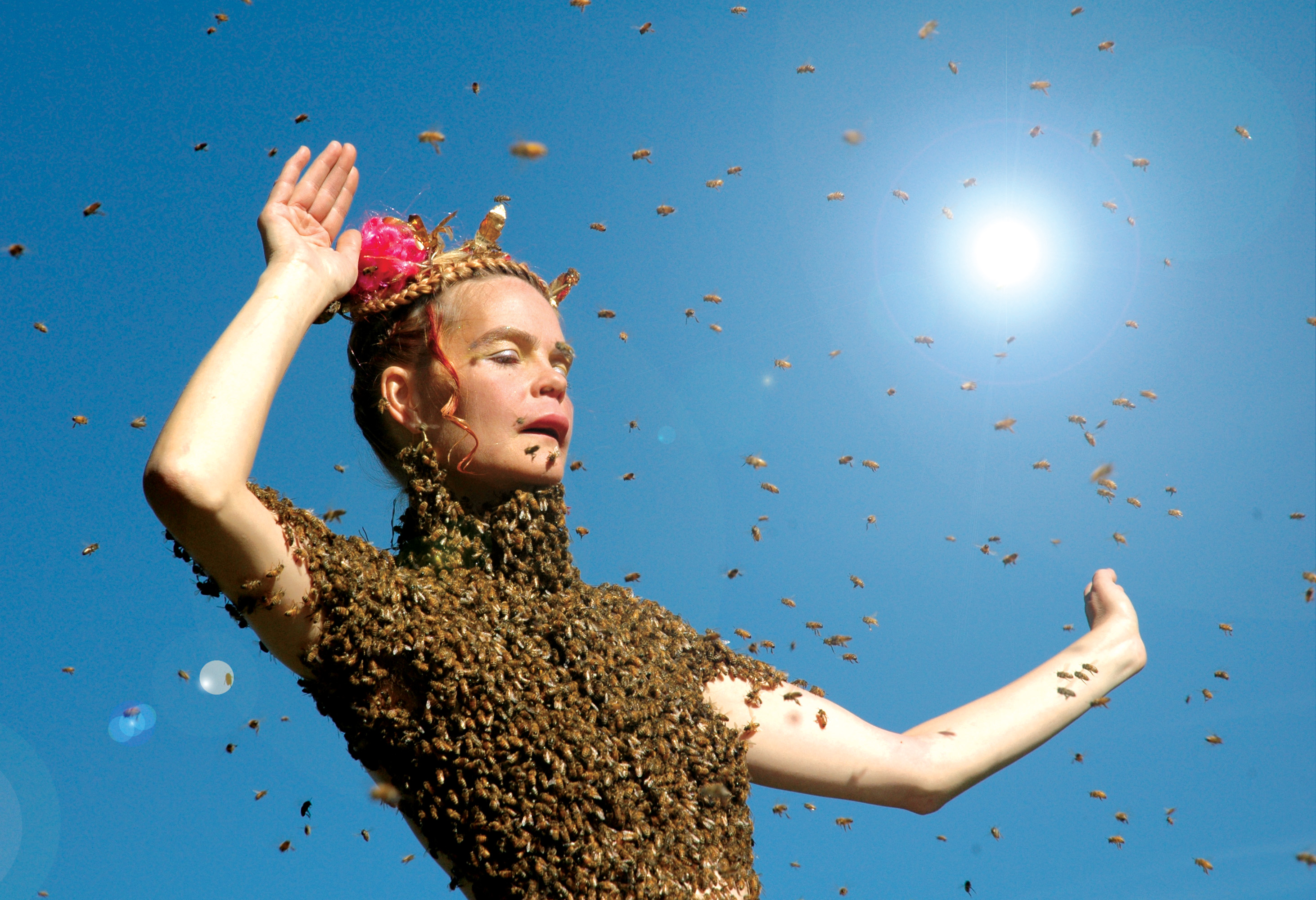
 In a November 1923 lecture, Austian anthroposopher Rudolf Steiner said, “Perhaps you noticed something about the entire nature of beekeeping, something, I would say, of the nature of an enigma. The beekeeper is understandably interested above all in what must be done. Actually, every human being should show the greatest interest in this subject, because, much more than you can imagine, our lives depend upon beekeeping.” Steiner also predicted that bees would disappear from the face of the earth in eighty to one hundred years. Sadly, Taggart Siegel’s compelling documentary about colony collapse disorder, Queen of the Sun, reveals that Steiner just might be right. Siegel (The Real Dirt on Farmer John) meets with experts around the world, including author Michael Pollan, biodynamic beekeeper Gunther Hauk, philosopher Horst Kornberger, Indian activist and physicist Vandana Shiva, Slow Food International president Carlo Petrini, molecular biologist Johannes Wirz, entomologist May Berenbaum, and such serious, oddball, and quirky beekeepers as Yvon Archard, Michael Thiele, David Heaf, Gunther Friedmann, Massimo Carpinteri, Ron Breland, and Warren Thompson, who talk about how integral bees are not only to the natural environment but to the very future of humanity. They also proudly show off their rather close personal relationships with their queens and hardworking drones as they discuss the hazards of monoculture, corporate migratory beekeeping, pesticide usage, and other factors that have led to the frightening disappearance of millions of colonies. “We could call it colony collapse of the human being too,” Hauk says. The film, which also includes a look at the legal battle over beekeeping in New York City, begins and ends with artist, energy healer, and beekeeper Sara Mapelli performing a ritual dance covered with some twelve thousand bees. Queen of the Sun has built quite a buzz, having won awards at festivals around the world, including the Planet in Focus Film Festival; it opens at Cinema Village today for a one-week run, the perfect prelude to National Pollinator Week, which takes place June 20–26. You’ll never look at honey the same way again.