Rockwood Music Hall Stage 2
196 Allen St. between Houston & Stanton Sts.
Wednesday, August 3, 9:00
212-477-4155
www.myspace.com/annirossi
www.rockwoodmusichall.com
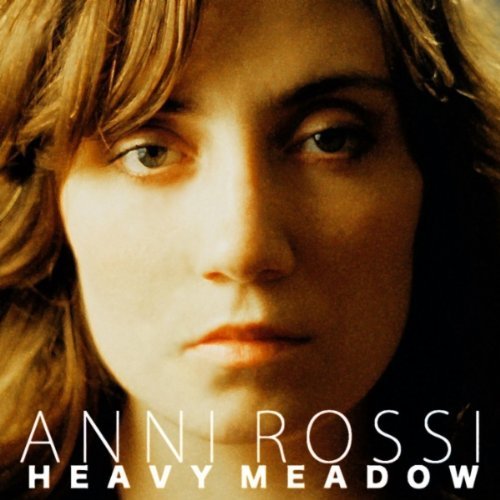
Classically trained violist Anni Rossi, who has moved from Minnesota to Chicago to East Wiliamsburg on her musical and geographical journey, goes less experimental on her new album, Heavy Meadow (3 Syllables, August 9, 2011). The follow-up to 2009’s Steve Albini-produced Rockwell, the disc consists of eleven playful, subtle synth-based electropop tunes with creative lyrics that range from the personal to the abstract, recorded with composer-drummer Devin Maxwell. “You’re my greatest fantasy / Won’t you take me for ice cream / Instead you ate alone / You got a smudge on your mouth,” Rossi sings on the opening track, continuing, “Play it cool / Play it cool / Down in Candyland / No one is a fool / Love’s the only rule.” Guitars begin and end “Texan Plains,” with multiple melody shifts in the middle; “Why are you leaving home? / I hope it’s not for me,” she argues. The new album also features such potentially damaging, violent songs as “Crushing Limbs,” “Hatchet,” “Sandstorm,” “Switchblade,” and “The Fight” before ending with the only somewhat more comforting “The Safety of Objects.” Over the course of her career, which has also included the EPs Scandia, My Grandmother Was a Church Organist, and Afton, Rossi has covered such songs as Radiohead’s “Creep,” Otis Redding’s “These Arms of Mine,” the Cure’s “In Between Days,” and Aaliyah’s “Are U That Somebody?” while recently citing Beyonce, Jay Z, Elastica, and Depeche Mode as influences, so you never know quite what to expect from the new Brooklynite, who recently peed in a plastic bag filled with birdseed. (Check her blog if you need to know the full story.) Rossi will be playing Stage Two at Rockwood Music Hall on Wednesday night at 9:00, preceded by Todd Alsup (7:00) and Peter Bradley Adams (8:00) and followed by Ravens and Chimes (10:00) and Xylopholks (11:00).
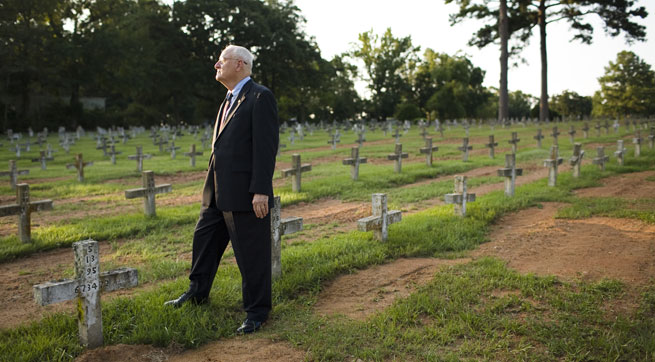
 For more than fifteen years, Pastor Carroll Pickett served as death-row chaplain for nearly one hundred inmates at the Walls prison in Huntsville, Texas. The soft-spoken man of God would spend the last eighteen hours of each condemned man’s life with him, offering prayer, confession, and, in some cases, a hand to hold. Documentarians Steve James and Peter Gilbert, who teamed up on the Oscar-nominated Hoop Dreams in 1994, follow Pickett as he tells his compelling story with deep emotion and remarkable insight. We see Pickett as he listens to old cassettes he recorded after each execution, talking about his own complicated feelings about his job — something he never shared with his family or parish. He discusses how his personal thoughts about capital punishment changed after the 1989 execution of Carlos De Luna, a young man who claimed he was innocent — and Pickett believed him but never spoke out about it. The film often switches to investigative reporters Steve Mills and Maury Possley of the Chicago Tribune as they research a story about De Luna’s innocence, speaking primarily with one of his sisters, Rose Rhoton, who is ashamed that she didn’t do more to save her brother’s life. But what is clear is that such miscarriages of justice are not any one person’s fault but the result of a severely broken system. James and Gilbert stay out of the way of the story; they do not hit viewers over the head with facts and numbers, they include no third-person narration or random talking heads, and they avoid the expected confrontations over this extremely controversial issue. Even Leo Sidran’s score is even-handed and sensitive. At the Death House Door is a fascinating examination of the death penalty, seen through the eyes of someone who has experienced it in a very personal, powerful way. The film is screening August 4 at the Maysles Institute as part of the Master Class: Steve James series curated by Sylvia Savadjian, which concludes August 5-11 with James’s latest, The Interrupters, which follows an organized group of former gang members trying to stop the violence in Chicago.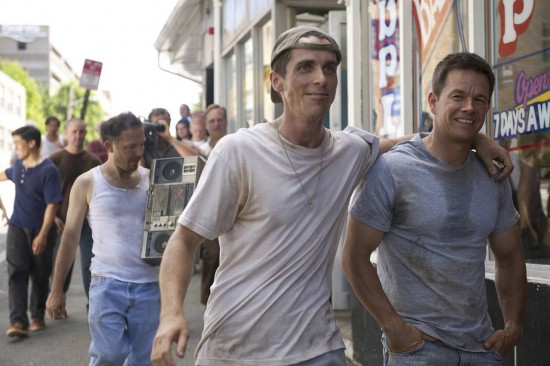
 A lot of professional fighters face adversity in and out of the ring, but “Irish” Micky Ward took it to a whole new level on his quest to be welterweight champion of the world, as documented in the winning motion picture The Fighter. Ward (Mark Wahlberg) surrounded himself with his family, with his mother, Allice Eklund (Melissa Leo), as his manager, his half-brother, the Pride of Lowell (for once knocking down Sugar Ray Leonard), Dicky Eklund (Christian Bale), as his trainer, and his many big-haired sisters, including Tar (Erica McDermott), Little Alice (Melissa McMeekin), Pork (Bianca Hunter), Red Dog (Dendrie Taylor), and Beaver (Kate O’Brien), part of the team as well. Despite getting pummeled over and over again and continually finding his brother at a condemned crack house, Micky stands by the family until Dicky is back in prison and Micky finally decides to go with a new promoter. As his stock begins to rise again, he is deeply affected by his separation from his family, who are blaming the parting on his new girlfriend, local bartender Charlene (Amy Adams). Based on the true story of the Ward/Eklund clan of Lowell, Massachusetts, The Fighter is a poignant tale of fighting and family, of love and responsibility. Bale, who won an Oscar for his performance, is a whirlwind as the effusive, drug-addicted Dicky, who dreams of helping his brother get a title shot even as he misses training sessions because of his dependence on crack. Leo, who nearly steals the show (and also took home an Academy Award), is virtually unrecognizable as Alice, who can’t understand why Micky would go with a new crew and has quite a few battles of her own with Charlene. And Walhlberg, who trained for several years to get himself in shape for the film, is strong and solid as the conflicted yet determined potential boxing champion. Director David O. Russell (Three Kings) gives The Fighter a realistic feel, at times echoing the documentary that HBO is making about Dicky in the movie, and even hiring Ward’s trainer, Mickey O’Keefe, to play himself. In fact, much of the cast got to meet their real-life counterparts, all of whom loved how they were portrayed onscreen, which is actually quite funny once you see how some of them come off. You don’t have to love boxing to love The Fighter, although fans of the sweet science will be impressed by the carefully choreographed fight scenes, complete with the original HBO commentary (and shot by some of the same cameramen). The Fighter is screening August 3 in Hudson River Park as part of the free Wednesday night RiverFlicks for Grown-ups series, with free popcorn; the schedule, which features 2010’s blockbuster hits, concludes with Scott Pilgrim vs. the World on August 10 and The Town on August 17. For a complete list of free outdoor summer films throughout the city, click