twi-ny recommended events

BATSHEVA DANCE COMPANY: HORA

Batsheva Dance Company brings Hora back to New York in two-week Joyce engagement (photo by Steven Pisano)

HORA
The Joyce Theater
175 Eighth Ave. at 19th St.
February 28 – March 12, $10-$75
212-691-9740
www.joyce.org
www.batsheva.co.il

Next year is the one hundredth anniversary of the Jewish circle dance known as the Hora, created by Baruch Agadati in Palestine in 1924, influenced by Romanian and Greek traditions. The dance is a staple of Jewish American weddings and bar and bat mitzvahs, usually accompanied by the folk song “Hava Nagila” and including the lifting of various celebrants on chairs. The Tel Aviv–based Batsheva Dance Company is paying tribute to that centennial by bringing back former artistic director and current house choreographer Ohad Naharin’s sixty-minute Hora, continuing at the Joyce through March 12.

When the 2009 piece came to BAM in 2012, I called it “a mesmerizing experience, a stunning balance of light, color, sound, and movement from one of the world’s most innovative and entertaining choreographers.” It is just as mesmerizing today.

Batsheva and Naharin have dazzled us with such other pieces as Deca Dance, Three, Minus 16, Project 5, Venezuela, and Last Work; this return to Hora is a welcome one, even if the required mask-wearing muffles some of the audience’s exhilarated gasping.

Naharin’s Hora features no chairs and no “Hava Nagila”; it takes place in an empty rectangular space bordered on three sides by a green wall, with a long bench (designed by Amir Raveh) in the back where the eleven dancers sit when not dancing. Isao Tomita’s electronic score incorporates such familiar sounds as Richard Strauss’s “Also Sprach Zarathustra,” Richard Wagner’s “Tannhauser: Overture” and “Die Walküre: Ride of the Valkyries,” Charles Edward Ives’s “The Unanswered Question,” Claude Debussy’s “Prelude to the Afternoon of a Faun,” Modest Mussorgsky’s “Catacombs,” and a whistled version of John Williams’s main theme from Star Wars. (The sound design and editing is by Maxim Waratt.)

The show starts with the eleven dancers rising from the bench and approaching the front of the stage, set and lighting designer Avi Yona Bueno initially casting them in silhouette. It is one of only a few times the performers will move in unison; they break out into solos and other configurations, seldom coming into contact with one another as they proceed in Batsheva’s unique Gaga language, ranging from sharp, angular gestures to nearly impossible formations that resemble animals, insects, and even animated video game characters. I’m still trying to figure out how Ohad Mazor touched his foot to his elbow.

There are also dazzling moments from Eri Nakamura (who designed the black costumes), Billy Barry (undulating on the floor), Sean Howe (repeatedly hitting himself in the head), Londiwe Khoza, Matan Cohen, Chiaki Horita (gyrating her torso) — well, the entire company, which also includes Chen Agron, Yarden Bareket, Yael Ben Ezer, Guy Davidson, Ben Green, Li-En Hsu, Adrienne Lipson, Gianni Notarnicola, Danai Porat, Igor Ptashenchuk, and Yoni (Yonatan) Simon, who all display a thrilling physicality, testing the boundaries of what the human body could, and should, do.

When all eleven dancers are off the bench, it is hard to know where to focus your attention, as they are all doing different things; if you follow a cartwheel, you might miss a trio rolling over the floor or a duo balancing against each other’s buttocks. To watch the entire troupe at once is to get absorbed in a kind of whirlwind of life in all its unpredictability and excitement. But no matter where you look, prepare to be amazed.

THE SEAGULL/ WOODSTOCK, NY

Thomas Bradshaw moves Anton Chekhov’s The Seagull to modern-day Woodstock in New Group world premiere (photo by Monique Carboni)

THE SEAGULL/ WOODSTOCK, NY
The New Group at the Pershing Square Signature Center
The Romulus Linney Courtyard Theatre
480 West 42nd St. between Tenth & Eleventh Aves.
Tuesday – Sunday through April 9, $38-$107
212-244-7529
thenewgroup.org
www.signaturetheatre.org

While sitting in the first row watching Thomas Bradshaw’s outrageously funny and psychologically insightful modern-day adaptation of Anton Chekhov’s The Seagull, called The Seagull/Woodstock, NY, I was reminded that I have never seen a traditional version of the play, one that uses the original dialogue and time period. And that’s just how the Russian playwright wanted it.

In John J. Desmond’s relatively serious and straightforward 1975 Williamstown production, which went straight from stage to film, Konstantin (Frank Langella), a young playwright whose mother, Irina (Lee Grant), is an aristocratic star, tells his uncle, landowner Sorin (William Swetland), about Irina, “She knows of course I haven’t got any use for the theater. She loves the theater. Seems to her she’s working for humanity and the sacred cause of art. But to me her theater today is nothing, nothing but a mass of routine and stale conventions.” Sorin responds, “Well, we can’t do without the theater, my dear boy.” A fanciful dreamer, Konstantin declares, “We need new forms, Uncle! New forms we must have. And if we can’t have those, we shall have nothing at all.”

Thus, Chekhov himself essentially demands new interpretations, and in New York City we have received them with such challenging works as Elevator Repair Service’s 2022 Seagull at Skirball and Aaron Posner’s 2016 Stupid Fucking Bird at the much-lamented Pearl.

Bradshaw tears down conventions in his 160-minute version (with intermission) for the New Group, in which the action has been moved from a late-nineteenth-century Russian country estate to a contemporary riverfront home in artsy Woodstock in Ulster County. The play begins with the actors warming up on a wooden proscenium platform, doing physical and vocal exercises; the audience sits on three sides of the stage as they get an advance glimpse of the cast and try to figure out who’s portraying who. After several minutes, everyone joins in a singalong of Crosby, Stills, Nash & Young’s 1970 classic “Our House,” the lyrics of which will run counter to what we are about to experience: “Our house is a very, very, very fine house / With two cats in the yard / Life used to be so hard / Now everything is easy ’cause of you.” (CSNY appeared at the 1969 Woodstock festival but did not sing that song; the next year, however, they released the song “Woodstock,” written by Joni Mitchell, in which they proclaim, “Got to get back to the land / Set my soul free.”)

A close-knit, motley crew is gathering by the river on Darren (Daniel Oreskes) and Pauline’s (Amy Stiller) property to see a new play by Kevin (Nat Wolff), a twenty-six-year-old ne’er-do-well living in the shadow of his narcissistic mother, Irene (Parker Posey), a star of the stage. Before she says hello to her friends and relations, she is already loudly complaining that there is no soy milk for her coffee. Kevin has written the one-person, two-hour show for Nina (Aleyse Shannon), a twentysomething with no boundaries. Kevin is in love with Nina, who will soon take a liking to the older William (Ato Essandoh), a well-known writer who is Irene’s current partner. Meanwhile, Pauline and Darren’s daughter, Sasha (Hari Nef), pines away for Kevin. Also on hand are Sasha’s teacher husband, Mark (Patrick Foley), brain surgeon Dean (Bill Sage), and retired lawyer Samuel (David Cale), Irene’s best friend.

Mother (Parker Posey) and son (Nat Wolff) have an awkward relationship in The Seagull/Woodstock, NY (photo by Monique Carboni)

When Sasha ridicules Kevin’s set, which consists solely of a cast-iron bathtub and a curtain that goes around it, Mark needles her, saying, “Tonight their artistic souls will unite on this very stage.” Right before Kevin’s play starts, Samuel tells Nina, who lives nearby and whose banker father is not a fan of her interest in theater, “Woodstock nurtures the artistic soul. Bob Dylan and Van Morrison wrote some of their best music here. [Your father] should have bought a place in the Hamptons if he wanted you to be a banker.”

Bradshaw fills the show with contemporary references, from Dylan and Morrison to viagra, #metoo, Alec Baldwin, wokeness, the Wailers, Donald Trump, Bertrand Russell, Instagram, Stephen Colbert, Tracy Letts, dramadies, and Paula Vogel’s How I Learned to Drive. He also takes on race, class, sexual identity, and truth but in subtler ways than he has in such previous works as Southern Promises, Intimacy, and Burning, or at least more subtle for him.

But Bradshaw and director Scott Elliott’s central target is art itself. “Hi, I’m Nina. I’m not a character in Kevin’s play. I’m me,” Nina says as the play-within-a-play kicks off. “Kevin hates artifice. So do I. I am myself, or I am no one. Who are you? Are you, you? Or are you hiding from yourself?” She adds, “The fourth wall tonight is broken. So that means I can see you just as clearly as you can see me. I can see everything about you. I can see things even you can’t see.” The fourth wall of Bradshaw’s play was broken immediately as well, when the actors got onstage and we all sang, and the lights stay at a level that allows us to see everyone in the audience.

Nina, who is biracial, then discusses “the N word,” actually saying it in full several times, which confronts her audience as well as Bradshaw’s, a writer who often strives to make his audience squirm in their seats. “I get that the historical legacy of the word is offensive. But does the word itself have any power?” she asks. Then, in true Bradshaw fashion, she switches to one of his favorite topics. “We recently went through a long period of isolation. Everyone in our society did. It was a period of intense loneliness for me. And for many of you, I bet. And what were we all doing during that time? Masturbating. Why can’t we talk about it? We all do it. I’d rather discuss masturbating than the weather.” Bradshaw understands that theater itself can be a kind of masturbation; in fact, in Intimacy, a character not only pleasures himself (using a prosthetic) in view of the audience but launches a sticky white substance into the crowd, some of which landed on the head of a major critic, who was none too happy. (One friend joked to me that Anton’s last name should be “Jackhov,” pronounced “jackoff.”)

Irene (Parker Posey) gets in the middle of Pauline (Amy Stiller) and Darren (Daniel Oreskes) in New Group world premiere at the Signature (photo by Monique Carboni)

After Kevin’s play ends, Irene tells Nina, “You were very good, in spite of my son exploiting you.” Nina replies, “Oh no. It was my choice. And he totally respected me, as an actress, and as a woman of color.” Irene says, “So you didn’t feel the least bit weird pretending to, uh, touch yourself, onstage?” Nina explains, “Oh, I wasn’t pretending. I had to really do it, in order to crack the artifice of normal theatrical conventions. There’s nothing real about realism. That’s Kevin’s philosophy. He believes in hiding nothing.” That is Bradshaw’s philosophy as well.

Throughout the show, the actors and stage crew bring chairs and tables on and off Derek McLane’s intimate set, which includes a narrow lower level around the platform where people in the first row can get comfy and put up their feet — until some of the actors walk across it. At times Elliott choreographs the play like it’s a dance, expertly guiding the cast of ten in the small space, who enter and exit through the aisles.

The cast seems to be having a lot of fun, and that feeling is infectious; the play moves at such an intoxicating pace that you might be disappointed when it’s over, wanting to spend more time with these well-developed, endearing, annoying, and frustrating people. “I think my character would feel more authentic if we knew more of her backstory. Right now the play feels abrupt,” Nina tells Kevin, who argues, “It is abrupt. That’s the point. We’re subverting typical American Theater. We’re getting right to the heart of the matter instead of making our audience suffer through an hour of incredibly dull backstory.”

Posey (Hurlyburly, Fifth of July) is a burst of summer sunshine as Irene, in flowery dresses, bobbed hairdo, and gloriously fake smiles. (The costumes are by Qween Jean, with lighting by Cha See and sound by Rob Milburn and Michael Bodeen that keep the audience immersed in the show.) Wolff (Buried Child, The Naked Brothers Band) wonderfully captures the constant nervous wreck that is Kevin, while Shannon (Charmed, Black Christmas) glistens as a strong young woman ready to take charge of her life, especially sexually, and Nef (Des Moines, “Daddy”) is a bundle of fear as the disillusioned Sasha. Cale, Essandoh, Foley, Nef, Oreskes, Sage, and Stiller round out the uniformly solid cast.

Bradshaw (Thomas & Sally, Fulfillment) and New Group artistic director Elliott (Mercury Fur, Sticks & Bones) also take a hard look at aging, not just in theater but in life. Irene is well aware that it is getting more difficult for her to find roles because she is in her fifties, and Samuel is facing serious health issues that affect the elderly.

“Is there anything new anymore? Are there any new stories? New forms? Or is everything just a new spin on something old? A reinvention of the comfortable and familiar?,” Kevin asks William. The Seagull/Woodstock, NY provides just the right answers to those questions.

twi-ny talk: JODY OBERFELDER / RUBE G. — THE CONSEQUENCE OF ACTION

Jody Oberfelder, Grace Yi-Li Tong, Paulina Meneses, and Ashley Merker will perform Rube G. — The Consequence of Action at Gibney this month (costumes by Claire Fleury / photo courtesy Jody Oberfelder Projects)

RUBE G. — THE CONSEQUENCE OF ACTION
Gibney Dance Agnes Varis Performing Arts Center, White Box Studio C
280 Broadway between Chambers & Reade Sts.
Saturday and Sunday, March 4-5, 11-12, 18-19, $15-$25
jodyoberfelder.com
gibneydance.org

New York–based director, dancer, choreographer, and filmmaker Jody Oberfelder is the September 2023 entry in the Modern Women: 21st Century Dance Coloring Book calendar. On that page she says, “Standing on my head I see the world upside down. When I’m right side up, I look again with a different perspective.”

The quote is apropos of her latest piece, Rube G. — The Consequence of Action, making its world premiere March 4-19 at Gibney.

“Many of the younger generation know my name in a vague way and connect it with grotesque inventions but don’t believe that I ever existed as a person,” Rube Goldberg once explained. “They think I am a nonperson, just a name that signifies a tangled web of pipes or wires or strings that suggest machinery. My name to them is like a spiral staircase, veal cutlets, barber’s itch — terms that give you an immediate picture of what they mean.”

Reuben L. Goldberg (1883–1970) was an engineer, sculptor, inventor, author, and cartoonist who won the Pulitzer Prize in 1948 for his political cartoon “Peace Today,” a depiction of an American family and their house perched atop a giant atomic bomb that is tilting precariously at the edge of a cliff. But Goldberg is best known for his drawings of crazy contraptions in which a series of odd items must connect in a chain reaction in order to make something happen, like dominoes but with objects and animals.

In Adam Felber’s 2006 novel Schrödinger’s Ball, a character explains, “You know: a lever is pulled, causing a boot to kick a dog, whose bark motivates a hamster to run on a wheel which winds a pulley that raises a gate that releases a bowling ball and so on? Until, at the end, finally, the machine does something incredibly mundane, like making a piece of toast. Yes? Well, as it turns out, that’s the world.”

A fun, immersive, interactive view of the world and our place in it, Rube G. — The Consequence of Action features Grace Yi-Li Tong, Paulina Meneses, and Ashley Merker, joined by Detroit native Oberfelder, weaving in and around an audience of forty people sitting on stools spaced two feet apart, with music by klezmer trumpeter Frank London. There is light touching as the performers ask audience members to give them small pushes, as if we’re all objects in a Rube Goldberg machine, which the Rube Goldberg Institution for Innovation & Creativity says “solves a simple problem in the most ridiculously inefficient way possible.”

In May 2019, London put together “In Dreams Begin Responsibilities” at the New York Public Library, in which he selected a wide range of artists to pay tribute to such Jewish cultural figures as Hannah Arendt, Benjamin Cardozo, Morton Feldman, Susan Sontag, and Kurt Weill; Oberfelder was assigned Goldberg. She spent the next four years researching him, leading to the short film Rube G., the performance Rube G at Roulette, and Amphitheater in East River Park.

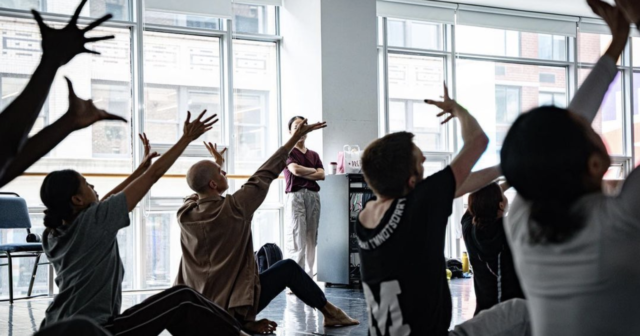
On a recent Monday afternoon, I was a “test guest” at a rehearsal for the new work, experiencing the piece and then talking about it afterward with Oberfelder, Yi-Li Tong, Meneses, Merker, and fellow test guest EmmaGrace Skove as Oberfelder took notes; she was particularly interested in a comment I made about one section reminding me of a pinball machine. Following the discussion, I spoke with Oberfelder — whose oeuvre also includes Madame Ovary, 4Chambers, Throb, The Soldier’s Tale, and The Title Comes Last — about Goldberg, working with new dancers, making connections, and her affinity for site-specific immersive presentations.

Jody Oberfelder watches team rehearse at Open Jar Studios in Midtown (photo by twi-ny/mdr)

twi-ny: In creating this work, did you have a specific fascination with Rube Goldberg himself or the Rube Goldberg machine?

jody oberfelder: I’m thinking of it in a larger context, like how one thing affects another. Frank London actually gave me the assignment in 2019. He had a thing about Jewish thinkers, philosophers, poets, writers. He had like twenty people on a program at the New York Public Library. And he assigned who got what. So I got Rube Goldberg. I knew about Rube Goldberg because when I was working on The Brain Piece, the neuroscientist who was teaching a class in illusion showed us the the Okay Go video [“This Too Shall Pass”], which is quite amazing. I think everybody knows about Rube Goldberg without knowing they know about Rube Goldberg. But now I’ve been researching who he was as a person and how he was of his time. The humor is very much Jewish humor too, like his comic strip “Foolish Questions.” He asks about how things affect each other and that’s a question that’s been in my choreographic toolbox. What interests me is intersections of people and ideas. And my medium is bodies. So this is really nice for me, instead of doing a purely conceptual piece to just work physically with awesome dancers.

twi-ny: You said Frank approached you in 2019, but I would’ve thought that it came out of the pandemic lockdown, when people couldn’t connect. But it was already in process.

j.o.: But that was different; it was more celebratory.

twi-ny: It has the same name, but it’s not the same?

j.o.: That one I called Amphitheater, because I knew I would do Rube G., and then we did the show at Roulette. It totally was about Rube Goldberg.

twi-ny: And you did the film also.

j.o.: The film was a total pandemic film. People said, Look, can’t we wear masks? I’m like, no. Because one day nobody’s going to want to see masks. I look at that film and it was everybody in their little boxes, they would go outside to dance. And I just strung them together with the same words that catalyzed this piece. Like “bounce lever carousel” is one, “slide slice.” So I just came up with the action words from studying Rube Goldberg machines that were posted online, the ones that people work on for a really long time and they jump up and down at the end. In fact, some of the sound score was ripped from YouTube. You can hear the dominoes falling.

twi-ny: So these are new dancers for you?

j.o.: Yes. And that’s what changed the piece.

twi-ny: In what way? Was it an open call?

j.o.: Yes, they’re from the audition that I had. I just thought start fresh, look around, see who’s out there. Ashley is my Gyrotonics teacher; she’s so beautiful when she teaches. I just said, Look, I’m thinking about adding in some new dancers. Do you want to come to the studio? And in a two-hour span of time, I made up a whole bunch of material with her; that was a no-brainer. And then I picked the other two from the audition I had.

twi-ny: Ashley just seems like a natural human connector.

j.o.: She danced with Doug Varone and she still dances with Jacqulyn Buglisi, but I had no idea. You don’t know until you get in the studio how someone will be with you. Each of them has their own quality. They’re not carbon copies of each other. They’re unique dancers. And they just went with the material. I had to stop inventing. Even Frank said, Jody, you’ve got too much material. Just stop inventing.

Grace Yi-Li Tong, Paulina Meneses, and Ashley Merker go horizontal mountain climbing in Rube G. — The Consequence of Action (photo by twi-ny/mdr)

twi-ny: You just want to keep watching them do something.

j.o.: Well, yeah. Now I want to do a pinball machine. I think we’ll have to do something as a transition where someone’s trying to get through and they get bounced back. That’s great.

I don’t like to get an idea from seeing someone in someone else’s piece, because they’ll be different. In fact, I did go see Ashley perform with somebody and I just said, She’ll be different with me.

twi-ny: Since the very beginning of your career, you’ve been into immersive, interactive, site-specific pieces, before it was a thing, a genre. What was the impetus?

j.o.: I’m pretty visual. And I like environments. If I look at the music stands in this room, there’s definite space around each one. [Gets up and walks around room] You get an idea from looking at the place that you’re in. [Returns to seat] The immersive stuff that I’ve been doing the last three years is very much like leading the audience on an experience so that they know what this space is, so that they’re going on a journey.

twi-ny: So that’s how you explore the spaces you’re in? Your mind automatically sees that.

j.o.: I applied for an NEA grant and hopefully we’re going to be partnering with Green-Wood Cemetery. That would be the next thing. I came up with a title before, and I have the location. It’s going to be called And then, no.

twi-ny: It’s a great place to see a performance.

j.o.: I’m also doing a piece called Walking to Present, which we’re doing in Munich, right on the site of a Trümmerberg, which is a trauma mountain. It’s at Olympiaberg in Olympic Park. What they did after World War II is they made these huge piles of rubble and just covered it with turf. And then they got the great idea to turn it into a park. And when, when the Olympics came in 1972, they made a beautifully scaled park. And that’s where the performance will take place.

So working on all this primed me to get back to Rube G. in a different way, so that it wouldn’t just be on the stage, there wouldn’t be a separation. It’s an experiment to see if I can be immersive inside, if I can make the room come alive as if it were an installation of people.

twi-ny: Right. As a test guest, that’s exactly what I felt.

j.o.: We’re all in this period where we need to lighten up and not be so hard on ourselves. And we’re in this period where a little goodwill, a little lightheartedness is important. There’s all this heavy stuff we have to think about daily. Walking to Present is a little more deep. But I hope I can find after this piece more lightness, even though the subject matter of walking through history and walking over history is heavy. Cemeteries are heavy, but, on the flip side, you can’t experience heaviness unless you have lightness.

twi-ny: You’re Jewish. Does that have anything to do with your choice of doing it in Munich [where eleven Israeli coaches and athletes were killed in a terrorist attack in the Olympic Village in 1972]?

Jody Oberfelder Projects will become a dancing Rube Goldberg machine in world premiere at Gibney (photo courtesy Jody Oberfelder Projects)

j.o.: Definitely. I’m married to a German guy, so I’ve been going to Germany a lot, and I performed there in 1983, a solo concert in a club, three pieces. And this curator saw me and we’ve been in touch all these years. I was doing my piece Life Traveler with the suitcases, where it’s a one-on-one piece. And she got the gist of that and just said, We’d love you to be part of the [2023 Dance München] festival. So I feel really lucky to have that be in such good company. But Rube G. is its own piece. And it’s not an identity piece. It’s just what it is. It’s not a political statement, but it is kind of, because what would be political about it is what happens when people gather together. Either you resist and you’re destructive or you’re constructive.

twi-ny: Do you see Rube G. as a natural progression of your career or more of an outlier?

j.o.: Oh, well, I see this piece as both. It’s a return to the really athletic physical stuff I did for most of the first twenty years. I mean, I was very athletic. I didn’t dance until I was nineteen and I did gymnastics and water ballet. I was a cheerleader. You couldn’t get me to sit in a chair for over forty minutes.

So it’s a continuation of my exploration of physical possibilities. And it’s fed by the idea that the fourth wall has to come down. It’s just not interesting to me to dance on a stage unless it’s something with bells and whistles, visual opera. I heard a piano concert, Yuja Wang, and that was on a stage and I was riveted, I was part of it. There’s a way to put things on a stage and have the audience be part of it. But I like intimacy.

twi-ny: As an audience member at so many of your shows, I can say that’s one of the draws; you’re not going to just be sitting in the audience as an observer. You’re going to be involved. You might be physically touched, but you’ll certainly be emotionally and psychologically touched.

j.o.: Well, with these pieces that only forty people can attend, it’s hard to make a living. I have to do a benefit and hope people will come to that [on March 19]. Apply for grants . . . but I’m not complaining. I don’t stop working. I feel like dancers and artists, we work so hard, and our brilliance is something the world needs. The climate is making the world smaller. We’re all going to be suffering the same things. I hope I’m putting something really great in the world for people to experience.

MERET OPPENHEIM: MY EXHIBITION

Wide-ranging Meret Oppenheim continues at MoMA through March 4 (photo by Jonathan Muzikar)

MERET OPPENHEIM: MY EXHIBITION
MoMA, Museum of Modern Art
The Robert B. Menschel Galleries, 3 East
11 West 53rd St. between Fifth & Sixth Aves.
Through March 4, $14-$25 (sixteen and under free)
212-708-9400
www.moma.org

In a 2010 SWI video, Lisa Wenger, the niece of Meret Oppenheim, said of her aunt, the German-born Swiss artist who died in 1985 at the age of seventy-two, “Immediately bought by MoMA in New York, [Object] is the work that most people associate Meret Oppenheim with, in a way fantastic, because she was so young — she was, like, twenty-two or twenty-three when that happened — and on the other hand, it was her prison, and she very often would say, ‘Uch, god, this damn fur cup,’ when people reduced her as an artist to that work or wanted her to do just this type of work, but that fur-covered cup and saucer was certainly her trademark, and it still is an icon of surrealism.”

That “damn fur cup” is part of “Meret Oppenheim: My Exhibition,” which continues at MoMA through March 4, but it is not the centerpiece. It is merely one of nearly two hundred paintings, drawings, sculptures, films, assemblages, reliefs, collages, jewelry design, and more on display. The pieces are so wide-ranging that it would at first be easy to assume it was a group show, but it’s all by Oppenheim, a surrealist and conceptualist who played by her own set of rules. As detailed in cocurator Nina Zimmer’s catalog essay, Oppenheim told television journalist Frank A. Meyer in 1983, when asked about whether she specifically tried to be uncategorizable, “Not at all! I simply always did what I felt like doing; anything else wouldn’t agree with the way I work. Committing to a particular style would’ve bored me to death.”

Meret Oppenheim, Stone Woman (Steinfrau), oil on cardboard, 1938 (private collection)

Oppenheim did help to shape her legacy through twelve pencil, colored pencil, and ballpoint pen drawings, collectively titled M.O.: My Exhibition, that essentially lay out plans for a retrospective of her work. The MoMA show also includes the dark Suicides’ Institute, an ink in which a young boy looks up at four hanged people; the cartoonish One-Eyed and Sitting Figure with Folded Hands; the Surrealist Little Ghost Eating Bread and The Night, Its Volume and What Endangers It; Ma gouvernante – My Nurse – Mein Kindermädchen, a pair of high-heeled shoes on a platter, with the heels wrapped like lamb chop booties; Fur Gloves with Wooden Fingers; the somewhat abstract gouache Three Murderers in the Woods; the small circular wall piece The House at the Bridge; the geometric oil Sun-Bedecked Fields; the transformed clock Animal-headed Demon; the gelatin silver print X-Ray of M.O.’s Skull; and a ten-minute clip from Desire Caught by the Tail, the Pablo Picasso play for which Oppenheim designed costumes and sets for a 1956 production.

“Meret Oppenheim: My Exhibition” celebrates legacy of German-born Swiss artist (photo by Jonathan Muzikar)

In a 1933 poem, Oppenheim wrote, “Finally! / Freedom!” The next year, in another poem, she declared, “Let the walls loose.”

That’s precisely the feeling one gets while experiencing “Meret Oppenheim: My Exhibition.”

NYICFF 2023

Dounia and the Princess of Aleppo is one of the highlights of NYICFF 2023

NYICFF 2023
Alamo Drafthouse Cinema, DCTV, Film Forum, Scandinavia House, SVA Theatre, Sag Harbor Cinema
March 3-12, $17-$20
nyicff.org

Entering its second quarter-century, the New York International Children’s Festival (NYICFF) spreads all over town March 3-19, with sixteen features and eight shorts programs, including many US, New York, and international premieres, being shown at Alamo Drafthouse Cinema, DCTV, Film Forum, Scandinavia House, SVA Theatre, and Sag Harbor Cinema. The opening night selection is Jean-Christophe Roger and Julien Chheng’s Ernest and Celestine: A Trip to Gibberitia, the sequel to the 2013 smash Ernest & Celestine, about a bear and a mouse; the screening will be followed by a Q&A with the filmmakers. Among the other features are Pierre Coré’s Belle and Sebastian: Next Generation (with Q&A), the continuing adventures of the beloved characters; Marya Zarif and André Kadi’s Dounia and the Princess of Aleppo (with Q&A), about a princess and some seeds; Keiichi Hara’s Lonely Castle in the Mirror, based on the YA novel by Tsujimura Mizuki; and Kajsa Næss’s Titina, a polar journey with an airship engineer and his dog, “more or less based on true events.”

Among the shorts programs are “Heebie Jeebies,” “Girls’ POV,” and “Celebrating Black Stories.” NYICFF was founded in 1997, “rooted in the belief of film as a path for young people to understand themselves and others. All programs are designed to celebrate the beauty and power of film, spark the inherent capacity of children to connect with complex, nuanced art, and encourage the creation of intelligent films that represent and celebrate unique, diverse, and historically excluded voices.”

ATHENA FILM FESTIVAL 2023

Tracy Droz Tragos’s Plan C is the closing night selection of the thirteenth Athena Film Festival

ATHENA FILM FESTIVAL 2023
Barnard Campus
Broadway between 116th & 120th Sts.
March 2-5, $16 (Festival Pass $50)
www.athenafilmfestival.com

Begun in 2011, the Athena Film Festival is “dedicated to celebrating and elevating women’s leadership. . . . showcasing women’s leadership from underexplored perspectives; women leading in all places and spaces who are resisting and refuting preconceived notions of all they can be and do. . . . bolstering the pipeline of women creatives who are telling these stories and fostering a network of women in film.” The thirteenth annual event, a collaboration between Barnard’s Women and Hollywood and the Athena Center for Leadership, runs March 2-5, consisting of forty features, documentaries, and shorts and six panel discussions. The opening night film is Chinonye Chukwu’s Till, the story of Mamie Till Mobley’s fight for justice following the lynching of her son, fourteen-year-old Emmett Till. The centerpiece is Davina Pardo and Leah Wolchok’s Judy Blume Forever, honoring the legendary author, and the closing night selection is the New York premiere of Tracy Droz Tragos’s Plan C, about the abortion pill in the wake of the overturning of Roe v. Wade.

Highlights in between include Madison Thomas’s Buffy Sainte-Marie: Carry It On, Sarah Polley’s Oscar-nominated Women Talking, Stephen Frears’s The Lost King starring Sally Hawkins and Steve Coogan, Valerie Kontakos’s Queen of the Deuce, Brydie O’Connor’s Love, Barbara about experimental filmmaker Barbara Hammer, and Destiny Macon’s Talk Black. The free panel discussion “Leadership from Below the Line” looks at women and nonbinary film production technicians; among the postscreening panels are “Andrea Dworkin: Ongoing Evolutions of Feminist Herstory,” “Policing Women’s Bodies,” and “Youth Activism, Climate Change, and Environmental Action.”

As I wrote in my preview of the inaugural festival in 2011, “More than a century after women started making movies, it seems a shame that we still need a festival that separates the girls from the boys to celebrate and foster women in film. But alas, we do.” And alas, despite some inroads, that is still true today.