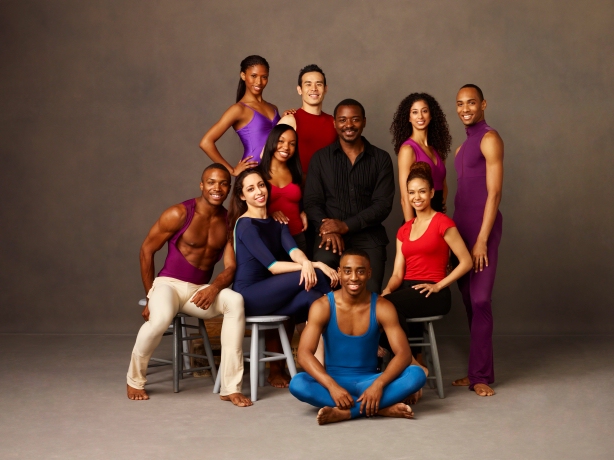
New Alvin Ailey American Dance Theater artistic director Robert Battle (c.) poses with dancers he has invited to join the company (photo by Andrew Eccles)
Alvin Ailey American Dance Theater
New York City Center
130 West 56th St. between Sixth & Seventh Aves.
November 30 – January 1, $25-$150
212-581-1212
www.alvinailey.org
www.nycitycenter.org
Founded in 1958, Alvin Ailey American Dance Theater had only two artistic directors over the course of its first fifty-two years, beginning with Ailey himself, who led the company until his death from AIDS in 1989, followed by Judith Jamison, who continued in the role through this summer, when in July she named her successor, Robert Battle. The thirty-eight-year-old Miami native has had a long affiliation with AAADT, having been an artist-in-residence since 1999, and he has had several works performed by the company, including “The Hunt,” “In/Side,” and “Love Stories,” a collaboration with Jamison and Rennie Harris.
Battle, who studied at Juilliard, danced with Parsons Dance Company, started his own group, Battleworks Dance Company, and was named a “Master of African American Choreography” by the Kennedy Center in 2005, is presenting his inaugural City Center season as AAADT artistic director from November 30 through January 1. The annual five-week event will feature Paul Taylor’s “Arden Court” (in his Ailey debut), Ohad Naharin’s interactive “Minus 16,” Jamison’s “Forgotten Time,” the world premiere of Harris’s AIDS-related “Home,” new productions of Joyce Trisler’s “Journey” and Alvin Ailey’s “Streams,” and several pieces by Battle, most notably the Ailey premiere of “Takademe.” Select performances of a number of works will include live music by such special guests as John Legend, Naren Budhkar, the Knights, and others. With the City Center season just a few weeks away, Battle talked with twi-ny about legacy, responsibility, and the precipice of discovery.
twi-ny: You are now only the third artistic director in the history of Alvin Ailey American Dance Theater. What is your greatest fear?
Robert Battle: I think that’s an unknown. Fear is not for me something that I turn on and off. Anybody, especially an artist, always has a healthy dose of fear mixed with optimism, because those two opposing forces is what creates energy, the energy that is the creative force. So I think it’s a healthy mixture of both of those things.
twi-ny: What are you looking forward to the most?
Robert Battle: I’m looking forward to watching and reveling at the dancers and the delights of the work that is coming in to the repertory and watching and being a part of taking the company into the future. That’s what I look forward to the most.
twi-ny: How did you go about selecting and grouping the dances for this year’s City Center season, which includes the company premiere of your own “Takademe”? Were you looking for an overriding theme?
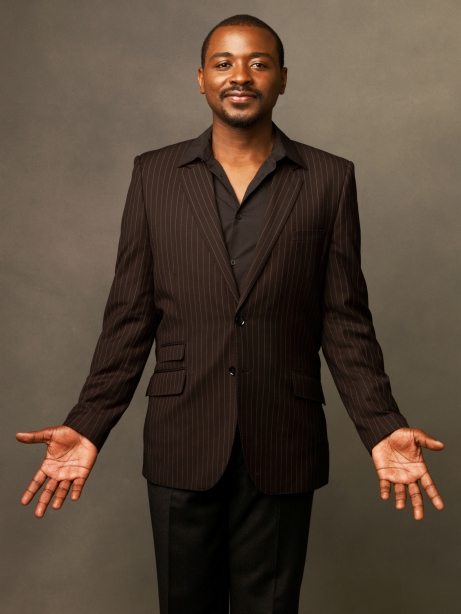
Robert Battle has taken over the reins of Alvin Ailey American Dance Theater from Judith Jamison (photo by Andrew Eccles)
Robert Battle: Yes, the overriding theme is past, present, and future. We’re a repertory company — in a way, we’re a repository for great modern dance works — so, of course, looking back at Mr. Ailey’s work, Joyce Trisler’s “Journey,” created in 1958, all of these works are part of looking back and new productions of those works. Being in the present, looking at Rennie Harris’s work and his commission [“Home”] — he’s a hip-hop choreographer, so he uses hip-hop as his language. That is a part of the present; hip-hop is on everybody’s mind, radio, whatever it may be, but dealing with hip-hop to tell the stories of people who are surviving and thriving with HIV/AIDS is a wonderful tribute because it’s about the celebration of life. And then looking at works to me that echo the future, like Ohad Naharin’s “Minus 16,” which breaks the fourth wall: It invites the audience onto the stage, it has audience participation, it has a whole new way of moving for the dancers. So in that way we’re looking at the future. So we’re looking at all three of those things.
twi-ny: Who are some of the new choreographers you’d like to bring into the extended Ailey family?
Robert Battle: Aha — that, I cannot say [laughs], with deference to all choreographers who may want to be a part of this. I can’t just list one or two, but I really want the work to express the complexity of the world, society. It should be a reflection of that, so that you have choreographers of different races and backgrounds and approaches and themes bringing their voice to our voice. That’s what Mr. Ailey wanted, what Ms. Jamison continued, and what I will continue, to look far and wide, and to keep the audience and the dancers on that precipice of discovery.
twi-ny: With that in mind, how are you balancing the Ailey tradition with, perhaps, the urge to bust things wide open and initiate potential change under your leadership?
Robert Battle: I think that question could have a period at the end. That is what I am doing, balancing the traditional with the sometimes nontraditional. I think the notion of doing something without it having some connection to what is already here is not something I’m interested in. I’m really interested in blending the two. And that’s because this is a repertory company; that’s why I’m able to do that. If it’s one choreographer’s work, it’s harder to do that, but when you’re choosing works from many different choreographers in one season you get the sense of that yin and yang, that stretching forward of busting the whole thing wide open but yet keeping the traditional so that the company stays rooted. That’s why it began in the first place; celebrating the African American tradition and culture and experience in this country but also expanding on that idea is what I’m trying to do.


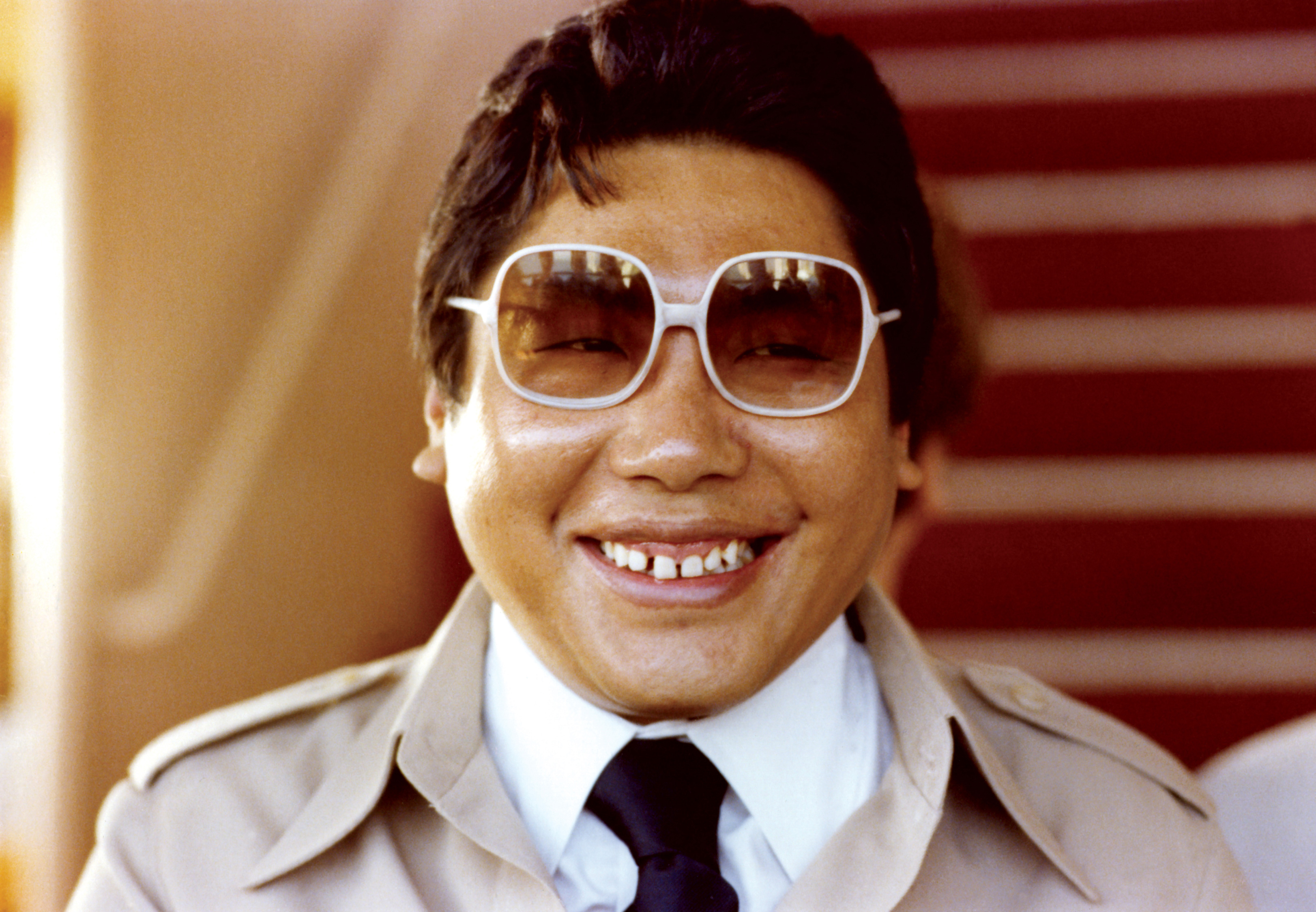
 Born in February 1939 and recognized as an enlightened reincarnation of the Trungpa tülkus when he was just thirteen months old, Chögyam Trungpa escaped his native Tibet during the 1959 Chinese invasion, eventually becoming a central figure in the spread of Tibetan Buddhism throughout the West. Filmmaker Johanna Demetrakas (Right Out of History: The Making of Judy Chicago’s Dinner Party), a former student and friend of Chögyam Trungpa’s, recounts his unusual story in the adulatory Crazy Wisdom: The Life and Times of Chögyam Trungpa Rinpoche. “From the first seminar, called ‘The Battle of Ego” in Los Angeles, to filming his cremation on a cloudless but rainbow-filled day in Vermont, Chögyam Trungpa literally blew my mind,” Demetrakas explains on the film’s official website. His fascinating tale is liable to blow your mind too. Chögyam Trungpa invited Demetrakas into his inner circle from 1983 to 1987, allowing her intimate access to his wild life, which included exchanging his monk’s robes for a business suit and later a pseudo-military uniform, confusing his followers and angering his critics. A proponent of what he called “crazy wisdom,” Chögyam Trungpa studied at Oxford, suffered partial paralysis in a car accident, married a sixteen-year-old westerner, smoked cigarettes, was a heavy drinker, and carried on dalliances with many of his female students while teaching about fear, self-deception, the ego, spiritual materialism, and the importance of meditation. “You can survive by doing nothing,” he preached, but he alienated some with his nontraditional actions, leading him to be known as the “Bad Boy of Buddhism.” Trying to get to the bottom of the complicated man who founded such learning centers as the Naropa Institute and Shambhala, Demetrakas speaks with Chögyam Trungpa’s wife, Diana Mukpo, his lover Agness Au, and his eldest son, Sakyong Mipham; such fellow teachers as Pema Chodron and Ram Dass; poets Allen Ginsberg and Anne Waldman; and various other scholars, journalists, and former students, supplemented by archival footage and clips from his teachings, which together paint a compelling portrait of a most colorful and singular individual. Crazy Wisdom is scheduled for a one-week limited engagement at the Rubin Museum beginning November 25, with all screenings (several of which are beginning to sell out) followed by Q&As with such special guests as Demetrakas, Waldman, Au, Meredith Monk, Tulku Jamyang Rinpoche, and others.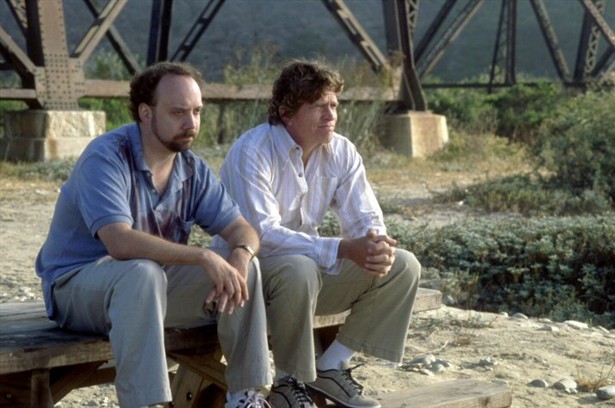
 Celebrating the release of Alexander Payne’s The Descendants, the Museum of the Moving Image’s “The Films of Alexander Payne” series concludes November 25 with Sideways, the eclectic director’s fourth film, following the underseen Citizen Ruth, the excellent Election, and the overrated About Schmidt. Sideways is fabulously entertaining from start to finish, a smart, inventive, very funny dark comedy about friendship and love set in California wine country. Paul Giamatti stars as Miles, a schlumpy wine connoisseur who is having trouble getting over his divorce and the failure of his massive novel to get published. His best friend, Jack (Thomas Haden Church), is getting married, so the two head off on a road trip, with Miles looking forward to sampling fine wine, and Jack anticipating sampling fine women. While Jack finds what he is looking for in Stephanie (Sandra Oh, who was married to Payne at the time), Miles seems hell-bent on not allowing himself to enjoy life, even as a beautiful woman with a deep appreciation of the grape (the excellent Virginia Madsen in what should have been a career-redefining performance) shows an interest in him. You definitely do not have to be a wine drinker to fall in love with this marvelous movie, one of the best of 2004; it was nominated for Best Director, Best Picture, Best Supporting Actress (Madsen), and Best Supporting Actor (Haden Church), and screenwriters Jim Taylor and Payne won for Best Adapted Screenplay.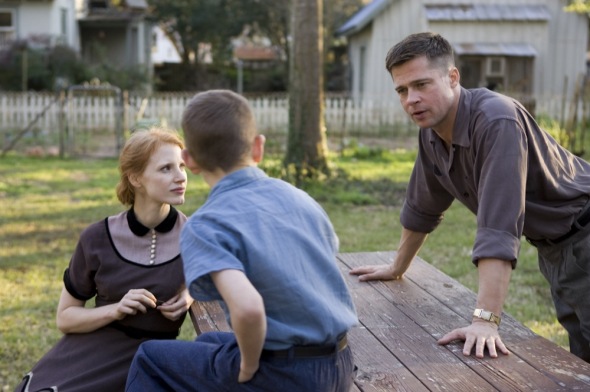
 Iconoclastic writer-director Terrence Malick has made only five feature films in his forty-plus-year career, but his latest is his very best. Following Badlands (1973), Days of Heaven (1978), The Thin Red Line (1998), and The New World (2005), The Tree of Life is an epic masterpiece of massive proportions, a stirring visual journey into the beginning of the universe, the end of the world, and beyond. The unconventional nonlinear narrative essentially tells the story of a middle-class Texas family having a difficult time coming to grips with the death of one of their sons in the military. Malick cuts between long flashbacks of Mr. and Mrs. O’Brien (Brad Pitt and Jessica Chastain) in the 1950s and 1960s, as they meet, marry, and raise their three boys, to the present, when Jack (Sean Penn), their eldest, now a successful architect, is still searching for answers. The sets by production designer Jack Fisk transport viewers from midcentury suburbia to the modern-day big city and a heavenly beach, all gorgeously shot by cinematographer Emmanuel Lubezki. Every frame is so beautiful, it’s as if they filmed the movie only at sunrise and sunset, the Golden Hour, when the light is at its most pure. The Tree of Life is about God and not God, about faith and belief, about evolution and creationism, about religion and the scientific world. The film opens with a quote from the Book of Job: “Where were you when I laid the earth’s foundation . . . while the morning stars sang together and all the sons of God shouted for joy?” Early on Mrs. O’Brien says in voice-over, “The nuns taught us there are two ways through life: The way of nature, and the way of grace. You have to choose which one to follow.” Malick doesn’t get caught up in those questions, instead focusing on the miracles of life and death and everything in between.