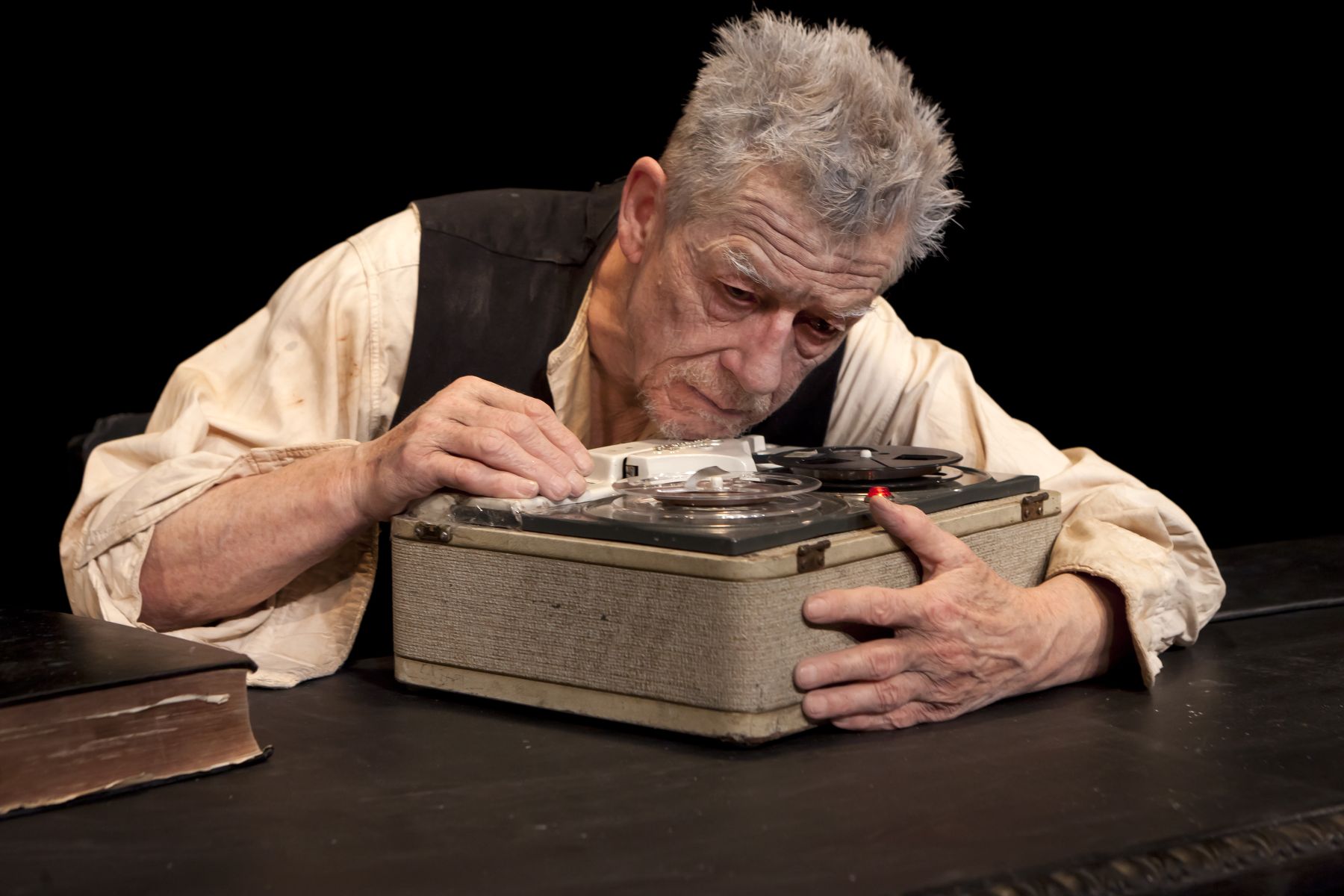
John Hurt listens to his past in KRAPP’S LAST TAPE, running at BAM through December 18 (photo by Richard Termine)
NEXT WAVE FESTIVAL
Brooklyn Academy of Music
BAM Harvey Theater
651 Fulton St. between Ashland & Rockwell Pl.
Through December 18, $25-$90
718-636-4100
www.bam.org
Originally written in 1958 for British actor Patrick Magee, Samuel Beckett’s autobiographical Krapp’s Last Tape is a haunting examination of time, memory, and the futility of language. Performed over the years by the likes of Magee, Harold Pinter, Brian Dennehy, and Michael Gambon, the fifty-five-minute one-act is perhaps most closely identified today with John Hurt, who first appeared in the play at Dublin’s Gate Theatre in 1999, starred in Atom Egoyan’s 2001 film version, and is now giving a bravura command performance at BAM through December 18. Making his New York stage debut, Hurt (Midnight Express, 10 Rillington Place) plays a failed writer named Krapp who, when first seen, is sitting at a table in silence, an old lamp dangling overhead. He says nothing for several minutes and then eventually gets up, walks around in squeaky white shoes, consumes two bananas, slips on a peel he dropped on the floor, and carefully approaches the darkness on either side of him, deciding not to venture out of the lighted area, as if something unknown and dangerous awaits outside his very private, solitary comfort zone. It is a critical moment in the play, establishing the precipice of life and death that Krapp is balancing on while also reminding the audience that this is a staged production. As he does every year on his birthday, Krapp listens to reel-to-reel recordings of messages he left on previous birthdays and makes a new one; in this case, the sixty-nine-year-old shabbily dressed man is looking for the tape he made on his thirty-ninth, which, according to his dusty old ledger, can be found in “box five, spool three.” Krapp takes delight in drawing out the word spool like he is a child. As he listens to his old self discuss the past, present, and future as he saw it thirty years before, he starts and stops the tape, remembering some moments that elicit strong emotions while clearly having no memory of others, the fractured narrative tantalizing and teasing the audience. “Thirty-nine today,” the recorded Krapp says. “Sound as a bell.” But alas, the sixty-nine-year-old Krapp is not sound as a bell, with little but death to look forward to.
Director Michael Colgan and lighting designer James McConnell have placed Krapp in a masterfully minimalist black-and-white world, surrounded by darkness, the only colors the yellow of the bananas and the green in Krapp’s description of a former love’s coat. Hurt, now seventy-one, is a less angry, more fragile and perhaps desperate Krapp than he portrayed in previous versions, cupping his ear tighter as he leans his head to hear the tape, shuffling to the back — through a minefield of his past, the boxes of tapes strewn across the floor — to steal a drink, staring straight ahead, wondering what happened to the ambitious youth he once was. (He even resembles Beckett himself this time around.) Krapp’s Last Tape is an extraordinarily complex work that delves deep into the human psyche, a challenge for both the actor and the audience, a play that will stay with you for a long time, eliciting thoughts of where you’ve been, who you are, and what awaits you in the future. Hurt will participate in a post-show artist talk on December 15; in addition, BAMcinématek will be highlighting four of the British actor’s best films in “John Hurt Quartet,” including The Elephant Man (David Lynch, 1980) on December 12, Scandal (Michael Caton-Jones, 1989) on December 13 (followed by a Q&A with Hurt), Love and Death on Long Island (Richard Kwietniowski, 1997) on December 14, and Nineteen Eighty-Four (Michael Radford, 1984) on December 15.


 Livia Bloom’s “Documentary in Bloom” series at the Maysles Cinema usually introduces new nonfiction films, but it has something a little different in store for December: the U.S. theatrical release of a thirty-six-year-old French work. It’s hard to believe that Daguerreotypes, Agnès Varda’s absolutely charming look at her longtime Parisian community, has never had a theatrical run in America, so it is exciting that her wonderful little tale is finally being shown on the big screen. In Daguerreotypes, Varda, who has made such New Wave classics as Cléo de 5 à 7 and Le Bonheur as well as such seminal personal documentaries as The Gleaners and I and The Beaches of Agnès, turns her camera on the people she and husband Jacques Demy lived with along the Rue Daguerre in Paris’s 14th arrondissement. Varda, who also narrates the seventy-five-minute film, primarily stands in the background while capturing local shopkeepers talking about their businesses and how they met their spouses as customers stop by, picking up bread, meat, perfume, and other items. Varda uses a goofy, low-rent magic show as a centerpiece, with many of the characters attending this major cultural event; the magician references the magic of both life and cinema itself, with Varda titling the film not only after the street where she lives but also directly evoking the revolutionary photographic process developed by Louis Daguerre in the 1820s and ’30s. Daguerreotypes will surely have a different impact now than it did back in the mid-1970s, depicting a time that already felt like the past but now feels like a long-forgotten era, when neighbors knew one another and lived as a tight-knit community. The film will be proceeded by the 1965 short Elsa la Rose, a twenty-minute documentary directed by Varda and Raymond Zanchi and narrated by Michel Piccoli that explores the loving relationship between French writers and communists Louis Aragon and Elsa Triolet.
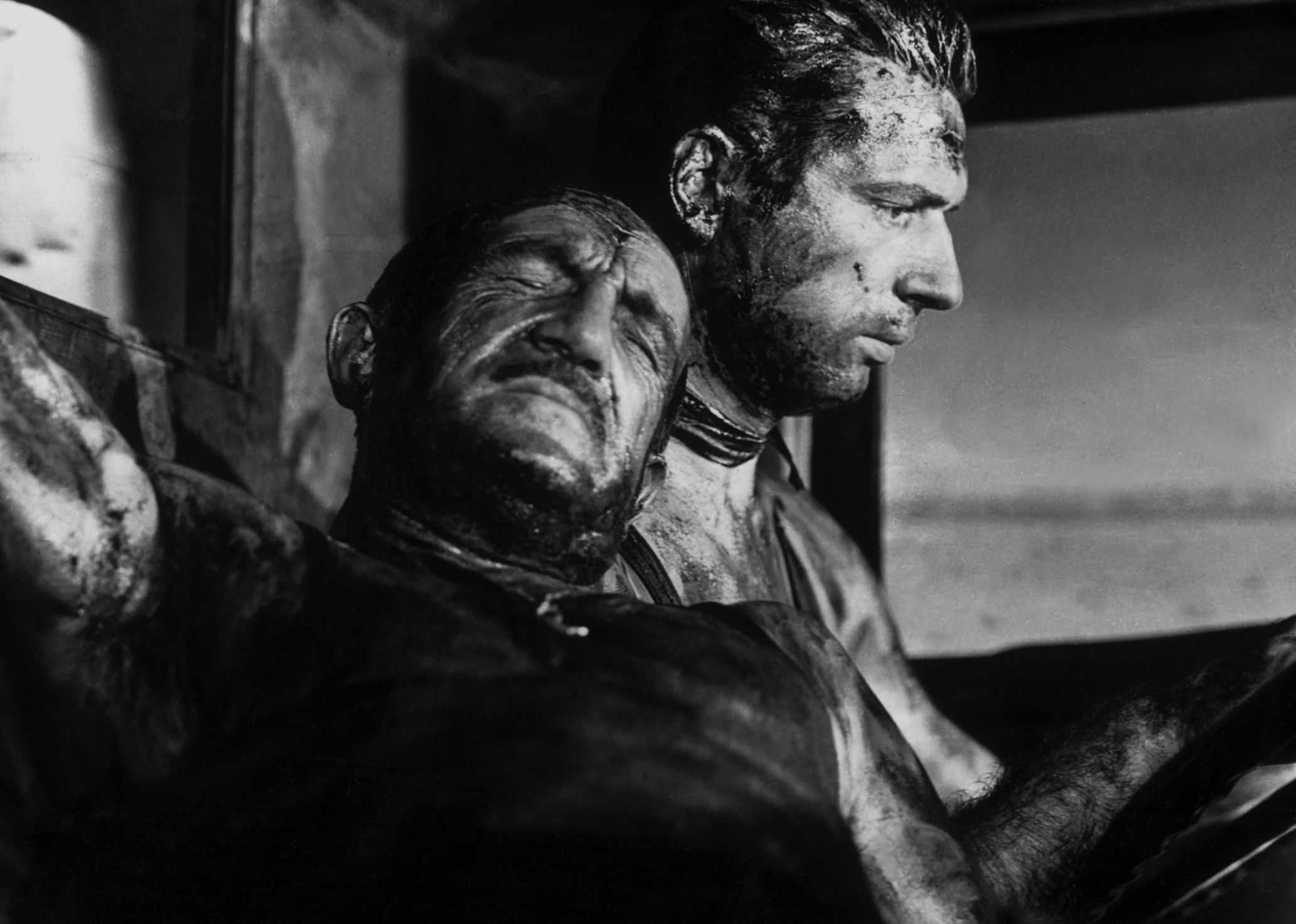
 In a very poor South American village, four men are needed to transport two truckloads of nitroglycerin to the scene of an industrial accident. The men jump at the chance to risk their lives for a small amount of cash because they have nothing else in their pitiful lives. Yves Montand stars in this endlessly tense, harrowing film that won the Golden Bear in Berlin, the BAFTA in England, and the Grand Prize at Cannes. The cast also includes Charles Vanet, Peter van Eyck, Folco Lulli, and Véra Clouzot, the wife of director Henri-Georges Clouzot (Les Diaboliques, Les Espions). Based on the novel by Georges Arnaud, The Wages of Fear was remade as Sorcerer by William Friedkin in 1977, starring Roy Scheider — a good film, but not nearly the cinematic experience the original still is. Clouzot’s back-and-white classic, a masterpiece of suspense that will literally have you on the edge of your seat, ready to explode at any moment, is being shown December 9-22 at Film Forum in a new 35mm that should make it even more terrifying. For more Clouzot, see