twi-ny recommended events

NORDIC OSCAR CONTENDERS: LE HAVRE

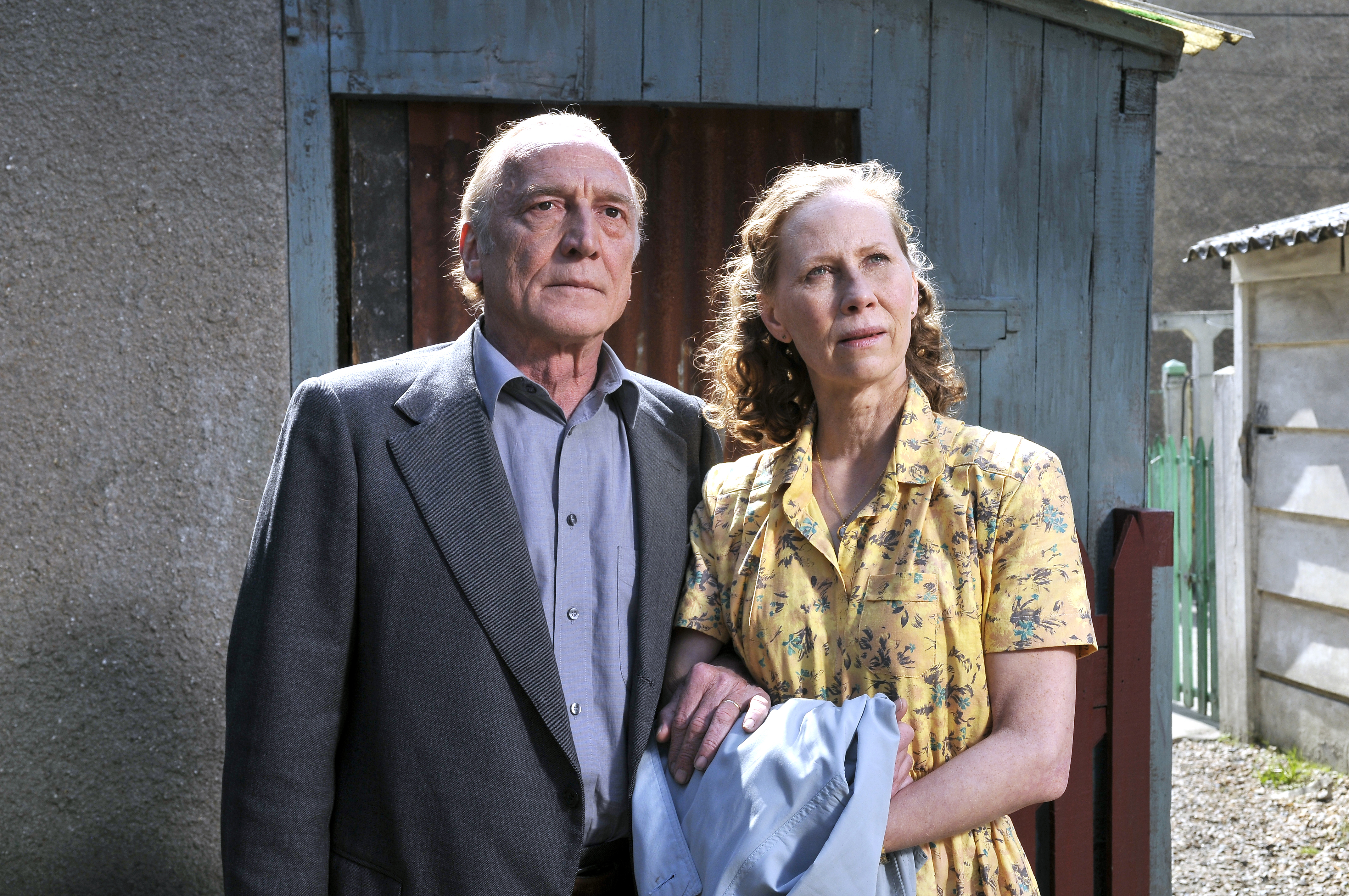
Marcel (André Wilms) and Arletty Marx (Kati Outinen) face life with a deadpan sense of humor in Aki Kaurismäki’s LE HAVRE

LE HAVRE (Aki Kaurismäki, 2011)
Victor Borge Hall, Scandinavia House
58 Park Ave. at 38th St.
Friday, January 6, $12, 6:30
Series runs January 4-9
212-847-9746
janusfilms.com/lehavre
www.scandinaviahouse.org

For nearly thirty years, Finnish auteur Aki Kaurismäki (Leningrad Cowboys Go America, The Man Without a Past) has been making existential deadpan black comedies that are often as funny as they are dark and depressing. Has there ever been a film as bleak as 1990’s The Match Factory Girl, in which a young woman (Kati Outinen) suffers malady after malady, tragedy after tragedy, embarrassment after embarrassment, her expression never changing? In his latest film, the thoroughly engaging Le Havre, Kaurismäki moves the setting to a small port town in France, where shoeshine man Marcel Marx (André Wilms), a self-described former Bohemian, worries about his seriously ill wife (Outinen) while trying to help a young African boy (Blondin Miguel), who was smuggled into the country illegally on board a container ship, steer clear of the police, especially intrepid detective Monet (Jean-Pierre Darroussin), who never says no to a snifter of Calvados. Adding elements of French gangster and WWII Resistance films with Godardian undercurrents — he even casts Jean-Pierre Léaud in a small but pivotal role — Kaurismäki wryly examines how individuals as well as governments deal with illegal immigrants, something that has taken on more importance than ever amid the growing international economic crisis and fears of terrorism. Through it all, Marcel remains steadfast and stalwart, quietly and humbly going about his business, deadpan every step of the way. Wouter Zoon’s set design runs the gamut from stark grays to bursts of color, while longtime Kaurismäki cinematographer Timo Salminen shoots scene after scene with a beautiful simplicity. Winner of a Fipresci critics award at Cannes this year and Finland’s official entry for the Best Foreign Language Film Oscar, Le Havre, the first of a proposed trilogy, is another marvelously unusual, charmingly offbeat tale from a master of the form. A selection of the 2011 New York Film Festival, Le Havre is screening January 6 at 6:30 as part of the “Nordic Oscar Contenders” series at Scandinavia House, which begins January 4 with Pernilla August’s Swedish entry, Svinalängorna (Beyond), and concludes January 9 with Anne Sewitsky’s Norwegian drama Sykt lykkelig (Happy, happy).
UNDER THE RADAR

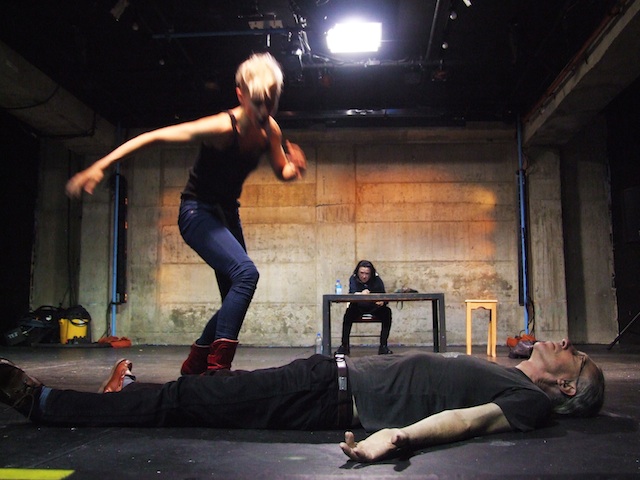
Judith Malina of the Living Theatre and Silvia Calderoni of Motus collaborate on THE PLOT IS THE REVOLUTION, a special Under the Radar presentation on January 9 at La MaMa (photo by End & Dna)

The Public Theater and other venues
425 Lafayette St. between East Fourth St. & Astor Pl.
January 4-15, free-$25
212-967-7555
www.undertheradarfestival.com

The eighth annual Under the Radar: A Festival Tracking New Theater from Around the World offers another diverse collection of live performances that provide a welcome alternative to conventional theater. Running January 4-15, this year’s fest includes such promising productions as Hideki Noda’s The Bee, an English-language drama at Japan Society about a horrible surprise waiting for a businessman upon returning home from the office; Bambï & Waterwell’s Goodbar, a live concept album reimagining of Looking for Mr. Goodbar, at the Public Theater; Suli Holum & Deborah Stein’s Chimera, about a woman who is her own twin, at HERE; and Stefan Zeromski Theatre’s unique musical take on Bernard-Marie Koltès’s In the Solitude of Cotton Fields, set to live Polish punk rock, at La MaMa. The Public will also be home to the LuEsther Lounge, presenting free live music throughout the festival. Among the other free events are the installation Gob Squad Resource Room at the Goethe-Institut’s Wyoming Building (the Gob Squad Arts Collective will also be presenting the interactive Super Night Shot at the Public); Camille O’Sullivan’s Feel, in which the Irish singer will play a different character for songs by Jacquel Brel, Nick Cave, Tom Waits, David Bowie, and others, at the Public; and the panel discussion “Performance and Context: The Black Box and the White Cube,” January 8 at 1:00 at the Public. In addition, a post-show discussion will follow the January 7 performance of Motus’s Alexis. A Greek Tragedy at La MaMa, a preshow talk will precede the January 8 performance of the Living Word Project’s Word Becomes Flesh at the Public, a panel will follow the January 11 performance of biriken & Ayça Damgaci’s Lick But Don’t Swallow! at La MaMa, chelfitsch’s Toshiki Okada (Hot Pepper, Air Conditioner, and the Farewell Speech) will lead a workshop for theater and dance professionals on January 14 at 1:00 at Japan Society, and “Everyone’s a Critic! Exploring the Changing Landscape of Arts Writing” will take place January 15 at 1:00 at the LuEsther Lounge. As always, Under the Radar offers adventurous theatergoers a chance to see a bunch of very different works, from an excellent selection of international companies.

NEW YEAR’S DAY POETRY MARATHONS

Visual artist and bilingual poet Yuko Otomo will participate in both New Year’s Day marathons (photo by Marilyn Kaggen)

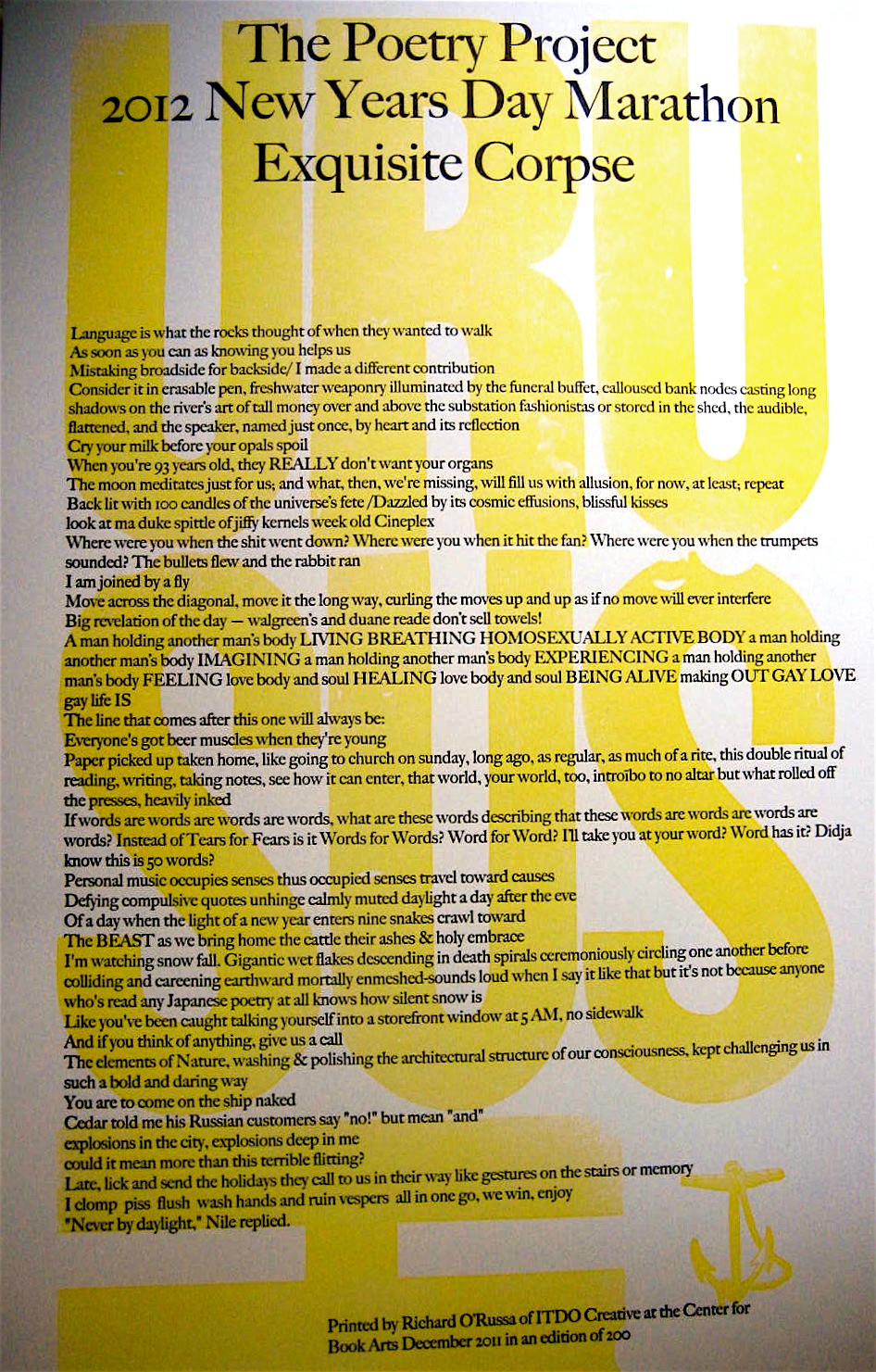
Every January 1, a pair of poetry marathons do battle on the Lower East Side in celebration of the new year. The Poetry Project at St. Marks Church (131 East 10th St. at Second Ave., $20, 3:00 – 12 midnight) will be hosting its thirty-eighth annual New Year’s Day Marathon Benefit Reading, featuring 140 artists, 52 of whom contributed a line to the broadside “Exquisite Corpse,” which begins, “Language is what the rocks thought of when they wanted to walk.” The always spectacular lineup includes Anne Waldman with Ambrose Bye & Daniel Carter, Bob Hershon, Church of Betty, Eileen Myles, Elinor Nauen, Elliott Sharp, John Giorno, John S. Hall, Jonas Mekas, Judith Malina, Lee Ranaldo, Lenny Kaye, Mónica de la Torre, Nick Hallett, Patti Smith, Penny Arcade, Steve Earle, Susie Timmons, Suzanne Vega, Taylor Mead, Thurston Moore, Wayne Koestenbaum, Yoshiko Chuma, and Yvonne Meier with Aki Sasamoto. The exact schedule is available only onsite. Meanwhile, over at the Bowery Poetry Club (308 Bowery between Houston & Bleecker Sts., free with suggested donation of paperback books for Books Through Bars, 2:00 – 12 midnight), the eighteenth annual Alternative New Year’s Day Spoken Word and Performance Extravaganza features more than 150 performers as well an open mic, with such guests as Corrina Bain, Richard Kostelanetz, Ocean Vuong, EJ Antonio, Adam Falkner, Marcy Alexis, Steve Cannon, Emanuel Xavier, Kathi Georges, Jackie Sheeler, Eve Packer, Nancy Mercado, Ngoma, Sparrow, Laura Dinnebeil, Angelo Vergas, and such double-duty poets as Steve Dalachinsky, Anselm Berrigan, and Yuko Otomo, who will read at both marathons. This year’s Bowery theme is “Kaleidoscope”: “Come observe what happens when words shift and flicker! We are a circle of mirrors. Together we reflect the rest of the world.”

ROBERT BURNS AND “AULD LANG SYNE”

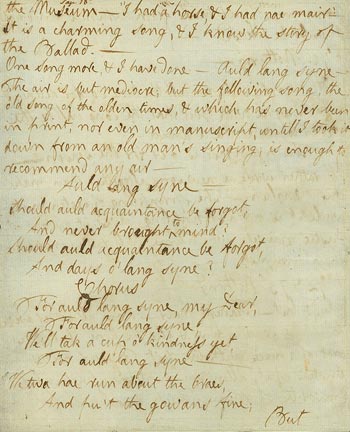
Robert Burns, “Auld Lang Syne” (detail), autograph manuscript written within a letter, dated (September 1793), to George Thomson

Morgan Library & Museum
225 Madison Ave. at 36th St.
Tuesday – Sunday through February 5, $15 (free Fridays 7:00 – 9:00)
212-685-0008
www.themorgan.org

Tonight at midnight, people around the world will break out into the same song, “Auld Lang Syne,” welcoming in 2012, but how many of those revelers know the true story about the famous tune? The Morgan Library is currently hosting a splendid little exhibition that examines the details behind the music and lyrics of the popular ditty, whose three-word title translates to “old,” “long,” “since.” It was Scottish poet Robert Burns who combined the familiar music and lyrics for publisher James Johnson in 1796, although there were different versions both before and after, from a 1667 lover’s lament and a 1760s Caledonian country dance to William Shield’s 1782 opera, Rosina, and Rudyard Kipling’s 1900 Boer War revision. The show, which comprises original letters, manuscripts, portraits, rare books, and even an arrangement by Beethoven, also features a strong online component where you can read and listen to snippets of the evolution of the complete song, so you’ll be able to surprise your fellow partyers tonight by breaking out into all four Burns stanzas, including “We twa hae run about the braes, / And pu’t the gowans fine; / But we’ve wander’d mony a weary foot, / Sin auld lang syne.” In addition, the Morgan will be celebrating the eve of Burns Day on January 24 with the special concert “Days of Auld Lang Syne: Euan Morton Sings Songs of Scotland,” in which the singer and actor will perform Scottish works, accompanied by composer Bryan Reeder on piano. (Also currently on view at the Morgan are “Charles Dickens at 200,” “Treasures of Islamic Manuscript Painting from the Morgan,” and “David, Delacroix, and Revolutionary France: Drawings from the Louvre.”

CHRISTMAS TREES 2011

The Met’s Christmas Tree and Neapolitan Baroque Crèche is one of many holiday trees that will remain up into the new year (photo by twi-ny/mdr)

Christmas might be over, but many of the city’s most popular trees are scheduled to remain up into the new year and some until the Epiphany, celebrated on January 6. So there’s still time to check out the Origami Holiday Tree at the American Museum of Natural History (through January 2), the South Street Seaport Chorus Tree light show (Monday through Friday through January 4), the Rockefeller Center Christmas Tree (January 7), the Winter Garden Holiday Lights at the World Financial Center (January 7), and the Christmas Tree and Neapolitan Baroque Crèche at the Metropolitan Museum of Art (January 8 ) in addition to the Lincoln Square Christmas Tree in Dante Park and trees at Bryant Park, Historic Richmond Town, Madison Square Park, Washington Square Park, the Cathedral Church of St. John the Divine, and Morningside Park. It’s also the time of year when Christmas trees start showing up on the streets wrapped in black plastic, looking like so many body bags. The city recycles its trees, and you should too. Tree recycling is already under way in Battery Park City, where you can leave your tree, sans decoration, through January 27. The city will also be picking up trees curbside January 3-14, or you can participate in the annual MulchFest, which takes place at various sites January 2-8.

DARK CHRISTMAS

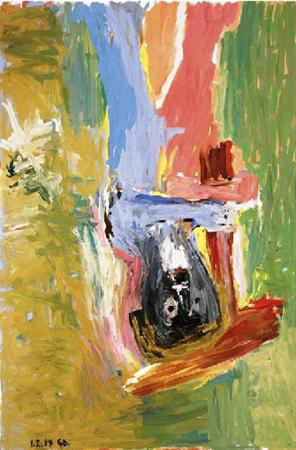
Georg Baselitz, “Die Kreuztragung (Christ Bearing the Cross),” oil on canvas, 1984

Leo Koenig Inc.
545 West 23rd St. between Tenth & Eleventh Aves.
Tuesday through Saturday through January 14 (closed 12/31)
212-334-9255
www.leokoenig.com

The holiday season always includes screenings of such films as White Christmas, the musical with Bing Crosby and Danny Kaye, and Black Christmas, Bob Clark’s bloody slasherfest, as well as multiple versions of such favorite seasonal tunes as “Blue Christmas,” which has been sung by everyone from Elvis Presley and the Partridge Family to Céline Dion and She & Him. This year Chelsea’s Leo Koenig Inc. gallery is adding “Dark Christmas” to the mix, a wide-ranging collection of paintings, photographs, and sculptures that date from the 1930s to the present examining secular and religious iconography, with a particular focus on the human body. Curated by Stephanie Schumann and Leo Koenig, the exhibition features numerous works that have been deemed obscene and sacrilegious along with pieces that are more abstract and not as easy for naysayers to condemn. Among the more clear-cut examples are Tony Matelli’s “Jesus Lives,” Ana Mendieta’s “Untitled (Body Print),” Andres Serrano’s “Piss Christ,” Georg Baselitz’s “Die Kreuztragung (Christ Bearing the Cross),” and Kiki Smith’s “Daisy Chain”; the show also includes works by Bruce Nauman, Sigmar Polke, Arnulf Rainer, Gerhard Richter, Cindy Sherman, Nicola Tyson, Christopher Wool, Hans Bellmer, Paul McCarthy, and others. So if you’re looking for something a little different to do to conclude your holidays, you might want to head into Chelsea to check out this unique and, at times, very colorful look at Christmas.

SEE IT BIG! BARRY LYNDON

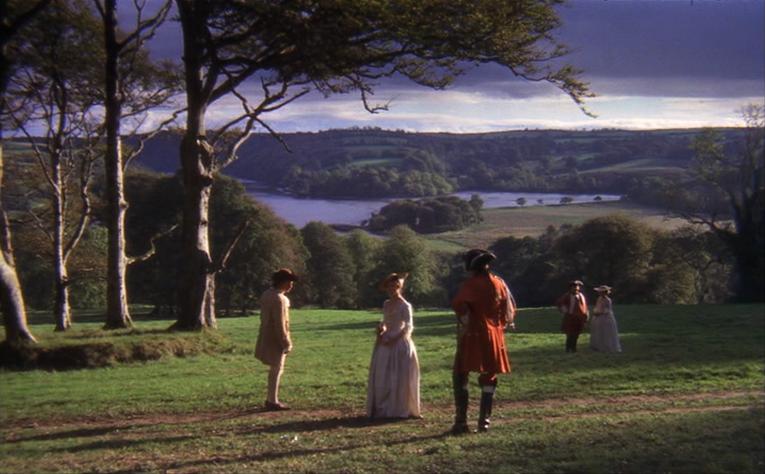
BARRY LYNDON will be shown on the big screen as part of “See It Big!” series

BARRY LYNDON (Stanley Kubrick, 1975)
Museum of the Moving Image
35th Ave. at 36th St., Astoria
Friday, December 30, $12, 7:00
Sunday, January 1, free with museum admission, 6:00
718-777-6800
www.movingimage.us

The Museum of the Moving Image concludes its “See It Big!” series, in which major motion pictures that deserve to be seen on the big screen are shown in the museum’s recently renovated and expanded theater, with one of the most elegantly visual pictures ever made, Stanley Kubrick’s lush, romantic epic, Barry Lyndon. Based on William Makepeace Thackeray’s 1844 serialized picaresque novel The Luck of Barry Lyndon, Kubrick’s extravagant three-hour tale follows the shenanigans of one Redmond Barry, played with endless charm by Ryan O’Neal. The man soon to be known as Barry Lyndon has a remarkable knack for survival — or maybe it’s just plain old Irish luck — as he rises in English society via a series of duels (with epees, guns, and bare knuckles), military battles (the Seven Years’ War), and, most prominently, sexual conquests. Consisting of two sections, “By What Means Redmond Barry Acquired the Style and Title of Barry Lyndon” and “Containing an Account of the Misfortunes and Disasters Which Befell Barry Lyndon,” the film features glorious music by Bach, Vivaldi, Handel, Mozart, Schubert, and the Chieftains in addition to absolutely divine locations and costumes that lay the groundwork for the sumptuous Oscar-winning art direction by Ken Adam, Vernon Dixon, and Roy Walker and cinematography by John Alcott; virtually every scene contains beautiful shots based on famous paintings, a treat for the eyes and the ears. (Leonard Rosenman took home an Academy Award as well for his adapted score.) The overly long story does drag at times, but it flows better once you get used to O’Neal in the title role. The underappreciated film also has a great supporting cast, with Marisa Berenson as Lady Lyndon, Patrick Magee as the Chevalier de Balibari, Hardy Krüger as Captain Potzdorf, Steven Berkoff as Lord Ludd, Leonard Rossiter as Captain John Quin, and Gay Hamilton as Nora Brady. The Museum of the Moving Image is screening a restored 35mm print of Barry Lyndon on December 30 at 7:00 and January 1 at 6:00.