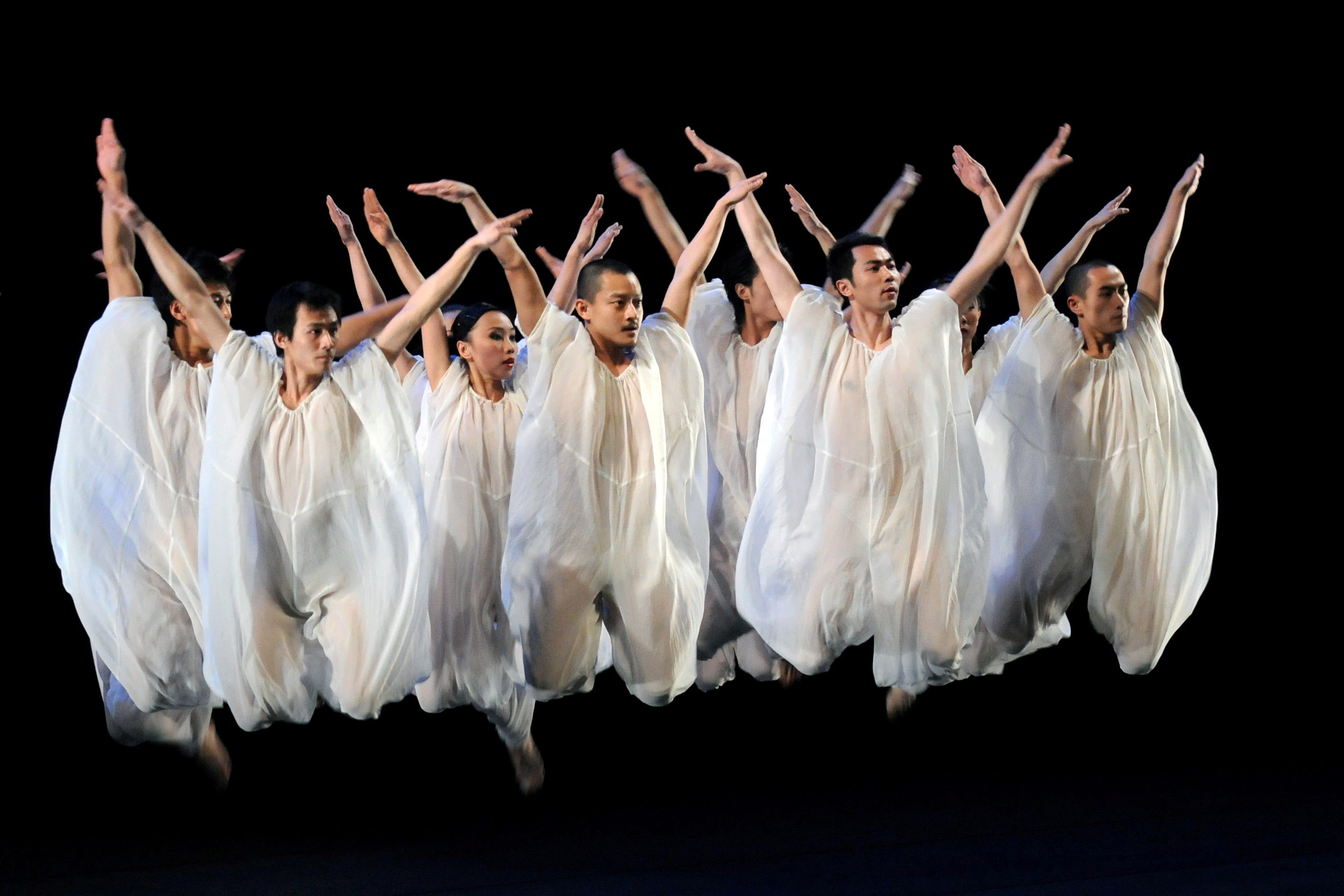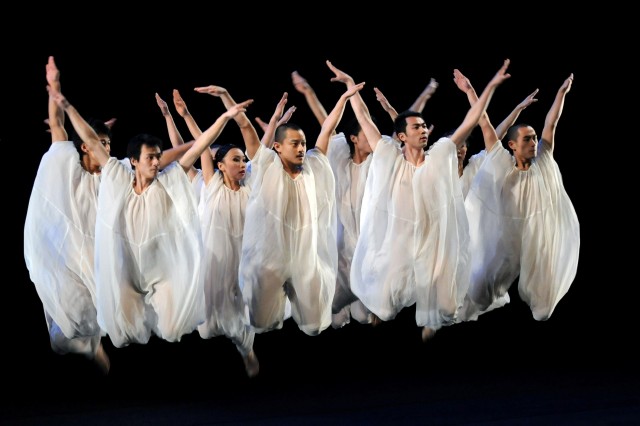
Jin Xing Dance Theatre Shanghai makes a very welcome return to the Joyce with SHANGHAI TANGO (photo by Angelo Palombini)
Joyce Theater
175 Eighth Ave. at 19th St.
January 31 – February 5, $10-$39
212-645-2904
www.joyce.org
Performing in New York City for the first time since undergoing gender reassignment surgery fifteen years ago, ballerina, choreographer, and People’s Liberation Army colonel Jin Xing leads her company, Jin Xing Dance Theatre Shanghai, in a lyrical, beautiful, stirring show at the Joyce. Jin Xing — who was born to Korean parents in Shanghai in 1967, is married to a German man, and has three adopted children — fills Shanghai Tango with ten exquisite works from throughout her career. The show opens with Liu Minzi spinning around and around on her toes, a light shining on her from above, casting a holy glow as twelve dancers pick up flowing white robes that surround her, the spirit of dance gathering her disciples as Dead Can Dance’s “The Host of Seraphim” plays. It’s a captivating narrative that prepares the audience for an evening of gorgeous set pieces featuring colorful, elegant costumes designed by Jin Xing, an eclectic score with music by Johann Strauss, John Williams, Astor Piazzola, and Rene Aubry, a lovely, unique movement vocabulary that mixes modern dance with ballet, numerous references to the Chinese Cultural Revolution, and a surprising sense of humor. In “Dance 02,” Dai Shaoting and Han Bin deliver a stunning pas de deux, spending much of the time with their backs on the floor, at one point Dai delicately balancing on Han with one leg on his chest and the other on his raised knee. In “Red Wine,” the male members of the company move around Jin Xing, who is seated in a chair, and ultimately give her the world’s biggest lap dance. In “Four Happiness,” Deng Mengna, Li Meilin, Liu Minzi, and Pang Kun dance on their knees all in a row, with Wang Peng’s lighting casting large shadows of the women on the back wall. In “Shanghai Tango,” Sun Zhuzhen, Han Bin, Wang Tao, and Liu Xianyi pose for an old-time family photo, but Sun is more interested in the man over her right shoulder than in her husband, who is sitting beside her. And all of that happens before intermission. The second act includes five more works that feature yet more dazzling costumes, breathtaking lifts, holds, and carries, sexy poses, a dazzling duet between Lu Ge and Liu Xianyi, such props as red fans, bicycles, and lilting sheets, and other inventive creations by Jin Xing and her remarkably talented company. Shanghai Tango, which continues at the Joyce through February 5 (with a postshow Dance Chat on February 1 and a preshow Dance Talk on February 2), marks the very welcome return of Jin Xing to New York; she’s been away far too long.
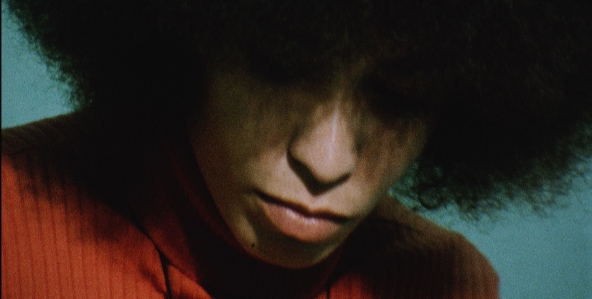
 From 1967 to 1975, a group of more than two dozen Swedish journalists came to America to document the civil rights movement. More than thirty years later, director and cinematographer Göran Hugo Olsson discovered hours and hours of unused 16mm footage — the material was turned into a program shown only once in Sweden and seen nowhere else — and developed it into The Black Power Mixtape 1967-1975, a remarkable visual and aural collage that focuses on the Black Panthers and the Black Power movement, a critical part of American history that has been swept under the rug. Olsson and Hanna Lejonqvist have seamlessly edited together startlingly intimate footage of such seminal figures as Eldridge Cleaver, Bobby Seale, Huey P. Newton, Dr. Martin Luther King, Jr., and Stokely Carmichael, including a wonderfully personal scene in which Carmichael interviews his mother on her couch. But the star of the film is the controversial political activist Angela Davis, who allowed the journalists remarkable access, particularly in a jailhouse interview shot in color. (Most of the footage is in black and white.) Davis also adds contemporary audio commentary, sharing poignant insight about that tumultuous period, along with Abiodun Oyewole of the Last Poets, singer Erykah Badu, professor, poet, and playwright Sonia Sanchez, Roots drummer Ahmir Questlove Thompson (who also composed the film’s score with Om’Mas Keith), and rapper Talib Kweli, who discusses specific scenes in the film with a thoughtful grace and intelligence. The Black Power Mixtape 1967-1975 is an extraordinary look back at a crucial moment in time that has long been misunderstood, if not completely forgotten. The Black Power Mixtape 1967-1975 is screening on February 3 as part of the Bronx Museum of the Arts’ free First Fridays program honoring Black History Month and will be followed by a Q&A with coproducer Joslyn Barnes. There will also be performances by GIF, Latasha N. Nevada Diggs, Mahogany L. Browne, and M.C. K~Swift, and the galleries will remain open until 10:00, giving visitors plenty of time to check out the exhibition “Urban Archives: Emilio Sanchez in the Bronx” and the Acconci Studio long-term installation “Lobby-for-the-Time-Being.”
 Experimental filmmaker Bill Morrison’s production company is called Hypnotic Pictures, and for good reason; the Chicago-born, New York-based auteur makes mesmerizing, visually arresting works using archival found footage and eclectic soundtracks that are a treat for the eyes and ears. In conjunction with the upcoming theatrical release of his 2011 film