
Spa Castle features an outdoor deck with numerous pools to relax in
131-10 11th Ave., College Point, Queens
Monday – Friday, $35; Saturday – Sunday, $45
718-939-6300
www.nyspacastle.com
You’ve heard the rumors about an amazing Korean spa in Queens, and we’re here to tell you that they’re absolutely true. Spa Castle, previously known as InSpa, is a treat for all five senses. The massive 100,000-square-foot complex in College Point features five floors of heated baths, pools, waterfalls, saunas, food and drink, massage, a sleep area, and more. Upon entering the facility, men and women are separated, given shorts and a T-shirt (don’t forget to bring your own bathing suit to wear underneath), and begin their journey stark naked in Healing Rooms (one for women, one for men) filled with multiple pools of water of varying temperatures, from cool to more than a hundred degrees. Men can also take a seat and give themselves a shave. After that, you head upstairs and proceed at your own pace, stopping off in an outdoor bade pool, holding on as powerful aqua jets shoot against your back and shoulders, letting a powerful surge of water fall down from above on your head and body, relaxing in a soothing Hinoki bath made from three-hundred-year-old pine, getting a foot or full-body massage (for an additional fee), or taking a nap in a dark room with comfortable lounge chairs (and, for some reason, individual televisions, which are not extremely helpful if you’re trying to sleep and the person next to you is watching some stupid program).

Healing saunas range from boiling hot to freezing cold at Spa Castle
The second floor is sauna heaven: seven saunas of varying sizes and styles. Each of the saunas is lined with different rocks, minerals, and other materials — from gold, jade, and salt to natural herbs, infrared, and ice — with unique properties that help promote the mind-body connection in different ways, working on circulation, breathing, blood pressure, the immune system, digestion, muscle fatigue, and other physical and psychological life energies. Even light and color come into play as healing methods. After that, you can grab a cocktail in the Aqua Bar or sit down for a fine Korean meal in the Sky Restaurant while looking down on people in the outdoor pool section or gazing upon the Whitestone Bridge in the distance. We actually prefer going in the wintertime, letting the freezing-cold air stab at your body as you move from pool to pool on the outdoor deck, making your ultimate immersion that much more satisfying. It’s best to go by car; otherwise, you have to meet up in a parking lot in Queens, where a too-small shuttle can only take so many people at a time, and it’s a free-for-all, with no line, just everyone pushing one another out of the way to get in first. Returning is a similar experience as well. It’s also much more crowded on weekends and holidays, when children are running around everywhere, so plan accordingly. The basics are a mere $35 Monday through Friday, with food, drink, the workout room, and massage extra. You pay via a plastic band you wear on your wrist, which also operates the aqua jets (at no extra charge). You really will feel like a king or queen at Spa Castle, a glorious way to spend a day and feel like you’re a million miles away from the maelstrom of the big city.

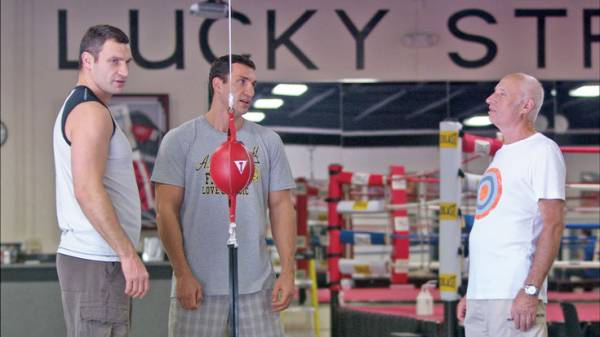
 When brothers Vitali and Wladimir Klitschko first entered the boxing arena in the 1990s, they were each like Ivan Drago in Rocky IV, seemingly unbeatable Russian machines. But both of them ended up facing tremendous adversity and rising up again, as depicted in the surprisingly intimate German documentary Klitschko. Director Sebastian Dehnhardt was given unlimited access to the brothers, their parents, Vitali’s wife, and other members of Team Klitschko, revealing the two skyscrapers to be much more than just a couple of great fighters. Both Vitali and his younger brother, Wladimir, are shown to be intelligent, well-spoken men (each with PhDs) who had one goal when they left kickboxing for professional boxing — to be heavyweight champions of the world. On their remarkable journey, Dehnhardt captures them training together, carefully watching each other’s performances in the ring, and playing chess. At one point Wladimir bans Vitali from his training camp, evoking the separation between “Irish” Micky Ward and his brother, Dicky Eklund, as seen in David O. Russell’s Oscar-nominated The Fighter, but the Klitschkos handle it very differently. The film features plenty of original fight footage in which Dehnhardt zooms in and slows things down to get breathtaking action shots from such contests as Vitali’s epic battle with Lennox Lewis, in which Klitschko got a horrifically deep gash over his left eye; Wladimir’s dizzying loss to Lamon Brewster; and both brothers taking on Corrie Sanders and Samuel Peter. Sharing their thoughts on the Klitschkos are longtime manager Bernd Bonte, Wladimir’s trainer Emanuel Steward, Vilati’s coach Fritz Sdunek, former champions Lewis, Brewster, and Chris Byrd, and boxing announcer Larry Merchant, none of whom have anything bad to say about the brothers, who come off as calm, thoughtful souls who love their mother dearly and rarely get riled up outside the ring. The film is disjointed, with an often hard-to-follow time line, and background information seems haphazard at best, but Klitschko is still a knockout of a film. Klitschko is screening February 19 at 4:00 as part of the Museum of the Moving Image’s “Fist and Sword” series, which continues March 13 with Patrick Alessandrin’s District 13: Ultimatum.

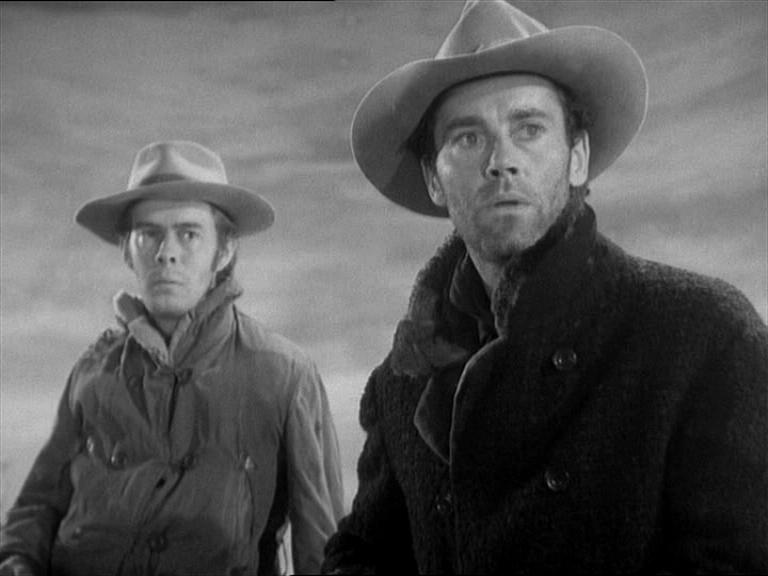
 In 1885 Nevada, members of a small town hear that one of their own has been murdered and his cattle stolen. Led by Major Tetley (Frank Conroy), his son, Gerald (William Eythe), and Jeff Farnley (Marc Lawrence), an angry posse sets out to find the killer thieves. They are joined by a pair of drifters, Gil Carter (Henry Fonda) and Art Croft (Henry/Harry Morgan), who don’t like what they’re seeing. The posse soon comes upon the trio of Donald Martin (Dana Andrews), Juan Martínez (Anthony Quinn), and Alva Hardwicke (Francis Ford), determining that they did the dirty deeds and must pay for their actions, leading to a heated debate over whether they should bring the three men in or hang them right there. Based on the 1940 novel by Walter Van Tilburg Clark, William Wellman’s harrowing classic is one of the greatest films ever made about frontier justice and mob vengeance. The scene in which the bold Martínez takes a bullet out of his body by all by himself is one of the most powerful moments you’re ever likely to see on-screen. In many ways, Fonda and Morgan play characters who are stand-ins for the audience, forcing viewers to examine what they would have done if ever put in similar circumstances. The Ox-Bow Incident is screening as part of Film Forum’s Wellman festival on February 17 at 1:00 by itself and three times on February 18 as part of a double feature with 1948’s Yellow Sky, a Western starring Gregory Peck and Richard Widmark.
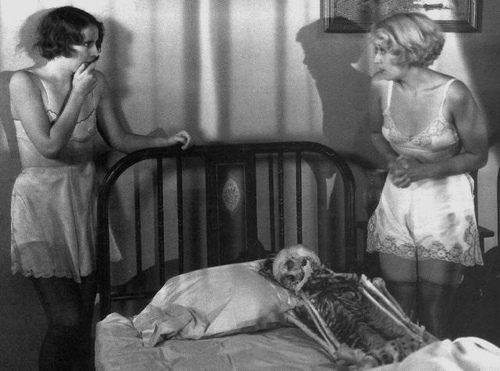
 Film Forum’s excellent William A. Wellman festival continues with one of the best examples of a pre–Hays Code film, the rarely screened 1931 doozy, Night Nurse. The first of five collaborations between Wellman and Barbara Stanwyck, Night Nurse, based on Dora Macy’s 1930 novel, stars Stanwyck as Lora Hart, a young woman determined to become a nurse. She gets a probationary job at a city hospital, where she is taken under the wing of Maloney (Joan Blondell), who likes to break the rules and torture the head nurse, the stodgy Miss Dillon (Vera Lewis). Shortly after treating a bootlegger (Ben Lyon) for a gunshot wound and agreeing not to report it to the police, Lora starts working for a shady doctor (Ralf Harolde) taking care of two sick children (Marcia Mae Jones and Betty Jane Graham) whose proudly dipsomaniac mother (Charlotte Merriam) is being manipulated by her suspicious chauffeur (Clark Gable). Wellman pulls out all the stops, hinting at or simply depicting murder, child endangerment, rape, alcoholism, lesbianism, physical brutality, and Blondell and Stanwyck regularly frolicking around in their undergarments. It’s as if Wellman is thumbing his nose directly at the Hays Code in scene after scene. Although far from his best film — Wellman directed such classics as Wings (1927), The Public Enemy (1931), A Star Is Born (1937), Nothing Sacred (1937), Beau Geste (1939), and The Ox-Bow Incident (1943) — Night Nurse is an overly melodramatic, dated, but entertaining little tale with quite a surprise ending. Night Nurse is screening at Film Forum on February 16 as part of a triple feature with 1932’s The Purchase Price, starring Stanwyck and George Brent, and 1929’s The Man I Love, Wellman’s first all-talkie.