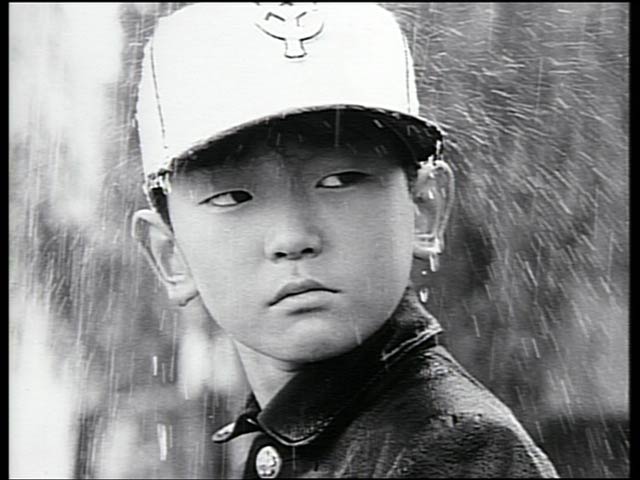
A child (Tetsuo Abe) seeks a better way of life in postwar Japan in Nagisa Oshima’s Boy
BOY (SHONEN) (Nagisa Oshima, 1969)
Anthology Film Archives
32 Second Ave. at Second St.
July 8, 6:00; July 13, 9:15; July 20, 7:00
Festival runs July 7-23
212-505-5181 anthologyfilmarchives.org
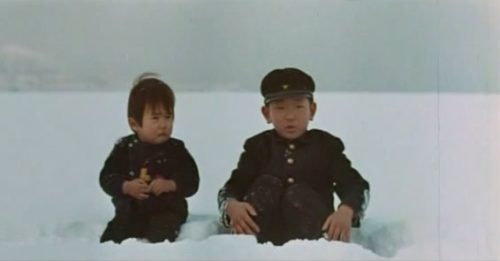
Controversial outlaw filmmaker Nagisa Oshima takes a unique, poignant look at the continuing problems in postwar Japan in the underseen 1969 drama Boy. After a major search for an actor to play the nameless title character, Oshima found Tetsuo Abe in an orphanage, and the young boy delivered one of the most memorable performances ever by a child. Inspired by actual events, the film follows wounded war veteran Takeo Omura (Fumio Watanabe), his second, common-law wife, Takeko Taniguchi (Akiko Koyama), their baby (Tsuyoshi Kinoshita), and Omura’s son from his previous marriage, played by Abe and referred to only as “kiddo.” The family travels across Japan, surviving by means of a classic con: First the stepmother, then the boy pretend to be hit by cars so they can extort money from the drivers. Meanwhile, the boy creates an alternate fantasy life that he shares with his baby brother, involving aliens and monsters, the only time he gets to be like a real kid. Otherwise, he is often by himself, never going to school, wandering lonely through the snow or walking down an empty path on one side of the screen as children play boisterously on the other side. As the authorities close in on the family, tragedy awaits.
Nameless brothers (Tsuyoshi Kinoshita and Tetsuo Abe) experience troublesome circumstances in Boy
Best known for radical, cutting-edge films filled with violence and sexuality, including Cruel Story of Youth, In the Realm of the Senses, and Taboo — as well as Max, Mon Amour, in which Charlotte Rampling plays a diplomat’s wife who falls in love with a chimpanzee — Oshima shows a warm, gentle touch in Boy, led by a tender lead performance by Abe, who is often shown standing firmly, dressed in a uniformlike outfit, like a little soldier. Oshima and cinematographers Yasuhiro Yoshioka and Seizo Sengen bathe the film in bursts of yellow, blue, and red, setting the bright colors against an essentially black-and-white palette that turns a haunting blue and then sepia near the end, accompanied by Hikaru Hayashi’s evocative, wide-ranging score. Hovering around the tale, which serves as a parable for the many troubles families experienced after World War II and is perhaps most reminiscent of François Truffaut’s nouvelle vague standard-bearer, The 400 Blows, is the Japanese flag; the father and the baby wave a small one in their hands, the family stops underneath one when figuring out their next move, and a large one taunts them on a back wall as the father berates the stepmother in a hotel room.
Through it all, the boy remains steadfast. “I’m a cosmic messenger of justice,” he declares to his baby brother. Boy turned out to be Abe’s only film, as he returned to the orphanage after it was finished. Boy is screening July 8, 13, and 20 in an eight-film Anthology Film Archives series that runs July 7-23 and also includes Pleasures of the Flesh,Japanese Summer: Double Suicide,Diary of a Shinjuku Thief,The Man Who Left His Will on Film,The Ceremony,Death by Hanging, and Merry Christmas, Mr. Lawrence, all shown in 35mm.
Jack Serio’s adaptation of Anton Chekhov’s Uncle Vanya is set in a private Flatiron loft (photo by Emilio Madrid)
UNCLE VANYA
Private Flatiron loft
Wednesday – Monday through July 16, $58.54-$247.54
Extension: August 8 – September 3, $58.37-$275.29 ($39 lottery) vanyanyc.com
Jack Serio’s superb production of Anton Chekhov’s Uncle Vanya is the theatrical event of the summer, and the one likely to be seen by the fewest people. It’s billed as being “hyper-intimate,” and it lives up to that description in just about every way.
Tickets were released without much fanfare on May 17 and sold out almost immediately; a mere forty seats were available for each of sixteen performances at an undisclosed private loft in the Flatiron District. The day before my show, I got an email advising me of the exact address and letting me know that “seating is general admission on a mix of chairs and comfortable high-back stools.” Because there is only one bathroom inside, we were told, “Please plan accordingly and use the restroom prior to your arrival if possible.” We were also warned not to come earlier than the designated time. “Please do not arrive prior to this time, as we will not be able to admit you into the building. We also cannot allow guests to congregate outside the building prior to or after the performance. Remember, this is a residential building and we’d like to be respectful to our neighbors.”
It made it all seem wonderfully secretive, as if we were part of some kind of clandestine club. There is no signage at the building; I was fully expecting there to be a hush-hush knock before I was led to a tiny elevator that can fit only a few people at a time. We got off at the second floor — stairs are not an option, up or down — where we were met with a large sign with information about the cast and creative team, so I knew I was in the right place. (Note that although the run is sold out, rush lottery tickets are available for each performance.)
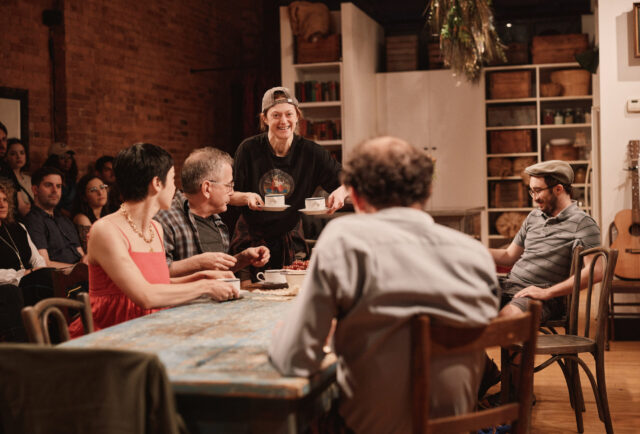
The main space is a narrow, rectangular room with two farm tables pushed together at the center. The audience sits on either side, in the first row of chairs or the second row of taller high-back stools. The night I went, more than half the seats already had names on them, so there was a bit of confusion for those whose names were not taped to a seat; several groups of two or three ended up sitting apart from one another because of the scarcity of available, unmarked chairs. (The pricing structure ranges from general admission to reserved, so if you purchased the former, be sure to get there early.) Meanwhile, songs by Bob Dylan and Neil Young played in the background.
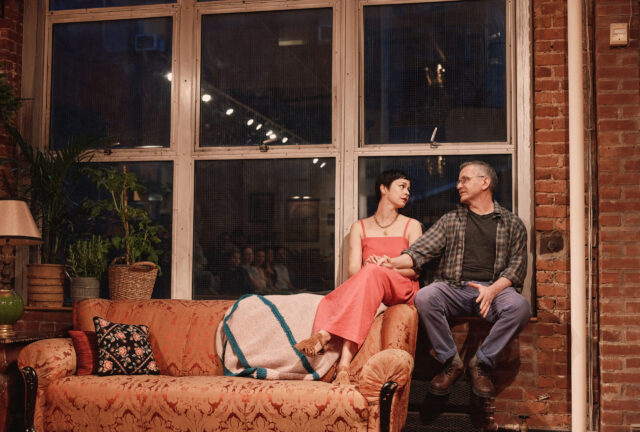
Ványa (David Cromer) can’t hide his love for Yeléna (Julia Chan) in hyper-intimate Chekhov production (photo by Emilio Madrid)
Walt Spangler’s cozy set features a working kitchen at one end and a couch beneath a window looking out at the courtyard at the other, with double metal doors leading to the fire escape, which is used as an entrance and exit throughout the show. Stacey Derosier’s lighting consists of two rows of track lights and a handful of carefully placed small stage lights, with flashlights and candles that cast mysterious glows. Carrie Mossman’s props include mirrors and old family photos on exposed brick walls and on the piano in one corner. Christopher Darbassie opts for a naturalistic sound design, which, the night I went, was enhanced by real rain and thunder. Ricky Reynoso’s costumes are contemporary but not fancy, save for Yeléna’s chic dresses, and several characters walk around in socks, slippers, or bare feet.
At an undefined time and location — although there are no cell phones — a group of friends and relatives have gathered at a country farm run by Ványa (David Cromer) and his niece, Sónya (Marin Ireland). Sónya’s father, the elderly, ailing professor Alexánder Serebriakóv (Bill Irwin), has arrived from the city with his second wife, the much younger and elegant Yeléna (Julia Chan), with plans on what to do with the estate they are tiring of. Both Ványa and Ástrov (Will Brill), a local doctor, are in love with Yeléna and not afraid to show it. Sónya, whose mother, Ványa’s sister, died many years before, is obsessed with Ástrov but too embarrassed to tell him, as she is afraid that she is too plain for him. Mrs. Voinítsky (Ann McDonough), Sónya’s grandmother, spends most of her time reading, drinking tea, and pontificating on such subjects as principles and change. Telégin (Will Dagger), known as Waffles, lives on the farm and helps out, still faithful to his wife, who left him for another man the day after they were married. And the longtime family nurse, Marína (Virginia Wing), knits and ruminates on the past.
Over the course of a few days, relationships entangle, secret loves are revealed, and one of the most famous gunshots in theater history echoes through the room.
Ástrov (Will Brill) can’t hide his love for Yeléna (Julia Chan) in Uncle Vanya (photo by Emilio Madrid)
Serio (This Beautiful Future,On Set with Theda Bara) maintains a fine line between intimate and immersive or interactive in the two-and-a-half-hour show (with intermission). Although the actors are almost always only a few feet away from the audience, they don’t make eye contact; it’s almost like a fly-on-the-wall documentary of a family falling apart, with no idea how to save itself. Cromer (The Waverly Gallery,A Raisin in the Sun) portrays Ványa as a broken man who seems to have already given up on life, essentially sleepwalking through the days, resigned to never be content. “Oh, God, my mind’s a mess,” he wails.
Brill (A Case for the Existence of God,Oklahoma!) imbues Ástrov with an innate selfishness that is the yin to Ványa’s yang. In this space, Ástrov’s environmentalism is even more prophetic than usual. “We were born with the ability to reason and the power to create and be fruitful, but until now all we’ve done is destroy whatever we see,” he says, talking about more than just trees, an ever-present pencil tucked behind one ear. “The forests are disappearing one by one, the rivers are polluted, wildlife is becoming extinct, the climate is changing for the worse, every day the planet gets poorer and uglier. It’s a disaster!”
You can feel the professor’s pain as Irwin (Old Hats,On Beckett) shuffles across the space, failing to recognize how his decisions impact everyone else, especially Ványa, who says of him, “A retired professor, a has-been, a moldy mackerel with a college degree. He has gout, rheumatism, migraines, his liver’s swollen with jealousy and envy.” Chan (2:22 A Ghost Story,The Great Canadian Baking Show) is alluring as Yeléna, who is well aware of her power over men. Dagger (The Antelope Party,Corsicana) offers welcome interludes as Telégin plays his acoustic guitar.
Sónya (Marin Ireland) can’t hide her love for Ástrov (Will Brill) in Jack Serio’s Uncle Vanya (photo by Emilio Madrid)
But Ireland (On the Exhale,Marie Antoinette), a New York City treasure, steals the show as Sónya, an ingénue who thinks she is ugly and undeserving of happiness. Telling Yeléna of her feelings for Ástrov, she opines, “It hurts so much! And it’s all so hopeless. It’s completely hopeless!” Ireland makes full use of the set; she sits on top of the couch and looks out the window longingly. She jumps on the kitchen island and speaks to Ástrov by tender candlelight. Wearing a baseball cap backward, she contorts her face and body in mesmerizing ways that capture the heartache in her soul. Sónya just wants to love, and be loved; she is the most human character in the play, the one most of us can identify with the closest.
The intimacy — or hyper-intimacy, if you will — allows us to understand the people who populate this farm in a deeply profound way. They exist in a world that is passing them by, stirring our compassion and inspiring us to wish to avoid the same fate.
[Ed. note: The play is being brought back August 8 – September 3 for an encore run, with a few cast changes: Thomas Jay Ryan (Dance Nation,Eureka Day) is taking over as Serebriakóv, with Dario Ladani Sanchez (Juliet & Romeo,a wake for david’s fucked-up face) as Yefim.]
[Mark Rifkin is a Brooklyn-born, Manhattan-based writer and editor; you can follow him on Substack here.]
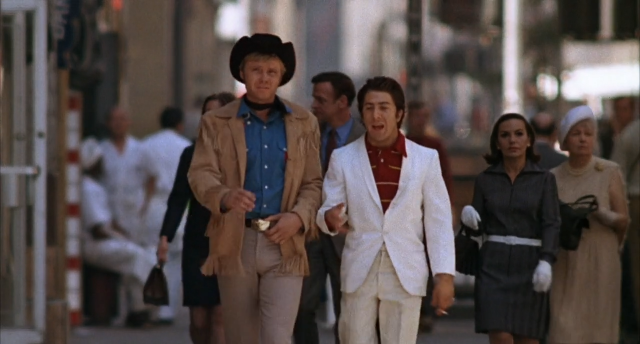
Oscar nominees Jon Voight and Dustin Hoffman try to make it in the big city in John Schlesinger’s powerful Midnight Cowboy
MIDNIGHT COWBOY (John Schlesinger, 1969) DESPERATE SOULS, DARK CITY AND THE LEGEND OF MIDNIGHT COWBOY (Nancy Biurski, 2022)
Film Forum
209 West Houston St.
Opens Friday, July 7
212-727-8110 filmforum.org
The only X-rated film to win a Best Picture Oscar, John Schlesinger’s masterful Midnight Cowboy follows the exploits of Joe Buck (Jon Voight), a friendly sort of chap who leaves his small Texas town, determined to make it as a male prostitute in Manhattan. Wearing his cowboy gear and clutching his beloved transistor radio, he trolls the streets with little success. Things take a turn when he meets up with Enrico Salvatore “Ratso” Rizzo (Dustin Hoffman), an ill, hobbled con man living in a condemned building. The two loners soon develop an unusual relationship as Buck is haunted by nightmares, shown in black-and-white, about his childhood and a tragic event that happened to him and his girlfriend, Crazy Annie (Jennifer Salt), while Rizzo dreams of a beautiful life, depicted in bright color, without sickness or limps on the beach in Miami.
Adapted by Waldo Salt (Serpico, The Day of the Locust) from the novel by James Leo Herlihy, Midnight Cowboy is essentially a string of fascinating and revealing set pieces in which Buck encounters unusual characters as he tries desperately to succeed in the big city; along the way he beds an older, wealthy Park Ave. matron (Sylvia Miles), is asked to get down on his knees by a Bible thumper (John McGiver), gets propositioned in a movie theater by a nerdy college student (Bob Balaban), has a disagreement with a confused older man (Barnard Hughes), and attends a Warholian party (thrown by Viva and Gastone Rosilli and featuring Ultra Violet, Paul Jabara, International Velvet, Taylor Mead, and Paul Morrissey) where he hooks up with an adventurous socialite (Brenda Vaccaro).
Photographed by first-time cinematographer Adam Holender (The Panic in Needle Park, Blue in the Face), the film captures the seedy, lurid environment that was Times Square in the late 1960s; when Buck looks out his hotel window, he sees the flashing neon, with a sign for Mutual of New York front and center, the letters “MONY” bouncing across his face with promise. The film is anchored by Harry Nilsson’s Grammy-winning version of “Everybody’s Talkin’,” along with John Barry’s memorable theme. Iconic shots are littered throughout, along with such classic lines as “I’m walkin’ here!”
Midnight Cowboy, which was nominated for seven Oscars and won three (Best Picture, Best Adapted Screenplay, and Best Director), is screening at Film Forum in conjunction with the theatrical release of Nancy Buirski’s Desperate Souls, Dark City and the Legend of Midnight Cowboy, which is not a typical making-of documentary; inspired by Glenn Frankel’s 2021 book, Shooting Midnight Cowboy: Art, Sex, Loneliness, Liberation, and the Making of a Dark Classic, Buirski explores the social context in which Midnight Cowboy was created and brought to the public. The film opens with Voight telling a great story about the day shooting wrapped:
“That’s the last shot. . . . John [Schlesinger], he was like this, shaking. I said, ‘John, what’s the matter?’ He said, ‘What have we done? What have we done? We’ve made a movie about a dishwasher who goes and fucks a lot of women in New York. What’ll they say? What’ll they say about this picture?’ I said, and I knew he’s having a complete meltdown, right? I didn’t know what to do. I mean, I was his friend, I want to help him. I grabbed him by the shoulders and I said, ‘John,’ — I looked him in the eye — ‘we will live the rest of our artistic lives in the shadow of this great masterpiece.’ He looks up, ‘You think so?’ [Voight laughs] I said, ‘I’m absolutely certain of it.’ It was the only thing that could get him out of it. I said the most ridiculous thing I could think of but . . . turned out to be true.”
Buirski (The Loving Story,Afternoon of a Faun: Tanaquil Le Clercq) speaks with Jennifer Salt, the daughter of Waldo Salt, who played Crazy Annie; Bob Balaban, who portrayed the college student in the movie theater; Brenda Vaccaro, who plays the socialite; cultural critic Lucy Sante; Schlesinger’s nephew, author Ian Buruma; film critic James Hoberman; Charles Kaiser, author of The Gay Metropolis; photographer Michael Childers, Schlesinger’s longtime partner; and cinematographer Adam Holender, who contributes modern-day photos of New York City. Writer, director, and producer Buirski and editor Anthony Ripoli include a barrage of archival color and black-and-white footage of the Vietnam War, Times Square, the Chicago Seven, and the moon landing; clips from dozens and dozens of movies, from The Graduate,Easy Rider,The Sound of Music,Flaming Creatures,The Boys in the Band,Taxi Driver, and numerous Westerns and Andy Warhol works to such other Schlesinger films as A Kind of Loving,Billy Liar,Darling, and Sunday Bloody Sunday. There are also snippets of older interviews with Waldo Salt, James Leo Herlihy, and Dustin Hoffman; Voight’s original screen test with Salt; and home movies of Schlesinger, who died in 2003 at the age of seventy-seven.
Desperate Souls focuses on the changing postwar class system; homoeroticism, particularly as it relates to the macho image of cowboys, from John Wayne to the Marlboro Man; and the transformation of pop culture in the 1970s, with a soundtrack that includes songs by Don McLean, the Guess Who, Gerry & the Pacemakers, and Janis Ian. There’s a significant amount of information overload about the era and Midnight Cowboy’s legacy instead of more behind-the-scenes details, but you can find out more when Buirski and Holender take part in a Q&A following the 6:00 screening on July 7 at Film Forum.
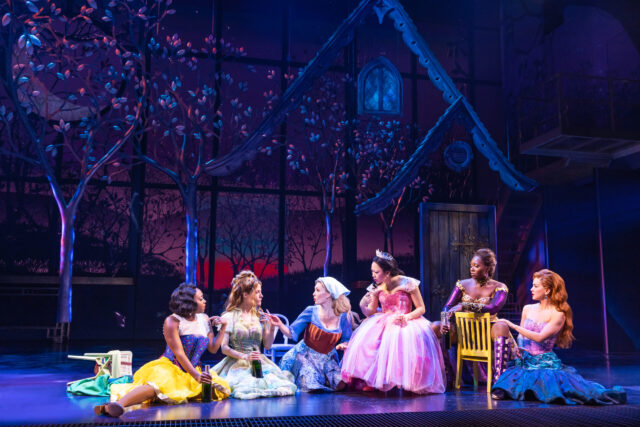
Six fairy-tale characters reimagine their future in Once Upon a One More Time (photo by Matthew Murphy)
ONCE UPON A ONE MORE TIME
Marquis Theatre
210 West Forty-Sixth St. between Seventh & Eighth Aves.
Tuesday – Saturday through September 3, $59.75-$319.50 onemoretimemusical.com
In May, I wrote about a pair of jukebox musicals, the extremely disappointing A Beautiful Noise: The Neil Diamond Musical, which unsurprisingly received no Tony nominations, and the absolutely delightful & Juliet, which earned nine nods but unfortunately took home none. The former was a disjointed look at the life and career of the Brooklyn-born megastar, while the latter was a clever follow-up to Shakespeare’s Romeo and Juliet in which his wife, Anne Hathaway, decides to pen a sequel in which Juliet survives and, leaving behind the dead Romeo, heads to Paris to start a new life, set to existing tunes written or cowritten by Swedish producer Max Martin for the Backstreet Boys, Robyn, Demi Lovato, Bon Jovi, Katy Perry, *NSYNC, Justin Timberlake, Britney Spears, and others.
Last week I encountered a similar situation when I saw two new musicals, one an unsatisfying biographical chronicle, the other a surprisingly clever reimagining of a fairy-tale world using nothing but songs by Spears, the Princess of Pop, who has sold nearly 150 million records but has won more Golden Raspberries (3) than Grammys (1).
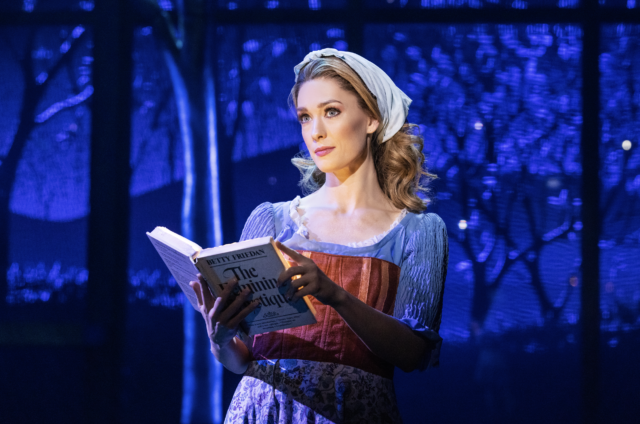
At the Marquis Theatre, Once Upon a One More Time is a load of fun despite a fairly ludicrous setup: After generations of following the rules enforced by the Narrator (Adam Godley), who makes sure to keep every female character in her place from story to story, Cinderella (Briga Heelan), Snow White (Aisha Jackson), Rapunzel (Gabrielle Beckford), Sleeping Beauty (Ashley Chiu), Princess Pea (Morgan Whitley), and Little Mermaid (Lauren Zakrin) start to realize there might be something else out there for them after the O.F.G. — the Original Fairy Godmother (Brooke Dillman) — gives Cin a copy of Betty Friedan’s 1963 game-changer, The Feminine Mystique, which helped usher in second-wave feminism. And they explore their situations through such Spears hits as “Lucky,” “Toxic,” “Womanizer,” “Oops! . . . I Did It Again,” and “. . . Baby One More Time.”
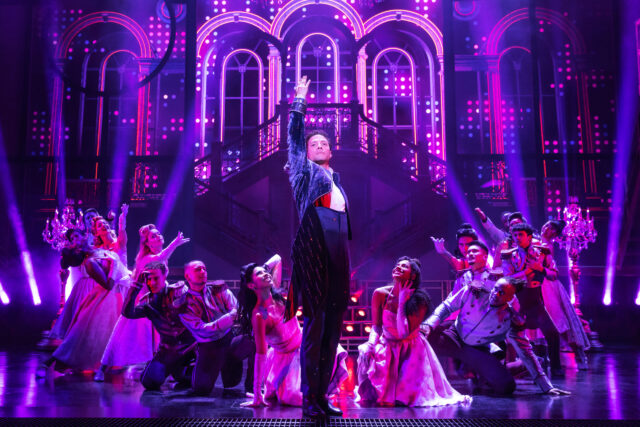
Prince Charming (Justin Guarini) turns out to be quite the dog in Britney Spears musical (photo by Matthew Murphy)
Cinderella is the first to consider that she might have a choice in her future, which upsets the Narrator. “Yes. Listen, I’ve been doing this a long time. And believe me, if I change so much as an intonation, the children go full Rumpelstiltskin,” he tells her. “They want things the same, every time. The narrative is very clear. We’re not here to make fairy tales, we’re here to follow them. Don’t overthink it. Oh, and don’t furrow your brow! We want you delivering lines, not wearing them. There. Better. Happy ever after.”
When Snow notices that Cin appears to be a bit off, she says, “Hey, you seem ‘stuck.’ Doc gives me pills for when I get like that.” Cinderella turns her down, then points out that Snow White’s latest needlepoint, “Happy ever after,” is filled with typos. Snow replies, “Huh. I guess neither of us knows what happy ever after’s supposed to look like. . . . All right, I gotta go get chased through the woods by a terrifying man in pitch blackness.”
When Cin discovers that her Prince Charming (Justin Guarini) is also Snow’s Faithful, the misogyny that is baked into traditional fairy tales rises to the surface and begins to turn things upside down and inside out. Not only do the young women — including Belle (Liv Battista), Goldilocks (Amy Hillner Larsen), and Red (Justice Moore) — start reevaluating the state of their being, but Prince Erudite (Ryan Steele) and Clumsy (Nathan Levy) wonder if they can explore their potential relationship as well. Meanwhile, Cinderella’s Stepmother (Jennifer Simard) and her two stepsisters, Belinda (Ryann Redmond) and Betany (Tess Soltau), lie in wait, willing to play by the rules in order to land Prince Charming or even Prince Brawny (Joshua Daniel Johnson), Mischievous (Kevin Trinio Perdido), Gregarious (Mikey Ruiz), Suave (Josh Tolle), or Affable (Stephen Scott Wormley).
Cinderella (Briga Heelan) discovers a whole new world in a book by Betty Friedan (photo by Matthew Murphy)
If you took Six,& Juliet,Into the Woods,Head Over Heels,Wicked, and Bad Cinderella and put them into a blender, you would come up with something like Once Upon a One More Time. Not all of it works; at two and a half hours with intermission, it is repetitive, and the last fifteen minutes or so should be chopped off, as it basically explains to us what we’ve already seen. The whole Betty Friedan element is still puzzling to me — I understand why they chose that book, but the whole idea of making it a key part of the plot and (sort of) getting away with it is mind-boggling to me — as are the Narrator’s threats to send rule breakers to a place called Story’s End.
Jon Hartmere’s (bare,The Upside) book is otherwise witty and clever, no doubt helped by five-time Tony nominee David Leveaux serving as creative consultant. The crack ten-piece band keeps Spears’s songs down to earth, avoiding haughty orchestrations, although several ballads threaten to go over the top. In their first Broadway show, directors and choreographers Keone and Mari Madrid (Beyond Babel,The Karate Kid) cut loose with ecstatic Spears-inspired dance numbers performed by an exuberant cast.
Anna Fleischle’s appealing set features trees and the facades of houses raised and lowered, an elegant staircase, a multilevel platform laden with stage lighting, a balcony, windowlike screens in the back, and a giant quill in a bubble hanging from the ceiling, daring anyone to grab it and rewrite the fairy tales. Sven Ortel’s projections range from the night sky to scary woods to magic castles, with fanciful lighting and plenty of glowing spots by Kenneth Posner and raucous sound by Andrew Keister.
Many of Loren Elstein’s costumes are based on outfits Spears wore in videos and concerts, with wigs by Nikiya Mathis that further our immersion into all things Britney, as if each fairy-tale character represents a separate part of her history. In her Broadway debut, Heelan is absolutely delightful as Cinderella, a stand-in for anyone ready to burst out with their own story. Jackson (Paradise Square,Waitress) is lovely as Cin’s best friend, Guarini (American Idiot,Wicked) has a field day as the self-absorbed, selfish prince who gets to belt out “Oops! . . . I Did It Again,” and two-time Tony nominee Godley (The Lehman Trilogy,Anything Goes) is just right as the Narrator, who is terrified of change. But two-time Tony nominee Simard (Company,Mean Girls), as she so often does, steals the show as the evil stepmother who always has a plan up her corset.
Once Upon a One More Time bites off more than it can chew, but it’s no poison apple it’s nibbling on but is instead shiny, fresh, and crisp, even if it’s occasionally sour.
While the show is not about Spears’s controversial life — it arrives on Broadway less than two years after Spears was freed from her father’s conservatorship — there are fairy-tale aspects to her early career, followed by bittersweet personal and professional entanglements that titillated the public and impacted her reputation. Once Upon a One More Time helps reestablish that original image.
When my mother was a teenager in the mid-1950s, she would sneak out of her apartment and catch rock and roll shows at the Brooklyn Paramount, seeing all the greats, the originators of the art form. I grew up with that music, treasuring two small boxes of 45s that contained many of the best singles ever recorded, by Little Richard, Chuck Berry, Jerry Lee Lewis, the Moonglows, the Coasters, the Platters, the Drifters, and others.
All of those artists and more are featured in Rock & Roll Man, a new musical about legendary DJ Alan Freed (Constantine Maroulis) that is making its New York premiere at New World Stages. It opens at the Paramount with Freed’s 1958 Holiday Rock and Roll Extravaganza, kicking off with my favorite song from that era, “Sh-Boom” by the Bronx-based Chords: “Life could be a dream / If I could take you up in paradise up above / If you would tell me I’m the only one that you love / Life could be a dream, sweetheart.” Unfortunately, after a promising beginning, the rest of the show proves not to be a dream of paradise.
The goofy premise is that on the last night of his life, January 20, 1965, amid Beatlemania and the Vietnam War, the Pennsylvania-born Freed is dreaming that he is being tried in an imaginary Court of Public Opinion by Judge Mental (Eric B. Turner) in the trial of The World versus Alan Freed; with the help of his lawyer, Little Richard (Rodrick Covington), Freed must defend his legacy against relentless prosecutor J. Edgar Hoover (Bob Ari), who has charged him with “the destruction of the American way of life by inventing the genre of music which you named rock and roll,” claiming that Freed is a “fraud . . . a modern day snake oil salesman who concocted this foul form of music solely for the purpose of self-promotion and illicit profit . . . then foisted it on our unsuspecting youth, manipulating them into a world of juvenile delinquency, alcohol, narcotics, and . . . SEX!!!!!”
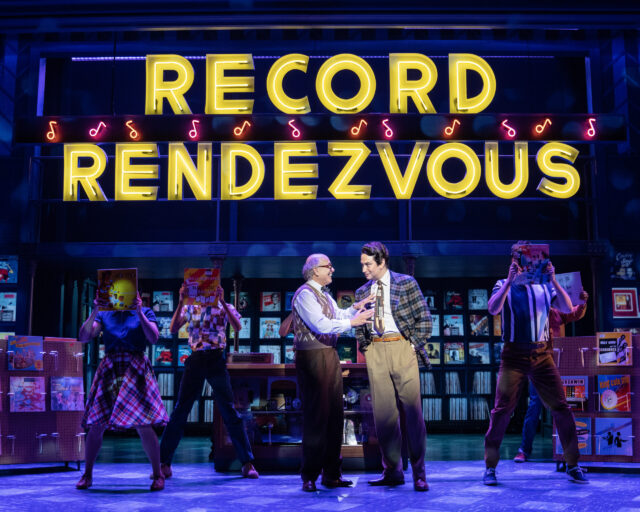
Through flashbacks, Freed returns to Cleveland, where he got his start in radio, teaming up with Record Rendezvous owner and station advertiser Leo Mintz (Joe Pantoliano) to bring rock and roll to the younger generation. Freed immediately draws an integrated audience, with Black and white teenagers listening to his Moondog Show, hanging out at the record store, and going to concerts hosted by Freed and featuring such acts as LaVern Baker (Valisia LeKae).
Freed hits the big time when he moves to New York City and WINS, teaming up with Roulette Records owner and Birdland cofounder Morris Levy (Pantoliano), who allegedly associated with the Mafia. When a district attorney asks him, “Is it true you associate with known mobsters like Vinnie the Chin Gigante and other members of the Gambino crime family?,” he replies, “Look, I grew up in New York City. I know a lot of different people, including a few of the gentlemen you just mentioned. I also know Cardinal Spellman. That don’t make me a Catholic. And by the way, the cardinal loves me. He’s a real mensch.”
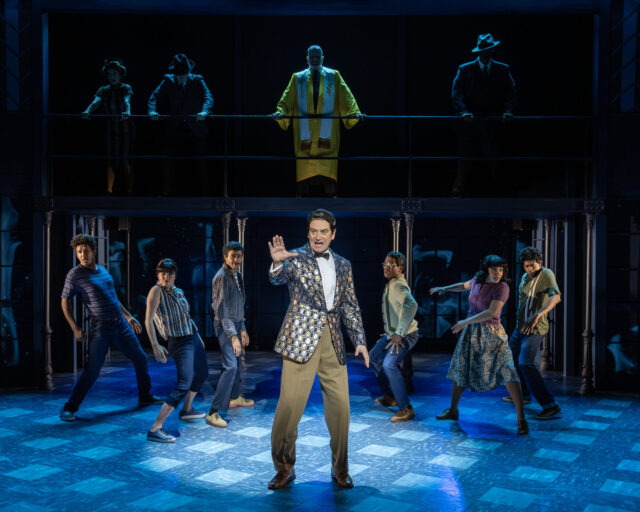
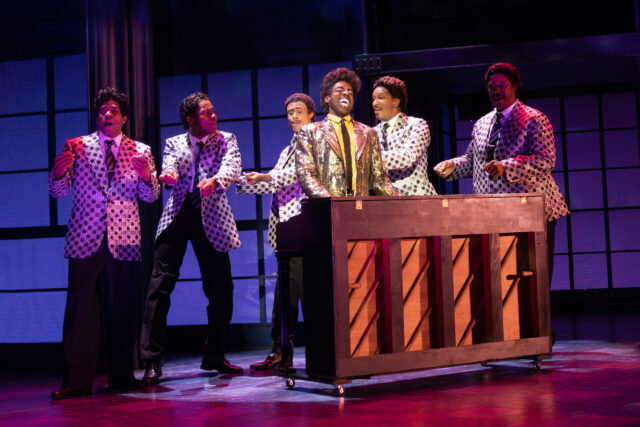
Freed and Levy present Little Richard, Frankie Lymon (Jamonté) and the Teenagers, Buddy Holly (Andy Christopher), Chuck Berry (Matthew S. Morgan), Jerry Lee Lewis (Dominique Scott), Bo Diddley (Eric B. Turner), and other breakthrough favorites, fighting off the trend of Caucasian crooners like Pat Boone (Christopher) “sucking the soul [right out of Little Richard’s] songs . . . bleaching ’em lily white,” with the original artists not seeing a penny in royalties when they’re played on the radio or on TV. Introducing Boone’s hot new song “Ain’t That a Shame” — first recorded by Fats Domino, who wrote it with Dave Bartholomew — on American Bandstand, host Dick Clark (Scott) calls himself “one of the good guys playing good clean American rock and roll for all you good clean American teenagers.”
But white performers and producers weren’t the only ones on the take; as Freed keeps growing more successful, FBI chief Hoover comes after him, accusing him of not only corrupting children but of accepting payola, setting up a final showdown.
By including new songs alongside classic oldies, Rock & Roll Man sets itself up with a major problem: Gary Kupper’s (Freckleface Strawberry,Consumer Behavior) original music and lyrics are vastly overshadowed by “Sixty Minute Man,” “Rocket 88,” “Lucille,” “See See Rider,” and “Smoke Gets in Your Eyes.” Covington and LeKae rip it up as Little Richard and LaVern Baker, respectively, with strong support from Turner as a singer in multiple groups, far outshining Morgan as Berry and Scott as Jerry Lee. The show might have benefited from a more wide-ranging book from Kupper, Larry Marshak, and Rose Caiola, adding much-needed attention to Freed’s family life; there are perfunctory appearances by his daughter Alana (Anna Hertel) and his wife Jackie (Autumn Guzzardi) — which was not the name of any of his three wives. Notably, one of the producers is Colleen Freed, who is married to Alan’s son Lance from his first marriage.
Director Randal Myler (It Ain’t Nothin’ But the Blues,Hank Williams: Lost Highway), music supervisor and arranger Dave Keyes (with Kupper), and choreographer Stephanie Klemons only lift the show out of first gear when the classic songs are performed, with Keyes on synth, George Naha on guitar, Lee Nadel on bass, Mark Ivan Gross Sr. on reeds, and Rocky Bryant on drums and percussion.
Tim Mackabee’s two-level set morphs from record store to nightclub to radio station to concert stage. Leon Dobkowski’s costumes capture the feel of the era, enhanced by Kelley Jordan’s fab wigs. The projections are by Christopher Ash, with lighting by Matthew Richards and Aja M. Jackson and sound by Ed Chapman.
Tony nominee Maroulis (Rock of Ages,Jekyll & Hyde) has a charm to him but is not given enough character depth, falling short of Tim McIntire’s more energetic portrayal of Freed in Floyd Mutrux’s 1978 film, American Hot Wax. Emmy winner Pantoliano (Great Kills,Frankie and Johnny in the Claire de Lune) seems more at home as Levy than Mintz, and he sings, too. Ari (Bells Are Ringing,Picasso at the Lapin Agile) is like a grizzly bear onstage as several villainous figures.
There’s no need to sneak out of your apartment to see Rock & Roll Man. If you need to hear “Tutti Frutti,” “Maybellene,” “Great Balls of Fire,” “Yakety Yak,” and “Why Do Fools Fall in Love” — and you do — you can always come over to my place and listen to the original pressings on my Victrola.
Liz Kingsman faces rock bottom in One Woman Show (photo by Joan Marcus)
ONE WOMAN SHOW
Greenwich House Theater
27 Barrow St. at Seventh Ave. South
Tuesday – Sunday through August 11, $67-$109 onewomanshownyc.com
“I’m mocking them for making an elaborate personal vehicle, when this is clearly an elaborate personal vehicle,” Liz Kingsman says in her hilarious and trenchant one-woman show called, well, One Woman Show.
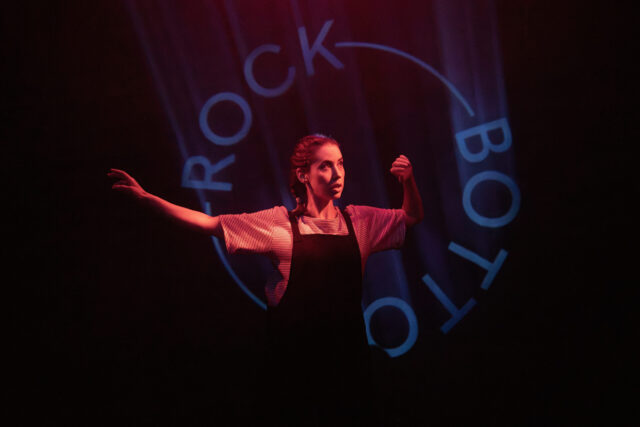
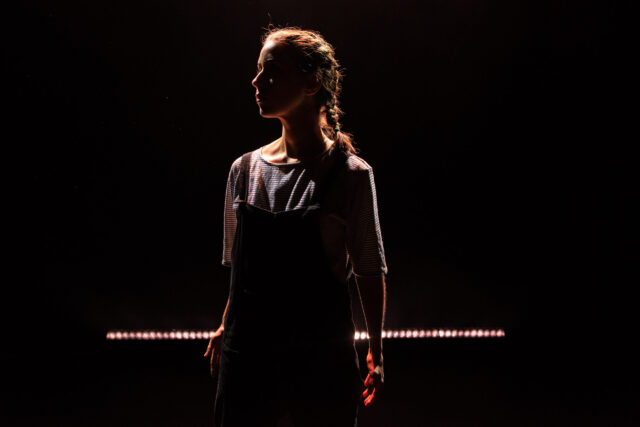
A surprise breakout hit at the Edinburgh Fringe Festival that transferred to the SoHo Theatre and then the West End, earning an Olivier nomination for Best Entertainment or Comedy Play, One Woman Show is making its US debut at Greenwich House Theater through August 11. As the play starts, Kingsman is a nervous actor speaking with her tour manager, Nick, who can be heard on the loudspeaker, about the camera placement for her performance of Wildfowl, which is being recorded live for a Hollywood producer. Kingsman is far more concerned about the filming than the audience at the theater, which she gives short shrift to. It’s an effective opening, especially because it’s actually part of the play; it quickly becomes clear that One Woman Show is about one-woman shows, most specifically Phoebe Waller-Bridge’s Fleabag, itself a riff on confessional presentations that also got its start at the Edinburgh Fringe. Kingsman’s costume even matches a striped shirt and overalls outfit worn by Waller-Bridge in the second season of Fleabag.
The fictionalized Kingsman of Wildfowl works in marketing at a wildlife conservation charity that protects birds; in one of an endless stream of clever inside jokes, birds is British slang for “young women.” A Manic Pixie Dream Girl, Liz has no filter as she discusses her fling with Jared, her intense sexual desire for an “eight-foot-nine” officemate, her relationship with her best friend from university, and her descent into drugs and alcohol, all the while fiddling around with clichés.
“You’re not a mess, you just want to be seen as one,” her Australian boss, Dana, tells her.
Liz Kingsman stands in the dark in razor-sharp parody (photo by Joan Marcus)
Along the way, Liz gets hit by a car, doesn’t know where she’s woken up, and shares vivid memories that would best be forgotten; at these moments, she announces, “I’m having a remember,” as Daniel Carter-Brennan’s lighting signals the start of a flashback. She tackles feminist tropes (“The only thing longer than my orgasm is how long it takes me to describe it to you.”), misogyny (“They still haven’t decided which woman is going to be successful this year.”), social media (“Are you happy with your life or are you happy with your likes?”), and success itself (“I guess I’m just relatable.”).
Every once in a while Nick butts in to talk about problems with the filming. “Sorry to interrupt,” he says, to which she replies, “That’s okay, I’m used to it.” She suggests that they should start all over for the producer, not caring whether the audience wants to sit through the same thing they just saw. We are just pawns in her rise to stardom.
Trying to get her life back together, she heads out to a nightclub, but it’s not exactly a fantasy evening. “You look like you’ve gone clubbing alone, which is basically the lowest a middle class woman can sink,” she admits.
As Waller-Bridge does in Fleabag, Kingsman never hesitates to paint women as real people with real dreams and desires, just like men. “We need more women’s story,” she says, with both sarcasm and truth.
Affectionately directed with tongue-in-cheek humor by Adam Brace (Just for Us,Literally Who Cares?!), One Woman Show is a fabulously funny and sharp-witted seventy minutes that are not afraid to push any envelopes out of its way. Chloe Lamford’s set features a chair at the center, a pair of self-standing cameras on either side, and random plants on the floor. Carter-Brennan’s lighting includes rows of chasing lights and square panels hanging from the ceiling onto which various images are projected. Max Perryment’s sound helps delineate between Wildfowl and One Woman Show, complete with Nick’s interruptions. The choreography, by Joshua Lay, is highlighted by Kingsman’s dancing at the nightclub.
Born in Sydney, Australia, the London-based Kingsman has appeared in such television series as Parlement,Borderline, and Power Monkeys. She didn’t plan on doing a solo show; she was writing a film script when she needed a distraction and came up with it by accident. She might not have been specifically inspired by such solo provocateurs as V (Eve Ensler), Karen Finley, and Lily Tomlin, but she is now entrenched with the current generation of women creators taking agency over their stories, from Waller-Bridge and Lena Dunham to Amy Schumer and Tig Notaro.
“There’s a guy — there’s always a guy,” Kingsman’s Wildfowl character says.
But there doesn’t always have to be, as One Woman Show so cleverly exposes.
[Mark Rifkin is a Brooklyn-born, Manhattan-based writer and editor; you can follow him on Substack here.]
Kenny Leon’s Hamlet follows his Much Ado About Nothing at the Delacorte (photo by Joan Marcus)
HAMLET
Central Park
Delacorte Theater
Tuesday – Sunday through August 6, free, 8:00 shakespeareinthepark.org
Don’t let the recent parade of Hamlets stop you from seeing Kenny Leon’s incisive adaptation that opened last week at the Public’s Delacorte Theater in Central Park.
There has been a surfeit of faithful versions and unique reimaginings of William Shakespeare’s 1599–1601 tragedy in New York City since 2015, from Robert Icke’s staging at Park Ave. Armory with Alex Lawther in the title role, Yaël Farber’s variation at St. Ann’s Warehouse starring Ruth Negga, and James Ijames’s Pulitzer Prize–winning Fat Ham at the Public and on Broadway with Marcel Spears to the Public Theater Mobile Unit’s traveling show with Chukwudi Iwuji, Michael Laurence’s Hamlet in Bed at Rattlestick, and Thomas Ostermeier and Theater Schaubühne Berlin’s iteration at BAM with Lars Eidinger.
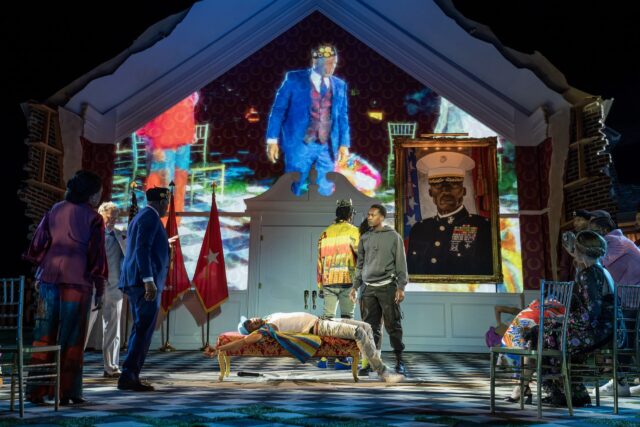
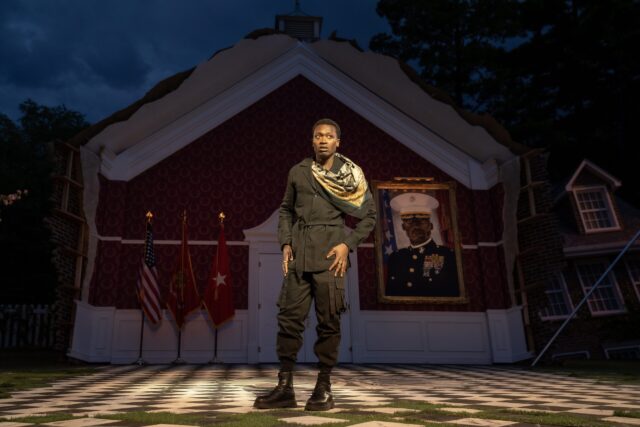
Tony winner Leon turns this Hamlet into a kind of sequel to his 2019 Delacorte triumph, a rollicking modern-day interpretation of Much Ado About Nothing that took place at a Georgia estate prominently displaying “Abrams 2020” banners, referring to two-time former Georgia gubernatorial candidate Stacey Abrams. Set designer Beowulf Boritt is back, tearing the estate in half; one part of the house is sinking into the ground, an Abrams poster sticking out at an angle, like a lonely, overturned grave marker, while a black SUV is stuck in the mud on the other side. It is as if a tornado, or a dangerous presidency, ripped through the land, leaving America in tatters, the white tiles on the grass evoking a cemetery. (The Delacorte itself will be torn down after this summer’s Hamlet and Public Works presentation of The Tempest to undergo a major renovation; it is scheduled to reopen in 2025.)
The central facade features a large portrait of a military hero in full dress uniform, looking like a dictator: the previous king’s funeral is just getting underway as a quartet performs three biblical hymns alongside a flag-draped coffin. “When you go, you’ll have to go alone / When you go, you’ll have to go alone / No one in this world / Can take your journey / When you go, you’ll have to go alone,” they sing. Leon adds in Harry Belafonte’s “Day-o,” an out-of-place tribute to the recently deceased artist and activist, but he also gives us a lovely introduction to Ophelia (Solea Pfeiffer), who offers, “You and Me (No Love Stronger).” Ophelia is given more agency than usual in this adaptation as she considers her affection for Hamlet (Ato Blankson-Wood).
Ato Blankson-Wood is impressive as the introspective Hamlet in latest Shakespeare in the Park production (photo by Joan Marcus)
“For Hamlet, and the trifling of his favor, / Hold it a fashion and a toy in blood, / A violet in the youth of primy nature, / Forward, not permanent, sweet, not lasting, / The perfume and suppliance of a minute, / No more,” Laertes (a firm Nick Rehberger) warns his sister before leaving.
Ophelias’s father and Claudius’s chief counsel, Polonius (Daniel Pearce), admonishes, “In few, Ophelia, do not believe his vows, / I would not, in plain terms, from this time forth / Have you so slander any moment leisure / As to give words or talk with the Lord Hamlet. / Look to ’t, I charge you. Come your ways.”
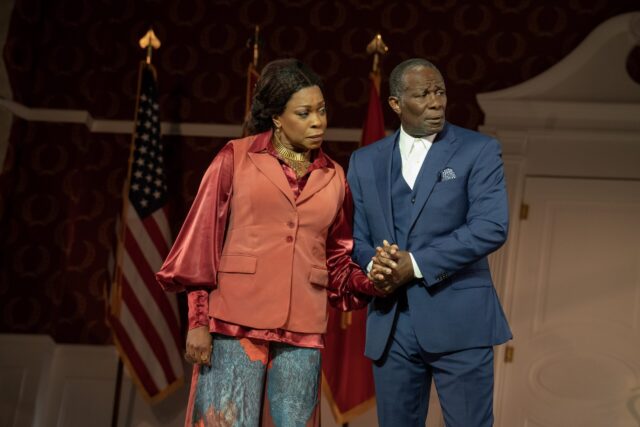
The dead king’s brother, Claudius (John Douglas Thompson), has quickly gained the throne by marrying his brother’s widow, Gertrude (Lorraine Toussaint). Deeply affected by this turn of events, Hamlet feels like he is alone. “A little more than kin and less than kind,” he whispers to the audience about his new stepfather. Blankson-Wood is brilliant as Hamlet slowly descends into madness, with Leon exploring the character’s state of mind more insightfully than I can remember ever seeing before.
Hamlet is soon visited by the ghost of his father, who appears like a distorted monster, projected onto the gable of the house, his otherworldly voice (recorded by Samuel L. Jackson) explaining to his son that Claudius murdered him; he proclaims, “Revenge his foul and most unnatural murder.” At one point Allen Lee Hughes’s lighting casts the shadow of Hamlet’s head across his father’s portrait, suggesting that he will never be able to escape from the former king’s legacy. (The lighting is by Allen Lee Hughes, with sound by Justin Ellington and projections by Jeff Sugg.)
Claudius calls for Hamlet’s old friends Rosencrantz (Mitchell Winter) and Guildenstern (Brandon Gill) to spy on him. Meanwhile, Hamlet arranges for a traveling troupe of players (Mikhail Calliste, Lauryn Hayes, LaWanda Hopkins, and Colby Lewis) to put on a show that will reveal to the king that Hamlet knows that he is a liar and a murderer. “The play’s the thing / Wherein I’ll catch the conscience of the king,” he says. The players perform a rap song, Jason Michael Webb’s “Cold World,” which features such un-Shakespearean lyrics as “Days are precious when you’re livin’ in a warzone / Tryna live, heart heavy like a diamond / City’s cold, but the streets are even colder / Gotta get out ’fore they say my time is over.” When Hamlet describes the plot, with its murder and marriage, Claudius gets up and storms off. The battle is on.
Leon (Topdog/Underdog,A Soldier’s Play) streamlines the play to a mere two hours and forty-five minutes with intermission, eliminating the subplot of the Norwegian crown prince Fortinbras, who mounts a challenge to Hamlet after Hamlet’s father slays his father. We don’t see Barnardo (Trí Lê), Horatio (Warner Miller), and Marcellus (Lance Alexander Smith) initially encounter the ghost. There is no mention of any state being “rotten,” no “to the manner born,” no “thoughts be bloody,” but none of that is missed.
Polonius is wonderfully portrayed by Pearce (Mother of the Maid,Timon of Athens) as a persnickety, bow-tied southern gentleman in a seersucker suit. Thompson, one of our greatest classical actors whether doing Shakespeare (The Merchant of Venice), Eugene O’Neill (The Iceman Cometh), or August Wilson (Jitney), is stirring as Claudius, commanding the stage with a moving vulnerability, while Toussaint (A Midsummer Night’s Dream,Stuff Happens) is a worthy cohort, finding compassion for her son even as her husband grows more combative. Greg Hildreth (Company,Moscow Moscow Moscow Moscow Moscow Moscow) nearly steals the show as the gravedigger, who uses skulls like bowling balls.
Lorraine Toussaint and John Douglas Thompson sparkle as Gertrude and Claudius in Hamlet (photo by Joan Marcus)
The staging does supply some significant problems. As opposed to Leon’s Much Ado About Nothing, which was set in modern-day Atlanta, it is not clear when and where his Hamlet unfolds, in Denmark, Georgia, or a different location. While Much Ado had an all Black and brown cast, Hamlet has several Caucasian actors. There are subtle references to what is happening in Trump-era America, the dialogue is spoken with a flowing style, and Jessica Jahn’s costumes are contemporary dress, from Claudius’s blue suit to Laertes’s dungaree jacket to Hamlet’s hoodie and Ophelia’s revealing bustier. So impressive in Much Ado, the car now seems like an excess prop. Leon might be attempting to meld past with present, but it can cause confusion, as when letters are delivered during a time when SUVs and 2020 placards are present.
Following in the footsteps of such actors as Sarah Bernhardt, Laurence Olivier, Richard Burton, Nicol Williamson, Mel Gibson, Kenneth Branagh, and Ethan Hawke — and, at the Delacorte itself, Michael Stuhlbarg in 2000, Sam Waterston in 1975, Stacy Keach in 1972, and Albert Ryder in 1964 — Blankson-Wood (Slave Play,The Total Bent) is a Hamlet for these times. His journey into madness has a method in it, a young man troubled by what he sees going on all around him, with his parents, his girlfriend, and the ruling class.
“I will be brief. Your noble son is mad. / ‘Mad’ call I it, for, to define true madness, / What is ’t but to be nothing else but mad?” Polonius says to Claudius. Blankson-Wood’s Hamlet is no skulking college student or shy mama’s boy; he is a prince trying to find his way in a complex and dangerous world, one that provides no sympathy. He delivers six of Hamlet’s seven soliloquies (“How all occasions do inform against me” has been cut) with a thoughtful, understated tenderness, not demanding attention to himself but instead to the character’s search for an unreachable inner peace.
It’s heartbreaking but, after all, Hamlet is a tragedy, no matter where or when it is set.
[Mark Rifkin is a Brooklyn-born, Manhattan-based writer and editor; you can follow him on Substack here.]
THE DEMOCRACY PROJECT
Federal Hall National Memorial
15 Pine St. at Nassau St.
Tuesday – Saturday through July 22, free federalhall.org
I had a rather telling kickoff to the long Independence Day holiday weekend.
On July 4, 1776, the Declaration of Independence was ratified by the Second Continental Congress in Philadelphia. It wasn’t until 1870 that it was made an unpaid holiday for federal employees; it became a paid federal holiday in 1938, leading to barbecues, parades, fireworks, and retail sales specials.
The preamble to the document begins, “We hold these truths to be self-evident, that all men are created equal, that they are endowed by their Creator with certain unalienable Rights, that among these are Life, Liberty and the pursuit of Happiness.” For 247 years, that’s been a nonstop roller coaster ride for many Americans.
After working half a day on Friday, I went to Federal Hall National Memorial on Pine St. to see The Democracy Project, a new site-specific play written by six award-winning writers. The forty-five-minute show was commissioned by the Federal Hall Conservancy, which brings “together the nation’s finest storytellers and scholars, writers and artists, poets, playwrights, and pundits to probe the ideas and ideals, flaws and contradictions of our democracy, a Constitutional experiment, which began at Federal Hall in 1789.”
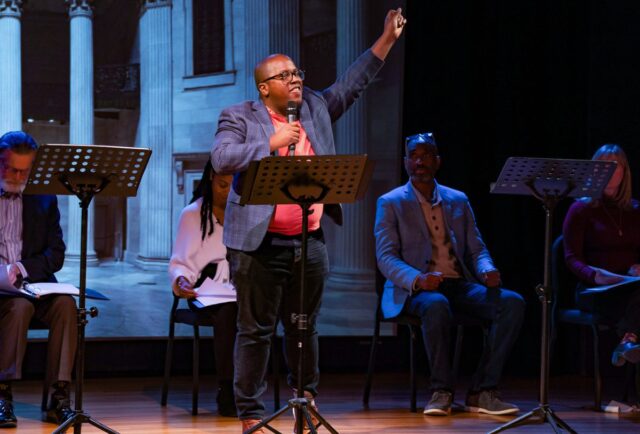
Federal Hall was America’s first capitol building, where George Washington was inaugurated as the first president on April 30, 1789. The story starts just before that, as George (Tom Nelis) debates what he will say in his speech and what he will wear when he delivers it. Also sharing their thoughts are George’s wife, Martha (Erin Anderson); future president James Madison (Anderson); Henry Knox (Anderson), the first secretary of war; Muscogee leader Alexander McGillivray (Jake Hart); Billy Lee (Nathan Hinton), George’s enslaved valet; Ona Judge (Tatiana Williams), Martha’s enslaved maid who was born into slavery at Mount Vernon; and a southern senator (Hart) who talks turkey with George. The cast also portray themselves as a troupe putting on a show about democracy in historic Federal Hall; when it is announced that one actor has just called in sick, an IT employee named Alicia (Williams) is called into action, handed a script, and told to just do her best, which is the American way. Alicia, who is Black, adds sharp commentary throughout regarding the treatment of Blacks since 1619 through to today — literally that day, June 30, 2023.
Deb O’s set includes replicas of George’s, Martha’s, and Madison’s beds, Chief McGillivray’s regalia, a velvet wingback club chair, and the pedestal on which stands the statue of George Washington outside on the steps of Federal Hall; Deb O also designed the period costumes. Among the topics that are raised are ensuring that the new country is not a monarchy like England, that there should be a separation between church and state, how Blacks should count as only three-fifths of a person, the Bill of Rights, and the notion of freedom itself. Around the circular space are various artifacts that are always on display at the historic hall, which was built as a Greek Revival–style Custom House that opened in 1842 following the demolition of the original structure in 1812 when it was no longer needed.
About halfway through the show, shortly after Billy Lee learns that he won’t be freed until George’s death and that Ona won’t gain her freedom until Martha passes — Hinton was rolling a tea cart when a large glass object fell off and shattered in the middle of the floor, shards scattered across a significant portion of the set. The audience — eighty people sitting on five rafters of four wooden benches each — held its collective breath for a moment, wondering whether this was part of the plot. It wasn’t.
One of the stage managers quickly ran to a room in the back, emerging a few minutes later with a broom and dustpan. Meanwhile, the play continued, with each actor bending down to pick up a few pieces of broken glass without pausing the narrative. At one point, it looked like Williams, as Ona, was going to be given the job of sweeping up the breakage, but fortunately that didn’t happen; I couldn’t help but think how awful that would have been, making a Black actress playing an enslaved maid and a modern-day techie clean up the mess.
However, the accident worked within the context of the play, representing the shattering of so many dreams of freedom of Black, brown, and Indigenous people in America. Later, the song “Democracy Is Messy,” by Tony and Pulitzer Prize winner Michael R. Jackson (A Strange Loop), took on an added meaning because of the incident. The show’s other writers, who collaborated on everything together, are WGA Award winner Tanya Barfield (Bright Half Life,Mrs. America), Pulitzer finalist Lisa D’Amour (Ocean Filibuster,Airline Highway), MacArthur Genius Grant recipient Larissa FastHorse (For the People,The Thanksgiving Play), Obie winner Melissa James Gibson (What Rhymes with America,House of Cards), and Tony and Pulitzer winner Bruce Norris (Clybourne Park,Downstate).
With all that talent, it’s a shame the play, directed by Tamilla Woodard (La Ruta,Men on Boats) and Tai Thompson (Dark Star from Harlem,Kleonostium) isn’t more provocative; instead, it caters too much to history aficionados and tourists, avoiding hard-hitting controversy. But it makes its points, and the cast, led by Williams (Confederates,The Legend of Georgia McBride) and Nelis (Girl from the North Country,Indecent) and also including Renata Eastlick and Joel Van Liew, is extremely friendly and likable.
Michael R. Jackson previews “Democracy Is Messy” at Works in Process at the Guggenheim in 2022 (photo by Titus Ogilvie Laing)
When I got home, I was overwhelmed by the news that the Supreme Court had voted 6–3 in favor of Lorie Smith in the case of 303 Creative LLC v. Elenis et al., in which Smith sued in order to allow her to refuse to design wedding websites for same-sex couples — even though the situation had never arisen. In his opinion of the court, Associate Justice Neil Gorsuch wrote, “Like many States, Colorado has a law forbidding businesses from engaging in discrimination when they sell goods and services to the public. Laws along these lines have done much to secure the civil rights of all Americans. But in this particular case Colorado does not just seek to ensure the sale of goods or services on equal terms. It seeks to use its law to compel an individual to create speech she does not believe.”
In her dissent, Associate Justice Sonia Sotomayor, joined by Associate Justices Elena Kagan and Ketanji Brown Jackson, argued, “Around the country, there has been a backlash to the movement for liberty and equality for gender and sexual minorities. New forms of inclusion have been met with reactionary exclusion. This is heartbreaking. Sadly, it is also familiar. When the civil rights and women’s rights movements sought equality in public life, some public establishments refused. Some even claimed, based on sincere religious beliefs, constitutional rights to discriminate. The brave Justices who once sat on this Court decisively rejected those claims.”
The day before, the court had struck down President Biden’s student debt relief plan and ruled in Students for Fair Admissions, Inc. v. President and Fellows of Harvard College in favor of “race-neutral” college admissions, effectively getting rid of affirmative action in higher education. In 1983, future justice Clarence Thomas, who had benefited himself from affirmative action, told the Equal Employment Opportunity Commission that “God only knows where I would be today” without laws that were “critical to minorities and women in this society.” In his Students for Fair Admissions concurring opinion, Thomas asserted, using the term race-neutral several times, “I write separately to offer an originalist defense of the colorblind Constitution; to clarify that all forms of discrimination based on race — including so-called affirmative action — are prohibited under the Constitution; and to emphasize the pernicious effects of all such discrimination.”
In her blistering dissent, Justice Jackson wrote, “No one benefits from ignorance. Although formal race-linked legal barriers are gone, race still matters to the lived experiences of all Americans in innumerable ways, and today’s ruling makes things worse, not better. The best that can be said of the majority’s perspective is that it proceeds (ostrich-like) from the hope that preventing consideration of race will end racism. But if that is its motivation, the majority proceeds in vain. If the colleges of this country are required to ignore a thing that matters, it will not just go away. It will take longer for racism to leave us. And, ultimately, ignoring race just makes it matter more.”
Admission is free to The Democracy Project, but it appears that reserving advance tickets through the website doesn’t matter; when I arrived with my QR code, there was no one checking it. Most of the attendees just walked in and sat down, many clearly without RSVPs. When I asked one of the stage managers what would have happened if I had shown up and there were no seats left, she replied, “You can reserve tickets online?”
EISENHOWER: THIS PIECE OF GROUND
Theatre at St. Clement’s
423 West 46th St. between Ninth & Tenth Aves.
Thursday – Monday through August 20, $55-$125 www.eisenhowertheplay.com
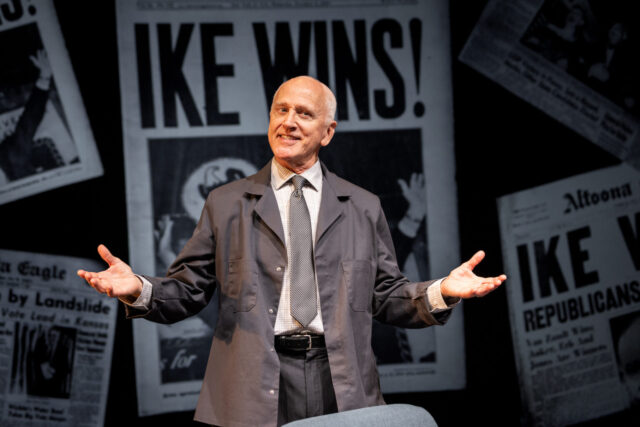
That night I headed to the Theatre at St. Clement’s to see Eisenhower: This Piece of Ground, Richard Hellesen’s new one-man bioplay in which Tony winner John Rubinstein portrays Dwight D. Eisenhower, the thirty-fourth president of the United States. The banner ads for Eisenhower and The Democracy Project are both prominently designed in red, white, and blue, with stars on them. It’s August 1962, and the seventy-one-year-old Eisenhower is at the family farm in Gettysburg working on his next memoir, about his time in the White House (1953–61). The show kickstarts with a prayer — it does take place in a church, after all — in which Eisenhower wishes, “May cooperation be the mutual aim of those who, under our Constitution, hold to differing political faiths, so that all may work for the good of our beloved country. The strength of free people lies in unity; their danger, in discord.”
Eisenhower is furious that the New York Times Magazine has just published the article “Our Presidents: A Rating by 75 Historians. Great, Near Great, Average, Below Average, and Failure,” in which Ike finished twenty-second out of thirty-one. (Some presidents were not included because of length of tenure and other reasons.) For 110 minutes (with intermission), Eisenhower provides a stark rebuttal to the claims made in the article, defending his record and the choices he made in Washington, DC. He quickly points out that when he was asked to run for the office, he was not even a member of a party. “Now, I did everything I could to stay out of politics — didn’t even choose a party. I wasn’t going to be called a Republican or a Democrat ’til I knew that one of ’em, at least, stood for things I thought were important to this country. Whatever the party, if you don’t have your foundation in causes that are right, and moral, you’re not a political party at all — you’re just a conspiracy to seize power.”
Many of his pronouncements, which are adapted from speeches, literature, and letters, are eerily relevant to what is happening in today’s America. He talks about his role in helping the civil rights movement (“Under the law, there cannot be any second-class citizens in this country. Period.”); battling Sen. Joe McCarthy’s hunt for Communists (“It wasn’t about loyalty to the country — it was about using fear to set up loyalty to Joe McCarthy.”) and the America First movement; railing against McCarthy’s “weasel assistant” Roy Cohn, who was in charge of banning books, among other things; meeting with Russian premier Nikita Khrushchev at the farm, seeking to limit nuclear weapons; trying to protect the Little Rock Nine, Black students who had to wind through a violent white mob just to go to school; discussing visiting his first concentration camp and deciding then and there to have it filmed (“So if anyone ever dared to say, oh, those stories of Nazi brutality are just propaganda, we could show ’em the truth.”); surmising that his vice president, Richard Nixon, was probably done after losing the presidency to John F. Kennedy; and attempting to pass a voting rights act that Sen. Lyndon B. Johnson ultimately gutted.
Nearly every one of those points relates directly to twenty-first-century America, as politicians and lobbyists rip up the Civil Rights Act of 1964, US governors make it illegal for certain books and subjects to be taught in schools, anti-Semitism and white nationalism are on the rise, and former president Donald J. Trump, whose heroes include Cohn, calls his haters Communists (and nastier insults), supports Russian president Vladimir Putin, promotes an America First mentality, and has praised and promised to pardon a violent mob that stormed the Capitol on January 6, 2021.
Directed by Peter Ellenstein (Assassins,Rocket to the Moon), the New Los Angeles Repertory Company production maintains a fairly even tone throughout but would benefit from a few more oomph moments; it occasionally gets confusing whenever Eisenhower, who is making an audiotape response to the Times Magazine article, looks out into the audience, as if he knows we are there even though he is actually speaking into the recording machine. In his first solo play, the seventy-six-year-old Rubinstein (Pippin,Children of a Lesser God) is confident and determined as the title character; he might not look and sound exactly like Ike, but he inhabits the role with grace and elegance.
Michael Deegan and Sarah Conly’s set is a re-creation of Eisenhower’s study at the farm, complete with five chairs, a main desk, an easel where Ike painted, and a backdrop that serves as a window to the vast expanse of the family’s land. The projections are by Joe Huppert, who adds archival footage of Eisenhower’s family, from his parents to his siblings to his own children and grandchildren, as well as other historical figures and episodes mentioned in the play.
It was impossible for me not to think about the Supreme Court, racism, anti-Semitism, ethnocentricity, classism, education, and the dismantling of the separation between church and state when Eisenhower, who died in 1969 at the age of seventy-eight, says about the segregated army, “You’d’ve had to be blind not to see how the country was going to have to change after the war, if those words ‘liberty and justice for all’ that we’d just fought for meant anything. We had to work toward a time when there would be no discrimination, of any kind. And I tried to do that, as far as I felt I could.”
Those issues go back to the start of this supposedly “more perfect Union,” when Gen. George Washington was sworn in as the first president of the United States of America, declaring from a balcony at Federal Hall in New York City, “I shall again give way to my entire confidence in your discernment and pursuit of the public good; for I assure myself that whilst you carefully avoid every alteration which might endanger the benefits of an united and effective government, or which ought to await the future lessons of experience, a reverence for the characteristic rights of freemen and a regard for the public harmony will sufficiently influence your deliberations on the question how far the former can be impregnably fortified or the latter be safely and advantageously promoted.”
John Rubinstein portrays Dwight D. Eisenhower in new play (photo by Maria Baranova)
Meanwhile, this Fourth of July, the New York government is already circulating an alert regarding the air quality on Independence Day as smoke from the Canadian wildfires descends on the state again. “It is impossible for us to predict what will happen for the holiday celebrations on Monday and Tuesday the Fourth, but, again, we’re asking people to be very, very vigilant before you plan your outdoor activities: Know what the numbers are, know the precautions you can take, because otherwise it may seriously have an effect on you.” The air quality — which many contend has nothing to do with climate change despite mounting evidence to the contrary — also might impact the fireworks themselves. Even though I live only a few blocks from where the barges will be on the East River, I might not be able to see the display at all, only smoke.
As they sing in The Democracy Project, “Democracy is messy / And everybody’s dream is not the same / So we push up the hill / And we do our best to play an unfair game.”
Democracy might be inherently messy and a Sisyphean task, but it’s in serious danger right now as we, the citizens of this republic, having been handed down the responsibilities to keep this Great American Experiment on track, keep insisting instead on ripping it apart, refusing to pick up the pieces and put it back together again. The Democracy Project was commissioned for the New Day at Federal Hall initiative celebrating America’s 250th birthday in 2026, but there’s no guarantee what the country will be like by then, who will be president and what they will stand for, and against.
Happy Fourth, everyone!
[Mark Rifkin is a Brooklyn-born, Manhattan-based writer and editor; you can follow him on Substack here.]