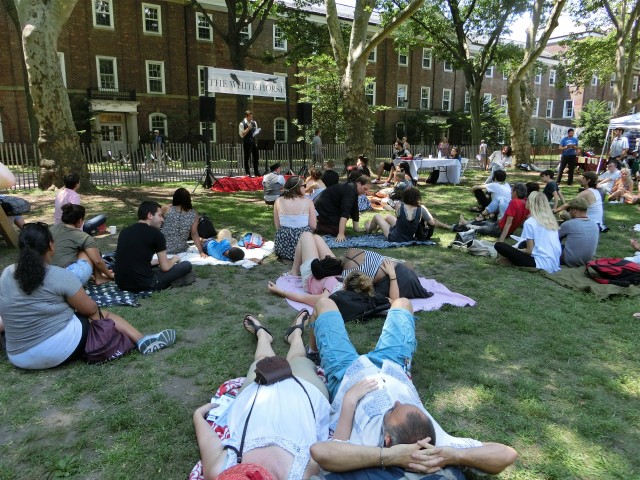
Hosted by the Poetry Society of New York, the twelfth annual New York City Poetry Festival returns to Governors Island this weekend, honoring Gotham’s literary heritage with stages named after such iconic landmarks as the Algonquin, the White Horse, and Chumley’s. Poets from dozens of publishing houses, university presses, and nonprofit organizations read their works, in addition to the Ring of Daisies open mic and other places where poetry just pops up. There should be lots of booths, with food and drink.
Walking across the big Colonels Row field, you can listen as one poem from one location morphs into one from another and then one from another in a kind of audio rainbow of words and expression. The 2023 headliners are Danez Smith, Franny Choi, Saeed Jones, and torrin a. greathouse. The festival also comes with a content warning, which reads in part: “We at the Poetry Society of New York want to acknowledge that the content of this festival may potentially cover triggering and graphic topics ranging from mental illness to imagery of painful human experiences. We have asked our readers to give content warnings before their readings. . . . We aim to create a safe space for both our readers and our attendees, so please be mindful that you may encounter themes that are uncomfortable to engage with.” The lineup should be posted here any time now.
GOLDEN JUBILEE ANNIVERSARY
City Winery New York
25 Eleventh Ave. at Fifteenth St.
Friday, July 28, and Saturday, July 29, $35-$125, 8:00
646-751-6033 citywinery.com
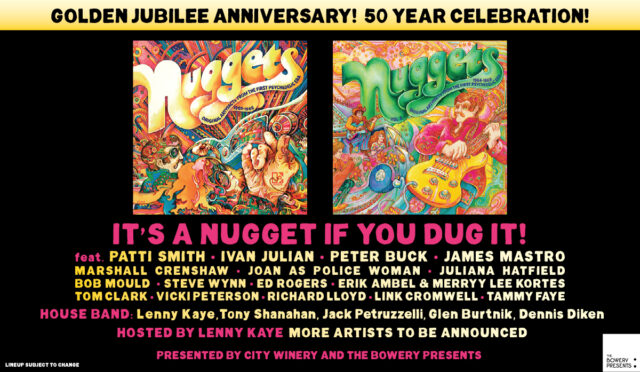
The greatest rock compilation in the history of pop music, Nuggets: Original Artyfacts from the First Psychedelic Era, 1964-1968 was released in October 1972 and led to the creation of generations of rock fans and garage bands. Assembled by Elektra Records founder Jac Holzman and record store employee and music critic Lenny Kaye, the double album consisted of seventy-eight minutes of twenty-seven gems, most under three minutes.
The collection was impeccable, beginning with the Electric Prunes’ “I Had Too Much to Dream (Last Night)” and the Standells’ “Dirty Water” and continuing with the Seeds’ “Pushin’ Too Hard,” the 13th Floor Elevators’ “You’re Gonna Miss Me,” Count Five’s “Psychotic Reaction,” the Leaves’ “Hey Joe,” the Amboy Dukes’ “Baby Please Don’t Go,” Blues Magoos’ “Tobacco Road,” and the Chocolate Watchband’s “Let’s Talk About Girls” before concluding with the Nazz’s “Open My Eyes,” the Premiers’ “Farmer John,” and the Magic Mushrooms’ “It’s-a-Happening.” I have never heard anything like it before or since.
On July 28 and 29, an all-star roster will be at City Winery performing songs from the original double album, the follow-up that was initially shelved, and “Also Dug-Its,” which have been released in a five-LP anniversary edition from Rhino. The additional tunes are from such groups as Love, the Swingin’ Medallions, the Beau Brummels, Syndicate of Sound, and ? & the Mysterians.
The outrageously cool lineup of musicians includes Patti Smith, Ivan Julian, Peter Buck, James Mastro, Marshall Crenshaw, Joan as Police Woman, Juliana Hatfield, Bob Mould, Steve Wynn, Ed Rogers, Eric Ambel, Mary Lee Kortes, Tom Clark, Vicki Peterson, Richard Lloyd, Link Cromwell, and Tammy Faye playing with the Jubilee house band: Tony Shanahan, Jack Petruzzelli, Glen Burtnik, Dennis Dike, and Kaye himself. A different set of songs will be performed each night.
“Oh Yeah” (the Shadows of Knight), there’s “No Time Like the Right Time” (the Blues Project) to “Run, Run, Run” (the Third Rail) to City Winery and show your “Respect” (the Vagrants), ’cause this ain’t just a bunch of “Talk Talk” (Music Machine); “It’s-a-Happening.”
Under the Turquoise Sky is centerpiece of 2023 Japan Cuts fest
JAPAN CUTS: FESTIVAL OF NEW JAPANESE FILM
Japan Society
333 East 47th St. at First Ave.
July 26 – August 6
212-715-1258 www.japansociety.org
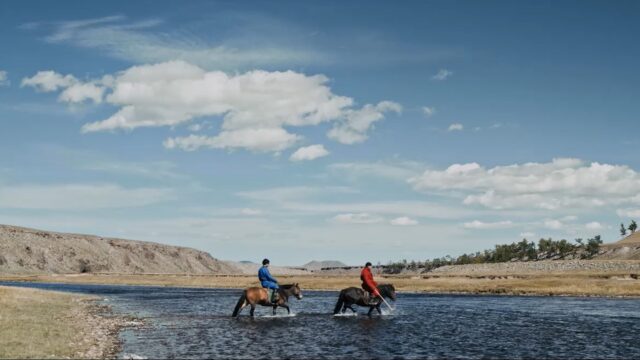
Always one of the best fests of the year, Japan Society’s Japan Cuts is back for its sixteenth iteration, consisting of two dozen features and fifteen shorts from across genres, including sci-fi/fantasy, romance, action-adventure, animation, comedy, mystery, thriller, and family drama. The Festival of New Japanese Film opens July 26 with Takehiko Inoue’s The First Slam Dunk, based on his 1990s manga about the Shohoku High School basketball team. The centerpiece is the US premiere of KENTARO’s Under the Turquoise Sky, a road movie set in Mongolia. The festival closes August 6 with the US premiere of Ryuhei Kitamura’s The Three Sisters of Tenmasou Inn, a supernatural drama set in a way station.
Japan Cuts pays tribute to the late composer Ryuichi Sakamoto with a special screening of Elizabeth Lennard’s 1985 documentary Tokyo Melody: A Film about Ryuichi Sakamoto, introduced by Akiko Yano, one of the pianist’s ex-wives, and will be followed by a Q&A with the director. The Next Generation sidebar comprises a half dozen flicks by emerging filmmakers, from actor Hiroki Kono’s debut, J005311, and Yusuke Morii’s Amiko to Ryohei Sasatani’s award-winning, 1960s-set Sanka: Nomads of the Mountain and Yuho Ishibashi’s When Morning Comes, I Feel Empty (followed by a Q&A with the director). Below is a look at several of this year’s selections, with more to be added as the festival continues.
Yuta Shimotsu’s Best Wishes to All weaves between past and present focusing on a frightening recipe for happiness
BEST WISHES TO ALL (みなに幸あれ) (MINA NI KO ARE) (Yuta Shimotsu, 2023)
Thursday, July 27, 9:00 japansociety.org
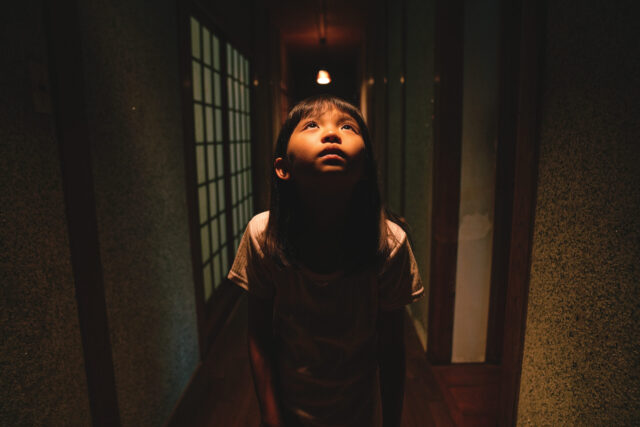
“Are you happy?” an elderly woman asks her grown granddaughter in Yuta Shimotsu’s creepy existential horror film, Best Wishes to All, making its North American premiere July 27 in Japan Society’s Japan Cuts festival. When a young Tokyo nursing student (Kotone Furukawa) returns to her grandparents’ farm in the Chikuho region, she is greeted by a surprise behind one of the doors. Or maybe it’s not really such a shocker, especially when her parents and little brother arrive and try to tell her what they claim she knew all along but refuses to face. Meanwhile, she rekindles a friendship with an old friend who is decidedly against what her family is doing.
Released earlier this year, Chie Hayakawa’s Plan 75 was a fictional, though frighteningly believable, tale about a government program in which Japanese citizens, upon reaching seventy-five years of age, could receive cash and free cremation in exchange for being euthanized in order to prevent further population growth. In Best Wishes to All, Shimotsu offers a bizarre twist on the idea of life, death, and happiness, involving — well, it wouldn’t be fair to say any more about that. But suffice to say it isn’t pretty. “I’m sorry that young people are sacrificed for old folks like me,” an old woman says to the befuddled nurse. And her grandmother scolds, “I bet you believe the world is good, right? You know nothing about the world.”
Written by Rumi Kakuta based on a story by Shimotsu, Best Wishes to All evokes such films as Takashi Miike’s The Happiness of the Katakuris and Gozu and Takashi Shimizu’s Ju-On series, the latter of which makes sense, as Shimizu is an executive producer on the film. Shimotsu and cinematographer Ryuto Iwabuchi weave between the past and the present as the secret is slowly revealed, but don’t try to think too hard about it, as it doesn’t make a whole lotta sense. Furukawa (Wheel of Fortune and Fantasy) is appealing as the nurse, and the rest of the cast ably do their part playing characters who have no names, adding to the mystery and confusion.
A trio of new friends try to save humanity in From the End of the World
FROM THE END OF THE WORLD (世界の終わりから) (SEKAI NO OWARI KARA) (Kazuaki Kiriya, 2023)
Saturday, August 5, 9:30 japansociety.org
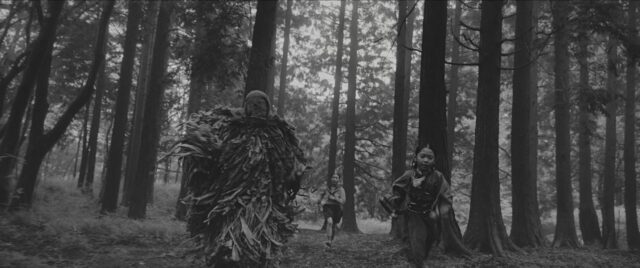
Kazuaki Kiriya’s fourth film in twenty years, From the End of the World — following 2004’s Casshern, 2009’s Goemon, and 2015’s Last Knights — is a rousing thriller, if not quite the epic it aims to be. It’s 2030, and seventeen-year-old Hana Shimon (Aoi Itô) has just lost her beloved grandmother who raised her after her parents were killed in an accident. Instead of sending her to a children’s home, Shogo Ezaki (Katsuya Maiguma) and Reiko Saeki (Aya Asahina), who may or may not be some kind of government agents, lets her stay in her home if she tells them about the dreams she’s been having. Hana often slips into terrifying black-and-white nightmares involving death and destruction, where she is joined by a young girl named Yuki (Mio Masuda) and an unidentifiable creature.
She soon finds out from an old woman with spectacular hair (Mari Natsuki) that the world will be ending in two weeks and that Hana is the only one with the power to prevent disaster. “What’s your impression of the word destiny?” the woman asks Hana. At school, Hana is befriended by Takeru (Jiei Wakabayashi), bullied by Sora (Ai Tominaga), and taught by a teacher played by director Shunji Iwai; she is also pursued by Chief Cabinet Secretary Satoshi Koreeda (Katsunori Takahashi), who has other plans for her. As the clock keeps ticking, a time capsule serves as a critical plot point as past and present merge toward an uncertain future.
Evoking elements of Stranger Things as well as both Takashi Miike (The Great Yokai War) and Hayao Miyazaki (Spirited Away,My Neighbor Totoro), From the End of the World — which Kiriya says will be his final directorial effort — looks fantastic, courtesy of cinematographer Chigi Kanbe, with gorgeous production design throughout as Hana travels through history. Itô (Missing,Gangoose) captures the fear and trepidation experienced by teenagers, whether having to turn in homework, battle a bully, or, well, save the Earth.
“Humans aren’t looking for salvation,” a hooded figure tells Hana. She might not have asked to be in this position, but does she have a choice?
Who: Adam Blackstone, Bell Biv DeVoe, Cam’ron, Coco Jones, Doug E. Fresh, Eric Bellinger, Fat Joe, Ferg, Jozzy, MAJOR., MA$E, Muni Long, Remy Ma, Ro James, Teyana Taylor, Tink, Wyclef Jean, Patra, Lumidee, Max Glazer, Mr. Killa, Nadine Sutherland, Nina Sky, Rupee, Serani, Wayne Wonder, more What: First annual Harlem Festival of Culture (HFC) Where:Randall’s Island When: July 28-30, $82-$108 per day, VIP $187-$266 per day, weekend bundle $240-$635, 3:00 – 11:00 Why: Questlove’s Oscar- and Grammy-winning 2021 Summer of Soul (. . . Or, When the Revolution Could Not Be Televised) reintroduced the world to the mostly forgotten 1969 Harlem Cultural Festival, when an extraordinary group of performers — including Stevie Wonder, Mahalia Jackson, Nina Simone, the 5th Dimension, the Staple Singers, Gladys Knight & the Pips, Mavis Staples, Blinky Williams, Sly and the Family Stone, and the Chambers Brothers — gathered at what is now Marcus Garvey Park over the course of six Sundays and played their hearts and souls out.
The inaugural Harlem Festival of Culture (HFC), taking place July 28-30 on Randall’s Island, seeks to recapture that feeling with live music, art, food, and more, hosted by MC Lyte. Friday’s lineup features Bell Biv DeVoe, Cam’ron, Doug E. Fresh, Ferg, MA$E, and Estelle Presents “The LinkUp” with Patra, Lumidee, Max Glazer, Mr. Killa, Nadine Sutherland, Nina Sky, Rupee, Serani, and Wayne Wonder. On Saturday’s roster are Jozzy, Major, Muni Long, Teyana Taylor, and Tink. Sunday’s headliner is Wyclef Jean, preceded by Adam Blackstone, Coco Jones, Eric Bellinger, Fat Joe, Remy Ma, and Ro James.
“From the Harlem Renaissance to the Harlem Cultural Festival of 1969 to the Harlem Shake, this community is known worldwide for its immeasurable contributions in fashion, sports, dance, art and music — and has always played an integral role in moving culture forward,” HFC cofounder Yvonne McNair said in a statement. “For this inaugural year, we were very thoughtful and intentional in building what is an amazing lineup that aptly reflects the incredibly unique legacy that is intrinsic to the village of Harlem as well as the breadth and brilliance of Black music and culture.”
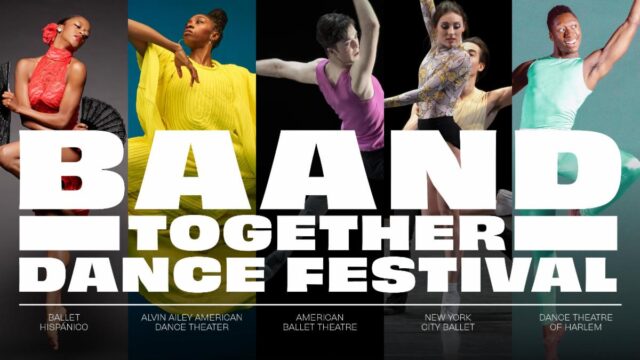
Who: Ballet Hispánico (BH), Alvin Ailey American Dance Theater (AAADT), American Ballet Theatre (ABT), New York City Ballet (NYCB), Dance Theatre of Harlem (DTH) What:Free dance festival Where: Damrosch Park, Lincoln Center for the Performing Arts When: July 25-29, free, workshops 5:00, performances 7:30 [ed note: The July 28 workshop and performance have been canceled due to extreme heat] Why: The third annual BAAND Together Dance Festival once again brings together Ballet Hispánico, Alvin Ailey American Dance Theater, American Ballet Theatre, New York City Ballet, and Dance Theatre of Harlem for five nights of free contemporary dance performances on the Damrosch Park stage as part of Lincoln Center’s Summer for the City programming.
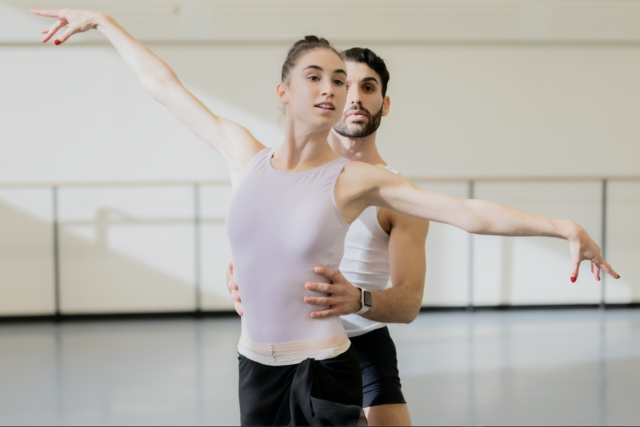
Dancers rehearse Pas de O’Farill for BAAND Festival at Lincoln Center this week (photo by Lawrence Sumulong)
From July 25 to 29 at 7:30, the troupes will present one work apiece: BH’s Línea Recta by Annabelle Lopez Ochoa (a unique take on flamenco, set to music by guitarist Eric Vaarzon Morel), ABT’s Other Dances by Jerome Robbins (choreographed for Natalia Makarova and Mikhail Baryshnikov, set to works by Frédéric Chopin), DTH’s Nyman String Quartet No. 2 by Robert Garland (a mix of styles and cultures), the world premiere of the BH/NYCB collaborative duet Pas de O’Farill by Pedro Ruiz (a tribute to Arturo O’Farill), an excerpt from AAADT’s Dancing Spirit by Ronald K. Brown (a tribute to Judith Jamison, with music by Duke Ellington, Wynton Marsalis, and War), and NYCB’s The Times Are Racing by Justin Peck (a sneaker ballet set to songs from Dan Deacon’s 2012 album, America). In addition, each show will be preceded by a workshop at 5:00 led by members of one of the five companies.
“The BAAND Together Dance Festival is a testament to the vibrancy and diversity of the New York City dance community,” the five artistic directors said in a group statement. “We are thrilled to be returning with a spectacular program that features the city’s most internationally revered repertory companies. This year’s program highlights the innovative visions that have made New York City our nation’s dance capital.”
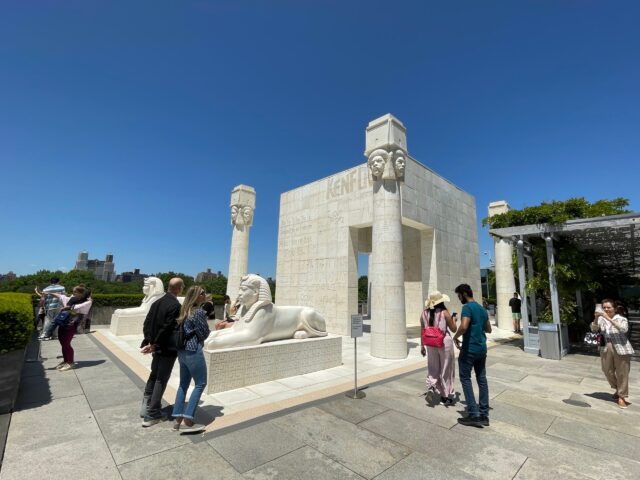
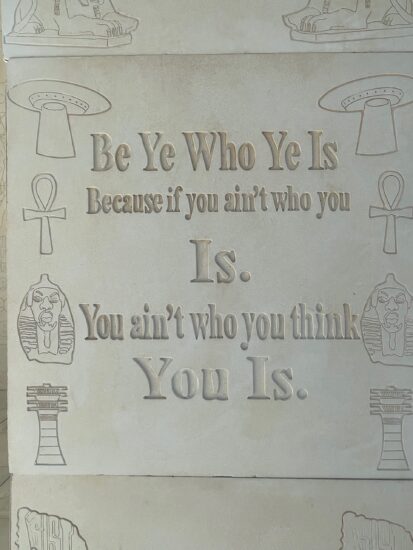
Lauren Halsey’s Met Roof Garden Commission will be activated by live performances and more this weekend (photo by twi-ny/mdr)
the eastside of south central los angeles hieroglyph prototype architecture (I)
Metropolitan Museum of Art, Met Fifth Avenue
The Iris and B. Gerald Cantor Roof Garden
1000 Fifth Ave. at 82nd St.
July 21-23, free with museum admission
Exhibit continues through October 22 (weather permitting)
Admission: $30 adults, children under twelve free (New York State residents pay-what-you-wish)
212-535-7710 www.metmuseum.org the eastside of south central slideshow
“I get to build the worlds I wish I lived in,” artist Lauren Halsey says in a promotional video about her Met Roof Garden Commission, the eastside of south central los angeles hieroglyph prototype architecture (I). “I collapse all of these worlds: street, pyramid, gorgeous nature, domestic worlds, into one composition to create new opportunities that are about uplift, that are about togetherness.” Wanting to build an Egyptian-style modern-day temple, Halsey studied works at the Met, including the Temple of Dendur, listened to PFunk, and constructed the eastside, which will be part of her community center Summereverything in South Central after the roof show is over.
This weekend Metlivearts will activate the sculpture, which features likenesses of Halsey’s loved ones and influences and carvings of local images and text she’s collected over the last fifteen years, with a series of special events, all free with museum admission and first come, first served. On Friday at 6:30 and 7:30 on the roof, California-born disabled choreographer, dancer, and sound artist Jerron Herman will perform the solo piece LAX, with an ornate costume by unsighted textile artist Sugandha Gupta, as part of Disability Pride Month. On July 22 at 6:00 and 7:15 on the roof, Moten/López/Cleaver will present a new work inspired by the eastside, with Fred Moten on vocals, Brandon López on double bass, and Gerald Cleaver on drums. And on Sunday from 11:00 to 2:00, “A Celebration — The Roof Garden Commission: Lauren Halsey” consists of interactive drop-in stations, a creative writing workshop in the Charles Engelhard Court, a Scent Lab and Architectural Art Making at the Temple of Dendur, and gallery chats on the roof and at the famed temple.
Lauren Halsey Met roof installation features carved text and imagery (photo by twi-ny/mdr)
“This work is aspirational,” Halsey continues in the video. “They’re images around community, transcendence, self-determination, and autonomy. . . . I hope when folks come to the Met and experience my piece, they walk away with a more holistic view about South Central that aren’t about the violence, they aren’t about dread, they’re very much about survival, vibrancy, love. And they also are just into me reinvisioning the hieroglyph as a form to tell stories.”
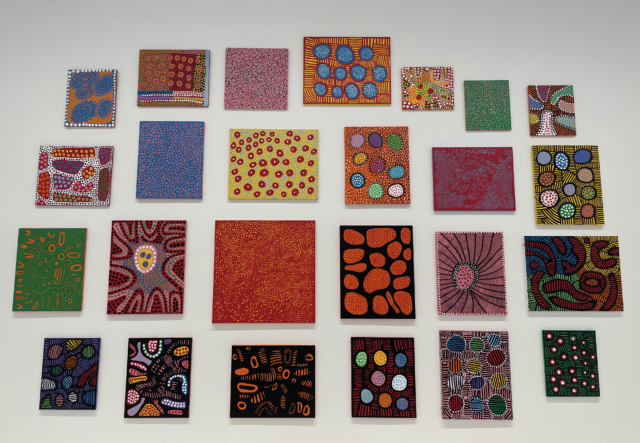
Twenty-five of Yayoi Kusama’s “Every Day I Pray for Love” paintings are part of new show at David Zwirner in Chelsea (photo by twi-ny/mdr)
YAYOI KUSAMA: I SPEND EACH DAY EMBRACING FLOWERS
David Zwirner
519, 525, 533 West Nineteenth St. between Tenth & Eleventh Aves.
Through July 21, free, 10:00 am – 6:00 pm www.davidzwirner.com online slide show
There are only two days left to see Yayoi Kusama’s latest exhibition of new works at David Zwirner, a three-part show entitled “I Spend Each Day Embracing Flowers.” Kusama is ninety-four and has been living voluntarily in the Seiwa Hospital for the Mentally Ill in Tokyo since 1977; every day she gets up and walks over to her studio across the street and works. There are long lines to get into the show on West Nineteenth St., but that is primarily for Dreaming of Earth’s Sphericity, I Would Offer My Love, a Mirror Infinity Room where groups of no more than five people can spend sixty seconds in a seemingly endless space of red, yellow, blue, and green disks; while it’s very cool, it’s not necessarily a must-see if you have to wait online for an hour or more to get inside.
There is less of a line, if any at all, to see the rest of the exhibit, a kind of organic follow-up to her wonderful “Cosmic Nature” display throughout the New York Botanical Garden in 2021. The title piece at Zwirner consists of thee large-scale, colorful, and hugely adorable stainless-steel flower sculptures, a celebration of the beauty of the natural world while also touching on the impermanence of life. In a back room, there are three dozen new acrylic and ink paintings, mostly from her “Every Day I Pray for Love” series, canvases that feature many of her favorite elements, from dots and circles to squiggly lines and abstract geometric shapes; twenty-five of the pieces hang together in a lovely display on one wall.
The highlight is Aspiring to Pumpkin’s Love, the Love in My Heart, a trio of long, undulating, somewhat flattened black and yellow bronze pumpkin sculptures winding their way through their own room. They evoke Richard Serra’s freestanding sets of weatherproof steel plates, only here bright with color and charm; I dare you to try not to smile as you follow the paths in and around the works, which reflect the light and passersby. See if you can find the two areas where Kusama used a camera obscura, resulting in upside-down images
Kusama has also delivered a special message for the show, summing up her world view: “I’ve Sung the Mind of Kusama / Day by Day, / a Song from the Heart. / O Youth of Today, / Let Us Sing Together a Song from / the Heart of the Universe!”
(To receive a digital booklet of select poems from Kusama’s 2023 collection Every Day I Pray for Love, go here.)