twi-ny recommended events

FROM PONG TO AI: CHILLING DATA AT THE LUCILLE LORTEL

Maneesh (Karan Brar) and Jonah (Brandon Flynn) take a break from work by playing ping-pong in Data (photo by T. Charles Erickson)

DATA
Lucille Lortel Theatre
121 Christopher St.
Tuesday – Sunday through March 29, $61-$126
www.datatheplay.com
lortel.org

The New York debut of Matthew Libby’s chilling Data feels like it’s been ripped from today’s headlines, but the playwright first started thinking about it in 2017, after interviewing for and not getting an internship at Palantir — one of the tech companies at the center of the current massive expansion of artificial intelligence — then reading an Intercept article about the firm’s plans, the title of which would be a major spoiler.

Data premiered in the fall of 2024 at Arena Stage in Washington, DC, directed by Margot Brodelon; director Tyne Rafaeli’s skillful adaptation opened at the Lucille Lortel on January 25 and has been extended through March 29. Karan Brar reprises his role as Maneesh Singh, a twenty-two-year-old Indian American working in the User Experience (UX) department of the fictional, highly prestigious Silicon Valley company Athena Technologies.

The play begins with Maneesh playing ping-pong in the almost blindingly white break room with fellow UX employee Jonah (Brandon Flynn), who has been assigned to be his mentor. They are not competing at championship-level table tennis but instead are hitting the ball back and forth slowly and casually, reminiscent of Pong, the 1972 Atari video game that brought digital technology into the mainstream and people’s homes. While the somewhat goofy Jonah gossips about secrecy, cutting-edge software, potential layoffs, Taco Tuesday, and an engineer in Data Analytics who left the company under mysterious circumstances, the very serious Maneesh has no interest in networking, listens to what his parents tell him to do (or not do), and, despite his obvious abilities, seems happy to stay in UX and not be promoted to Data Analytics, where the real work is being done.

When he bumps into Riley (Sophia Lillis), a college classmate now in Analytics, she is shocked that he is in UX. Next he is meeting with Alex Chen (Justin H. Min), the charming, fast-talking analytics head who used to work with Maneesh’s brother and now wants Maneesh to team up with Riley on a special project that involves signing an NDA. Maneesh is hesitant and uncomfortable, especially when Alex insists on knowing more about his breakthrough predictive algorithm, which Maneesh developed as a way to anticipate the success of baseball players and has since made it closed source, preventing access to it.

“Talk to me, bro. Cone of silence,” Alex says. Maneesh responds, “Look. As I got further and further into my thesis, and I realized what exactly it was I was creating . . . I, like, saw this conversation. Like, this exact conversation we’re having right now. Right down to the joking about baseball, because of course, the algorithm has nothing to do with baseball. The rare event model can be applied, hypothetically, to predict . . . anything, really. And so, after I presented the initial results, I started getting emails. But not from sports teams. They were from headhunters, trying to poach me, poach the project — investment firms, lobbying groups, even an oil company. And that . . . I guess I realized that scared me. I just mean — I felt it. That it’s not what I wanted.”

But it’s exactly what Alex and Athena want.

Riley (Sophia Lillis), Maneesh (Karan Brar), and Alex Chen (Justin H. Min) have different grand plans in New York City premiere (photo by T. Charles Erickson)

According to the script, the story takes place in the mid-2020s, but “it might already have happened.” The plot will make you think not only of Palantir but also about Mantic, Anthropic, OpenAI, Cambridge Analytica, and other such tech firms in the news. One of the script’s epigraphs is a quote from OpenAI CEO Sam Altman: “AI will probably most likely lead to the end of the world, but in the meantime, there’ll be great companies.” Last month, Anthropic safety researcher Mrinank Sharma quit, writing in an open letter, “The world is in peril. . . . We appear to be approaching a threshold where our wisdom must grow in equal measure to our capacity to affect the world, lest we face the consequences.”

Data marks Libby’s off-Broadway debut, and it’s an exciting one. The dialogue is keenly pointed, the characters believable, and plot twists and surprises abound in a taut hundred minutes. Only Jonah’s sexual pursuit of Riley rings false and feels forced, but otherwise Rafaeli (Weather Girl, Becoming Eve) maintains a deft touch.

Marsha Ginsberg’s set morphs from the break room to Alex’s spare, pristine office to a fascinating late shift; the whiteness recalls the streaming hit Severance, where employees are not sure what their jobs are for or what the company does while they keep their working and personal lives completely separate, one knowing nothing about the other. Scene changes are made in darkness as fluorescent lights speed around a rectangular frame accompanied by 8-bit digital music. (The lighting is by Amith Chandrashaker, with sound and music by Daniel Kluger and contemporary casual costumes by Enver Chakartash.)

Brar makes a terrific theatrical debut as Maneesh, capturing his deep unease at where his life appears to be going against his better judgment. Despite his vast tech knowledge and abilities, he represents all of us who are more concerned about the future of humanity than the success of a business, or a government. Lillis (Heroes of the Fourth Turning, A Midsummer Night’s Dream) brings a beguiling nuance to the complicated Riley, Min nails the bold, forward-thinking, eminently likable but ethically questionable tech boss, and Flynn (Kowalski, Kid Victory) lends Jonah the right balance, aside from the pervy subplot.

Libby studied cognitive science and symbolic systems at Stanford, so he knows what he’s talking about when Alex says, “It’s a geopolitical reality. Data is the language of our time. And like all languages, its narratives will be written by the victors.” But he’s also on target when Maneesh considers that AI can make “the world a worse place.”

It may have taken more than a half century to proceed from Pong to today’s video games, but so many elements of AI are moving so fast, Data could potentially be an ancient relic — like Pong — by the time it completes its run at the Lortel.

Thus, it’s better to see it now, while it’s still a legitimate cautionary tale and not a portent that the end is near, brought on by humanity itself.

[Mark Rifkin is a Brooklyn-born, Manhattan-based writer; you can follow him on Substack here.]
HIGH LINE COWBOYS AND WOMAN WARRIORS: RAVEN HALFMOON IN CONVERSATION WITH CECILIA ALEMANI

Raven Halfmoon will discuss High Line commission West Side Warrior on March 3 (photo by twi-ny/mdr)

Who: Raven Halfmoon, Cecilia Alemani
What: Artist talk about West Side Warrior
Where: Friends of the High Line Headquarters, 820 Washington St., fourth floor
When: Tuesday, March 3, free with RSVP, 12:30
Why: In a July 2023 interview with Forbes, artist Raven Halfmoon (Caddo Nation) explained, “When I was in those anthropology classes [at the University of Arkansas], not only was I learning about my own tribe and our histories, but also about the Olmec heads in Mexico and the Easter Island heads and then not only that, but the earthworks that are in America: Spiro Mounds in Oklahoma, Moundville in Alabama, Serpent Mound in Ohio. A lot of those earthworks my ancestors made, Caddo ancestors, especially in the Mississippi region, so I was always interested in large scale works and being a part of that, the idea of community being in those works.”

That description fits well with her latest piece, the High Line commission West Side Warrior, in which Halfmoon employs the ancient coiling method as she honors tradition and her heritage while exploring gender and personal experience. Located on the old railway at Little West Twelfth St., the bust, sitting on a plinth, depicts a Native American female horse rider in a cowboy hat, her left side white, her right side black; there are four vertical tattoos on her face and three stars on the back of her head, representing the Red River. In addition, the hand of the artist is present in the clay, which is not smooth. The piece refers not only to the American West, where she is from, but also to the West Side Cowboys, who protected pedestrians and carriages on Death Avenue by guiding New York Central freight trains down the street beginning in the 1850s.

(photo by twi-ny/mdr)

Raven Halfmoon’s West Side Warrior explores indigenous culture, the Old West, gender, and High Line history (photo by twi-ny/mdr)

On March 3 at 12:30, Halfmoon, who is based in her hometown of Norman, Oklahoma, will discuss West Side Warrior with High Line Art chief curator Cecilia Alemani inside the Friends of the High Line Headquarters on Washington St.; admission is free with advance RSVP. The next scheduled talk takes place March 12 at 6:30, when Saba Khan will discuss her three videos, Leaking Ocean, Water Lords, and The Dolphin, with High Line associate curator Taylor Zakarin.

[Mark Rifkin is a Brooklyn-born, Manhattan-based writer; you can follow him on Substack here.]
THE TIME IS NOW: CELEBRATING RONALD K. BROWN, WUNMI, AND TONI PIERCE-SANDS AT THE JOYCE

Ronald K. Brown/EVIDENCE returns to the Joyce for fortieth anniversary celebration

Ronald K. Brown/EVIDENCE, a Dance Company
Joyce Theater
175 Eighth Ave. at 19th St.
February 25 – March 1 (Curtain Chat February 25), $32-$82
212-645-2904
www.joyce.org
evidencedance.com

Ronald K. Brown/EVIDENCE celebrates its past while looking toward the future in its annual winter season at the Joyce, running February 25 through March 1. Because of the blizzard, opening night, February 24, has been canceled, but a 7:00 show has just been added, and great seats are available if you hurry.

The Brooklyn-based company will be presenting two exciting programs as part of its fortieth anniversary. The first honors longtime collaborator Wunmi Olaiya, a composer, costume designer, dancer, and visual artist who has been working with Brown since 1992, while the second pays tribute to TU Dance cofounding artistic director Toni Pierce-Sands, who danced with Alvin Ailey and EVIDENCE and would begin every TU Dance production with the Ulysses Dove mantra “Nothing to prove, only to share”; Pierce-Sands passed away in November at the age of sixty-three.

“Celebrating Wunmi” — born in London and raised in Lagos, she goes by one name — begins with Ebony Magazine: To a Village, a 1996 piece for Cleo Parker Robinson Dance Ensemble that EVIDENCE debuted in March 1998, featuring music and costumes by Wunmi centered around the repeated phrase “do you see what I see.” Clear as Tear Water is a 2006 solo originally choreographed for Pierce-Sands; at the Joyce, six different dancers will perform the work, which will be set to Wunmi’s “Woman Child” in Program A and Meshell Ndegeocello’s “Heaven” in Program B. Next is 1999’s Gatekeepers, a piece originally for Philadanco that delves into Native American mythology and African traditions, with music and costumes by Wunmi. Following intermission, the evening concludes with the rousing, nonstop Upside Down, an exhilarating excerpt from Brown’s 1998 Destiny, in which the company cuts loose to music by Wunmi, which she will play live with two drummers.

“With the trust Ron affords me, I dare to dream and visualize what the work he is creating is speaking on,” Wunmi explains in a Joyce interview. “Ron tells stories of human beings making their way . . . and, in there, I create costumes to make them visible. Thankful, trust is alive and well.”

Ronald K. Brown, Wunmi Olaiya, and Arcell Cabuag at the 2024 Alvin Ailey American Dance Theater gala

Planned prior to Pierce-Sanders’s death from cancer, “A Celebration of the Life and Legacy of Toni Pierce-Sands” kicks off with 2012’s Torch, a touching tribute to former Brown student and dance enthusiast Beth Young, who passed away in January 2012, followed by Clear as Tear Water. The company premiere of 2017’s Where The Light Shines Through, originally commissioned for TU at the Ordway, is choreographed by Brown and his partner, Arcell Cabuag, and set to music by Ndegeocello, Susana Baca, Ballet Folklórico Cutumba de Santiago, and Black Motion. The finale is the spectacular 1999 favorite Grace, originally choreographed for Alvin Ailey, which features twelve dancers moving, in costumes by Wunmi, to a melding of modern dance and West African idioms as only Brown and Cabuag can do, with music by Duke Ellington, Roy Davis Jr., and Fela Aníkúlápó Kuti and live vocals by Gordon Chambers; the beats will stay with you long after the show is over.

“This celebration is long overdue and I am happy the time is now,” Brown says in a program note.

The time is always now to see this extraordinary company, still going strong after forty marvelous years.

[Mark Rifkin is a Brooklyn-born, Manhattan-based writer; you can follow him on Substack here.]
UNDER YOUR SKIN: BUG ON BROADWAY

Agnes White (Carrie Coon) finds more danger inside than outside in Tracy Letts’s Bug (photo © Matthew Murphy)

BUG
Samuel J. Friedman Theatre
261 West Forty-Seventh St. between Broadway & Eighth Ave.
Tuesday – Sunday through March 8, $92-$407
www.manhattantheatreclub.com

It’s been several weeks since I saw the Broadway debut of Tracy Letts’s Bug, and I’m still feeling all itchy and out of sorts, scratching myself all over, thinking I’m being invaded by tiny killer insects.

Straight psychological horror plays don’t have a particularly impressive history on Broadway. While there have been plenty of successful spooky musicals, the same has not been true of legitimately frightening dramas. Recently, Levi Holloway’s thrilling Grey House got short shrift, closing early, and while Stranger Things: The First Shadow keeps going strong at the Marquis, it’s not pure horror, especially with its awkward Oklahoma! high school musical subplot. The last time I felt so shuddery after a Broadway play might go all the way back to watching Frank Langella from the front row of the Martin Beck Theatre in the 1977 smash Dracula.

Bug premiered in London in 1996 and came to New York eight years later, starring Shannon Cochran, Michael Shannon, Michael Cullen, Amy Landecker, Brían F. O’Byrne, and Reed Birney. It was adapted into a film in 2006, directed by William Friedkin (The Exorcist, The French Connection) and featuring Ashley Judd, Harry Connick Jr., and Michael Shannon.

Its Broadway bow at the Samuel J. Friedman is led by the sizzling hot Carrie Coon, Letts’s wife, a four-time Emmy nominee who has delighted in such series as The White Lotus, The Leftovers, Fargo, and, currently, The Gilded Age. In Bug she plays Agnes White, a forty-four-year-old woman living in a motel room outside of Oklahoma City. The opening moment is stark and beautiful: Agnes stands near the door, smoking a cigarette and holding a wineglass, looking outside as if the world is not for her. The phone rings but nobody says anything on the other end; Agnes assumes it’s her ex-husband, Jerry Goss (Steve Key), calling from prison. “I got a gun,” she warns the caller.

Next she’s having a crack, coke, and booze party with her best friend, the wild R.C. (Jennifer Engstrom), and a guy R.C. just met, a veteran named Peter Evans (Namir Smallwood). Agnes is suspicious of Peter, saying, “He’s a fuckin’ maniac, for all I know. . . . He’s a maniac DEA ax murderer, Jehovah’s Witness.” R.C. assures her he’s okay, as does Peter, whose first words are, “I’m not an ax murderer.” Agnes takes a liking to Peter and lets him stay while R.C. goes off to another shindig.

Peter explains to Agnes that he makes people nervous and uncomfortable with his talent for picking up on things, telling Agnes that he is a preacher’s son just looking for a connection to other people. When Peter starts hearing a chirping he can’t identify, Agnes at first thinks it’s a cricket. “Don’t kill him. It’s bad luck,” she says. It turns out to be the battery in the smoke alarm, which Peter claims is “more radioactive than plutonium.” He gets rid of it outside, disposing of a warning system that both of them will need as they go down a rabbit hole of conspiracy theories centered around Peter’s insistence that the room is crawling with dangerous bugs that are immune to standard sprays. “They’re blood-sucking aphids,” he later tells R.C. and Agnes, “and we’re infested.”

By the time Dr. Sweet (Randall Arney) arrives, it might already be too late.

Agnes (Carrie Coon) and Peter (Namir Smallwood) get creeped out in Bug on Broadway (photo © Matthew Murphy)

A Steppenwolf production presented by Manhattan Theatre Club, Bug is a dark dive into paranoia, perhaps even more relevant today than it was in 1996 or 2006, given the vast reach of social media, where anyone can say anything about whatever they want and watch their beliefs, regardless of facts and the truth, spread across the internet and, potentially, into mainstream society — and the government.

The play is like the bizarre offspring of Francis Ford Coppola’s brilliant 1974 The Conversation, in which Gene Hackman stars as Harry Caul, a surveillance expert who soon thinks he himself is the target being bugged, and — stay with me, now — the 1941 Popeye cartoon Flies Ain’t Human, in which the spinach-gulping hero tries his darnedest to kill flies in his home, even using a rifle.

Takeshi Kata’s hotel-room set is appropriately claustrophobic, especially in the second act. Heather Gilbert’s lighting maintains the dark mysteries hovering over it all, while Josh Schmidt’s sound ranges from a chilling quiet to brash noises.

Tony winners Letts (The Minutes, Mary Page Marlowe) and director David Cromer (Meet the Cartozians, Prayer for the French Republic) allow the plot to slowly slither along until some major set changes during intermission — which the audience can watch — ratchet up the tension for the even creepier second act as the characters’ perspectives on reality shift dramatically.

Tony nominee and Obie winner Coon (Mary Jane, Who’s Afraid of Virginia Woolf?) is hypnotic as Agnes, a strong-minded, independent woman who gets caught up in something she may not be able to get out of; you can’t take your eyes off her as her immediate future grows more and more ominous. Smallwood (Pass Over, Pipeline) portrays Peter with a keen ambiguity; you never know what he’s going to say or do. Their long nude scene together — the reason audience members must place their phones in Yondr pouches for the duration of the show — binds them to each other in a moving and emotional way. (The naturalistic costumes are by Sarah Laux.)

Bug is a taut, involving thriller, with authentic scares that get under your skin. It will also make you feel genuinely threatened the next time you’re itchy, searching for a creepy crawly creature — or following a military industrial complex conspiracy theory — with an unusual taste for human blood.

[Mark Rifkin is a Brooklyn-born, Manhattan-based writer; you can follow him on Substack here.]
HE WAS SO BEAUTIFUL: BILLY PRESTON AND GOD’S PLAN

The life and career of Billy Preston held many surprises revealed in documentary

BILLY PRESTON: THAT’S THE WAY GOD PLANNED IT (Paris Barclay, 2024)
Film Forum
209 West Houston St.
Opens Friday, February 20
filmforum.org

“Will it go ’round in circles? / Will it fly high like a bird up in the sky?” Billy Preston sang in his 1973 smash hit. He might not have realized it then, but that line foretold his career, which had a seemingly endless series of ups until it all came crashing down.

The rise and fall of one of popular music’s most talented and beloved figures is intimately detailed in Paris Barclay’s revelatory documentary, Billy Preston: That’s the Way God Planned It.

Born in 1946 and raised in the church by his mother, gospel singer Robbie Lee Williams, Preston began playing the piano at age three, appeared on The Nat “King” Cole Show in 1957, accompanied Mahalia Jackson and Pearl Bailey on keyboards in the 1958 film St. Louis Blues, played with the gospel group the Cogics (Church of God in Christ), and as a teenager toured with Little Richard and the Rolling Stones. An enthusiastic man with an infectious gap-toothed smile and a collection of impressive wigs, Preston was soon recording with the Stones, Sam Cooke, Sly Stone, Ray Charles, and Aretha Franklin.

He singlehandedly rescued the Beatles when the Fab Four was preparing the Let It Be album and concert, just dropping by to say hello but then taking a seat at the organ and starting to improvise with John, Paul, George, and Ringo, infusing them with the energy they had been previous lacking as rumors swirled that the band was breaking up. The tabloids nicknamed him the Fifth Beatle and the Black Beatle. “He never put his hands in the wrong place,” Starr says in the film.

Preston might have been the ultimate sideman, but when performing he couldn’t help himself, often getting up and dancing wildly, joy emanating out of every pore. He couldn’t read music and never used charts but just felt the music blaze through him, even when playing backup. “He would steal the record without you even knowing until later, and you’d go, ‘He’s done it again,’” Clapton explains.

When Preston brought an original song to George Harrison for a potential solo LP, the Quiet Beatle quickly assembled an all-star roster to back him up: Harrison, Eric Clapton, Keith Richards, and Ginger Baker.

In the 1970s, he hit the charts with such songs as “Outa-Space,” “Will It Go Round in Circles,” “Nothing from Nothing,” and “With You I’m Born Again,” all of which are featured prominently in the film. He was a musical guest on the very first episode of Saturday Night Live. Most people don’t realize that Preston wrote and originally recorded “You Are So Beautiful,” made famous by Joe Cocker; one of the highlights of the documentary is Preston’s performance of the song at the Apollo 50 celebration, joined by Cocker and Patti LaBelle on vocals. We also learn that it is a love song — to his mother, who he also plays it with in the film.

But his life started falling apart as he got lost in a haze of drugs and alcohol (Courvoisier, coke, eventually crack), starred as Sgt. Pepper in the ill-fated movie Sgt. Pepper’s Lonely Hearts Club Band, and continued to hide his sexuality, even though his friends, family, and musical colleagues knew he was gay going back to his youth. He was often seen with young men he referred to as cousins, but he was overcome with loneliness.

In their debut documentary, three-time Emmy winner Barclay (NYPD Blue, Glee) and cowriter Cheo Hodari Coker (Ray Donovan, Luke Cage) also delve into the sexual abuse Preston suffered as a child, which added to his problems as an adult. In the 1990s, he was arrested for DUI, charged with assault and child molestation, and spent time in prison, but he kept on playing music until his death in 2006 at the age of fifty-nine.

“He couldn’t move on,” soul and gospel singer Merry Clayton says. “No one knew what had transpired but us, the inner circle, family people. He’d have that smile, but his heart would be broken.”

Producer Suzanne de Passe notes, “Billy Preston was a gifted, genius, wonderful, talented human being, and he had a very, very self-destructed aspect to who he was. I wish I could have been more of a help in the parts that weren’t any of my business.”

Similarly, engineer Bob Margouleff says wistfully, “I don’t think anyone, including me, knew how to help him.”

The film has a bevy of revelatory archival material, from photographs and home movies to rare clips of Preston from childhood through his entire career, including key segments from a 2004 live appearance. Barclay also speaks with Billy Porter, producer Tony Jones, recording artists Gloria Jones and Blinky Williams, Pastor Sandra Crouch, musician Cory Henry, A&M publicist Don Mizell, biographer David Ritz, Preston’s cowriter Bruce Fisher, his nephew Derrick Preston, his managers Bob Ellis and Joyce McRae Moore, and numerous members of his bands, who all share poignant stories of Preston as a performer and a human being, a man bursting with life but hiding so much inside.

“I just want to be free, to play the music that God’s given to me,” Preston says.

It’s a tragic, if not unfamiliar, story, in this case happening to a cherished person who could not conquer his demons. But as he sang in his first big hit: “Let not your heart be troubled / Let mourning sobbing cease / Learn to help one another / And live in perfect peace.”

[Billy Preston: That’s the Way God Planned It opens February 20 at Film Forum, with Q&As with the filmmakers and special guests at the 7:00 shows on Friday and Saturday.]

[Mark Rifkin is a Brooklyn-born, Manhattan-based writer; you can follow him on Substack here.]

REFLECTING ON DANCE: VAN CLEEF & ARPELS FESTIVAL RETURNS TO NEW YORK

Nacera Belaza’s La Nuée will be at New York Live Arts for Dance Reflections festival (photo by Laurent Philippe)

DANCE REFLECTIONS BY VAN CLEEF & ARPELS FESTIVAL IN NEW YORK
Multiple venues
February 19 – March 21
www.dancereflections-vancleefarpels.com

The second Dance Reflections by Van Cleef & Arpels Festival returns to New York City with sixteen performances and twenty-four workshops by some of the finest companies in the world, running February 19 through March 21.

The exciting series kicks off February 19-21 with the Lyon Opera Ballet presenting Merce Cunningham’s BIPED and Christos Papadopoulos’s Mycelium at City Center and the Ballet national de Marseille bringing (LA)HORDE’s Age of Content to BAM’s Howard Gilman Opera House from February 20 to 22. The lineup continues with such shows as Jan Martens’s The Dog Days Are Over 2.0 at NYU Skirball, Leïla Ka’s Maldonne at New York Live Arts, Noé Soulier’s The Waves at the Joyce, and Lucinda Childs’s Early Works for the Guggenheim’s Works & Process program.

Below is a look at five more of the highlights.

LA Dance Project’s On the Other Side is part of triptych at PAC NYC (photo by Jade Ellis)

BENJAMIN MILLEPIED AND THE L.A. DANCE PROJECT: REFLECTIONS: A TRIPTYCH
Perelman Performing Arts Center (PAC NYC)
251 Fulton St.
Saturday, February 21, 8:00, and Sunday, February 22, 3:00, $61-$157
www.dancereflections-vancleefarpels.com
pacnyc.org

Benjamin Millepied merges dance, music, and visual art in the New York premiere of Reflections: A Triptych, three pieces inspired by precious stones. The thirty-minute Reflections (2013) boasts a score by David Lang and a bold scenic design by Barbara Kruger, with six dancers musing on longing and memory. The seventeen-minute Hearts and Arrows (2014) features a set by Liam Gillick, music by Philip Glass performed by Kronos Quartet, and fab costumes by Janie Taylor. Several Glass compositions and a set by Mark Bradford anchor the forty-five-minute On the Other Side (2016), which explores communal human experience. Audrey Sides will teach a “Hearts & Arrows Repertory” workshop at the New York Center for Creativity & Dance on March 12.

DANCING WITH BOB: RAUSCHENBERG, BROWN & CUNNINGHAM ONSTAGE
BAM Howard Gilman Opera House
30 Lafayette Ave. between Ashland Pl. & St. Felix St.
February 26-28, $46-$110
www.dancereflections-vancleefarpels.com
www.bam.org/trisha-brown

Trisha Brown and the Merce Cunningham Trust celebrate their extensive collaboration with Robert Rauschenberg, and the artist’s recent centennial, with two classic works for which Rauschenberg created the visual design and the costumes. Commissioned by BAM in 1983, Set and Reset is a postmodern masterpiece, with music by Laurie Anderson, that was recently reconceived as an art installation at the Tate. The vaudevillian pièce de résistance Travelogue (1977) is set to John Cage’s “Telephones and Birds,” which has been adapted for mobile devices, and is performed within Rauschenberg’s Tantric Geography environment. “I feel like this is the one time I can let the cat out of the bag and let you know just how dear this man is to me,” Brown once said about Rauschenberg. “Bob understands how I construct movement.” Bob returned the compliment: “Particularly with Trisha, it’s always a challenge because she remains so unpredictably fresh.” Cecily Campbell and Jamie Scott will lead a “Trisha Brown Discovery” workshop at the New York Center for Creativity & Dance on February 28.

Benjamin Millepied reconfigures his Romeo & Juliet Suite specifically for Park Ave. Armory

ROMEO & JULIET SUITE
Park Avenue Armory, Wade Thompson Drill Hall
643 Park Ave. at 67th St.
March 2-21, $55-$245
www.dancereflections-vancleefarpels.com
www.armoryonpark.org

Benjamin Millepied follows up his PAC NYC Reflections tryptych with an eighty-minute multimedia adaptation of Sergei Prokofiev’s 1930s ballet Romeo and Juliet, combining dance, theater and film reconfigured specifically for the entire Park Ave. Armory building. The cast of eighteen dancers will rotate as Shakespeare’s doomed young couple, with the presentation spreading from the Wade Thompson Drill Hall to the historic period rooms and other spaces, so be sure to get there early. “Of all the places I’ve shown Romeo & Juliet Suite, the armory is by far the most fitting, as it provides the massive scale, flexibility, and grandeur needed to present this work at its fullest potential,” Millepied, who will participate in an artist talk with NYU professor André Lepecki on March 4, said in a statement. “I invite audiences to forget what you think you know about the story of these two star-crossed lovers — and how it should be told — and open your mind to experiencing a radically reimagined tale about love suited for modern day.”

Anne Teresa De Keersmaeker delves into the walking blues in Exit Above (photo © Anne Van Aerschot)

ANNE TERESA DE KEERSMAEKER: EXIT ABOVE — AFTER THE TEMPEST
NYU Skirball Center for the Performing Arts
566 La Guardia Pl.
March 5-7, $60-$90
www.dancereflections-vancleefarpels.com
nyuskirball.org

Exciting Belgian choreographer Anne Teresa De Keersmaeker displays her principle of “My walking is my dancing” in Exit Above, in which thirteen dancers move to the sounds of Meskerem Meesre interpreting the blues of Robert Johnson in addition to music by TC Matic’s Jean-Marie Aerts and dancer-guitarist Carlos Garbin, with scenic design by Michel François, costumes by Aouatif Boulaich, and opening text taken from Walter Benjamin’s “On the Concept of History.” In a 2023 interview, De Keersmaeker explained, “Less is more, I increasingly think. For me that means going back to the source, to the real thing. Blues goes all the way back to that essence, also content wise: It is about sorrow and joy, my sorrow, my joy but also our sorrow, our joy. Both individual and collective: That tension is crucial to me. Blues the ultimate emotional alchemy: we sing about our sadness, but by singing about it with others we transform it into a strength, something joyful. Singing about sorrow immediately contains the consolation for that sorrow. Isn’t this ultimately why we make art? To mourn together and to celebrate joy together. Beauty and solace. I know that beauty is considered to be old-fashioned, but we need it more than ever: Our relationship with nature is disturbed, we are living on the edge of an ecological catastrophe. When you’re lost, it’s a good idea to retrace your footsteps.” Jacob Storer and Clinton Stringer will lead an Exit Above workshop at the New York Center for Creativity & Dance for professionals on March 6 and everyone on March 7.

Compagnie Hervé KOUBI will worship the sun again in Sol Invictus at the Joyce (photo by Nathalie Sternalski)

COMPAGNIE HERVÉ KOUBI: SOL INVICTUS
Joyce Theater
175 Eighth Ave. at 19th St.
March 10-15, $32-$82
www.dancereflections-vancleefarpels.com
www.joyce.org

French choreographer Hervé Koubi studied dance and biology at the University of Aix-en-Provence, and he combines the two elements gorgeously in Sol Invictus as his company of eighteen performers pushes the limits of what the human body can do. Previously staged at the Joyce in 2023, Koubi calls the seventy-five-minute piece “a manifesto for life,” and he fills it with sections that explore ritual, worship, faith in a higher power — in this case, the sun — and life, death, and rebirth. “I want to talk about light, solidarity, and those bonds that unite us,” Koubi explains about the work, which features music and soundscapes by Mikael Karlsson, Maxime Bodson, Beethoven (the funeral procession from the Seventh Symphony), and Steve Reich and costumes by musical arranger Guilaume Gabriel. Several of the dancers will lead a “Sol Invictus Discovery” workshop at the New York Center for Creativity & Dance on March 13, and there will be a Curtain Chat following the March 11 show.

[Mark Rifkin is a Brooklyn-born, Manhattan-based writer; you can follow him on Substack here.]
THE ONLY THING MORE POWERFUL THAN HATE IS LOVE: KRAMER/FAUCI AT SKIRBALL

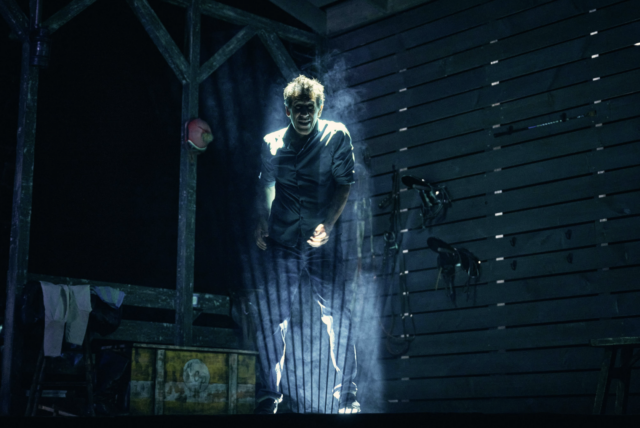
Thomas Jay Ryan, Jennifer Seastone, Will Brill, and Greig Sargeant bring a C-Span discussion to vivid life in Kramer/Fauci (photo by Maria Baranova)

KRAMER/FAUCI
NYU Skirball Center for the Performing Arts
566 La Guardia Pl.
February 11-21, $60-$90
nyuskirball.org

Daniel Fish again proves his genuine creative genius with the wildly entertaining and unpredictable Kramer/Fauci, running at NYU Skirball through February 21.

On November 30, 1993, C-Span host Steve Scully spoke about the AIDS crisis with Dr. Anthony Fauci, the director of the National Institute of Allergy and Infectious Diseases at the National Institutes of Health, and playwright and activist Larry Kramer, author of the novel Faggots and the play The Normal Heart and cofounder of Gay Men’s Health Crisis and ACT UP (AIDS Coalition to Unleash Power). For sixty minutes, while Fauci was in the studio with Scully and Kramer was beamed in onscreen from New York City, they discussed government funding, drug research, bigotry, public awareness, and more, in addition to taking phone calls from viewers.

Fish has transformed that visually dry program into an exciting, rich theatrical experience with such unusual elements as a woman on roller skates, a hilarious colorful costume, and a whole lot of bubbles.

As audience members enter the auditorium, six rows of nine lights apiece are blazing from the back of the stage, reminding me of a flag too bright to bear looking at — except for a colleague of mine who had (knowingly?) brought sunglasses. The show starts slowly in the empty space: Scully (Greig Sargeant) sits in the middle in a chair, Dr. Fauci (Will Brill), in a crisp suit, stands closer to the front to Scully’s right, and Kramer (Thomas Jay Ryan), in a turtleneck, hovers against the back wall to Scully’s left. The three begin reciting the exact transcript from the interview, as Scully raises a question about President Clinton’s formation of a new task force. Fauci provides a relatively straightforward bureaucratic response, but Kramer gives a hint of what’s to come when he criticizes the technology C-Span is using — he is unable to see Scully or Fauci but can only hear them, although he complains about the earpiece as well — and says, “This is a task force to identify what the stumbling blocks are, we know what they are: a lot of bureaucracy, a lot of red tape, a lot of stupid laws by Congress, and a lot of idiots, uhhhhhhh, putting their two cents worth, uh uhhh, how are you gonna get rid of all of these things is what I want to know and I have yet to hear a task force form to tell me that.”

After several minutes of physical stasis, Fauci and especially Kramer start moving around the stage as they argue over how recent administrations dealt with AIDS, what the real number of people afflicted with the disease are (and will be), how much money is needed for research, and why more is not being done. When Scully brings up the topic of the AIDS epidemic being normalized, Fauci begins, “Larry and I have had conversations about this many, many times over the years, and I a-appreciate it and in many respects, remire . . . admire the, the rage that he has about a very, very difficult problem. But I think you have to . . .” Kramer cuts him off, proclaiming, “Tony, if you start that business about science isn’t done that way, I’m gonna come on there and slap your face.” Fauci peacefully responds, “Nah . . . nah . . . All right, Larry, hang on for a sec. I love you, Larry . . . Uh . . . The fact is that the real solutions will in fact, come from the science.”

Scully occasionally cuts away to play audio footage of news conferences and to take calls, each of which is delivered by Jennifer Seastone in a few different voices, first riding in circles on roller skates and later donning an oddball costume. (The costumes are by Terese Wadden, with set by Jim Findlay, lighting by Scott Zielinski, and sound by Tei Blow.) Movement director Beth Gill soon has Kramer making his way over to Fauci and the roving callers, hugging one of Skirball’s golden pillars, and approaching the audience. It ranges from absurdly comical to substantially confrontational, all of it fascinating and compelling.

And then, the bubbles.

Expect the unexpected in Daniel Fish’s inventive re-creation of a C-Span program on AIDS (photo by Maria Baranova)

In A (radically condensed and expanded) Supposedly Fun Thing I’ll Never Do Again, the New Jersey–born, New York City–based Fish used tennis balls and existing text in a play about the work of Infinite Jest author David Foster Wallace. Fish earned a Tony for his unique staging of Oklahoma!, in which the audience was served chili at intermission. In White Noise, he used bold, giant projections and an actor sitting in a large, dark circle in the middle of a screen to tell part of Don DeLillo’s treatise on consumerism gone mad. And in Elektra, Sophocles’s title character, played by Brie Larson, was a kind of punk goddess spitting out some of Beyoncé’s “Daddy Lessons” while an unexplained blimp floated nearby.

For Kramer/Fauci, the actors wear earpieces that feed them the lines in order to maintain the precise pace and tone of the original program. Tony winner Brill (Stereophonic, Oklahoma!) is cool, calm, and collected as the cool, calm, and collected Fauci, who might not have gained as much fame for his work on AIDS but became a divisive and highly public figure during the Covid-19 pandemic. Two-time Drama Desk Award winner Ryan (Eureka Day, Dance Nation) is sensational as Kramer, a deeply concerned, knowledgeable, and emotional activist who is fed up with the government’s response to what he insists is a plague, not merely an epidemic or crisis.

The play centers on the complex friendship between Fauci and Kramer, who strongly disagree on how to deal with AIDS. It is summed up best in this exchange, which, like everything else, is taken verbatim from the transcript, with every pause and repetition:

Kramer: It’s all of this rhetoric of yours and everybody else in the bureaucracy. You know, I want to say something about, about Tony Fauci because I think the world must think I ha—, I hate him or something the way I’m going on tonight. I love Tony, actually I d—, I think I probably have a more complicated relationship with Tony than anybody in my entire life. He is a man, an ordinary man who was being asked to play God and he is being punished because he cannot be God. And that is a terrible situation to be in to be the lightning rod for all of us. Uhhhh . . . he has had to deal with Reagan and Bush and defend those monsters, for all we know he probably kept the labs open when John Sununu and Gary Bauer, and other awful bigots, probably wanted them closed, and he had to do it at a price, probably uh at a price for his own soul that we’ll never know that that he had to say things that in his heart he never believed. But he is there and he has been the, this this this incredible fighter for us and for AIDS. I just get angry when he puts on this bureaucratic suit and out comes this boilerplate, uhhhhh, that like Donna Shalala said the same, they, all his rhetoric that doesn’t mean anything. Tony, more than anyone in this world, knows how awful everything is, knows what has to be done, knows that he should have been given a lot more money to do it, knows who all these terrible people are, and yet he can never say it in public like I can say it in public.
Scully: Dr. Fauci, let me go back to an earlier question . . .
Kramer: Why don’t you respond to that, Anthony?
Scully: Oh, go ahead, Doctor.
Fauci: I love you, Larry. [Laughs.]

The play is eerily prescient of so much of the ensuing debate about public health. Most of us well remember what happened during Covid-19, when Fauci was at odds with the Trump administration, and today the battle over vaccines rages on with new updates every day, while the LGBTQ community has a growing fight on its hands, about a lot more than just the taking down of a Pride flag. However, Fish doesn’t reference any of that, instead keeping his focus on communicating the drama of this extraordinary debate between two dedicated, extremely intelligent men trying to do what’s best for an ailing population. How he chooses to punctuate and illustrate the power of their conflict with stunning, dumbfounding, and yet somehow near-perfect staging is where his genius lies.

[Mark Rifkin is a Brooklyn-born, Manhattan-based writer; you can follow him on Substack here.]